Two Lines, Full Comrade Status
Why is this OpenSource meme funny?
Level 1: Sticker on the Team Project
This is like helping a huge school project by adding two tiny labels, then feeling like you are now officially part of the whole club. The funny part is that the help was small, but being included feels enormous.
Level 2: The Comment Patch
An open source project is software whose code is publicly available for others to inspect, use, and often improve. A contribution might be a feature, a bug fix, a test, documentation, or even a small comment that explains confusing code. Those changes are commonly submitted as a pull request, where maintainers review the work before merging it.
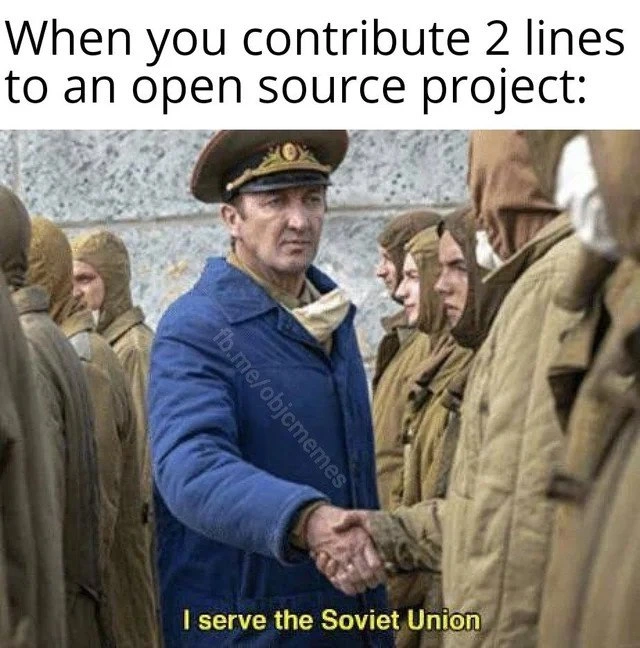
The visual elements make the technical process feel ceremonial. The person shaking hands represents the project accepting the contributor. The soldiers in uniform make the contributor look like part of an organized collective. The yellow subtitle, I serve the Soviet Union, turns "my tiny edit got merged" into "I now belong to this entire cause." For many junior developers, that first merged change really does feel oversized: GitHub shows the contribution, the project history includes your name, and suddenly git commit feels like a passport stamp.
The extra message, "And they're just comments", matters because comments are usually not executable behavior. They help humans understand code, but they do not usually change what the program does. That makes the pride even funnier: the smallest kind of code-adjacent change still produces full contributor energy.
Level 3: Two-Line Citizenship
When you contribute 2 lines to an open source project:
I serve the Soviet Union
The joke works because open source contribution has a wildly disproportionate emotional payload. In practical terms, two lines, especially if the post text is right that "they're just comments", may be a microscopic diff. In community terms, it can feel like a formal induction ceremony. The uniformed handshake and the subtitle I serve the Soviet Union inflate a trivial pull request into total institutional allegiance, which is exactly the kind of melodrama developers quietly experience after their first merged patch.
That exaggeration lands because open source is not only about code. A PullRequest can be a technical change, a social signal, a resume artifact, a rite of passage, and sometimes an invitation into a long-running maintenance burden wearing a friendly label. A newcomer fixes a typo in documentation, and suddenly they are watching CI, responding to review comments, learning project conventions, and caring about release notes for software they barely understood yesterday. The repository says "thanks"; the brain hears "welcome, comrade maintainer."
There is also a gentle jab at OpenSourceCulture. Projects often talk in collective language: maintainers, contributors, community, governance, stewardship. That language is valuable, but it can make even tiny contributions feel grander than their actual blast radius. The image captures the funny gap between the sober reality of +2 -0 and the identity boost of seeing your username attached to a public project. No production incident was solved. No architecture was redeemed. But the diff is merged, and the anthem is already playing.
Description
The meme has large top text reading "When you contribute 2 lines to an open source project:". Below it is a scene of a uniformed Soviet officer shaking a soldier's hand, with yellow subtitle text at the bottom saying "I serve the Soviet Union" and a faint diagonal watermark across the image. The joke is that even a tiny two-line patch can make a contributor feel absorbed into a vast collective project with ideological intensity. In developer terms, it captures the emotional asymmetry of open source: a trivial diff can still carry identity, community, and the first taste of shared ownership.
Comments
1Comment deleted
Open source has no small patches, only small diffs that unexpectedly compile into identity.