Skip to content
DevMeme
446 of 7435
Programming Pranks: Unicode vs. Hex Editors
Debugging Troubleshooting Post #514, on Aug 5, 2019 in TG

Programming Pranks: Unicode vs. Hex Editors

Why is this Debugging Troubleshooting meme funny?

Level 1: Can’t Fool Me

Imagine you’re baking a cake, and your sneaky friend secretly swaps the sugar in your kitchen with salt. Salt and sugar look almost the same – white and grainy – so you might not notice the switch at first. When you taste your cake, it’s awful because, well, salt isn’t sugar! Normally, you’d be really upset and confused about why your recipe failed. But let’s say you’re a super-experienced baker who always checks ingredients carefully. You take one tiny taste of the “sugar” before mixing it in and immediately realize, “Nice try, this is salt!” You swap it back and continue baking like nothing happened, while your prankster friend is left disappointed that you didn’t fall for it.

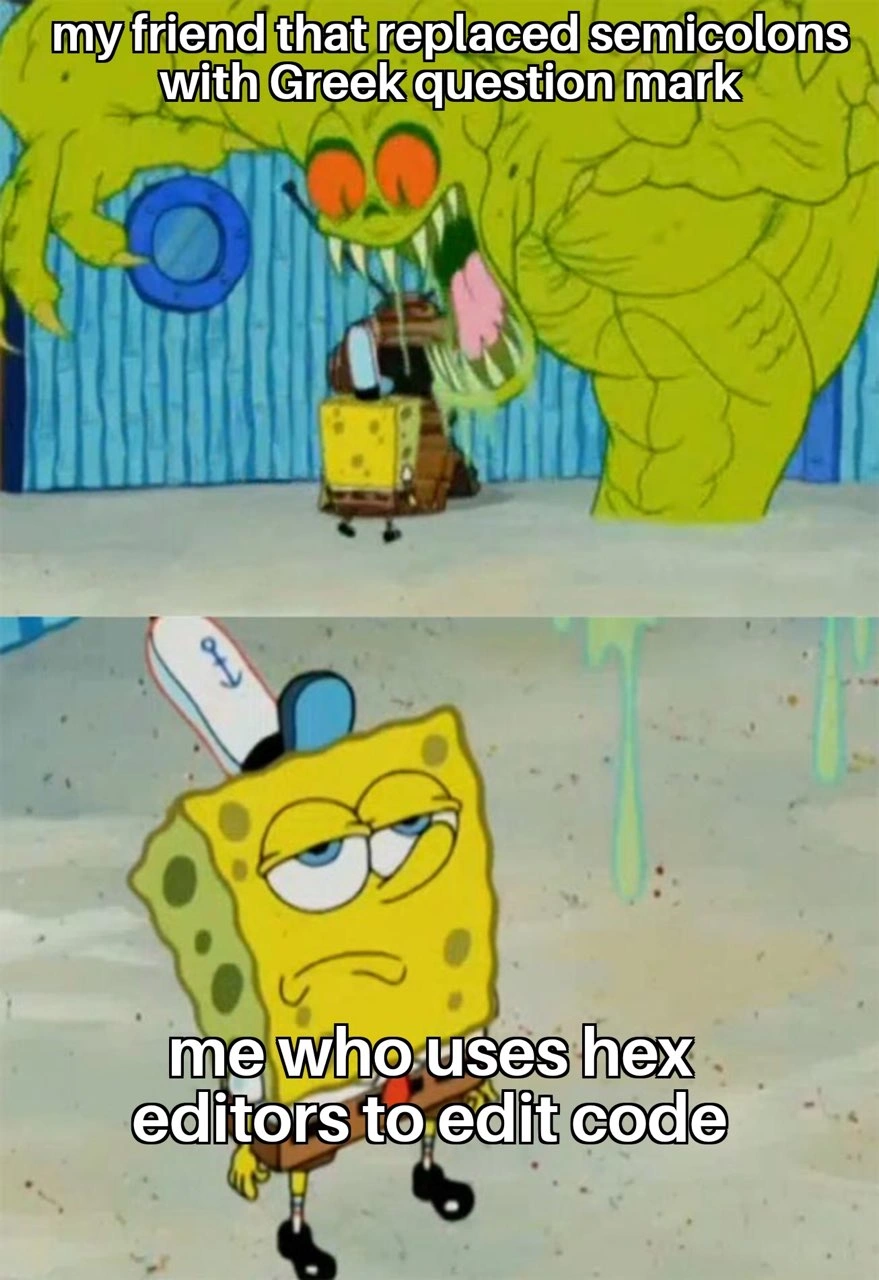
In this meme’s story, the code semicolon is like the sugar in our recipe – a small thing that’s really important. The friend replacing it with a Greek question mark is like swapping sugar for salt: a prank to mess things up. Most people would get a nasty surprise (a broken program, like a ruined cake) and panic. But the “me” in the meme is like that expert baker – they catch the trick early by using special tools (sort of like tasting the ingredient) and just shrug it off. The joke is that the prank didn’t work on them because they’re just too experienced to be fooled by something that only looks right. The big green monster in the picture is the tricky problem, and the calm SpongeBob is the unbothered expert saying, “You can’t fool me with that!”

Level 2: Sneaky Semicolon

Let’s break down the joke in simpler terms. In many programming languages, semicolons (;) are like the periods at the end of a sentence – they tell the computer “this statement is done.” Now, imagine someone replaced every semicolon in your code with a Greek question mark. A Greek question mark looks almost the same as ; to you and me, but the computer sees it differently. Computers don’t actually see letters and symbols; they see numbers that represent each character. The regular semicolon has its own number (its ASCII/Unicode code is U+003B), and the Greek question mark has another code (U+037E). They may look alike, but to the program, they’re as different as the letter O vs the number 0.

What happens if you use the wrong character in code? Chaos! If the language expects a ; and finds this impostor instead, you get a bug: typically a syntax error. It’s as if the punctuation is written in a foreign language the compiler doesn’t understand – “it’s Greek,” literally, “to the compiler.” A beginner encountering this would be very confused: the code visually has all the semicolons in the right places, yet the compiler keeps complaining about missing semicolons or illegal characters. It’s a sneaky situation because the bug is hiding in plain sight. Unless you know to look for odd Unicode characters (which most newbies don’t), you could spend hours scratching your head. This plays on the CodingMistakes trope where a tiny detail (like a wrong character or a stray invisible symbol) can break your whole program. A classic real-world example: copying code from a website and accidentally getting “smart quotes” or an en-dash instead of a normal dash -, leading to mysterious errors. This meme just cranks that scenario up to 100 by using an obscure Greek punctuation mark.

Now, why is SpongeBob looking so unimpressed in the bottom panel? Because “me who uses hex editors to edit code” is basically saying: “I deal with code at the raw byte level.” A hex editor is a special kind of editor that doesn’t show you the text normally – it shows you the hexadecimal values (base-16 numbers) of each byte in the file. For example, the letter A is 0x41 in hex. The regular semicolon ; is 0x3B. That sneaky Greek question mark would appear as two bytes: 0xCD 0xBE (in UTF-8 encoding). A developer who opens their source code in a hex editor would spot those weird bytes immediately and know something’s off. Most of us use normal text editors or IDEs (like VS Code, IntelliJ, etc.) which might not visibly flag such a subtle difference. But a hex-editing power_user is basically scanning the Matrix – they see the code’s true form. It’s an extreme way to debug, usually only done when you suspect something funky that a normal editor isn’t showing. It’s the kind of thing you might do to hunt an invisible character bug or to manually patch binary data.

So the meme’s contrast is clear: the friend’s prank would terrify an average coder (just like SpongeBob is terrified of that monster) because it’s a unicode_support nightmare and a really nasty trick. But the “me” in the meme claims to be the type of coder who works so closely with the underlying bytes that this sort of problem doesn’t scare them at all – they just roll their eyes. Essentially, “Oh, you replaced my ; with ;? Big deal, I’ll fix it in hex in two seconds.” It’s a tongue-in-cheek way to brag about being a hardcore programmer. The humor also taps into developer humor around ridiculous debugging stories – the kind where the solution ends up being something absurd like “there was a Greek question mark in the code.” Everyone can laugh in hindsight, but only after the tears of frustration are dried.

Level 3: Greek to the Compiler

This meme unleashes a niche coding nightmare born from character encoding quirks. In the top panel, SpongeBob is menaced by a green, red-eyed monster labeled “my friend that replaced semicolons with Greek question mark” – a humorous way to portray the chaos caused by an insidious unicode_confusion_bug. The friend has performed a devious semicolon_replacement_prank: swapping every normal semicolon in code with a Greek question mark character (Unicode U+037E). At a glance, that Greek punctuation looks identical to a regular semicolon (;), but under the hood it’s a completely different code point. To a compiler or interpreter, it’s as if the semicolons simply vanished or turned into gibberish. In many programming languages (like C, C++, Java, etc.), a semicolon is a critical end-of-statement marker. Replacing it with an alien character is like swapping out a bolt in a machine for one that almost fits – the program breaks in baffling ways.

From a seasoned developer’s perspective, this is a classic esoteric_code booby trap. It’s leveraging a homoglyph (a look-alike symbol) to create a perplexing bug. Think of it as a stealthy “Trojan semicolon” attack. The code might compile with angry errors or not run at all, and the error messages aren’t immediately helpful – e.g., a C++ compiler might spit out something cryptic like:

error: stray ‘\xCD’ in program

The \xCD here is part of the two-byte UTF-8 encoding of the sneaky character (0xCD 0xBE represents ;). In other words, the compiler is complaining about an unexpected byte it found – our Greek interloper – because it doesn’t recognize it as a valid symbol in the language syntax. This is the kind of bug that can drive you mad: the code looks perfectly fine in your editor, yet it refuses to build. It’s a true character-encoding landmine, playing on the fact that humans see glyphs, but compilers see numeric code points.

Now, enter the bottom panel: SpongeBob with a bored, unimpressed face amid dripping slime, captioned “me who uses hex editors to edit code.” This is the punchline: the developer (the “me”) is so hardcore about examining code that even a monstrous Unicode prank doesn’t ruffle them. A hex editor lets you view and edit the raw bytes of a file. So instead of relying on potentially misleading visuals, this coder looks directly at the file’s hexadecimal contents. Using a hex editor, our calm SpongeBob developer would immediately notice something like 0xCD 0xBE in place of the usual 0x3B (;) – a dead giveaway of the non_ascii_punctuation_in_code. They’d just smirk and replace the impostor character with a proper semicolon in hex, essentially defusing the bomb at the binary level. This is an extreme IDE/Editor power move – akin to a mechanic who fixes an engine by looking at the individual gears. It’s an absurdly high level of comfort with the lowest-level representation of code. No wonder the SpongeBob coder just shrugs: when you routinely tinker with raw bytes, a Unicode homoglyph bug is just another Tuesday.

The humor here comes from juxtaposing a monster vs. smug SpongeBob scenario as an analogy. The “friend” is depicted as an over-the-top green beast wreaking havoc – symbolizing how scary and bug-inducing a sneaky Unicode character can be. In contrast, the “me” is SpongeBob barely batting an eye, representing a dev with almost superhuman debugging skills (or insanity, one might joke, since hex-editing source code isn’t exactly standard practice). It’s a nod to those battle-hardened programmers who have seen such bizarre issues that they’re practically unphased by any new CodingMistakes. As the poster quipped, “Pretty sure some mad-programmer like this is out there” – indeed, this meme salutes the existence of both the mad prankster who’d do this source_code_obfuscation and the equally mad (or genius) coder who could catch it without breaking a sweat.

Description

This is a two-panel meme using the 'Terrified Spongebob and Unimpressed Spongebob' format. In the top panel, a monstrous green creature looms over a scared Spongebob, with the caption: 'my friend that replaced semicolons with Greek question mark'. This depicts a notoriously difficult-to-debug prank where a visually similar Unicode character is used to cause compilation errors. In the bottom panel, Spongebob appears bored and unimpressed, with the caption: 'me who uses hex editors to edit code'. The humor comes from the one-upmanship of esoteric and 'evil' programming practices. While the Greek question mark prank is a clever and frustrating act of sabotage, editing code directly in a hex editor represents a much deeper, more fundamental level of system manipulation, making the first act seem like child's play in comparison. It's a joke for experienced developers who understand the different levels of complexity and obscurity in code modification

Comments

7
Anonymous ★ Top Pick Replacing semicolons with Greek question marks is chaotic evil. Editing a production binary with a hex editor is lawful evil - you're fixing a bug you probably introduced, and you're not leaving a commit history
  1. Anonymous ★ Top Pick

    Replacing semicolons with Greek question marks is chaotic evil. Editing a production binary with a hex editor is lawful evil - you're fixing a bug you probably introduced, and you're not leaving a commit history

  2. Anonymous

    Everyone’s losing it over U+037E posing as a semicolon; meanwhile I’m in xxd thinking, “Call me when the zero-width joiner starts committing directly to main.”

  3. Anonymous

    The same developer who debugs Unicode issues in hex is now maintaining a COBOL system where the real terror is that semicolons are optional and everyone just uses periods

  4. Anonymous

    The Greek question mark prank is the developer equivalent of a supply chain attack - visually identical, syntactically catastrophic, and guaranteed to waste hours before someone finally runs `hexdump` and discovers the Unicode betrayal. But if you're already editing binaries in a hex editor, you've transcended such mortal concerns; you're operating at a level where the distinction between `;` (U+003B) and `;` (U+037E) is just another two bytes in the entropy of existence

  5. Anonymous

    ; fools prettier; hex edits fool the VM - until it all segfaults

  6. Anonymous

    I only trust semicolons that are ASCII 0x3B - your eyes see “;”, the compiler sees U+037E, and PagerDuty sees you; hence code reviews in hexdump

  7. Anonymous

    When the parser wants 0x3B and your teammate ships U+037E, the only IDE left is xxd

Use J and K for navigation