Skip to content
DevMeme
4018 of 7435
Hercules vs. the Dependency Hydra: A Developer's Eternal Struggle
Dependencies Post #4375, on May 10, 2022 in TG

Hercules vs. the Dependency Hydra: A Developer's Eternal Struggle

Why is this Dependencies meme funny?

Level 1: Never-Ending Chores

Imagine you’re trying to clean up your room, and for every toy you put away, two new toys suddenly drop onto the floor. No matter how many times you tidy up, there’s always another mess appearing moments later. 😫 It feels like you just can’t finish the chore because the task keeps resetting itself. This meme is joking about that exact feeling, but in a coder’s world. The picture shows a hero fighting a monster that grows more heads whenever one is chopped off – just like your magically messy room, the work keeps multiplying. It’s funny in a “oh no, here we go again!” way. Anyone who’s had to do a simple job over and over (because it keeps undoing itself) can relate to the hero’s tired-but-determined face. The humor comes from recognizing that shared frustration: it’s an endless battle, and sometimes all you can do is laugh about how silly and exhausting it is, like playing a game of whack-a-mole that never ends.

Level 2: Pull Request Overload

Let’s break this down in simpler terms. Modern software projects rely on lots of third-party code libraries, commonly called dependencies. For example, if you’re building a Node.js application, you might use libraries like TypeScript (for writing typed JavaScript), Jest (for running tests), Prettier (for formatting code), and many more. Each of these libraries has its own version number, and developers release updates for them regularly (to add features, fix bugs, or patch security issues). Keeping all those dependencies updated is important, but it can become a headache – often nicknamed “dependency update fatigue”.

Dependabot is a friendly automation tool provided by GitHub to help manage this. It keeps an eye on your project’s dependency files (like a package.json or package-lock.json in a Node project). Whenever a new version of one of your dependencies comes out, Dependabot can automatically create a pull request (PR) in your repository to update the version. A pull request is basically a proposal to merge some changes into the code – in this case, the change is just “update the version number from old to new.” For instance, if your package.json currently says you depend on "typescript": "4.6.3", Dependabot might open a PR suggesting:

-    "typescript": "4.6.3"
+    "typescript": "4.6.4"

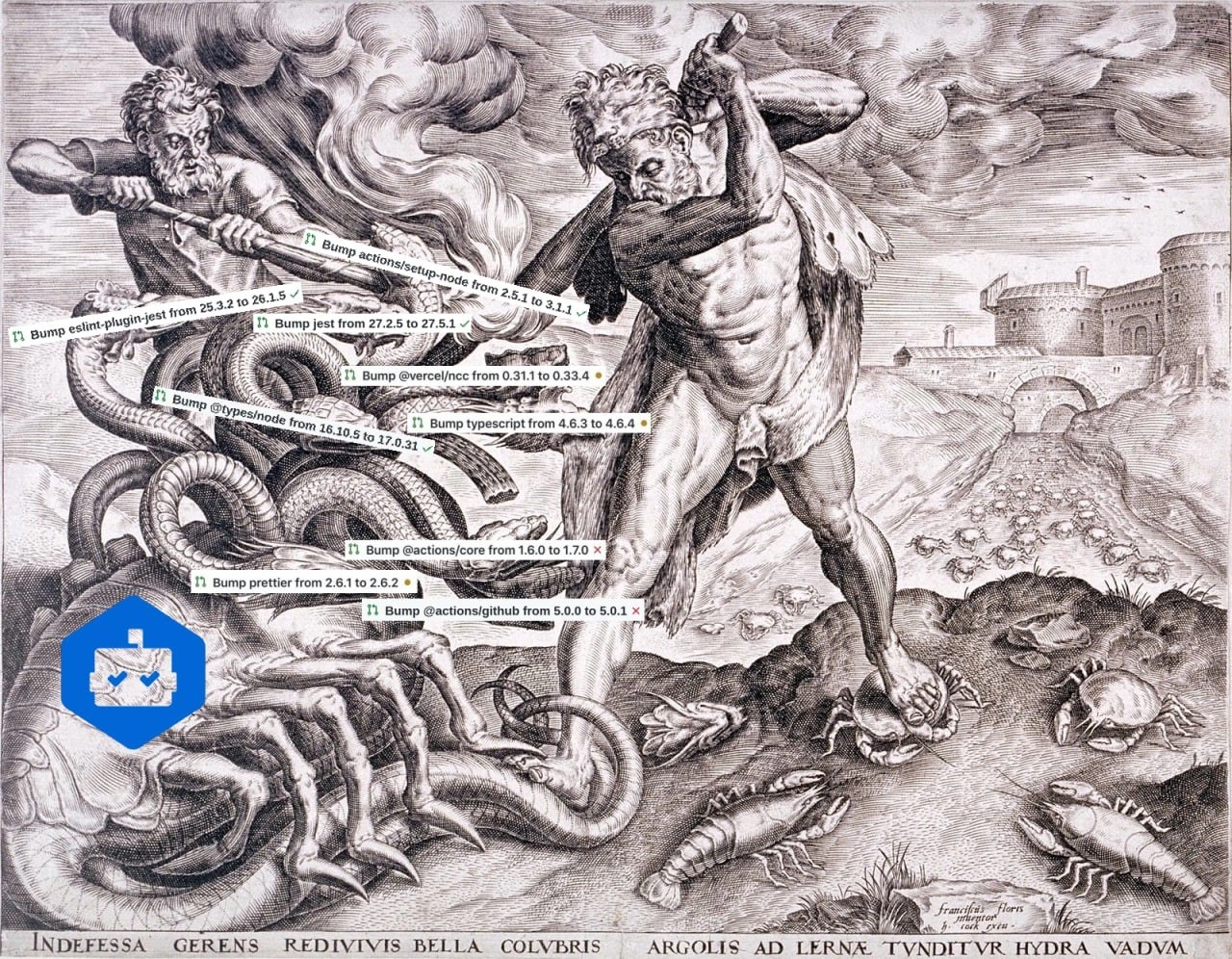
This diff shows the essence of a “bump” PR – it’s literally pointing out, “hey, let’s upgrade TypeScript from version 4.6.3 to 4.6.4.” The title of that PR would be “Bump typescript from 4.6.3 to 4.6.4”, exactly like one of the labels on the Hydra heads in the meme. Each such PR comes with automated checks: your project’s CI (Continuous Integration) system will run tests to make sure this new version doesn’t break anything. In the meme, a green checkmark (✓) on a PR label means the tests passed for that update, while a red cross (✖) means something went wrong (maybe tests failed or the PR can’t be merged automatically). So, the poor hero in the picture not only has to merge a lot of these PRs but also contend with the occasional failing update that requires manual intervention.

Now, why is this depicted as a Hydra, a beast with many regenerating heads? In Greek mythology, the Hydra is a monster that grows two new heads for each one cut off. The comparison is playful but fitting: with a lot of dependencies, updates can feel never-ending. Imagine you have 20 dependencies and every week a few of them release new minor versions. On Monday, Dependabot opens 5 PRs: update library A, B, C, D, and E. You diligently merge all five (cut off five heads). But by Thursday, libraries A and D have another new version out, and maybe library F and G (which hadn’t changed before) now have updates too – boom, Dependabot opens 4 more PRs (new heads emerge). No matter how many you merge, there always seem to be more waiting the next day or the next week. It can feel like a game of whack-a-mole, where you hit one mole and two more pop up elsewhere. That’s the pull request overload the title refers to: an overwhelming queue of PRs, each fairly small on its own, but collectively taxing.

For a junior developer, seeing a bunch of these “Bump X to Y” PRs might be confusing at first. Why are we spending time on tiny version changes? The answer is that staying up-to-date is generally good practice. Small updates (often indicated by the last number in a version, known as a patch version in Semantic Versioning) usually fix bugs or security issues. For example, going from 2.6.1 to 2.6.2 means there was a minor fix or tweak. Those are usually safe and even important (security fixes especially). Slightly larger updates (bumping the middle number, a minor version like 27.2.5 to 27.5.1 for Jest) add new features but are meant to be backward-compatible. Major version changes (like something going from 1.x.x to 2.x.x) can be breaking changes. In the meme’s PR list, eslint-plugin-jest from 25.3.2 to 26.1.5 suggests a major release of that plugin (since 25 → 26 is a big jump), which might explain why managing these updates is non-trivial – major upgrades need extra care (and indeed might cause the Hydra’s teeth – the failing tests!). Dependabot will still propose them, but developers might have to do more work to actually slay those particular heads (fix compatibility issues, update code to match the new version’s requirements, etc.).

The classical engraving style of the meme is part of a trend where serious old art is repurposed for tech humor. The idea here is to dramatize a mundane developer task. Hercules fighting Hydra looks infinitely more heroic than a programmer clicking “merge” on GitHub, right? But emotionally, it feels like a heroic struggle when you’re bogged down by 15 trivial changes and the real feature work is delayed. The bottom line for a new dev is: this meme is highlighting the frustration of maintenance work. Automation tools like Dependabot are supposed to save time, and they do help catch updates you might miss, but they also can flood you with constant distractions. It’s a double-edged sword – or maybe a double-headed sword, in Hydra’s case! The key learning is that dependency upkeep is an ongoing chore in software development. Each PR in the meme is essentially saying, “There’s a new version of something – please update me.” Multiply that by the number of dependencies, and you see why the hero has so many snake heads attacking at once. Developers need to balance this: use automated tools smartly (maybe batch updates or set a schedule) so that you’re not drowned in notifications every day.

In summary, the meme is a funny exaggeration of what it’s like to maintain a project with lots of dependencies. The developer vs. Hydra analogy means: fix one thing, and two more things demand fixing. If you’ve ever fixed one bug only to have a new bug pop up, or updated one library only to realize another ten are outdated, you’ll get the joke. It’s a rite of passage in programming to feel overwhelmed by these “tiny” tasks. But hey, every time you merge one of those PRs, you did improve the project a little. Just like Hercules had to keep his cool and strategize (he got help from his nephew Iolaus to burn Hydra’s necks so heads wouldn’t regrow), developers learn to automate and manage these updates smartly – or at least laugh about the absurdity of it all through memes like this.

Level 3: Hydra of Dependencies

In this meme, a hard-pressed developer is depicted as Hercules, locked in epic combat with a multi-headed Hydra. But look closely: each serpent head carries a GitHub Dependabot banner reading things like “Bump eslint-plugin-jest from 25.3.2 to 26.1.5”. It's a perfect parody of Dependency Management in modern software projects. Just as in Greek myth where cutting off one Hydra head causes two more to grow, here merging one dependency update pull request (PR) seems to spawn two new ones. The developer’s struggle is Herculean: every time they swing their proverbial club to merge a version bump, another package bump PR appears in their repository. The visual mash-up of classical art and software notifications brilliantly captures how fighting a Dependency Hell can feel like battling a legendary beast.

Each Hydra head’s label corresponds to an automated PR from Dependabot, GitHub’s update robot. For example, one head says “Bump typescript from 4.6.3 to 4.6.4” – a tiny patch update – while another snarls “Bump @actions/core from 1.6.0 to 1.7.0 ✖”. Notice the green checkmarks (✓) and red crosses (✖) on those banners. The ✓ indicates a PR where all automated tests passed, meaning that version bump likely didn’t break anything. The ✖ is more ominous: it means the update caused a failing test or merge conflict. In mythical terms, some Hydra heads can be slain easily, but others bite back! A simple patch upgrade (like Prettier 2.6.1 → 2.6.2) might sail through, yet a bigger leap (like a major version of a GitHub Action) can break the build. The hero-developer must investigate those failing PRs, much like Hercules figuring out how to cauterize Hydra’s necks to prevent regrowth. It’s a clever way to show how even semantic versioning micro-updates can unexpectedly cause drama in a codebase.

The humor here resonates strongly with seasoned devs. The Node.js and JavaScript ecosystem – which this meme is referencing via packages like TypeScript, Jest, and ESLint – is infamous for rapid-fire updates and enormous dependency trees. A modern Node project can have hundreds of indirect packages. New releases come out weekly or daily, and keeping up to date can feel like an endless slog. Dependabot is an automation tool meant to help by offloading the chore: it scans your package.json and other manifest files, then automatically raises PRs to update dependencies to their latest versions. In theory, this is fantastic for staying secure and current. In practice, on a busy project it can lead to pull request overload – dozens of trivial-sounding PRs like “Bump this library from 1.2.3 to 1.2.4” piling up. It’s like being pecked to death by ducks (or bitten by snake heads one after another). The meme exaggerates this scenario by turning Dependabot into the Hydra, a monster that just keeps coming no matter how many times you hit it.

Why is this so funny (and painful) to us devs? Because it’s too real. We’ve all had that week where every morning we check GitHub and find a fresh batch of Dependabot PRs demanding review. Each one is small – a minor version bump, a patch – but together they consume time and mental energy. Updating packages sounds easy until a continuous integration (CI) pipeline fails or a dependency’s new version has a subtle breaking change. The Herculean hero in the picture has the same exasperated posture as a coder who just wants to get on with building features, but instead must play whack-a-mole with version numbers. The classical art style gives the whole ordeal a grand, satirical flair: it elevates the mundane grind of package management to the scale of myth. It’s a wry commentary on how software development sometimes turns seemingly trivial tasks (like bumping a version) into an epic struggle. A tongue-in-cheek subtitle might as well read, “Abandon all hope, ye who maintain dependencies.”

There’s also a hint of dark humor in the details: the Hydra’s claw in the engraving has been replaced with Dependabot’s cute blue logo (a little robot face with checkmarks for eyes). Even the helpful bot becomes a fearsome beast when it’s bombarding you with work. The Latin inscription on the original engraving (about Hercules battling the Hydra in the swamp of Lerna) is ironically apt — developers often feel bogged down in build chores and endless updates. In the software world, we have our own methods of torching the Hydra’s necks: for instance, you might cauterize this flow of PRs by configuring Dependabot to batch multiple updates into one, or by temporarily pausing it. Some teams schedule a specific “update day” each month to slay all the pending bumps in one concerted effort. But much like Hydra’s immortal head (Hercules ultimately had to bury it under a rock), there’s always that one core dependency you can’t easily upgrade without major refactoring, so it lingers. This meme nails the sisyphean (or rather Hydra-ian) nature of maintenance work. It’s an inside joke and a cathartic release: we laugh because we’ve all been that embattled Hercules, fighting a multi-headed monster of our own making (our beloved, ever-evolving tech stack).

Description

This meme brilliantly captures the Sisyphean task of dependency management using the classical Greek myth of Hercules fighting the Lernaean Hydra. The image is a classical engraving of Hercules and his companion battling the multi-headed serpent. Each of the Hydra's heads is cleverly replaced with a GitHub Dependabot notification for an outdated dependency, such as 'Bump jest from 27.2.5 to 27.5.1' and 'Bump typescript from 4.6.3 to 4.6.4'. The blue Dependabot logo is prominently displayed on the Hydra's body. Hercules, representing the developer, is about to smash a dependency 'head' with his club. In the background, his companion sears a stump, a metaphor for resolving a dependency issue, only to have more appear, just as the Hydra would regrow two heads for each one that was severed. The endless stream of crabs emerging from the water can be seen as the continuous flow of new vulnerabilities and minor updates that plague developers. For senior engineers, this is a painfully accurate and humorous depiction of the never-ending battle against technical debt and software entropy, where 'fixing' one thing often reveals or causes other issues

Comments

11
Anonymous ★ Top Pick Dependabot is the modern Hydra: for every dependency you update, two more with breaking changes spring forth
  1. Anonymous ★ Top Pick

    Dependabot is the modern Hydra: for every dependency you update, two more with breaking changes spring forth

  2. Anonymous

    Dependabot is the modern Hydra - merge one “harmless” patch PR and two “low-risk” minors respawn; a few sprints later you’re a full-time version archaeologist and the actual feature branch is the real myth

  3. Anonymous

    Just like Hercules discovered with the Hydra, every dependency you update spawns two more breaking changes in your transitive dependencies - except instead of cauterizing with fire, we just pin everything to exact versions and pray the security scanner doesn't notice we're 47 patches behind

  4. Anonymous

    Hercules cauterized each neck so heads couldn't regrow; the npm equivalent ships in a major version you're nine Dependabot PRs behind on

  5. Anonymous

    Renovate Bot perfectly embodies the Sisyphean nature of modern dependency management - you merge eight PRs bumping minor versions, close your laptop feeling accomplished, and return Monday morning to find twelve more waiting. The mythological Hydra metaphor is painfully accurate: for every dependency you update, two more transitive dependencies need attention. Senior engineers know the real battle isn't the updates themselves, but explaining to stakeholders why 'just updating a few packages' requires a full regression suite, careful changelog review, and existential dread about that one package that hasn't been maintained since 2019 but is somehow critical to your build pipeline

  6. Anonymous

    Enabled Renovate and discovered the CAP theorem of upgrades: cut one PR, three spawn, two break the matrix, and the invoice achieves eventual consistency

  7. Anonymous

    Dependabot Hydra: cut off one “bump TypeScript” head and three grow back - @types/node, jest, and GitHub Actions suddenly demanding Node 18. Turns out semver is mythology, not a contract

  8. Anonymous

    Cut one Hydra head, two peer deps regenerate - Hercules needed 'npm dedupe' more than a golden sword

  9. @GLXBX 4y

    Wtf?

    1. dev_meme 4y

      Github bumps updates for packages

  10. @SamsonovAnton 4y

    Resolving dependencies by hand when building a *nix program from souce code.

Use J and K for navigation