The Inevitable JavaScript Takeover Sparks Existential Dread
Why is this Containerization meme funny?
Level 1: If It Ain't Broke...
Imagine you’re moving to a new house and you’ve packed all your stuff into big, sturdy boxes. These boxes work great: they protect your things, and the moving company knows how to handle them. Now your neighbor comes over, super excited, and says: “Hey, I have a new idea! Let’s unpack everything into these tiny flimsy shoeboxes instead. They’re lighter, and we can carry more of them at once!” You’d probably look at your pile of reliable big boxes and say, “No, please stop.” In other words, the neighbor’s idea sounds “innovative” but is actually impractical. You already have a solution that works. The meme is funny because it shows an expert reacting the same way to a wild new tech idea — basically saying, “We don’t need to swap out our big, strong boxes for something silly and unproven, thank you very much.”
Level 2: Containers vs Containers?
Let’s break down what’s going on in that tweet and article in more straightforward terms. First, “Linux containers” refers to the kind of containers we use with Docker. A Docker container is like a little isolated box that has your application and everything it needs to run (its code, the runtime like Node or Python, libraries, and so on). Think of it like packing your app into a portable box that you can run on any machine, and it will behave the same. Docker achieves this by using features of the Linux operating system to make the app think it has its own little machine, when in reality it’s sharing the kernel of the host OS under strict isolation. If you’ve started learning about DevOps, you’ve probably encountered Dockerfiles (recipes to build these containers) and maybe Kubernetes (which helps run lots of containers across many servers). The key point: a Linux/Docker container is an industry-standard way to deploy apps, and it works for any language or stack because it’s mimicking an entire OS environment for each app.
Now, “JavaScript containers” sounds a bit odd because it’s not a term you’ll find in official docs. It’s more of a concept that came up from Ryan Dahl (who created Node.js and later a new runtime called Deno). Node.js let JavaScript run on servers (outside the browser), which was a huge deal for web development. Deno is his attempt to improve on Node with better security and developer experience. Dahl suggested that for many web services, instead of using a Linux container for each service, we could use a JavaScript runtime to isolate services. In plainer words, rather than packaging each service with a full OS, you’d run many services inside one Node/Deno process, and isolate them from each other at the JavaScript level.
Think about how web browsers work: you might have multiple tabs open, each running some code from different websites. The browser engine (like Chrome’s V8 engine) keeps those execution contexts separate to some extent, so one tab can’t just modify another tab’s data. “JavaScript containers” are kind of like that idea, but for backend services. Instead of five Docker containers each running Node.js for five services, you’d have one process running, say, Deno, and it would run five services inside itself, each in a separate sandbox. An analogy: Docker containers are like five separate apartments (each with its own entrance, plumbing, etc.) on the same server, whereas JavaScript containers would be like one big house with five rooms – each room is private, but the rooms share the same foundation and roof.
For a newer developer, this might initially sound neat: if all your microservices are written in JavaScript/Node, maybe you don’t need the overhead of Docker for each one. It could potentially start faster and use less memory because you’re not duplicating the whole OS environment each time. That’s Dahl’s pitch: many web services (like APIs or small websites) could be simplified by this approach.
So why the pushback (“No please stop”)? Because even though it’s an interesting idea, it comes off as hype that doesn’t acknowledge the downsides. Imagine you just got comfortable with Docker and Kubernetes — tools that have a bit of a learning curve — and then you see an article suggesting those might be on their way out in favor of something completely different that you’ve never heard of. That’s frustrating! It’s like, “Can I at least catch my breath before I have to re-learn how to deploy everything?” A lot of developers, not just juniors, feel like tech trends change too quickly, and this meme is poking fun at exactly that.
There are also practical limitations: Docker containers can run anything, not just JavaScript. Your project might use a mix of technologies. Maybe you have a Node.js backend, but you also use Redis for caching (written in C), or you have a service written in Python, or a machine learning component in R or whatever. Docker can containerize all of those. But a “JavaScript container” by definition runs JavaScript. It’s not going to run your Redis server or your Python script unless those get rewritten in JS. That makes Dahl’s idea more niche than the headline suggests. It might apply to some specific scenarios (like a Platform-as-a-Service that only hosts Node/Deno apps), but it’s not a general replacement for Docker.
Now, about the meme format: it’s literally just a screenshot of a tweet reacting to an article headline. This is common in dev circles. Someone sees a hot tech take (like “XYZ will replace ABC”), and the quickest joke is to quote it with an eye-roll type comment. ThePrimeagen saying “No please stop” is funny because it’s so concise and sounds almost polite, but in context it’s an expression of, “Please, no more crazy changes, we’ve had enough.” If you’re an early-career dev, know that feeling you get when a new JavaScript framework is announced the day after you just learned one? This meme is the whole community saying yep, we feel that too. It’s humorous because it validates that exhaustion. Even the pros are sometimes like, “ugh, really? another ‘next big thing’?” So you can chuckle at the absurdity of it and feel a little less alone in the fast-paced world of tech trends.
Level 3: Not Another Docker Killer
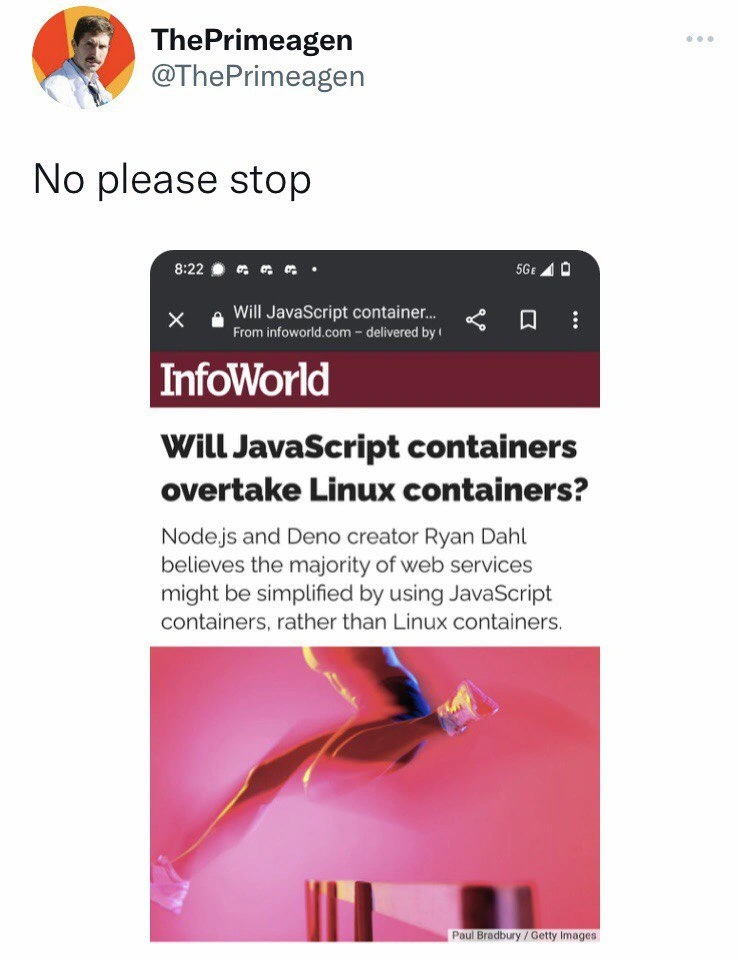
This meme strikes a chord with seasoned developers because it encapsulates a familiar cycle in the tech world: hype springs eternal, and with it comes fatigue. The image is a tweet by ThePrimeagen (a popular dev who’s known for blunt, humorous takes) simply pleading, “No please stop.” It’s posted above an InfoWorld headline asking, “Will JavaScript containers overtake Linux containers?” That juxtaposition is instantly funny to anyone who’s seen “the next big thing” declared every other year. The humor is in the deadpan, one-line reaction to yet another grand tech proclamation. It’s the digital equivalent of a veteran engineer rubbing their temples and sighing, “Here we go again…”.
Why is this so funny (or maybe painfully relatable)? Because Docker and Linux containers aren’t exactly old, failing tech in need of replacement. They revolutionized how we deploy software in the 2010s. A whole DevOps ecosystem was built around container images, registries, and tools like Kubernetes to manage them. It’s been a massive effort across the industry to adopt and master these. Think of all the late-night debugging sessions to figure out why a container couldn’t see a network, or the painstaking work to containerize legacy apps, or the complexities of managing dozens of microservices in containers. Now that a lot of teams finally have a handle on that, along comes a headline suggesting we toss it out for a completely different approach using JavaScript. The knee-jerk response is basically collective developer exhaustion: “Oh no, not another supposed Docker killer – please, spare us.”
It also taps into the running joke that JavaScript is trying to take over everything. Over the last decade, JavaScript went from living just in web pages to running on servers (with Node.js), powering mobile apps (with React Native/Ionic), desktop apps (Electron), and even IoT devices. People joke that soon you’ll be able to run your fridge and toaster on JavaScript. So when an article suggests JavaScript could even replace how we containerize and deploy applications, it feels like peak absurdity – like a parody of JavaScript’s world domination. ThePrimeagen’s “No please stop” perfectly voices the community’s mix of amusement and exasperation at this trend. It’s like we collectively think, “JavaScript, we love you for many things, but this is getting ridiculous.”
There’s a bit of media skepticism here as well. InfoWorld’s headline is a classic example of tech publishing hyperbole – “Will X overtake Y?” is how you get clicks from curious readers. Experienced devs have seen so many of these: “Is Java dead?”, “Did Kubernetes make SysAdmins obsolete?”, “Will AI replace programmers?”. Nine times out of ten, the answer is “not exactly” once you read the article. So a senior engineer sees that headline and doesn’t immediately take it at face value — instead, they roll their eyes a bit. The article does mention Ryan Dahl (who created Node and Deno) to give the idea some credibility. And sure, Dahl is a respected figure. But seniors also remember that Dahl has been here before: he launched Deno with buzz about fixing Node’s flaws, and while Deno is cool, Node.js is still extremely alive and kicking. Big shifts in tech rarely happen just because one guru proclaims an idea. It usually takes years of community buy-in and proof that the new thing is unquestionably better in most ways.
From an Ops/SRE perspective, the skepticism is even stronger. These are the folks who get paged at 3 AM when infrastructure breaks. They finally got Docker containers working smoothly in production. They’ve set up all the monitoring, logging, and security around those containers. The idea of ripping that out and running production services in a totally different way (inside a JS runtime) is scary. It’s like telling a building manager who finally fire-proofed and secured an apartment complex that next week we’re replacing it with a giant open-plan building with no walls because one architect thinks it might be more efficient. You can bet that manager would have something to say about it — probably “No, please stop (and let me sleep).”
There’s also an undercurrent of the right tool for the job. Backend engineers often prefer using a mix of technologies suited to each task: maybe Java for one service, Python for another, a specialized database here, a caching layer there. Docker containers let all these different pieces coexist peacefully on the same infrastructure. Saying “everything should be JavaScript” rubs many engineers the wrong way – it sounds like unnecessary homogenization for the sake of it. It reminds me of the phrase, “if all you have is a hammer, everything looks like a nail.” To skeptics, Dahl’s suggestion might feel like “I have a JavaScript hammer, so let’s treat containers as nails.” But not everything is a nail! Sometimes you need a screwdriver or a wrench (or in computing terms, sometimes you need a SQL database or a highly optimized C service). So the meme captures that pushback in a humorous, concise way.
In reality, even if JavaScript-based containers (or V8 isolates) become more common for certain platforms (like edge computing services or specialized cloud functions), it’s unlikely they’ll wholesale replace OS containers in the foreseeable future. There’s too much software out there that isn’t JavaScript, and too many scenarios where a full Linux environment is just the pragmatic solution. The meme gives us a chance to laugh about the hype. It’s a shared moment of, “Ha, imagine that… but yeah, no thanks.” Every developer, junior or senior, feels a bit of relief laughing at it, because it confirms that it’s okay to not jump on every hype train that comes along.
Level 4: Namespaces vs Isolates
At the cutting edge of containerization, the meme highlights a clash between two fundamentally different sandboxing paradigms: traditional Linux containers (like those used by Docker and Kubernetes) versus a new idea of JavaScript containers. A Linux container is essentially a lightweight virtual machine at the operating system level. It uses kernel features like cgroups (to control resource usage) and namespaces (to give each container its own isolated view of the system: its own process tree, network interfaces, file system mounts, etc.). In essence, a Linux container packages an application along with just enough of an OS environment to run it, isolated from other containers on the same host. This has been the backbone of modern DevOps: you build an image with your app and its dependencies, and you run it anywhere the Linux kernel runs, confident that the app won’t step outside its containerized sandbox.
JavaScript containers, as posited by Node.js and Deno creator Ryan Dahl, flip this concept on its head by operating at the language runtime level. Instead of isolating at the OS, you isolate within the V8 JavaScript engine. Imagine running not a whole OS environment for each service, but running many services inside a single OS process, each confined to its own V8 isolate or similar sandbox. A V8 isolate is essentially a separate heap and context for executing JavaScript code within the same running engine, so that one piece of code can’t directly tamper with another’s state (at least, that’s the theory). It’s like having one giant Node.js process that internally acts like dozens of little “virtual Node” containers, each one running a separate service’s code in isolation.
This approach is reminiscent of multi-tenant architectures seen in serverless platforms (for example, Cloudflare Workers or Google’s V8 isolates for Cloud Functions) where thousands of user scripts run in the same process but are isolated by the runtime. The potential benefits are enticing: dramatically lower overhead (no duplicate OS per service, so starting a new “container” could be as fast as instantiating a function in milliseconds) and potentially simpler deployment (just upload your JS code rather than building a full container image). Dahl’s quote that “the majority of web services might be simplified” with this method is rooted in the observation that many web services essentially just run JavaScript/TypeScript anyway (especially with Node.js so prevalent on the backend). So, why not cut out the middleman (the OS layer) for those cases?
However, this is where theory meets a skeptical veteran’s raised eyebrow. Linux containers are popular not just by chance, but because they provide strong, time-tested isolation. They act as moats around each service. JavaScript containers, by contrast, would all live in the same castle keep – the single runtime – with partitions that we hope are secure. A bug in the V8 engine’s isolation mechanism or a crafty exploit could potentially break out of one JavaScript “container” and then have access to all the others in that process. With Linux containers, an escape from one container typically still lands an attacker in a restricted user space, not directly inside your other containerized applications (such breakouts are rare, given the maturity of OS isolation). There’s also the matter that OS-level containers can run anything: Python, Java, Go binaries, databases – you name it. JavaScript containers would… well, run JavaScript. Great for Node/Deno-based microservices, not so great if you need to, say, run a Redis server or a legacy C++ service.
So when engineers see a headline asking if JavaScript containers will overtake Linux containers, they immediately think of the many technical trade-offs being glossed over. It’s as if a chef suggested replacing all kitchen cookware with one specialized tool – intriguing for certain recipes, but impractical (or unsafe) for others. The meme’s technical subtext is about questioning the feasibility of replacing a general, robust abstraction (the OS container) with a niche, language-specific one (the JS engine isolate).
Let’s break down some core differences:
| Linux Container (Docker) | JavaScript Container |
|---|---|
| Isolated at the OS level using kernel features (separate namespaces, enforced via cgroups, separate network stack, etc.) | Isolated at the runtime level within the JavaScript engine (e.g. using V8 isolates or Deno’s sandbox) |
| Runs an entire userland: includes a minimal OS (like Alpine Linux), any needed runtime (Node, Python, etc.), libraries – essentially a small OS per service | Runs JavaScript code (and maybe WebAssembly) only, within a host process – no separate OS per service, just code + JS runtime context |
| Heavyweight: higher startup time (could take seconds to launch a new container), more memory overhead per instance (each container might have its own OS processes and memory) | Lightweight: near-instant startup (just create a new isolate in an existing process), lower memory overhead (shared engine, no duplicate OS), ideal for many small or short-lived services |
| Proven security isolation – if configured right, a process in one container can’t directly affect another container or the host (would require a kernel exploit to break out) | Security isolation depends on the JS engine – a breakout from one isolate (via a V8 bug, for example) could compromise the whole host process and all other isolates in it |
| Rich existing tooling and standards: Dockerfiles, container registries, and orchestration via Kubernetes; well-understood monitoring & debugging workflows | New paradigm, new tools needed: would require its own orchestrators for isolates, new debugging techniques, and the ecosystem is in its infancy (not battle-tested) |
Under the hood, this reflects a classic trade-off of abstraction layers. Linux containers abstract at the OS level – they fake multiple tiny computers using one kernel. JavaScript containers abstract at the language VM level – they fake multiple isolated programs using one process. It’s not that one is categorically better; each has different constraints. The humor in seriously asking “Will JavaScript containers overtake Linux containers?” comes from the boldness of expecting a specialized solution to replace a general one so easily. Engineers versed in these details start thinking about practical issues: garbage collection pauses affecting many services at once, difficulty handling system calls or native modules in a pure JS sandbox, etc. In short, the scenario prompts an eye-roll and a “this sounds better in theory than in practice” skepticism.
From a battle-scarred engineer’s perspective, none of this hype is new. We’ve heard similar promises in the past. Remember how Java applets were supposed to let you run safe mini-apps everywhere? Or how the JVM (“write once, run anywhere”) was touted as a container for all software that might make OS differences irrelevant? Those ideas brought some benefits but never eliminated the need for good OS-level isolation and flexibility. Now, we hear JavaScript making similar claims. The fundamental question remains: what’s the right layer to isolate? There’s no one-size-fits-all. So, when an article boldly talks about a JavaScript-based approach overtaking a proven technology like Linux containers, experienced devs can’t help but respond with a bit of side-eye and that meme-worthy plea: “No please stop.”
Description
The image is a screenshot of a tweet from the popular tech influencer 'ThePrimeagen'. The tweet itself is a simple, desperate plea: 'No please stop'. Below this text is a screenshot of an InfoWorld article with the headline, 'Will JavaScript containers overtake Linux containers?'. The article's sub-header elaborates that 'Node.js and Deno creator Ryan Dahl believes the majority of web services might be simplified by using JavaScript containers, rather than Linux containers.' The humor comes from ThePrimeagen's relatable reaction of exasperation. For experienced developers, especially those in DevOps and backend, Linux containers (like Docker) are a mature, robust, and fundamental part of modern infrastructure. The idea of replacing this with a 'JavaScript container' feels like a classic case of the JavaScript ecosystem's tendency to reinvent everything, often with added complexity and hype. It taps into the professional fatigue with the constant churn of new, often unnecessary, technologies in the web development world

Comments
24Comment deleted
A 'JavaScript container' sounds like a great idea until you realize it's just a 1GB node_modules folder with a Dockerfile attached
JavaScript containers: finally, a way to trade 5 MB of Alpine for 500 MB of node_modules so we can debug prod latency spikes with `console.log('cold start')`
After 15 years of containerizing everything to escape dependency hell, we're now proposing to containerize the very language that gave us node_modules - a folder so dense it creates its own event horizon. It's like solving a house fire by moving into the volcano
Atwood's Law, infrastructure edition: anything that can be containerized in JavaScript eventually will be, including your will to live
When Ryan Dahl suggests replacing battle-tested Linux containers with JavaScript containers, even ThePrimeagen - who literally makes a living talking about code - can only muster 'No please stop.' It's the infrastructure equivalent of proposing we rebuild the Golden Gate Bridge out of npm packages: sure, technically you *could* chain together 47,000 dependencies to hold up a suspension cable, but the real question is whether your bridge will still be standing after `npm audit` finds 3,847 critical vulnerabilities in [email protected]
JS containers overtaking Linux? Great - my base image can be package.json, cgroups become gc(), and the next Sev-1 is because left-pad broke /sbin/init
JS containers: namespaces via Proxy traps, cgroups with setImmediate - kernel privileges? So 2013
JavaScript containers overtaking Linux containers? Perfect - swap cgroups and seccomp for package-lock.json, GC pauses, and “npm audit fix --force” in the postmortem
wtf is this js containers Comment deleted
https://tinyclouds.org/javascript_containers Comment deleted
thanks dude, appreciate that Comment deleted
That's edge computing that leads to decentralization and such containers looks like a good idea. Interested if they can be migrated online. Comment deleted
Basically the same as an iframe in a website... tabs in tabs in tabs lol Comment deleted
Hierarchy Comment deleted
But JS is the worse in this aspect because every single JS engine has problems with the JIT Comment deleted
World has shortage of these containers, but kids try to invent their own thing. Comment deleted
Does he mean... I dunno... something serverless like AWS lambda? Comment deleted
Every day a new JIT 0-day rce or sbe gets discovered Comment deleted
modprope nodejs Comment deleted
What. The. Actual. Fuck. Comment deleted
Postmodern engineering Comment deleted
More like post-mortem engineering: when the brain is dead long before such an "engineering" starts. Comment deleted
Postmodern rejects any truth and especially universal truth, so there’s no correct way to do anything because any way is success and failury simultaneously. To sum up, maybe dead brain isn’t even a bad thing! Comment deleted
and we will have websockets streaming data to and from the processor Comment deleted