The Veteran Developer's Choice: Frameworks vs. Fundamentals
Why is this Frameworks meme funny?
Level 1: Just Ice Cream
Imagine two kids arguing over whether chocolate ice cream or vanilla ice cream is better. They’re really serious about it — each kid insists their flavor is the absolute best in the world. Now a third friend comes along, hears them fighting and just shrugs, saying, “I don’t mind, ice cream is ice cream!” 🥄 The other two kids pause, because that wasn’t an expected answer. It’s funny because the friend didn’t even pick a side; they just pointed out the simple fact that no matter the flavor, it’s still all yummy ice cream.
This meme is doing the same thing, but with coding. People were debating whether React or Angular (two fancy tools for building websites) is better. Instead of picking one, the developer says, “JavaScript,” which is like saying, “Hey, they’re both ice cream — I just love ice cream!” It’s a simple, almost obvious answer that makes the big argument seem a bit silly. The humor comes from that relief and surprise: sometimes the simplest, most basic thing (like just enjoying ice cream, or just using the basic programming language) is the best answer when everyone else is busy choosing sides.
Level 2: Frameworks vs Fundamentals
If you’re a newer developer, you might have heard people debating React versus Angular and wondered what’s the big deal — or which one you should learn. This meme jokes that one developer just answers, “JavaScript,” as if to say, “I choose the core language instead of either framework.” To appreciate the humor, let’s break down the terms and context:
JavaScript: A programming language that runs in web browsers (and elsewhere, like on servers with Node.js). It’s what makes web pages interactive. When you click a button and something happens without the page reloading, that’s JavaScript in action. It’s the fundamental building block for FrontendDevelopment on the web. Browsers understand JavaScript by default — no extra tools needed to run it. Writing Vanilla JavaScript means writing your web app using just JS and the browser’s built-in capabilities, without any additional libraries or frameworks. (Fun fact: calling it “vanilla” is like calling it plain, original flavor, with no extra toppings.)
React.js: A popular JavaScript library (often called a framework informally) for building user interfaces, created by Facebook. React helps developers build complex UIs out of small pieces called components. Instead of directly manipulating the webpage (the DOM) all the time, you describe how the UI should look in a declarative way (often using a syntax called JSX that looks like HTML inside JavaScript). React then figures out the most efficient way to update the page when data changes. It’s powerful and trendy, but ultimately, it works using JavaScript under the hood. You include the React library in your project, and you still write JavaScript (plus JSX) to create components. Example: with React you might write
ReactDOM.render(<h1>Hello</h1>, document.getElementById('app'));to put a heading on the page.AngularJS: A heavyweight JavaScript framework for building web applications, originally created by Google. (AngularJS refers to the 1.x versions; newer versions drop the “JS” and are just called Angular, which is a different, more modern framework rewritten in TypeScript.) AngularJS (the older one) introduced features like two-way data binding (where your UI and data model stay in sync automatically) and had a more rigid structure (controllers, services, etc.) than React. To use AngularJS, you’d include its script and follow its specific patterns to build your app (writing HTML with AngularJS directives, and JS for the logic). Again, at the end of the day, AngularJS code runs as JavaScript in the browser’s engine.
Think of it this way: JavaScript is the core language, and React or Angular are like big collections of pre-written JavaScript that provide a structure or shortcuts for building apps. They are tools built with JavaScript to help manage complicated tasks. The meme’s joke is that when asked to pick one fancy tool or the other, the developer just picks the basic tool that’s common to all of them: plain JavaScript itself.
This reflects a piece of common advice: “learn the basics first.” If you understand JavaScript well — how to manipulate the DOM (Document Object Model) to change a webpage, how functions and variables work, how to handle events, etc. — then picking up a framework like React or Angular becomes much easier. It’s like learning to drive the car before worrying about which GPS navigation system to install. If you dive into React or Angular without solid JavaScript foundations, you might end up confused by errors or concepts because, under the covers, you’re still dealing with JavaScript things (like objects, arrays, this context, promises, etc.).
The term “framework fatigue” mentioned in the context is something new developers might feel too: it seems like every month there’s a new “must-learn” front-end framework or a hot new library. One day everyone talks about Angular, the next day React, then Vue, then something else like Svelte. It’s easy to feel overwhelmed or think you have to chase every trend. But the truth is, all those frameworks serve a similar purpose and rely on JavaScript. So focusing on JavaScript fundamentals can give you confidence to work with any of them as needed. It’s a more stable knowledge that doesn’t go out of style as fast.
To illustrate how frameworks and JavaScript relate, here’s a simple example. Say we want to show a “Hello, World!” message on a web page. We can do it with just JavaScript, or with a framework like React:
<!-- Our HTML page has a spot for content: -->
<div id="app"></div>
// Using plain JavaScript (Vanilla JS) to insert a message:
document.getElementById('app').textContent = 'Hello, World!';
// Using React (a framework) to insert a message:
ReactDOM.render(<h1>Hello, World!</h1>, document.getElementById('app'));
// In both cases, the end result is that "Hello, World!" text appears on the page.
// The React version still relies on the JavaScript environment to do its work.
In the first approach, we directly used a core Web API (document.getElementById and setting textContent) provided by the browser to update the page. In the second, we used React’s ReactDOM.render function and JSX syntax (<h1>Hello, World!</h1> looks like HTML but is actually JavaScript behind the scenes) to do the same thing. React is doing some extra magic (it creates a virtual DOM, diffs changes, etc.), but ultimately it calls similar low-level operations like document.getElementById internally. The key takeaway: no matter which framework you choose, you’re still writing and running JavaScript.
So, when the meme shows a developer answering “JavaScript” to “React or Angular?”, it’s highlighting that one should not ignore the core language beneath the frameworks. It’s a bit like being asked, “Which fancy tool do you want to use to eat — a fork or chopsticks?” and replying, “I’m comfortable using my hands.” It might sound overly simplistic, but it emphasizes self-reliance on fundamental skills. Many experienced folks recommend that newcomers get comfortable with things like HTML, CSS, and basic JavaScript before getting too caught up in a specific front-end framework. After all, frameworks are transient; the core language and web basics will serve you throughout your career.
And if you’re wondering, “Well, which should I learn, React or Angular?”, the honest answer often is: eventually, learn both if you can, and maybe others too — each has its place. But start with JavaScript itself. Once you can build a tiny interactive webpage with just Vanilla JS (no libraries), learning React will feel more natural, and you’ll understand what React is doing for you. The meme is a playful reminder of this foundational learning path. Instead of joining the framework_selection_debate right away, focus on core_language_over_frameworks at first. The frameworks compete and evolve, but JavaScript is the common thread through it all.
Level 3: Vanilla JS Strikes Back
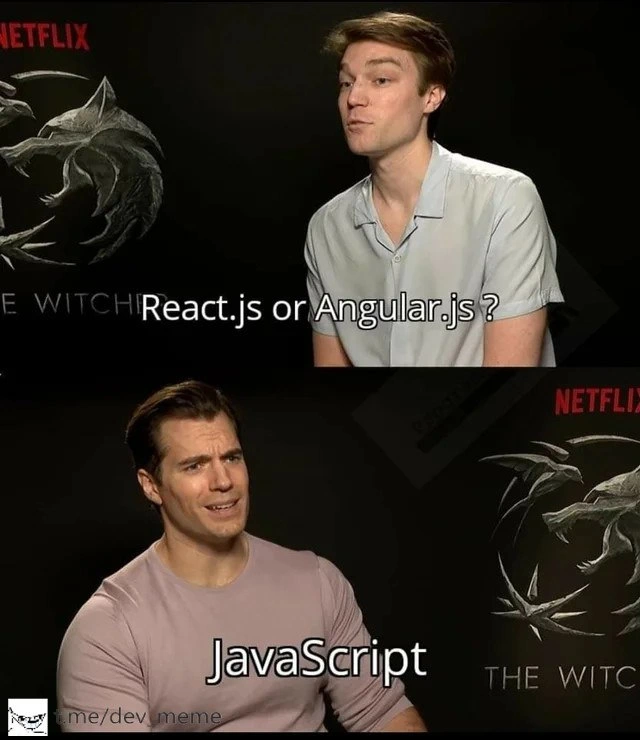
In this meme, a tense Frontend framework war gets disarmed in seconds. The scene is styled as a Witcher interview on Netflix: a serious interviewer asks the burning question of the day, expecting a framework fanboy answer. Instead, our unflappable developer (Henry Cavill in meme form) responds with a single, deadpan word. The exchange goes like this:
Interviewer: React.js or Angular.js?
Developer: JavaScript.
That punchline hits experienced developers right in the FrameworkFatigue. 😅 Why is it funny? Because it cuts through the endless React vs Angular debate by pointing out that underneath both, it's all just JavaScript. Seasoned devs have seen this drama before: today it's React vs Angular, yesterday it was AngularJS vs jQuery, and tomorrow it'll be some new JS framework du jour. Each time, someone eventually sighs and says, "Can we remember the basics?" This meme captures that exact veteran sentiment in one word.
Framework wars are practically a rite of passage in FrontendDevelopment. React and Angular each have passionate armies of developers ready to defend their chosen tool. Tech conferences, Twitter threads, and Reddit posts often resemble battlegrounds with arguments about performance, scalability, syntax, and which framework is "dead" or "dominating" this year. It's akin to LanguageWars, but on a micro level: instead of Java vs Python, it's which JavaScript framework will rule the web. The meme humorously throws cold water on the whole fight. By answering "JavaScript," the developer implies: "Why are we fighting? Both frameworks are built on the same core language. Let's not forget to actually know that core!"
This resonates especially with senior engineers who have lived through the churn of FrameworkChurn. They’ve learned and re-learned dozens of hot new libraries and frameworks as each fell in and out of fashion. Many remember when AngularJS (the original Angular 1.x) was the shiny new thing, then the complete rewrite to modern Angular (2+), then the rise of React.js, and then the surge of others like Vue.js, Svelte, and so on. Keeping up can feel like a monster-slaying quest of its own. The term “framework fatigue” sums it up: constant exhaustion from watching the JavaScript ecosystem spawn a new tool every other month. So when the developer in the meme just says “JavaScript”, it’s a relief and a joke rolled into one. It’s as if Geralt of Rivia (the Witcher) himself shrugged and said, “I don’t choose sides in a petty squabble; I focus on the root of the matter.”
Technically speaking, the answer is on-point. React and Angular code don’t run by magic — the browser’s JavaScript engine ultimately executes plain JS. React’s components and Angular’s directives eventually translate to standard DOM operations done in JavaScript. The meme hints at that truth: no matter how fancy your front-end framework, a deep understanding of core JavaScript is indispensable. You can almost hear an experienced mentor saying, “Learn Vanilla JS first, kid. Frameworks come and go, but the language is here to stay.” In fact, there’s an inside joke that Vanilla JS (just plain JavaScript) is the most widely used framework of all — a tongue-in-cheek way veterans remind everyone that a solid base is more important than flashy tools.
What elevates the humor is also the calm confidence of the answer. The developer isn’t dismissive or saying “both suck”; he simply states the foundational truth with a straight face. It’s a mic-drop moment for those tired of pointless debates. The Witcher interview meme format adds extra flavor: Henry Cavill is known to be a bit of a geek in real life, so tech audiences love seeing him inadvertently championing good coding wisdom here. The setting (Netflix logo, Witcher medallion in background) gives it that epic, serious interview vibe — which makes the one-word answer even more hilariously blunt.
In summary, at the senior level this meme is poking fun at our industry’s habit of getting caught up in framework hype cycles. It’s a reminder that frameworks are tools, not religions. A developer who confidently says “JavaScript” is essentially asserting: master the fundamentals, and the framework choice becomes a detail, not a dogma. Seasoned devs find this funny because it’s true — and maybe because they wish more people on tech forums would take this meme’s advice to heart before igniting yet another framework flame war.
Description
A two-panel meme using the popular 'Henry Cavill Interview' format, set against a black background with logos for Netflix and 'The Witcher'. In the top panel, an interviewer asks the question, overlaid in white text: 'React.js or Angular.js ?'. In the bottom panel, actor Henry Cavill, looking skeptical and slightly disdainful, provides his one-word answer, also in white text: 'JavaScript'. A watermark for 't.me/dev_meme' is visible in the lower-left corner of the second panel. The meme humorously subverts the endless 'framework wars' common in the frontend developer community. Cavill's response represents the viewpoint of a seasoned engineer who sees the debate as trivial, emphasizing the importance of the core language (JavaScript) over any specific, and often transient, framework built upon it
Comments
7Comment deleted
Debating React vs. Angular is like arguing over which Gwent deck is superior. A seasoned developer just pulls out their silver sword - vanilla JS - and gets the job done
After surviving Prototype, MooTools, Backbone, two different Angulars, and React’s hook detox, my architectural guideline is simple: always bet on whatever eventually transpiles to plain JavaScript
After 15 years of watching frameworks rise and fall like empires, you realize Cavill's right - sometimes the best abstraction is no abstraction, especially when your 'simple' React app has 847 dependencies and takes 3 minutes to npm install
After 15 years in the industry, you realize the 'React vs Angular' debate is just the modern incarnation of 'Vim vs Emacs' - passionate arguments over tools that ultimately compile down to the same DOM manipulations. The real senior move is recognizing that framework choice is an implementation detail, not an architectural philosophy. They're all just abstractions over JavaScript, and in five years, we'll be having the same heated debate about whatever replaces them while the fundamentals remain unchanged
Geralt knows: React hooks or Angular services, it's still JavaScript mutating your closures in prod
Veteran move: answer at the correct abstraction - “React or Angular?” “JavaScript”; frameworks are implementation details you’ll rewrite by the next OKR
React or Angular? JavaScript - the frameworks churn, but the 3 a.m. on-call is always the same event loop