Skip to content
DevMeme
1450 of 7435
A Literal Data Center to Cloud Migration
Cloud Post #1624, on May 26, 2020 in TG

A Literal Data Center to Cloud Migration

Why is this Cloud meme funny?

Level 1: Up in Smoke

Imagine your friend told you, "We should move all your toys to the cloud so they won't get lost." They meant putting your toys onto a safe computer system (like saving pictures of them online). But you take it very literally: you pile up all your toys in the backyard and set them on fire, watching a big cloud of smoke rise into the sky. You then proudly say, "Look, I moved my toys to a cloud!" Clearly, that’s not what your friend meant at all. All your toys just burned up – nothing is actually saved. It’s a total disaster. This silly scenario is basically what the meme is joking about. The company wanted to move its data from its own building to "the cloud" (online servers), but instead it’s as if they accidentally sent it up in smoke. The humor comes from how wrong that literal idea is. It's like a cartoon where someone completely misunderstands an instruction in the worst way. You can almost see people slapping their foreheads when they realize what happened. We laugh because obviously setting something on fire isn’t how you’re supposed to move it. The meme is essentially saying, "Oops, we took 'to the cloud' way too literally!" It's funny in a ridiculous, head-smacking kind of way.

Level 2: Firefighting Mode, Literally

If you're a junior dev or just starting out in IT, this meme might be both shocking and confusing. Let's break down the jargon and context so it makes sense. First, the term "data center to cloud migration" usually means moving all your software, databases, and servers from a private data center (a building full of company-owned machines) to the cloud (servers run by third-party providers like Amazon Web Services or Google Cloud). In normal situations, this migration is a carefully managed process: you copy data over the network, you test that applications run in the new environment, and eventually you switch over with minimal downtime. No buildings are supposed to catch fire during a proper cloud migration!

A data center is literally a big warehouse or facility filled with racks of servers, networking gear, and cooling systems. Companies that don't use the cloud have their own data centers; that's called on-premises infrastructure (meaning it's on the company's own premises). The cloud, on the other hand, is a friendly name for someone else's data center that you rent as a service. We call it "the cloud" because in diagrams and conversations, we often draw a cloud shape to represent the internet or remote resources that are abstracted away. It's not an actual fluffy cloud in the sky; it's still lots of computers in buildings, just managed by a cloud provider and shared among many users.

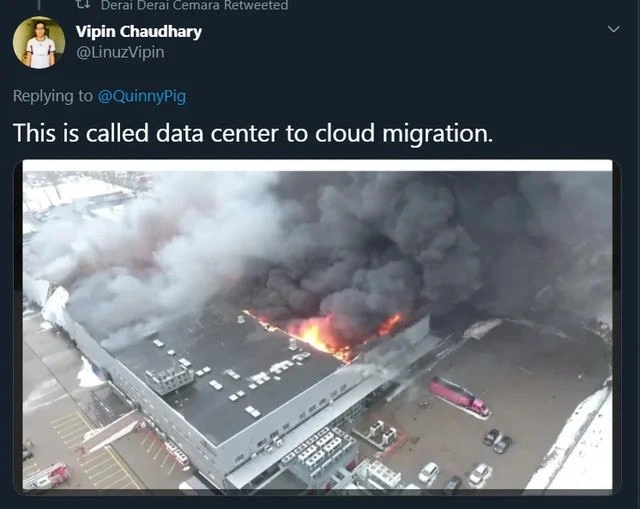
In the Twitter post shown (with the dark-mode interface), someone is replying to a well-known cloud pundit with a photo of a burning industrial building. That building appears to be a real data center facility engulfed in flames. Thick black smoke is pouring out, rising into what looks like a dark cloud overhead. The joke here is that this disastrous fire has created a literal cloud of smoke above the data center, so the poster snarks that this is what "data center to cloud migration" looks like. In other words, the data center physically went to the cloud (of smoke) instead of the company successfully moving its operations into cloud computing. It's a pun – a play on words – mixing up the figurative meaning of cloud (online services) with the literal meaning (a cloud in the sky, in this case made of smoke).

For a newcomer, it's important to know that cloud migration is normally a positive, planned activity. Companies do it to save costs, improve scalability, and avoid the headaches of maintaining hardware themselves. Seeing a data center on fire is the absolute opposite of that plan: it's an uncontrolled disaster. This brings us to the idea of Disaster Recovery. In tech, teams prepare for worst-case scenarios (like fires, hurricanes, or power outages hitting a data center) by having backups and redundancy. For example, they might keep duplicate copies of critical data in another city or in a cloud storage service, so if one site is destroyed, the system can switch over to the backup (this process is called failover). A junior dev might hear seniors talk about "DR plans" or participate in drills for simulated failures. The meme’s picture is basically the ultimate DR scenario: What if our whole primary site burns down? If the company was prepared, they'd restore systems from backups or fail over to a different data center or a cloud provider. If they weren't prepared... well, then they might literally have nothing left except a smoking hole in the ground. The joke is hinting at that dire outcome.

Now let's talk about on-call duty and "firefighting" in a tech context. When you're on-call, it means it's your responsibility to respond if something breaks in production (the live system) outside of normal hours. Many DevOps engineers and SREs (Site Reliability Engineers) rotate on-call shifts. You might get woken up by a pager or phone alert at 3 AM and have to fix a server that's down or a website that's crashing. We often call urgent incident response "firefighting" because you're rushing to extinguish the metaphorical fires in the system – like a sudden server overload or a critical bug causing chaos. In this meme, though, the firefighting isn't metaphorical at all. Actual firefighters with hoses are needed because the data center is literally on fire. It's a scary scenario that operations folks dread. The meme exaggerates it for dark humor: the on-call engineer can't do anything to fix this with code or a reboot; their entire data center is physically gone.

This kind of humor is common in DevOps/SRE circles and among sysadmins – it's a form of gallows humor, where you joke about very serious or painful things as a way to cope. A new engineer might be taken aback: "Why would anyone joke about a data center fire?" But when you've been on-call long enough, you develop a wry sense of humor about major production incidents. It doesn’t mean anyone actually wants these disasters to happen; it’s just that sometimes you have to laugh so you don't cry. Think of doctors making the occasional dark joke about a tough day in the ER – it’s a similar coping mechanism, just in the tech world.

One more small detail: the Twitter screenshot is in dark mode (white text on a black background). Many developers prefer dark themes in their tools and apps to reduce eye strain and because, well, it looks cool. Seeing the meme in dark mode is like a wink to developer culture. It matches the brooding, dark humor of the joke itself.

In summary, this meme takes a common tech phrase (cloud migration) and shows an absurdly literal, catastrophic twist on it. It's saying, "Here's a CloudHumor example of how NOT to do a cloud migration – by burning down your data center and creating a smoke cloud!" For someone early in their career, it highlights why backup plans and careful migrations are so important (so that "going to the cloud" is done the right way, not the wrong way shown here). And it gives a taste of the kind of dry, ironic jokes that seasoned ops engineers crack to survive the stress of the job.

Level 3: Disaster as a Service

At 3:00 AM, an on-call SRE's pager explodes with alerts: the entire on-prem data center just vanished from the network. No, it's not a new serverless feature – the building is literally on fire, a fact quickly confirmed by a panicked phone call and perhaps even a local news clip. In the meme's dark Twitter screenshot, the author quips: "This is called data center to cloud migration." It's a brutal pun that only a battle-scarred ops engineer could love. Normally, cloud migration means carefully moving your applications and data from private infrastructure (your own servers in that data center) to a Cloud provider (like AWS or Azure). It's a huge project involving months of planning, diligent data transfer, and making sure nothing breaks in the process. Here, though, the only thing that migrated to the cloud is the smoke from your burning servers. 😅

This scenario resonates with senior engineers because it's the ultimate OnCall_Humor and nightmare rolled into one. We often talk about "firefighting" in production incidents as a metaphor – racing to fix issues under pressure. Well, this is firefighting mode made horrifyingly real, complete with actual flames and real firefighters. The ops team isn't just pushing hotfix patches; they're watching a physical_infrastructure_failure in the form of a giant blaze. The tweet's gallows humor (CloudHumor) is a coping mechanism. When you're staring at a charred shell of what used to be your server rack, sometimes the only thing you can do is make a dark joke: "Welp, I guess we achieved our cloud migration ahead of schedule."

Why is this funny to us hardened DevOps folks? Because it's painfully relatable in a twisted way. Data centers are supposed to be ultra-reliable fortresses with backup power, cooling, and fire suppression. Yet every experienced engineer has that secret terror of an uncontainable disaster – a fire, flood, or some freak event turning thousands of running servers into scrap metal. There's a whole discipline called Disaster Recovery (DR) planning meant to prepare for exactly this sort of catastrophe. You keep off-site backups, duplicate systems in another region, and design failovers so that even if one site goes down, your service lives on. But the unspoken truth: many organizations are woefully unprepared. Backups might be incomplete, failover processes untested. Until the day comes, nobody expects their data center to literally go up in smoke.

This meme also skewers the corporate speak around cloud strategy. You've probably sat through meetings about "our cloud migration strategy" and "digital transformation initiatives." Here those buzzwords meet a very tangible, fiery reality. It's as if someone in the ops bullpen muttered, "The only way we'll get approval for full cloud adoption is if the old site burns down" – and fate said, "Challenge accepted." The image of the burning building with thick smoke_clouds is that nightmare manifested. It’s tragic, but calling it "cloud migration" is an absurd, ironic twist. It's basically the physical-world version of running rm -rf / on your entire infrastructure – irreversible and catastrophic, yet ironically efficient at eliminating legacy hardware.

Seasoned engineers find grim chuckles here because we've all seen projects where management asks for the "fast track to cloud." Well, you can't get faster than a four-alarm fire obliterating your on-premises footprint! Of course, in reality this is a disaster, not a strategy. But that contrast between a careful migration plan and a chaotic calamity is the punchline. To highlight the absurdity, consider a comparison:

Planned Cloud Migration "Migration" via Literal Fire
Weeks or months of meticulous planning Happens in one unexpected night (surprise!)
Data copied via networks and backups Data converted into smoke and ash
Controlled, scheduled downtime (minutes or hours) Uncontrolled outage (indefinite downtime)
All systems come back online in the cloud eventually Systems completely offline; hardware is gone
Business celebrates a successful cut-over Company scrambles to file insurance claims
Known as digital transformation Known as a conflagration (big fire)

Looking at that, it's obvious which one is the proper CloudMigrationStrategy and which one is the worst day of your career. The humor is that the tweet treats the second column as if it were the strategy, with a deadpan delivery only a jaded engineer could muster.

This dark joke also underscores why CloudInfrastructure (using big providers with multiple data centers) can be safer. Cloud providers build redundancy so that even if one facility has an issue (yes, even fires – it has happened), your data is replicated elsewhere. Many of us have spent late nights convincing executives to invest in backups or geo-redundancy with tales of "what if the building burns down?". Usually those are hypothetical scare tactics; here, Mother Nature (or Murphy's Law) provided a real-world example.

In the end, senior devs and SREs chuckle at this meme while nervously remembering their own worst ProductionIncidents. It's a classic piece of DevOps gallows humor: pointing out that with enough bad luck (and maybe some negligence), your on-prem environment can literally disappear into a puff of smoke. And if that day ever comes, you might cope by tweeting something just like this – after you finish making frantic calls to restore service from whatever remains of your backups, of course.

Description

This image is a screenshot of a tweet from Vipin Chaudhary (@LinuzVipin). The tweet shows a large, modern warehouse-style building, which is a data center, engulfed in flames and thick black smoke. Fire trucks are visible on the ground. The caption of the tweet reads, 'This is called data center to cloud migration.' The humor is dark and literal, joking that the physical data center burning down is forcing a 'migration' to the cloud, as the smoke ascends to the sky, which is colloquially referred to as 'the cloud.' This resonates with senior engineers who have experienced the immense pressure and challenges of migrating critical infrastructure from on-premises data centers to cloud platforms like AWS, Azure, or GCP. The fire represents a catastrophic failure, turning a complex technical process into a grimly funny visual pun
Comments

7
Anonymous ★ Top Pick That's one way to solve the legacy hardware decommissioning ticket. The migration plan just went from a 6-month project to a 6-alarm fire
  1. Anonymous ★ Top Pick

    That's one way to solve the legacy hardware decommissioning ticket. The migration plan just went from a 6-month project to a 6-alarm fire

  2. Anonymous

    Proof-of-concept for zero-touch lift-and-shift: ignite the racks, call it smoke-testing, and tell Finance the RTO is now literally whenever the ashes cool

  3. Anonymous

    Finally, a migration strategy where the data actually reaches the cloud faster than our Terraform pipeline

  4. Anonymous

    When the CFO finally approves your cloud migration budget after rejecting it for three years, but only because the data center decided to implement its own aggressive depreciation strategy. Nothing accelerates digital transformation quite like your entire infrastructure achieving 100% uptime in the literal cloud as smoke particles

  5. Anonymous

    The ultimate immutable infrastructure: apply fire, achieve perfect blast radius without Kubernetes

  6. Anonymous

    Turns out our cloud strategy was a smoke test: the DC combusted, we declared it serverless, and the RPO was prayer

  7. Anonymous

    Nothing says multi-cloud like a plume on the prevailing wind: CAPEX up in smoke, RPO is last week's off-site, and RTO starts when the fire marshal signs off

Use J and K for navigation