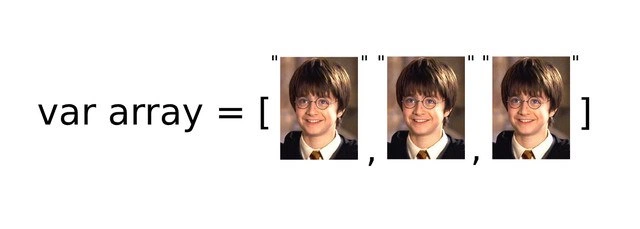
A Literal Array Implementation
Why is this Languages meme funny?
Level 1: When Code Goes Literal
Imagine you learn a new word that sounds like two smaller words put together. For example, think of the word “butterfly.” It doesn’t actually have butter or a fly in it – it’s the name of an insect. But if someone made a silly joke and drew a butter stick with wings like a fly, it would look funny, right? This meme is doing something similar, but with a coding term. In coding, an array is like a simple list of things, kind of like a tray with slots to hold items. The word “array” sounds just like “a ray.” A ray is a type of fish (like a stingray you might see in the ocean or an aquarium). The joke is that instead of putting a regular item in the list, they put a picture of a ray (the fish) in between the brackets. It’s as if the code asked for an “array,” and someone mischievously misunderstood it as “a ray” and delivered a fish! It’s a playful mix-up. We laugh because it’s unexpected and goofy – taking a technical term and interpreting it in a totally literal, visual way. In simple terms, the meme is funny for the same reason a knock-knock joke or a pun is funny: it plays with how words sound and surprises you with a silly twist.
Level 2: Marine Data Structure
Let’s break down the basics behind this joke. An array in programming is a fundamental data structure that holds a collection of items. You can think of it as a row of lockers, where each locker (each position in the array) can store a piece of data. Many programming languages have similar syntax for creating an array (or list). For example:
# Python example of an array (list) literal:
fruits = ["apple", "banana", "cherry"]
In such code, the square brackets [ ] with items inside are an array literal – literally writing out the array’s contents. If we put one item in the brackets, we get an array with a single element. The meme shows array = [ ... ] with one element inside. But instead of a normal value like a number or a string, the element is a picture of a stingray fish. Why a stingray? Because of a language quirk: “array” (pronounced like “uh-RAY”) sounds just like “a ray”. A stingray is a kind of fish often simply called “a ray.” So the meme is using a homophone (two different things that sound the same) to be funny. The word “array” from coding and the phrase “a ray” (the animal) are pronounced identically. This is homophone humor in action.
So, in the meme’s imaginary code, they’ve put a ray (fish) inside an array. Visually, it’s shown by actually inserting an image of a stingray between the brackets. For a developer, seeing array = [stingray] (with an actual stingray picture) is unexpected and goofy. Normally, we might write something like array = ["stingray"] (with quotes, meaning a string that spells the word stingray), or perhaps an object like array = [RayObject] if we had a class for rays. But nobody would ever put a real fish into code! That’s why it’s funny – it’s mixing up the literal meaning of the word outside programming with the symbolic meaning inside programming.
A few key terms and concepts here:
- Array: a list of items in code. It’s a basic container to hold things like numbers or strings, indexed by position (starting at 0 in many languages). For example,
my_arr[0]would access the first item ofmy_arr. Arrays are part of every beginner’s computer science learning, which is why this joke is super accessible to programmers. - Array literal: a way to write an array directly in code using brackets (or other notation, depending on language). It’s a quick way to define an array with some values without having to push them one by one. In JavaScript you might do
let array = [1, 2, 3];and in Pythonarray = [1, 2, 3]similarly. - Homophone pun: a joke that relies on two words sounding the same. Here “array” (the code term) and “a ray” (the fish) are homophones. If you say the code out loud – “array equals bracket ray bracket” – it sounds like a regular phrase “a ray in brackets.” The meme took that literally. Wordplay puns like this are common in developer memes because programming is full of jargon that sometimes overlaps by chance with everyday words.
- Square brackets: the
[ ]symbols in the meme are instantly recognizable to coders as the notation for arrays or lists. This visual cue sets up the expectation that we’re looking at code. By using the exact characters and font style we see in code editors, the meme taps into our pattern recognition. It screams “this is code!” to our brains before delivering the twist.
In summary, at this level we see that the meme is combining a basic coding concept (an array) with a pun from regular language (a ray, the stingray). It’s meant to be a quick and relatable joke for anyone who's written a simple program. Even if you’re a junior developer or a student who just learned about arrays, you likely know enough to get the joke. It’s pure syntax humor and wordplay, no advanced computer science required beyond knowing what an array is and enjoying a good pun!
Level 3: The Sting of Homophones
At first glance, this meme looks like a snippet of code: array = [ with something inside, then a closing bracket ]. In many programming languages (like Python or JavaScript), square brackets define an array literal – a way to directly create an array (or list) with some initial elements. Here the surprise is that the single element inside the brackets isn’t a number or string as one might expect, but a picture of a stingray fish. This is a clever homophone pun: the word “array” sounds exactly like “a ray” (as in a stingray). The meme literally puts a ray (the fish) inside an array, playing on the dual meaning. It’s taking a very literal approach to an array literal. In code, a “literal” means a value written exactly as itself (like [1, 2, 3] for an array of three numbers). Here, that concept gets twisted – we have an array literal that contains a literal ray. This kind of wordplay pun is a classic form of developer humor: it mashes up code syntax with everyday language in a way that tickles the brain of anyone who’s fluent in both.
For seasoned devs, the humor also lands because it’s so CS_Fundamentals 101. Just about every programmer’s first data structure is an array, taught in the early days of learning to code. After dealing with high-stakes production bugs and complex frameworks, seeing an array joke is like comfort food – it harkens back to simpler times of basic syntax and first programs. The meme uses a monospace font on a white background to perfectly mimic a code snippet in a textbook or an IDE. You read “array = [ ]” and your brain prepares for some typical content, maybe array = [42] or array = ["hello"]. Instead, you get an image of a ray (the marine creature) in there. That subversion of expectation is what makes you do a double-take and then chuckle. It’s syntax humor meeting a sight gag. The juxtaposition is absurd in the best way: in a real program, you obviously can’t insert a live fish into an array data structure (sorry, no fish object type in the standard library! 🐟). But visually, the meme can do exactly that, creating a silly literal interpretation of the code.
This kind of joke also highlights how context switching between human language and programming language can yield funny results. In a programming context, “array” has a very specific meaning – a sequence of items stored in contiguous memory, accessible by index. In plain English, though, if you break the word apart, “a ray” could mean a single ray fish. The meme exploits that overlap. It’s the homophone_humor of two domains: human language and code. Developers often enjoy these jokes because they reward you for knowing the technical side (recognizing the array = [ ] syntax) and the playful side of English (identifying the stingray pun). It’s the kind of tech humor that makes you feel “in on the joke” thanks to your coding knowledge. In short, the meme is a lighthearted wordplay nugget mixing marine biology with computer science. It finally puts an actual ray in an array, and the result is a quick, relatable laugh that just about any coder can appreciate.
Description
A minimalist and clever visual pun that plays on programming terminology. The image displays a single line of text against a white background, mimicking a line of code: 'array = [ ]'. Inside the square brackets, which are used to define an array in many programming languages, is a photograph of a stingray. The humor lies in the phonetic pun: the word 'array' sounds like 'a ray,' and the image literally places a ray fish inside an array data structure. It's a simple, effective joke that resonates with anyone familiar with basic programming concepts
Comments
7Comment deleted
Be careful when you iterate through that array. The first element might throw a PoisonPointException
Perfect - an array that stays monomorphic as long as the junior doesn’t push an int and turn our hidden-class into a megamorphic sting operation
After 20 years of explaining arrays to junior devs, you realize the real challenge isn't teaching zero-indexing or memory allocation - it's resisting the urge to populate production databases with marine biology puns when the code review backlog hits triple digits
This is the kind of array initialization that passes code review but fails the marine biology department's standards - though I suppose it does technically satisfy the 'contains at least one element' requirement, even if that element has a barbed tail and prefers saltwater environments over heap allocation
array = [ray] - textbook bounds checking: C reads past the tail, Java throws, Rust panics, and the PM asks if we can just hide it with CSS
The perfect JS sparse array: vast empty ocean with one element gliding through undefined indices
Finally, an Array<Ray> - JavaScript is fine with it, TypeScript insists on Array<Elasmobranch>, and the linter says array.flat() is redundant