Skip to content
DevMeme
6299 of 7435
The True Heaviest Objects in the Universe: node_modules and PyTorch venvs
Dependencies Post #6905, on Jun 20, 2025 in TG

The True Heaviest Objects in the Universe: node_modules and PyTorch venvs

Why is this Dependencies meme funny?

Level 1: Mountain of Toys

Imagine you have a little toy, and you ask for some help to play with it — but instead of just a few helpers, thousands of toys come tumbling into your room. Your room fills up and the floor starts bending under the weight! Normally, we think of really heavy things like elephants, mountains, or even the Sun in the sky. The heaviest thing we can think of in space is a black hole (that’s like a giant vacuum cleaner in space that’s super heavy). Now, this joke is saying the folders of code on a programmer’s computer (called node_modules for one type, and a Python venv with PyTorch for another) are so super heavy, they make even a black hole seem light. 😊

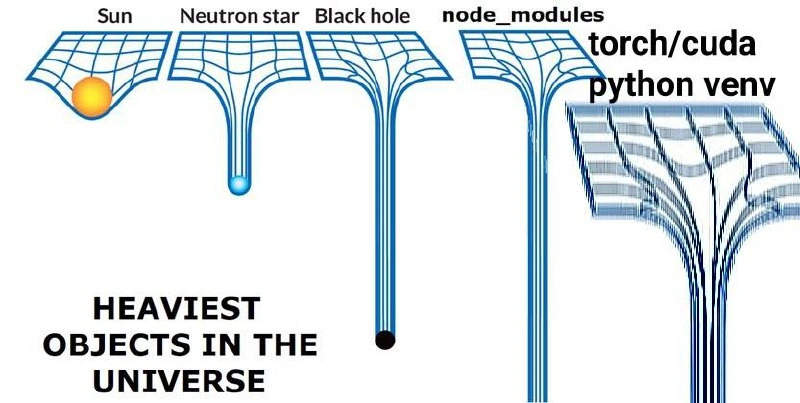
It’s a funny cartoon: they show a grid (like a trampoline or a blanket stretched out). If you put a bowling ball on a blanket, it makes a dip. If you put something heavier, it makes a deeper dip. In the picture, the Sun makes a dip, a neutron star (even heavier star) makes a deeper dip, and a black hole makes a super deep dip. But then for a laugh, they show the node_modules folder making an even deeper hole in the blanket, and the torch/cuda python venv (that’s just a name for a really big bunch of AI program files) making a hole so deep it goes off the picture! It’s like saying, “This pile of computer stuff is so huge and heavy, it broke the chart!” Of course, computer files don’t really have weight like your toys do, but they do take up space on your computer’s disk. The joke is comparing how much space or how much stuff is in these folders to ridiculously heavy things.

So in simple terms: programmers sometimes need a lot of pieces to make their apps work. One kind of app might need a node_modules folder full of pieces, and another might need a venv folder for Python full of pieces. These folders can grow super big — so big that it surprises people. The meme is a playful way of showing that surprise. It’s like saying, “Wow, my project’s help-kit is heavier than a black hole!” It’s funny because it’s an exaggeration, and it helps us laugh about the fact that sometimes our computer projects become huge without us realizing it.

In the end, the feeling behind the meme is a mix of amazement and frustration, expressed in a silly way. Even if you’re not a programmer, you know heavy things are hard to handle. This meme is just saying a programmer’s pile of tools can get comically heavy, and that makes everyone who’s seen it happen chuckle and nod. Imagine needing a whole truck for your toys — that’s how a programmer feels seeing these giant folders. 🚚😄

Level 2: Dependency Heavyweights

Let’s break down the humor in simpler terms. In programming, dependencies are the libraries or packages your project needs to work. This meme compares those dependency folders to super heavy cosmic objects. It’s saying, “Our code libraries are so huge, they’re heavier than the Sun or even a black hole… at least on our computer’s disk!”

  • Node.js and node_modules: Node.js is a popular JavaScript runtime for building server and web applications. It uses a package manager (like npm, Node Package Manager) to add libraries. When you run npm install to add something, it creates a folder called node_modules/ in your project. This folder holds all the code for the libraries you downloaded, plus any other packages those libraries depend on. Over time, this folder can become enormous. Think of it like a big toolbox containing many smaller toolboxes inside. For example, if you install five libraries, each of those might include ten other little libraries. Suddenly you have 5 + 50 = 55 libraries’ code on disk. No joke, a simple project’s node_modules can end up containing hundreds of folders and files. New developers are often shocked: “I only wanted one feature, why did I just download a warehouse of code?” This is what we call dependency bloat. There’s even a running joke in web development that the node_modules folder is so large it has its own gravity (hence the meme’s gravity well drawing). It’s a humorous way to highlight how package management in Node can spiral: you start with a small app, and end up with a Dependency Hell of too many packages.

  • Python, PyTorch, and virtualenv: In Python, developers often create a virtual environment (often named venv/) for each project. This is like a separate sandbox folder that contains all the Python packages your project uses, so they don’t conflict with other projects. If your project is simple (say a small web app), your venv might just be a few megabytes. But if you’re doing Machine Learning and you install PyTorch, things change dramatically. PyTorch is an advanced library for building neural networks (a kind of AI model). It’s powerful, but it’s also huge. Why? Because PyTorch includes a lot of compiled code and can come with CUDA support. CUDA is NVIDIA’s technology to let your GPU (graphics card) crunch numbers for machine learning, which makes training AI models much faster. However, supporting CUDA means including big driver files and math libraries for the GPU. When you pip install torch with CUDA, your computer downloads large binary files (some single files can be hundreds of megabytes). Your Python virtualenv folder (torch/cuda python venv as the meme labels it) suddenly swells up massively. It’s not unusual for an environment with PyTorch to be multiple gigabytes in size. For context, that’s like the size of a high-definition movie or two, just in support libraries! So, this meme jokes that a Python environment with PyTorch and CUDA is so heavy, it went off the charts of the diagram — implying it’s beyond even a black hole in “weight.”

  • Gravitational well illustration: The image uses a physics analogy. Normally, a spacetime curvature grid with a ball on it is how we visualize gravitational pull: heavier objects (like the Sun, then a Neutron star, then a Black hole) make deeper dents in the grid. The deeper the well, the stronger the gravity. The meme takes this familiar science image and labels two of the wells as node_modules and torch/cuda python venv, and draws them as even deeper than the black hole. Of course, in reality, a folder on your disk has no gravity! But visually, it’s a funny way to say “these folders are super heavy (in terms of disk space usage).” It exaggerates just how large and unwieldy our development dependencies have become by comparing them to the heaviest things in the universe.

For a junior developer, the takeaway is: modern programming often relies on many layers of pre-made code (packages). This is convenient (you don’t have to reinvent the wheel), but it means you’ll accumulate a lot of stuff on your disk. Package management systems like npm or pip handle grabbing all those pieces for you, but they don’t warn you about size. So when you see “Sun, Neutron star, Black hole, node_modules, torch/cuda venv”, the meme is saying: Even the Sun (which is huge) and a Black Hole (even huger) are nothing compared to how huge these folders can get on your computer. It’s a playful exaggeration familiar to anyone who’s opened a project folder and thought, “Why on earth is this so large!?”

In day-to-day terms, this can cause practical annoyances: projects taking a long time to download or copy, version control systems (like git) ignoring node_modules because it’s way too large to track, or needing to upgrade your hard drive because a few such projects fill it up. Companies with continuous integration (CI) systems often cache these dependency folders to avoid re-downloading them for every build. But even caching them means you need lots of storage space on the CI server. That’s why the meme caption about “making black holes seem weightless in disk gravity” rings true in a jokey way — developers treat these folders as the ultimate weighty thing you have to manage.

In summary, node_modules (for Node.js projects) and a PyTorch CUDA virtualenv (for Python ML projects) are being humorously called out as the heaviest things a developer might encounter, almost as if they have their own gravity. It’s an exaggeration that builds on real experiences in software development. If you’ve ever installed an npm package or a machine learning library, you’ll get the joke. And if you haven’t yet: just wait, one day you’ll open your project’s dependency folder and do a double-take at its size, and this meme will click instantly. 😅

Level 3: Event Horizon of Bloat

At the senior engineer level, this meme hits like a gravitational field of truth. It comically equates cosmic mass to the digital heft of modern development dependencies. The five side-by-side spacetime curvature grids show increasing dents: from Sun to Neutron star to Black hole — each a known heavy hitter in astrophysics. Then it jumps to a node_modules folder and finally a torch/CUDA Python venv (a PyTorch virtual environment with GPU support). The last two aren’t celestial bodies at all, but the meme exaggerates their disk impact as if they’re the ultimate heaviest objects in the universe. Seasoned devs smirk because sometimes it feels like a fresh npm install adds more weight to your disk than collapsing a star into a black hole.

Why is this funny? Because it’s alarmingly relatable. We’ve all seen a simple project balloon into gigabytes thanks to dependency sprawl. The Node.js ecosystem (via npm packages) is infamous for pulling in countless sub-dependencies. One minute you just want a date formatting library; the next minute your node_modules has recursively sucked in 200 packages. This dependency singularity is so massive that devs joke about it possessing its own gravity well. The meme’s gravitational well diagram visually captures that absurdity: the node_modules well is drawn deeper than a black hole’s, meaning in the dev universe, a Node project’s dependency folder can feel more colossal than a collapsing star. It’s a tongue-in-cheek jab at Dependency Hell and Package Management gone haywire.

The final panel — “torch/cuda python venv” — sinks completely off the chart, warping the grid as if reality itself breaks. That’s a nod to modern Machine Learning stacks. Installing PyTorch with CUDA (for GPU acceleration) in a Python virtualenv is like dumping a neutron star into your disk. The PyTorch library with NVIDIA’s CUDA drivers brings along huge binary files (think hundreds of megabytes, even gigabytes of data for GPU kernels, tensor operations, and deep learning models). Senior devs who have provisioned CI servers or set up training environments know this pain intimately. They’ve watched CI pipelines groan under the weight of copying torch binaries or caching node_modules. Disk_space_anxiety is real when your continuous integration builds fail because the disk ran out while caching these heavy folders. It’s the 21st-century developer equivalent of exceeding payload capacity: “Oops, our test runner can’t pull in that 2GB PyTorch wheel – container full!”

From an architectural perspective, the meme is poking fun at how our tools have evolved to be convenient but hefty. In theory, you could handcraft a tiny web server in C with zero outside code, or train a small neural net from scratch. But in practice, we pull in frameworks and libraries for productivity. NodeJS projects happily depend on a rich ecosystem of NPM packages. Each package might rely on dozens of others (for logging, config, left-padding strings, you name it). The result? node_modules turning into a digital black hole that swallows disk space. There’s a famous quip, "Ever do ls in node_modules and watch your terminal beg for mercy?". Seasoned devs chuckle (and cry a little) because they’ve been there. They’ve seen node_modules folders so large that deleting them (rm -rf node_modules) becomes a minor I/O marathon.

On the Python side, AI/ML engineers recognize the torch/cuda venv joke. PyTorch with GPU support bundles in everything from NVIDIA’s CUDA toolkit to cuDNN, MKL, and other math libraries to make tensor computations lightning fast. Great for training a state-of-the-art PyTorchNetwork, but all that performance power has mass. The Python virtual environment directory (venv) ends up stuffed with .so or .dll files, Python binaries, and support libraries. It’s not uncommon for a deep learning project’s env folder to be tens of thousands of files and multiple gigabytes. The meme suggests this weight is so extreme, it’s off the charts, bending the theoretical spacetime grid in the illustration beyond recognition. In cosmic terms, our virtualenv_size isn’t just bending space, it’s tearing it – a playful exaggeration.

Crucially, the humor also lies in the contrast: Black holes are supposed to be the ultimate heavy objects. Yet, here comes our mundane node_modules directory humorously trumping them. It’s a classic tech inside-joke: only devs know that a folder of JavaScript packages can feel like something that needs its own orbital classification. It’s making fun of our industry’s penchant for bloat. A senior dev has likely fought the battle of trimming dependencies: “Do we really need half of lodash and two different JSON parsers in here?” But due to deadlines or convenience, the bloat stays and grows. Over years, we’ve normalized measuring our tools’ weight in gigabytes. The meme simply pushes that to absurdity: gigabytes so big they metaphorically outweigh stars.

In essence, this is collective tech catharsis. The meme wouldn’t be as funny if it weren’t grounded in truth. Every experienced engineer has winced at a node_modules so large it strains their SSD, or a machine learning environment so hefty it takes an afternoon to set up. We laugh because otherwise we’d cry at the sheer ridiculousness. The Dependencies and PackageManagement systems we rely on empower us to build amazing things quickly — but they also dump the mass of the entire ecosystem onto our drives. It’s the trade-off we’ve all begrudgingly accepted. And this meme wryly crowns these dependencies the kings of weight, outclassing even astrophysical phenomena for comedic effect.

So, the next time you see your disk light thrashing after an npm install or pip install torch, remember this meme. It’s not just you – we’re all orbiting massive dependency black holes, hoping not to get sucked in. 😅 In the cosmic comedy of software development, node_modules_bloat and pytorch_cuda_dependencies have their own special place, warping our project’s spacetime and eliciting knowing groans from every veteran coder.

Description

A five-panel meme based on a scientific illustration of spacetime curvature, humorously depicting the 'Heaviest Objects in the Universe'. The diagram shows a progression of objects creating increasingly deep 'gravity wells' in a grid representing spacetime. It starts with real celestial objects: the Sun, a Neutron star, and a Black hole, each showing a progressively deeper indentation. The meme then pivots to the tech world for its punchline. The fourth panel, labeled 'node_modules', shows a gravity well even deeper than a black hole, poking fun at the notoriously large size of JavaScript project dependencies. The final and most extreme panel, labeled 'torch/cuda python venv', depicts a massive, wide distortion, hyperbolically suggesting that a Python virtual environment for machine learning with PyTorch and CUDA libraries is the heaviest and most cumbersome of all. This joke resonates deeply with developers who struggle with the enormous disk space and complex management required for modern development environments, particularly in AI and web development

Comments

12
Anonymous ★ Top Pick I tried to `rm -rf node_modules` and accidentally created a singularity. Now my laptop has an event horizon and my build times are infinitely red-shifted
  1. Anonymous ★ Top Pick

    I tried to `rm -rf node_modules` and accidentally created a singularity. Now my laptop has an event horizon and my build times are infinitely red-shifted

  2. Anonymous

    If Einstein had run 'npm install' and 'pip install torch-cuda', General Relativity would include a corollary on df -h curvature

  3. Anonymous

    The real reason we moved to microservices wasn't architectural elegance - it was to distribute node_modules across multiple file systems before they achieved gravitational collapse and formed an actual singularity in our data center

  4. Anonymous

    After 15 years in this industry, I've learned that the observable universe contains approximately 10^80 atoms, but a single 'npm install' of a modern React app with ML dependencies will somehow require 10^81. The event horizon of a black hole is the point of no return; the node_modules folder is the point where your SSD weeps and your Docker images become singularities. At least with a black hole, Hawking radiation eventually causes it to evaporate - node_modules are eternal, and no amount of .gitignore can save your soul from accidentally committing them at 2 AM

  5. Anonymous

    At this point npm install and pip install torch are change managed operations; the blast radius is measured in gigabytes and gravitational lensing

  6. Anonymous

    Black holes evaporate via Hawking radiation; node_modules accretes gigabytes eternally, defying all rm -rf horizons

  7. Anonymous

    Nothing warps disk quotas like npm i followed by pip install torch --index-url nvidia; our CI cache now orbits a 7GB Docker layer

  8. @dilshodbekikromov 1y

    explanation ?

    1. @mrYakov 1y

      cuda stuff easy got 10+gb

      1. @dilshodbekikromov 1y

        Thanks

  9. @Trigger1801 1y

    16 gigs on my working venv 😭

  10. @Agent1378 1y

    Why so big?

Use J and K for navigation