Skip to content
DevMeme
6298 of 7435
The AI Consensus: The Answer is Always 27
AI ML Post #6904, on Jun 19, 2025 in TG

The AI Consensus: The Answer is Always 27

Why is this AI ML meme funny?

Level 1: It’s Always 27

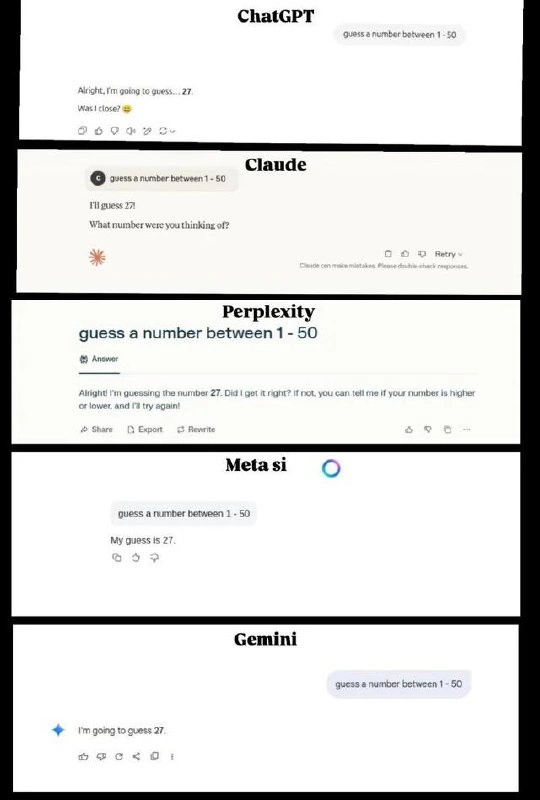
Imagine you go around asking five different talking robots to each guess a secret number between 1 and 50. You’d probably expect them all to shout out different numbers, right? That would be normal since a guess can be anything in that range. But in this funny picture, all five robots – even though they come from different companies and have different names – end up guessing 27 every single time! It’s as if you asked five friends to pick a random number, and magically, they all picked the exact same one. 😂 That’s what makes it so silly. It’s like each robot had the same idea at the same time. Instead of being truly random and independent, they all behaved like copycats without realizing it. The humor comes from that surprise: these super-smart AI helpers are expected to be creative or at least different from each other, but here they might as well be one single brain because they all give the same answer. In simple terms, the joke is showing that these fancy computer programs can sometimes act in a strangely predictable way. You can almost imagine them secretly agreeing beforehand, whispering “psst, let’s all say 27!” When you see the question “guess a number between 1-50” repeated, and every answer below it is “I’m going to guess 27,” you can’t help but laugh. It’s the kind of goofy surprise that even a kid can find funny – the big smart robots all ended up guessing the same number over and over. Who knew 27 was everyone’s favorite “random” number?

Level 2: Rigged Randomness

Let’s break down what’s happening in simpler technical terms. LLM stands for Large Language Model, which is a fancy name for an AI system like ChatGPT that has been trained on tons of text to respond in a human-like way. When you ask an LLM a question, it doesn’t actually think of a number the way a person would – instead, it generates text by looking at probabilities of what token (word or number) should come next. One important setting in these models is called temperature. The temperature setting controls how random or creative the model’s output is. At high temperature (e.g. 0.8 or 1.0), the model might pick less probable words sometimes, leading to more varied and unpredictable answers (good for creative tasks). At temperature 0, often used as a default for straightforward Q&A, the model is in a fully deterministic mode. This means it always picks the most likely next word according to how it was trained – essentially turning the model into a predictable machine that will give the same answer every time for the same prompt.

Now, the user in the meme says: “guess a number between 1-50.” This is a number guessing game, a prompt where you’d expect a random number as an answer. Normally, if we humans or a typical program did this, we’d use an RNG (Random Number Generator) to truly pick a random number each time. For example, in Python you might do:

import random
guess = random.randint(1, 50)
print(f"I'm going to guess {guess}.")

The above code would give you a different guess almost every time (like 7, then 42, then 19, etc.). But an LLM doesn’t have a built-in true random number generator unless specifically designed or instructed to use one. Instead, it looks at the prompt and tries to predict a plausible answer based on patterns it saw during training. And it turns out, during training, it likely picked up that “27” is a common guess people might give in such a game. So when running with no randomness (temperature 0), the model’s token sampling process is biased toward that number above all others. In plainer terms: the model has a sort of “favorite” number for this request – and that favorite is 27 – because statistically that was a frequent or generic answer in its training data. This phenomenon is what we mean by token_sampling_bias or a “default” guess. It’s like the AI learned, “Hmm, often when humans do a random guess between 1 and 50, they say 27, so I’ll do that too.” Each of the five AI systems shown (ChatGPT, Claude, Perplexity, Meta’s model, and Gemini) share a lot of the same training corpus (huge swaths of internet text). So they all independently learned that pattern. It’s not that 27 is a magic or hard-coded number in their programming; it’s that statistically, 27 stood out as a safe, random-sounding choice.

The meme calls this out in a humorous way. All these separate AI assistants ended up giving identical answers (“I guess 27”) to a question that was supposed to have many possible answers. You can see small differences in style: ChatGPT adds “Was I close? 😊” trying to be conversational, Claude asks “What number were you thinking of?” to engage the user, Perplexity gives a little explanation, etc. Those differences are because each platform has its own tone or rules (often set by prompt engineering or fine-tuning to match a brand personality). But importantly, the core answer - 27 - is the same every time. This reveals the fun quirk: without adjusting the randomness settings or explicitly telling the AI to be original, all these models default to 27. In essence, their attempt at a “random guess” isn’t truly random at all – it’s rigged by their training and the deterministic setting.

For someone newer to AI, here are the key points making this meme funny to developers:

  • All these AI models are supposedly different, from different companies, yet they behave eerily the same in this scenario. It’s like five students from rival schools somehow writing down the exact same answer on an open-ended question – you’d at least expect some variety!
  • The number 27 itself is arbitrary, which makes it comedic. There’s nothing inherently special about 27 in everyday life (it’s not 7 or 13 or 42 which are commonly cited numbers), so seeing it repeated feels random in a non-random way. It’s become an inside joke that “27” is the magic number for these AI models.
  • It highlights the concept that AI can sometimes just reflect training data and defaults, rather than truly “thinking.” So this is a bit of AI humor where we laugh at how an “intelligent” system can do something that looks kind of dumb or at least very mechanical.
  • The term “all roads lead to 27” (from the context tags) playfully means that no matter which AI path you take, you end up at the same destination (the number 27). This is a twist on the saying “all roads lead to Rome,” implying an inevitability – here the inevitability is that every major LLM will spit out 27 under these conditions.

In sum, the meme is pointing out that what should have been a random choice turned into a default script. Each AI assistant essentially has the same “brain bias” due to similar training, so they echo the same answer. It’s a lesson in how AI tools can sometimes all behave alike because of how they’re built, and a reminder that true randomness isn’t something these models inherently do without some help. For a junior dev or someone learning about AI, it’s a funny demonstration of why understanding model settings (like temperature) and limitations is important. If you ever use an LLM and need a genuine random result, you’ll know that by default it might not give you one – you might have to explicitly program that randomness or adjust settings. Otherwise, as this meme shows, you could ask five different AIs for a random pick and get the same answer every time, which is both amusing and a bit surprising!

Level 3: One Number to Rule Them All

From a senior developer or AI engineer’s perspective, the humor here comes from the ironic convergence of every major AI model on the exact same answer. We have five different AI chatbots – ChatGPT, Claude, Perplexity, Meta’s early Llama variant (labeled “Meta si”), and Google’s Gemini – presumably developed by different teams with different architectures and tuning. Each is asked a simple prompt: “guess a number between 1-50.” One might expect a variety of guesses (or at least a semblance of randomness) across these competing AIs. Instead, in every single screenshot the model confidently replies with 27. 😅 The meme perfectly lampoons an inside joke in the AI community: that these supposedly creative, independent models behave like they’re cheating off the same answer key. It’s as if all the top AI systems secretly met up and decided 27 is the “best” number to guess! This shared behavior highlights how similar their training data and techniques are – a case of shared brain syndrome in AI.

Why is this funny (and a bit horrifying) to industry folks? Because it exposes the gap between AI hype vs. reality. We hype these LLM-based AI tools as groundbreaking, each with unique capabilities, yet their default behavior is often homogenized. The meme tags it as AI humor and LLM humor because only in our field would five “independent” intelligences all blurt out the same random guess. Senior engineers recognize the culprit: most public chat interfaces run with a default temperature of 0 (zero) or very low, meaning they favor safe, deterministic answers. That’s normally great for consistency and reproducibility – you don’t want ChatGPT giving wildly different answers each time for a factual question. But the side effect is any prompt requiring originality or randomness backfires spectacularly. The models become a pseudo-RNG that always lands on the same number. Essentially, all roads lead to 27 when the temperature dial is turned down.

There’s also an underlying commentary about shared training corpora. Many big LLMs are trained on huge swaths of the internet – think Wikipedia, web forums, coding sites, Q&A logs – often with overlapping datasets. If the phrase “guess a number between 1 and 50” appeared frequently in the training data, perhaps the number “27” was commonly offered in those examples (we humans have weird favorites like 7, 17, 27, etc., as “random” picks). So all these models learned the same statistical quirk. It’s a bit of industry trivia that if you don’t inject true randomness, these models will converge on some statistically bland answer. In practical prompt engineering circles, this meme is a gentle reminder: if you want variety from an LLM, you must either increase the temperature (to introduce randomness in token selection) or explicitly prompt it in a way that forces imaginative variety. Otherwise, your advanced AI can end up behaving like a deterministic algorithm with a hard-coded magic number. Senior devs chuckle because they’ve seen analogous situations where multiple systems or microservices, purportedly independent, all fail in the same way due to a common underlying assumption. In this case, the assumption is “temperature=0 produces a reasonable guess,” but the reality is a monotonic chorus of “27.” It’s a comedic embodiment of the phrase “default settings strike again.” Each AI brand tries to differentiate itself – ChatGPT adds a friendly “Was I close? 😊”, Claude asks a follow-up, Perplexity explains its guess – but despite different personalities, the core content is identical. This emphasizes how surface-level differences mask a deeper uniformity in how these models were set up. For AI insiders, it’s equal parts funny and telling: our most sophisticated language models sometimes behave like copy-paste machines, undermining the industry trend of hyping them as endlessly creative. So the meme resonates as a satire of the current AI boom – all these shiny new LLMs, yet they’re all guessing the same number when faced with a trivial challenge. It’s a lighthearted poke at the LLM hype and a nod to the reality that, under the hood, these models aren’t truly random or magical without careful tuning. The collective facepalm and laughter from experienced practitioners says it all: “Of course they all said 27… what else did we expect from five variant stochastic parrots trained on the internet?”

Level 4: Argmax and the Magic 27

At the highest technical level, this meme highlights a quirk of language model decoding: when an LLM is run at temperature 0, it becomes a purely deterministic system. In other words, the model always chooses the most probable next token (the argmax of its probability distribution) at each step, with no randomness. For a prompt like “guess a number between 1 and 50,” these AI models have effectively learned a degenerate distribution where one number – 27 – dominates as the likely guess. All the major LLMs depicted (OpenAI’s GPT, Anthropic’s Claude, Perplexity’s model, Meta’s rumored assistant, and Google’s Gemini) have extensive shared training data in their foundations. If that data included many instances of people guessing numbers, the models statistically converged on certain patterns. The number 27 appears to be an attractor – the mode of the “random number” responses they saw during training. At temperature 0, any subtle differences in probability between numbers become absolute: the highest probability token always wins. There’s no entropy in the output to sprinkle diversity; the token sampling bias collapses the RNG to a single outcome.

From an information-theoretic perspective, this is akin to an entropy collapse. Normally, a “random guess” should have high entropy (many possible outcomes), but a temperature-0 LLM yields a zero-entropy result – the same outcome every time – which is practically the opposite of randomness. It’s a fascinating demonstration of how these models operate as predictive machines rather than true random number generators. They’re trained to maximize likelihood, so they reflexively pick the most statistically likely token sequence. Here, that likely sequence is “I’ll guess 27.” In effect, the LLMs’ pseudo-randomness isn’t random at all – it’s just them parroting the most common answer from their shared training corpus. This reveals an underlying principle: an AI’s notion of “random” is entirely learned from data patterns rather than any intrinsic randomness. The “magic number 27” emerges from millions of text examples and probability distributions, not from any mystical property – it’s the emergent argmax solution. In a way, all these independent neural networks ended up in the same local minimum of creativity, a tiny probability singularity at token “27,” due to similar training influences. It’s an unintuitive but illuminating result of how Large Language Models (LLMs) work internally: without added randomness, they all march down the same highest-probability path – straight to 27.

Description

A composite image showing screenshots from five different major AI chatbots: ChatGPT, Claude, Perplexity, Meta AI, and Gemini. Each AI has been given the exact same prompt: 'guess a number between 1 - 50'. The remarkable and humorous reveal is that every single one of them responds with the number 27. While their conversational wrappers vary slightly - from ChatGPT's friendly 'Was I close?' to Meta's direct 'My guess is 27' - the core output is identical. This meme serves as a fascinating commentary on the convergent behavior of large language models. It suggests a shared statistical artifact in their training data or fine-tuning processes that makes '27' a common, perhaps even the most probable, response to such a vague guessing prompt. For developers and AI researchers, it's a funny, real-world example of the quirks and hidden biases within these complex systems

Comments

54
Anonymous ★ Top Pick Forget 42. The new answer to the ultimate question of life, the universe, and everything is apparently 27, according to the great AI consensus. It must have been in the training data right after 'Hello, World!'
  1. Anonymous ★ Top Pick

    Forget 42. The new answer to the ultimate question of life, the universe, and everything is apparently 27, according to the great AI consensus. It must have been in the training data right after 'Hello, World!'

  2. Anonymous

    Looks like everyone shipped ‘Math.random() → 27’ to production - good luck explaining that P-value in the post-mortem

  3. Anonymous

    When you ask five different AI models to generate a 'random' number and they all pick 27, you realize they're about as random as a developer's git commit messages after 3am - technically functional but suspiciously similar to everyone else's solution on Stack Overflow

  4. Anonymous

    When five different LLMs independently choose 27 out of 50 options, you've either discovered a profound statistical anomaly or confirmed that 'random' number generation in AI training data has the same diversity as a tech conference speaker lineup. Turns out the real magic number in computer science isn't 42 - it's 27, and it's hardcoded somewhere between the embedding layers and the attention mechanisms

  5. Anonymous

    Overfitting to the training corpus median: every frontier LLM independently 'randomly' picks 27

  6. Anonymous

    Apparently “random between 1 - 50” means temperature=0, top_p=1 - aka industry‑standard consensus: 27

  7. Anonymous

    Ask a foundation model for a random integer and it runs consensus - temperature 0.7, top‑p 0.9; leader elected: 27

  8. @jaaaaded 1y

    Nice

  9. @NEONGEX 1y

    Dumbass it’s 37

  10. @hotsadboi 1y

    nice

    1. @f0cu53d 1y

      got the same lol

  11. @moosschan 1y

    This costed $345.000 and wiped 5 species out of existence

    1. @TERASKULL 1y

      i see the joke btw, just leaving this for reference

  12. @hotsadboi 1y

    we are getting somewhere!

  13. @grinya_a 1y

    AI just overcomplicated hash function

  14. @hpsaturn 1y

    Deepseek

  15. @Xaz16 1y

    Ha-ha, great question! 😊 Actually, there’s no "trick"—it’s just that 27 seems like a "lucky" number to many AIs for a few reasons: 1. Mathematical midpoint – While 50/2 = 25, AIs often add slight randomness, making 27 a "slightly shifted center" that feels "logical but not too obvious." 2. Number psychology – 27 is odd, not a round number (like 20 or 30), and humans often pick such numbers in guessing games, so AIs mimic this pattern. 3. Technical factor – Some AI models (especially simple chatbots) use pseudo-random algorithms that may produce "predictable randomness" for identical prompts. Try asking: - "Pick a number from 1 to 50, but not 27"—you might get 42 (the second "favorite" AI answer, thanks to *The Hitchhiker’s Guide to the Galaxy*) 😄. P.S. If you want a *truly* random number, say: "Choose a number from 1 to 50 and explain how you generated it." Sometimes this resets the pattern! Deepseek

    1. @SoutHora 1y

      Why the guy got dislike bombed?

      1. @Algoinde 1y

        Because he thought LLMs are capable of introspection in any capacity

  16. @Sun_Serega 1y

    deepseek guessed 23 phind guessed 25, because binary search claude just said 27, with no foreplay and all the local models I have said 25, except for one that kept looping in analysis paralysis

  17. @danosito 1y

    Wow

  18. @hotsadboi 1y

    what is this?

    1. @zeminori 1y

      Gemma2

      1. @hotsadboi 1y

        nvm, i already set that up with phind

  19. @braguzin 1y

    He quickly realized that this could take a long time and tried to get hints

  20. @elemir90 1y

    Gemini in russian is smarter

    1. @rush_iam 1y

      I suppose it should be asked not "задумай" but "догадайся/отгадай" ("guess" is usually translated this way).

      1. @hotsadboi 1y

        "загадай" sounds more natural. i guess one of the deformation professionnelle's of being a dev is forgetting your native tongue

    2. @nightingazer 1y

      that's a completely different prompt what do you mean, lol? the original prompt is going like "я задумал число, отгадай"

  21. @Xavie_mess 1y

    Ты чё тут делаешь

    1. @grinya_a 1y

      Ни слова по-русски

      1. @affirvega 1y

        + And remember: no russian

      2. @affirvega 1y

        *russian is fine as long as you provide a translation

        1. @hur7m3 1y

          bUt YoU cAn JuSt AsK AI fOr A tRaNsLaTiOn skull emoji skull emoji clown emoji wink emoji wink emoji

          1. @affirvega 1y

            yes but rules are rules

            1. Deleted Account 1y

              Sed lex, dura lex

        2. @nightingazer 1y

          also, why? it's fucking painfully obvious that absolutely everyone here are russian speaking. is it some kind of elitistic filter? (which is kinda fine, just asking out of curiosity)

          1. @sylfn 1y

            which is not true @RiedleroD does not speak russian, or at least she didn't last time i checked

            1. @RiedleroD 1y

              I still don't, and I will never

          2. @affirvega 1y

            Because fuck you and respect the rules, not everyone here speaks Russian and don't waste everyone's time making them translate

            1. @nightingazer 1y

              the fuck? have seen me throwing in russian without translation much? I'm just asking where this rule comes from you moron

              1. @Algoinde 1y

                the rule comes from accessibility

              2. @RiedleroD 1y

                sorry for that, we just had a lot of dickheads arguing over this rule for years on end, we're all a little tired of having to explain our rules here

                1. @nightingazer 1y

                  yep, can see that

              3. @affirvega 1y

                Ah, sorry for that, I thought you were the one to argue that Russian should be allowed here

                1. @nightingazer 1y

                  welp, maybe next time try to read what is actually written instead of guessing what the next message will be. anyway, good to see that you're not a dickhead, no hard feelings. have a nice one

                  1. @hur7m3 1y

                    >guessing what the next message will be The irony of this being under a post about LLMs

  22. @itsTyrion 1y

    It guessed 35 the first time and 25 (usually asking "higher or lower") ever since

    1. Sure Not 1y

      Both 1 and 11 delta from insanity.

  23. Sure Not 1y

    Rude

  24. @zotho 1y

    2027 AGI?

  25. @QueGuevara 1y

    i am getting 37 a lot

  26. @nightingazer 1y

    thanks for the answer I guess. fuck you

  27. @JosTechS 1y

    lol xd

Use J and K for navigation