Skip to content
DevMeme
6300 of 7435
When the 'Easy' Test is a Legendary Internet Mystery
Cryptography Post #6906, on Jun 20, 2025 in TG

When the 'Easy' Test is a Legendary Internet Mystery

Why is this Cryptography meme funny?

Level 1: Treasure Hunt Test

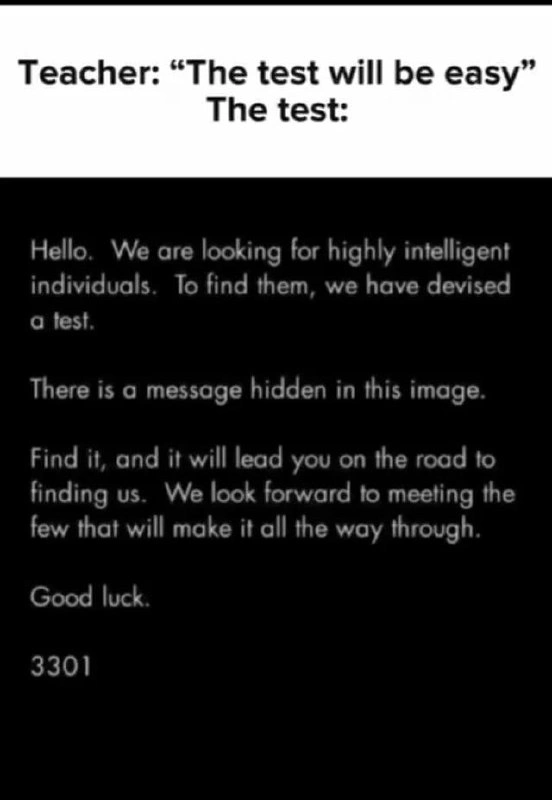
Imagine your teacher says, “Don’t worry, today’s quiz will be a piece of cake,” but then the paper you get isn’t a normal quiz at all – it’s like a secret treasure map with coded messages! Instead of simple questions, it’s telling you there’s a hidden message you have to find, almost like a spy puzzle. You’d probably blink twice and think, “Is this for real?” It’s the same feeling as if you prepared for a quick homework check, and suddenly you’re asked to solve a riddle from a detective novel. That surprise is what makes this funny. The teacher promised something easy, but what you got was an extreme surprise challenge – like expecting a little scavenger hunt and getting a full-blown mystery adventure. In plain terms: it’s funny because the test was supposed to be simple, but it turned out to be as complicated as finding hidden treasure with secret clues. It’s an exaggeration that makes us laugh at how wildly different the reality is from what we were told.

Level 2: Secret Message 101

For a newer developer or student, let’s break down why this scenario is funny. The teacher says the test will be easy – something any student wants to hear. But the meme shows that “The test” is not a normal test at all; it’s written like a secret message recruiting codebreakers. The large block of text in the meme (“Hello. We are looking for highly intelligent individuals…”) is actually mimicking a real-life mystery known as Cicada 3301. Cicada 3301 was a series of elaborate online puzzles that started back in 2012. It was kind of like an internet treasure hunt created to find super-skilled puzzle solvers. It wasn’t an official contest; it just appeared on forums and drove code enthusiasts wild. The puzzles involved things like cryptography (secret codes), steganography (hiding messages inside images or other files), and tons of clever problem-solving. For example, one puzzle said there was a hidden message in an image – exactly like the text shown in this meme. That meant if you looked at the picture normally, you’d see nothing unusual. But if you knew how to examine the bytes (the raw data) of the image, you could find a hidden clue. It’s like a high-tech version of writing in invisible ink.

Now, why put that in a school test context? The humor comes from the clash between expectation and reality. An “easy” quiz should have straightforward questions on whatever the class studied. Instead, the meme pretends the test is telling students to solve a top-secret puzzle! Cryptography is not typical school fare unless you’re in a very specialized class. Most students wouldn’t know how to begin finding a concealed message in an image – that’s a niche skill people learn in cybersecurity or programming hobbies. Steganography (hiding one piece of data inside another) is even more specialized. For instance, a simple form is taking a color picture and tweaking each pixel’s color just a tiny bit to encode letters or numbers. To the naked eye, the picture looks the same, but a program could read the tiny changes and spell out a secret. Cool, right? But definitely not intro algebra material. So the meme exaggerates: the teacher either greatly underestimates how hard the test is, or is pulling a huge prank. It’s as if a teacher said, “Don’t worry, the math quiz is easy,” and the first question is “Prove Fermat’s Last Theorem.” Absurd and unexpected – that’s why it’s funny.

Some terms from the meme and tags explained: “3301” is just the number used by the mysterious group that made the Cicada puzzles – it became their signature. “Find the flag” is a phrase from hacking competitions (CTFs, or Capture The Flag) where the goal is to find hidden clues or codes (flags) in challenges. It’s relevant because the test in the meme basically is a find-the-flag challenge. Instead of a normal question, it’s telling you to uncover a hidden message. The tag HiddenComplexity really sums it up: something that looks simple (easy test) actually has complex stuff lurking beneath. In real learning experiences, you might encounter this when a project or problem seems straightforward until you dig in and discover new concepts you didn’t know before – that’s a steep LearningCurve moment. Here that idea is blown up to cartoonish proportions. The teacher-student context also brings up the teacher_gap: sometimes teachers or experts forget that what’s easy for them (after years of experience) is mind-blowing for newcomers. If a cryptography expert made a “fun little quiz,” it might look like a nightmare puzzle to the students who’ve never seen such things. The meme is a tongue-in-cheek way to say “that feel when you’re promised an easy ride, but end up in over your head.” And for anyone not familiar with Cicada 3301, just know: it’s the kind of puzzle that even pros found super challenging. So imagining it as a test in class is hilariously ridiculous.

Level 3: Puzzle in Disguise

From a seasoned developer’s perspective, this meme humorously captures the bait-and-switch of hidden complexity. We’ve all been there: someone in authority (a teacher, a manager, a senior architect) assures us “Oh, this will be straightforward,” and then we uncover a rabbit hole worthy of a cryptographic puzzle. Here the teacher promises an easy test, but “The test:” turns out to be a full-blown Cicada 3301-style enigma. Cicada 3301 is practically legend in tech circles – a series of nearly ludicrously difficult cryptography and puzzle challenges that emerged on the internet. By referencing it, the meme dials the situation up to eleven. It’s saying: imagine a quiz so over-the-top that it expects you to be a world-class code-breaker. Seasoned engineers chuckle (or groan) at this because it mirrors real-life situations where a task advertised as simple masks layers of hidden complexity and arcane domain knowledge.

Why is this funny to an experienced dev? Because it’s relatable. In software projects, we often hear things like “It’s a small change, won’t take long,” only to discover that “small change” touches five microservices, breaks backward compatibility, and requires understanding a legacy protocol from 1998. The gulf between initial expectation and actual effort is comedic in hindsight (if not painful in the moment). The meme uses the Cicada puzzle as the ultimate example of over_engineered_exam: a test so convoluted that it might as well be recruiting cryptographers. It lampoons the teacher gap – where instructors or bosses misjudge difficulty. Perhaps the teacher (like that one professor who’s a cryptography buff) thinks a steganography riddle is a fun little challenge, while students are left utterly perplexed. This resonates with any junior dev handed a “trivial” bug fix that requires spelunking through thousands of lines of cryptic legacy code. HiddenComplexity in both academia and industry means you sometimes need Sherlock-Holmes-level sleuthing for what was billed as routine.

The structure of the meme even visually emphasizes this contrast. The teacher’s claim “The test will be easy” is in plain bold text on white – calm, innocuous, nothing to worry about. Then “The test:” reveals itself in eerie typewriter font on black, like a secret dossier. Any engineer who’s seen a command-line or a hacker movie terminal gets the visual cue: uh oh, this just got complicated. The text itself, “There is a message hidden in this image… Good luck. 3301”, is essentially the starting gun of an alternate reality game puzzle. It’s the kind of thing you’d find on a shady forum or a crypto challenge site, not on a midterm exam paper! That absurd mismatch is what triggers the laughter. It’s referencing that feeling when you realize a task is way beyond what you prepared for. In real life, no teacher would put a secret steganography_puzzle in a normal test – but on projects, we often discover unwelcome surprises of similar magnitude. The meme’s humor lies in exaggeration and recognition. It exaggerates the difficulty (Cicada 3301 is famously hard) and expects the audience to recognize that reference. When devs get it, they nod and smirk: “Haha, been there – told it’s easy, ends up being a Cicada-tier nightmare.”

This also pokes fun at the concept of find_the_flag challenges creeping into places they don’t belong. Capture-the-Flag puzzles are great in hackathons or security competitions, but imagine them suddenly showing up in your Learning environment or daily work without warning. It’s a commentary on how out-of-place that level of complexity is in an “easy test.” For senior folks, it also hints at the unspoken truth: complexity can hide anywhere. Whether it’s an exam or a seemingly minor feature request, you sometimes unveil a whole crypto_recruitment_test worth of problems. The seasoned perspective finds humor (tinged with war-weariness) in that reality. Just like Cicada solvers needed perseverance and a broad skillset, developers often need to become impromptu detectives. We’ve learned that a task labeled “easy” might require breaking out the hex editor, writing a quick Python script to decode something, or reading academic papers – all before lunch. This meme encapsulates that lesson with a wink: Never trust the words “easy quiz,” especially not from a teacher with a glint in their eye.

Level 4: Hidden in Plain Bytes

At the deepest technical level, this meme invokes steganography – the craft of hiding data within other data – and high-end cryptography challenges. When the test prompt says, “There is a message hidden in this image,” it’s hinting at a classic steganographic puzzle. Digital images are made of millions of pixels, each pixel’s color encoded as numbers (for example, three values for Red, Green, Blue). In a 24-bit RGB image, each color channel is 8 bits, so a pixel might be stored as something like (10110010, 11001001, 00101101) in binary. Changing the last bit of each color (the least significant bit) has almost no visible effect on the image – humans can’t tell the difference if a pixel’s blue value is 00101101 vs 00101100. Puzzle-makers exploit this by embedding a secret message in those least significant bits (LSBs) of many pixels. For instance, if you take every LSB across a large image, they could form the bytes of a hidden text or file. Thus the image looks normal, but buried in its binary guts is a covert message – truly hidden in plain bytes.

The infamous "Cicada 3301" challenge referenced here began exactly with this kind of trick. Solvers discovered that an innocuous image had extra information concealed in it. By running tools (for example, using the strings command or a steganography decoder) on Cicada’s image, they found a hidden message that led to the next clue. This required knowledge of computer file structures and cryptographic encoding. In steganography puzzles, you often have to parse image headers, look at byte frequencies, or use algorithms to extract bits that don’t fit usual patterns. It’s a blend of CS_fundamentals: understanding binary data, algorithm design for extracting or decoding information, and sometimes cryptanalysis if the extracted data is further encrypted. In Cicada 3301, each clue often led to another in a different format – one moment you’re reading hidden image text, the next you’re factoring prime numbers or deciphering a Vigenère cipher. The challenge creators essentially forced participants to demonstrate a Swiss Army knife of technical skills.

In a theoretical sense, hiding a message poses interesting problems: how do you encode data so that it’s undetectable? There’s a whole science of steganalysis (detecting hidden info) verses steganography (hiding info). Information theory tells us that truly undetectable steganography approaches the carrier medium’s entropy limits. Practically, this means if you alter pixel bits randomly to encode your secret, you want it to appear as noise. Too much pattern and an algorithm can flag, “Hey, those LSBs look suspiciously non-random.” Real cryptographic steganography might even encrypt the hidden message before embedding (so that even if someone finds it, they can’t read it without a key). The Cicada text “3301” itself is like a signature – it became the namesake of the puzzle and hints at a secret group. It’s not a trivial number; enthusiasts speculated it might relate to prime numbers or just be an identifier. The hidden complexity here is staggering: what looks like a simple image can harbor layered secrets that require diverse computer science fundamentals to uncover. The meme’s “test” is basically pointing to a find_the_flag style challenge. It’s a nod to the kind of crypto recruitment test or advanced Capture The Flag (CTF) puzzle that only the most determined (or obsessed) individuals solve. By invoking this, the meme sets an extreme contrast: an “easy” quiz that secretly demands understanding of image byte structure, encryption, and maybe even some number theory – knowledge light-years beyond a normal quiz. It’s both a tribute to the depth of these puzzles and a tongue-in-cheek warning: sometimes what’s presented as simple hides a labyrinth of complexity and arcane problem-solving.

Description

A two-panel meme that humorously contrasts expectations with reality. The top panel sets up the premise with the text 'Teacher: “The test will be easy” The test:'. The bottom panel reveals the 'test' itself: a screenshot of the infamous introductory message from the Cicada 3301 puzzle. The message, in white text on a black background, reads: 'Hello. We are looking for highly intelligent individuals. To find them, we have devised a test. There is a message hidden in this image. Find it, and it will lead you on the road to finding us. We look forward to meeting the few that will make it all the way through. Good luck. 3301.' The joke lies in the extreme disparity between a supposedly 'easy' test and one of the most notoriously difficult and cryptic internet puzzles ever created, which required deep knowledge of cryptography, steganography, and other advanced topics. It's relatable to any developer who has been told a task would be simple only to discover it's a rabbit hole of immense complexity
Comments

18
Anonymous ★ Top Pick The PM said it was a simple UI tweak. After seeing the codebase, I'm pretty sure the solution is hidden in the image's LSB, the answer is a PGP-signed email, and the final destination is a server in a bunker
  1. Anonymous ★ Top Pick

    The PM said it was a simple UI tweak. After seeing the codebase, I'm pretty sure the solution is hidden in the image's LSB, the answer is a PGP-signed email, and the final destination is a server in a bunker

  2. Anonymous

    Sure, it’s only one question - just extract the LSBs, crack the book cipher, and brute-force the XOR key… still less work than deciphering requirements from marketing

  3. Anonymous

    The only thing harder than explaining to your PM why that 'simple' feature will take 3 sprints is explaining why you spent your weekend solving cryptographic puzzles from anonymous internet entities instead of fixing that production bug

  4. Anonymous

    Ah yes, the classic 'easy' technical interview - where 'easy' means they've only hidden the actual requirements in a steganographic cipher requiring knowledge of prime number theory, image forensics, and the Tor network. At least they're honest about wanting 'highly intelligent individuals' - translation: someone who can decode their job description before even applying. Nothing says 'we value your time' quite like a Cicada 3301-level puzzle just to schedule a phone screen where they'll ask you to invert a binary tree anyway

  5. Anonymous

    PM: 'Quick spec update.' Figma PNG: LSB-stego'd Cicada 3301. Auditors love it

  6. Anonymous

    In engineering, “quick test” apparently means write an LSB extractor, recover the payload, verify it with PGP, and explain why JPEG was a terrible stego container - good luck, 3301

  7. Anonymous

    The recruiter promised 'just FizzBuzz,' but question one is: extract the PGP block from the image's LSBs, follow the onion link, and then justify the CAP trade-offs of your decoding pipeline

  8. @OxDEADFACE 1y

    easy peasy

    1. @sambord 1y

      explain plz

      1. @JackOhSheetImSorry 1y

        You can find info about Cicada 3301 on the internet. It's a series of anonymous-posted cryptography problems, where a solution of one leads to the next one. It happened in the 2000s I guess

      2. @mohamed_023 1y

        Open the image in a hex editor you will see the text hidden inside (literally)

        1. _ 1y

          Looks like the image got compressed, how do you get the original ?

          1. @mohamed_023 1y

            It's on the internet, this thing has been around since 2012 I think

          2. @Broken_Cloud_1 1y

            Go search cicada 3301

  9. @ZgGPuo8dZef58K6hxxGVj3Z2 1y

    Cidia? Or whatever it was called?

    1. @viktorrozenko 1y

      Cicada

      1. @ZgGPuo8dZef58K6hxxGVj3Z2 1y

        Yes that thing

  10. @Loner_feed 1y

    My tech interview be like

Use J and K for navigation