Skip to content
DevMeme
2627 of 7435
Haskell Developer's Guide to Variable Naming
FunctionalProgramming Post #2906, on Apr 7, 2021 in TG

Haskell Developer's Guide to Variable Naming

Why is this FunctionalProgramming meme funny?

Level 1: Spin the Name Wheel

Imagine you have a bunch of toys, and instead of giving each toy a real name, you decide to label them with just single letters. One day your teddy bear is called “B”, and your toy car is “C” – pretty silly, right? Normally, you’d pick a name that helps you remember what’s what (like “Fuzzy” for the bear or “Speedy” for the car), but using random letters would make everyone confused (“Which one was B again?”). This meme is funny for the same reason: it shows a programmer who is jokingly picking names for things in their code by spinning a big wheel of random letters. It’s like saying, “Coming up with real names is too hard, so let’s leave it to luck!” Of course, no programmer actually does that, but the picture exaggerates it to make us laugh. It’s a goofy image that makes the serious challenge of naming things seem as simple (and absurd) as spinning a wheel and grabbing whatever letter comes up.

Level 2: The ABCs of Haskell Names

This meme shows a programmer using a colorful spinning wheel to choose a single letter as a variable name. The developer in question is a Haskell programmer, and the joke here is tied to how Haskell code is often written. Haskell is a functional programming language. In functional programming (often abbreviated FP), code is built mostly around functions and their composition, rather than using a lot of changing variables like in some other languages. One side effect of this style is that Haskell developers tend to use very short variable names – sometimes just a single letter like x or f – or even no named variables at all in a function definition!

Why would they do that? In Haskell, the compiler has a superpower called type inference. That means the compiler can figure out the types of values and many details on its own, without the programmer spelling everything out. Because of this, a Haskell programmer often doesn’t need to write as much explanatory code. They might write something concise like sum xs (to sum up a list named xs) and not worry about explicitly naming every little detail. The context and the strong type system carry a lot of the meaning. It's a bit like a puzzle where the picture is clear from the shapes of the pieces, even if none of the pieces have labels on them.

Now, in most programming languages and good code quality guidelines, we’re taught that variable names should be descriptive. For example, in Python you might have:

total_sales = price * quantity  # descriptive names for clarity

which clearly states what each variable represents. But a Haskell developer might do something more terse:

t = p * q   -- p and q might represent price and quantity

This Haskell snippet works the same (t would be the total), but it’s not immediately obvious to a newcomer what p or q stand for. Haskell programmers often get away with such brevity because the language’s design makes heavy use of mathematical style notation. Just like in math class where equations use single-letter variables (like E = m · c²), Haskell code often uses one-letter variables for the sake of brevity. It’s a bit of a language quirk that experienced Haskellers understand by habit. For instance, xs is a common name in Haskell to mean “a list of x’s” (basically, a bunch of things, where x is a typical element), and f usually just means “some function”.

Another quirky feature is something called point-free style. This is an advanced trick where a Haskell programmer writes a function definition without ever giving a name to its argument at all. For example, if you wanted to increment every number in a list, you might normally write:

addOneToAll xs = map (\x -> x + 1) xs

But point-free style lets you drop the xs and x entirely:

addOneToAll = map (+ 1)

This works because map (+ 1) is understood as a function that will add one to each element of whatever list it’s given – you don’t need to explicitly say “take a list xs”. The code is concise, magically so, but notice we eliminated naming the variable (x or xs) at all! Haskell’s ability to do that is pretty unique among programming languages. It means a lot of Haskell examples end up with very few named variables compared to, say, a Java or Python program.

So, what’s the joke? Basically, giving things short or no names at all can go so far that it seems like Haskell developers just randomly pick a letter when they do need a name. The meme exaggerates this by showing a “Wheel of Fortune” style spinner with letters. It’s saying: here’s how a Haskell dev chooses a variable name – by spinning a wheel and using whatever letter comes up! Of course, that’s not literally how anyone names variables, but it sure can look that way when you see Haskell code full of single-letter identifiers.

This is funny to developers because naming things in programming is famously a tricky task. We usually try to choose clear and meaningful names for our variables so that the code is easy to understand. But Haskell’s culture and features make variable naming feel less important sometimes, to the point of absurdity. Every programming language has its own conventions. In Haskell, one convention is that short names are perfectly fine, and the meaning of the code is carried by how the functions and data plug together rather than by lengthy variable names. The end result? A lot of one-letter variables flying around. It’s both clever and a little comical to outsiders. The meme is poking fun at that by imagining the naming process as literally spinning a carnival wheel of letters. If you’ve ever looked at Haskell code and thought, “These names are so short, did they just throw darts at the alphabet?”, this picture humorously answers “Yes!” and makes us laugh at how choosing good names can sometimes feel like a game of chance.

Level 3: One Letter to Name Them All

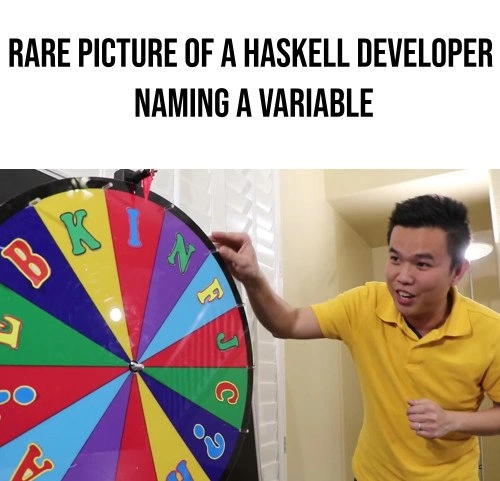
The meme’s caption shouts in bold text, “RARE PICTURE OF A HASKELL DEVELOPER NAMING A VARIABLE.” That tongue-in-cheek tone sets the stage: it’s supposedly a once-in-a-blue-moon sight to catch a Haskell programmer in the act of naming anything! In the image, our Haskell dev stands next to a big Wheel-of-Fortune style spinner covered in bright letters, as if deciding a variable name is literally a game of chance. This lands as humor because anyone who’s peeked at idiomatic Haskell code knows how true it feels – Haskellers often use ridiculously short, cryptic names (sometimes just one letter), or they avoid naming variables altogether. Seeing him spin a giant wheel of letters 🎡 to pick his next identifier perfectly exaggerates that habit.

Why do Haskell folks end up with such terse names? Well, naming things is notoriously hard in programming – so much so that there’s a classic joke about it:

“There are only two hard things in Computer Science: cache invalidation and naming things.”
— Phil Karlton (humorously, some add a third hard thing: off-by-one errors)

Rather than wrestling with long descriptive identifiers, Haskell culture often sidesteps the issue by leaning into abstraction and brevity. If you can write a function without naming intermediate values, why not do it? Many functional programmers value conciseness and trust that the strong static types and composition will make the code’s intent clear enough. It’s a double-edged sword: on one hand, fewer names can mean less clutter – on the other hand, when everything is named f, g, x, or y, it can feel like you’re reading algebra or an inside joke instead of straightforward code.

We’ve all seen code where a variable like data or temp tells us nothing meaningful. Haskell just takes that minimalism to the extreme. For example, Haskell code often leans on very short names:

f = (+ 1)             -- f is a function that adds 1
xs = [1,2,3]          -- xs is a list of numbers
result = map f xs     -- apply f to each element of xs

Everything here is incredibly terse: f for a function, xs to denote a list (plural of “x” by convention), and result is just as generic as it sounds. Meanwhile, in a more verbose style, say Python, one might write the equivalent as:

numbers = [1, 2, 3]
def add_one(n):
    return n + 1

result = [add_one(element) for element in numbers]  # descriptive names: add_one, element, numbers

Here we explicitly named things add_one, element, numbers for clarity. The Haskell version relies on context and familiarity with functional idioms to convey meaning, whereas the Python snippet spells everything out. This contrast highlights how Haskell’s brevity can be powerful yet puzzling: it’s impressive to pack logic into so few symbols, but it also means you’re leaning on the reader to decipher a lot from very little.

And that’s exactly what the meme is poking fun at. It turns the act of picking a variable name into a random lottery. This resonates with experienced devs because we’ve all been in scenarios where a colleague (or we ourselves) chose one-letter variable names that made sense in the moment but became a headache for others later. In Haskell, this tendency is amplified by a few factors:

  • Point-free style: Haskellers often write pipelines of functions without explicitly naming the data that flows through. Great for avoiding the “naming things” problem initially… but when you revisit that code, you may have to mentally assign names to follow what’s happening.
  • Mathematical conventions: The language’s lineage in math and logic means a lot of code looks like concise math notation. Mathematicians use single letters all the time (think f(x), n, y). Haskell code inherited that flavor – which is elegant to insiders but can be as impenetrable as a calculus formula to the uninitiated.
  • Generic abstractions: Haskell encourages writing very generic, reusable code. When a function works for any type or scenario, coming up with a specific, concrete name is tricky. So devs default to ultra-generic placeholders like a or t for type variables, and similarly terse names in function bodies. It’s as if, the more powerful and abstract the code, the less need there is felt to give it a descriptive name.

From a code quality standpoint, this is both a strength and a weakness. Concise code with fewer extraneous names can be beautiful and focused. But if you push it too far, you get what looks like a heap of one-letter puzzle pieces. Debugging or extending such code can be a challenge: you might find yourself reverse-engineering what each single-letter stands for. It’s a common trope that Haskell code can devolve into “line noise” – a term usually reserved for overly terse or symbolic code (like someone swatted a fly on the keyboard and out came a program).

The humor here is that the Haskell dev in the meme has essentially thrown up his hands and said, “Meaningful names? Meh, I’ll let fate decide!” It’s a tongue-in-cheek acknowledgment that in Haskell’s world, choosing a variable name is often the least of your worries – in fact, it sometimes feels like an afterthought. Seasoned Haskell programmers chuckle because they’ve been on both sides of this. They’ve delighted in writing a whole algorithm with nothing but composition and single-letter parameters, and they’ve also experienced the pain of untangling someone else’s code that does the same. The meme tickles that common experience. It playfully exaggerates a real language quirk: when naming things gets hard, Haskell devs just spin the proverbial wheel and pick an $x$.

Level 4: Combinator Roulette

At the deepest level, this meme hints at some pretty deep functional programming theory. In Haskell (and its theoretical foundation, the lambda calculus), variable names are largely arbitrary placeholders. In fact, in pure lambda calculus two functions are considered equivalent if they only differ by the names of their bound variables – a concept called alpha equivalence (renaming a function’s parameter doesn’t change its behavior). For example:

$$ \lambda x., x + 1 ;\equiv; \lambda y., y + 1 $$

Both of these expressions represent the same underlying function (adding 1 to the input) – the specific letter (x versus y) doesn’t matter. Just like you could call your loop index i or j or k without changing what it does, a Haskell function’s outcome doesn’t depend on whether you named the argument x or spun a wheel to call it k. The meme’s wheel-of-letters gag is a playful nod to this principle: any letter will do!

Haskell as a language is heavily influenced by academic foundations where naming values is optional. Ever heard of combinatory logic? It’s a system developed by mathematicians Moses Schönfinkel and Haskell Curry (yes, Haskell is named after Curry) that eliminates the need for explicit variables using combinator functions. Those mysterious letters on that wheel – like B, K, and I – aren’t random at all. They correspond to famous combinators:

  • B (Bluebird) stands for function composition – essentially Haskell’s (.) operator, which glues two functions together.
  • K (Kestrel) is the “constant” combinator – in Haskell you know it as const, a function that ignores its second argument and always returns the first.
  • I (Identity) is exactly the identity function id – it returns its argument unchanged.

Combinators like B, K, I (and others like S, C, etc.) let you build complex computations without naming any intermediate variables. The fact that the wheel in the meme has big single letters is like a wink at how combinators are denoted by single letters in theory. It’s as if the Haskell developer is literally spinning the wheel of combinators to decide which function to apply next, embracing a very abstract, point-free mindset.

Speaking of point-free style (also called tacit programming): this is a Haskell idiom where you define functions without explicitly mentioning their arguments. Instead of writing f x = g (h x) + 1, a point-free version could be f = (g . h) . (+1). Here we use the composition operator (.) to connect functions g and h and build a new function, and we never mention the input x at all. This technique comes straight from combinatory logic – you use high-level combinators to avoid introducing a named “point” (argument). It’s powerful and can make code very concise, but it turns reasoning about the code into a sort of equation-solving exercise since you have to infer what the missing variables would have been. No surprise that point-free Haskell code can look like abstract math to the untrained eye!

Haskell’s strong Hindley–Milner type inference also encourages minimal naming. The compiler can deduce the type and purpose of expressions from context, so developers often rely on that rather than lengthy variable names or comments. If xs is a list of integers and you see sum xs, the compiler knows exactly what xs is (a list of numbers) just by how it’s used. This static analysis acts like a safety net, making it less risky to use generic names like xs or n, because any mix-up in meaning would be caught by a type error. Essentially, Haskell’s type system is so informative that the code can afford to be terse – every one-letter variable is backed by a well-defined type and role.

At this theoretical height, the meme is highlighting a core truth: the actual names of variables don’t fundamentally matter to the computation. You could rename every variable in a Haskell program to random letters, and as long as you kept the positions and roles the same, it would run exactly the same. This “rare picture” joke takes that idea to an absurd extreme, portraying a dev who treats naming as a literal game of chance. It’s funny because it’s grounded in reality (Haskell code really can feel like it uses arbitrary letters), yet it’s obviously exaggerated. The humor comes from recognizing the grain of truth in the absurd: in a language built on lambda calculus and combinators, choosing x versus y truly is as inconsequential as a spin of the roulette wheel.

Description

A two-part meme. The top section contains white background with black, capitalized text that reads, "RARE PICTURE OF A HASKELL DEVELOPER NAMING A VARIABLE". The bottom section is an image of an enthusiastic man in a yellow polo shirt spinning a colorful game show-style wheel filled with single capital letters like B, K, I, N, F, and J. The joke satirizes a common stereotype in the programming community that developers using functional languages like Haskell prefer to use terse, single-letter variable names (e.g., 'f', 'x', 'm') rather than more descriptive ones. This practice is often attributed to the mathematical roots of functional programming, where single letters are common placeholders. The meme humorously suggests that the choice of these single letters is as random as spinning a wheel, a concept that resonates with senior developers who have encountered or debated different variable naming conventions across various programming paradigms
Comments

8
Anonymous ★ Top Pick In Haskell, a long variable name is anything that doesn't fit in a single cache line, including the type signature
  1. Anonymous ★ Top Pick

    In Haskell, a long variable name is anything that doesn't fit in a single cache line, including the type signature

  2. Anonymous

    Wheel of Fortune: Haskell edition - spin for a random consonant, alpha-rename whatever it shadows, and trust the type checker to divine your intent while future you greps hopelessly for “k” in a 12-layer monad stack

  3. Anonymous

    After 15 years of explaining to junior devs why 'xs' is perfectly clear in context and that 'f . g . h' is more elegant than 'processUserInputAndValidateAndTransform', you realize the real monad was the single-letter variables we accumulated along the way

  4. Anonymous

    The wheel is actually unnecessary - any experienced Haskell developer knows the answer is always 'f', 'x', or 'a'. Bonus points if you chain them into 'fmap f xs' where nobody, including your future self, will remember what 'f' transforms or what 'xs' contains. It's not obfuscation; it's 'embracing mathematical elegance' and 'letting the type system do the documentation.' Meanwhile, the rest of us are left reading code that looks like someone spilled alphabet soup on a keyboard, wondering if 'm >>= k' is profound wisdom or a cry for help

  5. Anonymous

    Haskell variable naming: where 'let k = spinWheel' finally makes type inference a game of chance

  6. Anonymous

    Wheel lands on “f”? Perfect - eta-reduce to point-free, let type inference erase the variable, and declare that naming was a side effect

  7. Anonymous

    Haskell naming algorithm: if x is taken, try xs; if that’s taken, spin the wheel, lowercase the result (constructors are uppercase), and let the type signature explain everything

  8. @obemenko 5y

    I hope it won't be a question mark

Use J and K for navigation