Haskell dev discovers code can ship, experiences immediate existential crisis
Why is this FunctionalProgramming meme funny?
Level 1: Baking a Real Cake
Imagine a kid who absolutely loves reading cookbooks and studying recipes, but they’ve never actually baked a cake. Every day, this kid reads about the science of baking – how ingredients mix, what temperature makes the best fluffiness – treating it like a fun puzzle or game. They get really, really good at understanding recipes on paper. Now picture someone comes along and says, “You know, you can use all that knowledge to bake a real cake that people can eat.” And the kid goes, “Wait... you can actually do that?!” Their eyes go wide, they put their hand over their mouth, totally shocked. They’re amazed and maybe a little worried – because suddenly all those recipe books aren’t just for fun, they’re for making something in real life! That surprise and a bit of panic they feel? That’s exactly the feeling this meme is showing, but with programming.
In the meme, the Haskell programmer is like that kid. Haskell is like the recipe book filled with super fancy, perfect recipes (the code is very elegant and pure). The programmer has been happily playing in that world, treating programming like a neat puzzle. When they discover programming can create a “product”, it’s like the kid realizing a cake can come out of the oven and not just live in a book. It’s a funny, “Oh wow!” moment. The chess guy holding his head in disbelief is just a really dramatic way to show how mind-blown that programmer feels. It’s humorous because, of course, most people know from the start that we cook to make food and we program to make useful apps or programs. But seeing someone act astonished at that obvious fact is silly and that’s why we chuckle. It’s like watching a brilliant wizard who studied spells for years suddenly realizing, “Wait, my spells can actually help people in the village?!” – a playful twist where the genius has a basic epiphany. The meme makes us laugh and maybe remember not to lose sight of the real-world reasons we do things, whether it’s baking cakes or coding apps.
Level 2: Pure Functions vs Revenue
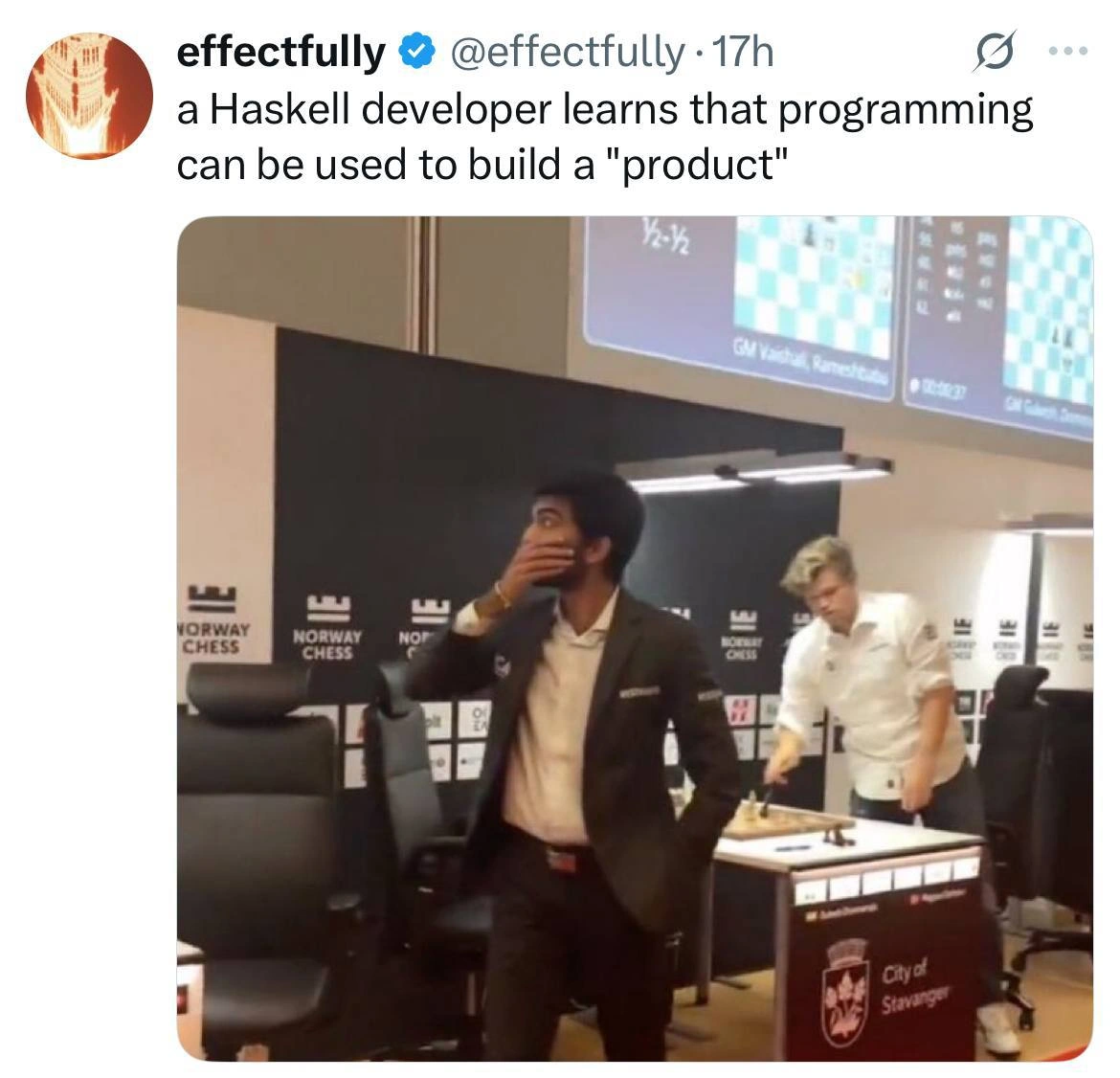
Let’s break this meme down in simpler terms. First, what are we looking at? It’s essentially a tweet joking about a Haskell programmer suddenly realizing that programming isn’t just a theoretical exercise – it’s actually used to make real products that people use. The picture attached shows a chess player in a fancy tournament looking completely shocked, which the meme uses as a visual metaphor for the programmer’s reaction. Now, why is this funny to developers? To understand that, we need to know a bit about Haskell and the culture around it.
Haskell is a programming language, but it’s not your everyday, run-of-the-mill programming language. It’s a poster child for what we call functional programming. In functional programming (FP for short), code is written in a way that emphasizes mathematical functions. One key concept is the pure function. A pure function is kind of magical: if you give it the same input, it will always give you the same output, and it won’t cause any side effects. “No side effects” means it won’t do anything else behind the scenes like modifying a global variable, printing to the screen, or writing to a file. It just takes input and returns output, nothing more. This is great for reasoning about code – it’s very predictable, like a formula. For example, a pure function might be something like square(x) = x * x. Whatever number you feed into square, it just gives back the number times itself. It won’t suddenly print a log message or change some setting elsewhere in the program.
Haskell enforces this purity pretty strictly. If you want to do things that involve side effects – say, read a user's input, or print a result to the console, or fetch data from the internet – you have to use special structures (here’s that fancy word) called monads. Monads are an advanced concept (often considered a bit mind-bending for beginners) that essentially allow Haskell to handle real-world actions while pretending everything is still a pure function. Think of a monad as a wrapper or a context that says, “Okay, inside here we might do something effectful, but we’ll contain it neatly.” It’s a clever trick: it lets Haskell stay true to its mathematical neatness, by isolating the messy parts of computing (like I/O, state changes, etc.) inside these monadic wrappers. The result? Haskell programs can be very robust and easy to test, because the majority of the code is pure and behaves like math. But the trade-off is that Haskell can feel abstract and academic, especially to newcomers or developers from more conventional languages. You see a lot of <$> and >>= operators and terms like Maybe, Either, Functor, and monad, and it can feel like you’re back in math class. In fact, many people first encounter Haskell in a university setting, and it has a reputation of being the language of programming language enthusiasts and researchers. This is why you’ll hear jokes about the “Haskell ivory tower” – an ivory tower meaning a place where brilliant minds contemplate lofty ideas, sometimes without practical considerations.
Now, on the other side of this meme’s coin, we have the idea of a “product”. In everyday tech talk, a product is a complete piece of software that’s meant for end users or customers. For example, Microsoft Word is a product, Facebook’s app is a product, the game Minecraft is a product. It’s something you can deliver, sell, or deploy for people to use. Usually, products solve a problem or fulfill a need (even if that need is just “I’m bored, entertain me” in the case of games). Building a product typically involves a lot more than just writing a clever algorithm. It means considering user experience, reliability, marketing, monetization (making money from it), and maintenance. When someone says “product-market fit,” they’re talking about how well a product satisfies the demands of the market – basically, whether people actually want it and will use it (and pay for it, if it’s commercial).
So why is it funny to say “a Haskell developer learns that programming can be used to build a ‘product’”? The joke here is playing on a stereotype: that some Haskell developers (or by extension, very academic-minded coders) are so used to treating programming like a theoretical playground – solving puzzles, writing perfect code with no bugs – that they forget the real-world purpose of programming is often to create useful applications. It’s an exaggeration, of course. Real Haskell developers know you can build products; there have been successful projects in Haskell. But it’s true that the Haskell community often focuses more on the purity and correctness of code than, say, churning out the next startup MVP (Minimum Viable Product). In contrast, if you look at, say, a typical JavaScript developer in a startup, they’re often concerned with getting things working end-to-end quickly. They might not care if the code has some quirks or isn’t the most elegant solution, as long as they can launch the website or app and people can start using it. The measure of success in that environment is user satisfaction or hitting a growth metric, not whether the code follows a particular theoretical principle.
The meme’s chess image wonderfully captures the emotional punchline. Imagine a chess genius who has studied every strategy (just like a Haskell dev might study every algorithm or type law) suddenly encountering a move or an outcome he never considered. In the picture, the player has this “What on earth just happened?!” expression, hand over mouth, eyes wide. For context, in a chess match such a reaction could mean the player didn’t expect the game to end the way it did – maybe an unbelievable draw or loss happened. The meme leverages that feeling: The Haskell developer is similarly gobsmacked to discover something obvious to outsiders – that code isn’t written just for its own sake, but to make something for users. His world has been kind of narrow (just the chessboard of code elegance), and now someone opened a door to a much larger world beyond (the marketplace of software products). It’s like a eureka moment flipped on its head – instead of joyous discovery, it’s comedic shock.
To put it into a relatable scenario: Think of a computer science student who’s done lots of programming assignments. They might write a program to sort a list or to implement a game logic, but it’s all for a grade or for learning, not for real users. Then they graduate and join a software company. In the first team meeting, the product manager says, “We need to add a feature that lets users upload photos, and it should be done by the end of the month because competitors have it too. How can we do it quickly and make sure it’s easy to use?” Now, this new developer might be taken aback. They’re thinking, “Wait, we’re not going to spend two months refining the perfect algorithm? We’re not aiming for a theoretical optimum solution? We just... make something that works and iterate on it?” That mindset shift can be jolting. In fact, many of us have experienced that learning curve from school (where correctness and completeness are paramount) to industry (where delivery and speed often take precedence). The meme is riffing on that, but dialing it up by using Haskell – the poster child for academic elegance – and implying this dev never even considered the idea of delivering a product until now. That’s the comedic exaggeration.
Now, Haskell and the functional programming community do sometimes face good-natured ribbing from other developers. This falls under what you might call language wars or paradigm wars. It’s mostly friendly: one community jokes about another’s quirks. For instance, Haskell folks might tease Python developers for runtime errors due to dynamic typing (“if only you had a type system, you’d catch that bug!”), and Python folks might tease Haskell devs that they spend so long proving their code correct that they never actually release anything useful (“while you were proving a theorem, I already deployed the app”). Of course, these are jokes and stereotypes – the reality is there are productive Haskell systems and there are plenty of buggy Python scripts – but humor often lives in the land of stereotypes. This meme firmly plants its flag there. It’s basically a cartoonish portrayal of a dev community’s stereotype: the Haskell enthusiast as an academic who forgot about the real world.
Let’s also talk about the “existential crisis” mentioned in the title of the meme. An existential crisis is a big, deep moment of questioning the meaning of one’s life or work. In the context of this meme, the Haskell dev’s existential crisis is, “Oh no, I’ve dedicated myself to this beautiful bubble of code and now I realize it’s supposed to serve something bigger – what have I been doing?!” It’s played for laughs, but maybe you can empathize a bit. If you’ve ever been super invested in a hobby or a niche skill and then stepped back and thought, “How does this fit into the bigger picture?”, you know the mix of confusion and revelation that comes with that. The meme nails that feeling in a comic way.
To sum it up, this meme is funny to developers because it contrasts two extremes: coding as a pure intellectual pursuit vs. coding as a means to an end (building a product). It highlights a cultural divide in a lighthearted way. Even if you’re a newcomer to programming, you might recognize these archetypes: the perfectionist coder who wants everything just right, and the hustling coder who just wants to make something people can use. The Haskell dev represents the first archetype taken to an extreme (since Haskell is about as perfectionist as it gets with code), and the idea of a “product” represents the second. When the two collide, it’s like oil meeting water – or rather, it’s like our chess master suddenly realizing he’s not playing the game he thought he was. And that surprised look? That’s the punchline we can all laugh at, precisely because on some level, we’ve seen a bit of ourselves or our peers in that situation. It’s exaggeration with a kernel of truth, which is the recipe for great tech satire.
Level 3: Monads Meet Market Fit
This meme lands especially well with seasoned developers because it satirizes a familiar scenario: the brilliant programmer who’s so deep in solving abstract problems that they momentarily forget the actual point of software. The tweet text – “a Haskell developer learns that programming can be used to build a ‘product’” – sets the stage with a tongue-in-cheek tone. The implication is that this Haskell dev has been happily hacking away in an academic vacuum, and only now, perhaps late in their career, has someone pointed out, “You know we’re trying to ship something people will use, right?” The shock on his face says it all.
The image chosen amplifies the joke. It’s a scene from a professional chess tournament (Norway Chess, as the branding shows) where a grandmaster stands up, hand over mouth, eyes wide in disbelief. In the background, another player (in fact, the world champion Magnus Carlsen casually resetting pieces) looks nonchalant. The scoreboard reading “½–½” indicates the game was a draw. It’s a dramatic moment: in chess, a draw against a much higher-rated opponent can feel like a surreal victory for the underdog. The meme compares the Haskell developer to that stunned grandmaster. He’s essentially a genius in one arena (like the grandmaster at the chessboard of type theory), but he’s just now encountering an unexpected outcome – that all those elegant moves might serve an external goal. The ½–½ score subtly underscores a stalemate: the intellectual beauty of code versus the practical demands of product development might need to meet halfway. It’s as if theoretical purity and real-world needs have been sparring to a draw all this time.
For experienced developers, this scenario is hilariously relatable because many have seen a version of it in real life. Perhaps you’ve worked with a colleague who was an academic or a true-believer in some paradigm (be it Haskell, Lisp, Prolog, you name it). They might spend days chasing the perfect generalization or implementing a fancy pattern – say, turning everything into a combinator or insisting on a new abstraction for every little operation. Meanwhile, the project manager is frowning at the empty deploy pipeline, asking when the feature will be ready for customers. The humor here comes from that disconnect: the Haskell dev is in an “ivory tower” (a term often used to describe when someone is disconnected from practical realities, i.e., haskell_ivory_tower in the tags), and suddenly the tower’s walls come crumbling down.
On an industry level, this meme pokes fun at how different dev communities prioritize different things. The Haskell/functional programming community famously prioritizes correctness, purity, and abstract beauty. There’s a badge of honor in writing code that is provably sound — for instance, using advanced type system features to ensure at compile time that certain bugs are impossible. They might joke about monads and functors the way other devs joke about coffee – it's that ingrained in their culture. In contrast, startup culture or mainstream development teams often prioritize speed, iterating on user feedback, and yes, making money (revenue, growth, etc.). It’s pure functions vs. revenue. One side might say, “Does the code adhere to Category Theory laws?” while the other side asks, “Does the app have enough users and a viable business model?” When these worlds collide, you get the kind of wide-eyed, “Is this even allowed?!” reaction depicted in the meme.
The tweet’s wording puts “product” in quotes, hinting at a bit of sarcasm. It’s as if the word product is alien in the Haskell developer’s vocabulary – something they’ve heard whispered in distant lands of enterprise startups. To someone who has been living in code kata and academic papers, the idea of a “product” might indeed sound almost profane. (A product? You mean this code is supposed to escape the REPL and… actually do something in the wild? Gasp! 🤯) This is comedic exaggeration, of course. In reality, plenty of Haskell devs build real systems – from fintech trading platforms to web servers. But the stereotype exists for a reason. Haskell has a bit of a reputation: it’s powerful and beautiful, but often deemed impractical for mainstream use. It became a running joke that Haskell was the best language to write code that never leaves the lab, while more “boring” languages (like Java, JavaScript, or Python) were out there cranking out popular apps and making money. This meme leans into that stereotype hard for laughs.
From a senior developer’s perspective, this also touches on the eternal reality check in software engineering: elegance is great, but delivered value is greater. There’s an old saying that fits perfectly:
“In theory, theory and practice are the same. In practice, they’re not.”
We all strive for clean architecture, zero bugs, and clever algorithms – and those are worthy goals. But seasoned engineers know that perfect code which never ships is valueless, whereas slightly flawed code that reaches users can be life-changing (or at least job-saving!). The Haskell expert in the meme is experiencing that epiphany as an earth-shattering event. It’s funny because many of us have had milder versions of this epiphany. Maybe it was the first time you had to drop a beloved design pattern to meet a deadline, or when you realized that writing a one-off script to fix data for a client was better than spending a week designing an elaborate data pipeline from scratch. That Oh... moment in the image – hand on forehead, eyes gazing into the distance – that’s exactly how it feels.
Let’s break down the contrast at play here in a more structured way. The meme essentially contrasts a “Haskell mindset” with a “Product mindset”:
| Haskell Mindset (Ivory Tower) | Product Mindset (Real World) |
|---|---|
| Pursues elegance and mathematical purity in code. | Pursues features that customers want ASAP. |
| All functions ideally pure (no side effects, ever). | Side effects everywhere if they solve the problem (logging, network calls, you name it). |
| Loves abstractions like monads, functors, and fancy types. | Loves solutions that deliver value quickly, even if the code is a bit ugly. |
| Measures success by correctness proofs and lack of bugs. | Measures success by user satisfaction and revenue (even if a few bugs pop up). |
| Tends to ask: "Is it theoretically sound?" | Tends to ask: "Does it solve the user’s problem?" |
The table might be a playful oversimplification, but any senior dev reading it will likely chuckle and nod. We’ve all been on projects where these two columns struggle to reconcile. The meme zeros in on that moment of reconciliation – the realization by the “Ivory Tower” side that the “Real World” side exists and actually calls the shots for software that isn’t just a research experiment.
We should also acknowledge the meta-humor here. The tweet comes from @effectfully, which itself sounds like a pun on Haskell’s approach to side effects (in Haskell, you handle side effects very effect-fully through constructs like the IO monad or newer effect systems). It’s likely someone deeply familiar with the functional programming community making an affectionate joke at their own expense. The functional programming crowd, especially in languages like Haskell, OCaml, or Lisp, often have this self-awareness. They know others tease them for not shipping products, and they play along. In fact, this makes the meme even funnier for those in the know: it’s not an outsider poking fun, it’s an inside joke. When an Haskell dev themselves jokes, “Hey, maybe we should, uh, deliver something?”, it carries a grain of truth wrapped in spicy irony.
The dev community aspect is key. Every language community has its in-jokes and its stereotypes. The meme’s popularity stems from the broader “language wars” and paradigm debates. Object-oriented folks might rib functional folks for their abstractions; functional folks might tease OOP folks for their design patterns and verbosity. Here, the functional camp (Haskell in particular) is mockingly portrayed as oblivious to the idea of a deliverable product. It’s a bit like imagining a master chess theorist who wrote books on chess strategies being shocked that, hey, chess can actually be played as a sport with championships and prize money! Of course they know that – but the exaggeration lands because of the grain of truth: Haskell is more often taught in universities and discussed in papers than seen in your everyday mobile app.
For a senior developer, there’s also a hint of “we’ve been here before”. The history of computing is full of brilliant technologies that struggled to find commercial footing. Lisp in the 1980s AI boom is one example – amazing language, ahead of its time, but hard to turn into wide-spread products back then. Haskell, since its inception in the late 1980s as a standardized functional language, followed a trajectory mostly in academia and niche industries. Only in the 2010s did it start creeping into certain startups or companies (like fintech and data analysis) for production use. So when we see a Haskell dev “learning” that programming can build a product, it’s winking at that history. It’s as if this poor dev has been happily iterating over lazy infinite lists and crafting monads, and missed the memo that Python and JavaScript developers have been out there churning out web apps, games, and SaaS platforms.
Ultimately, the meme is humorous but not mean-spirited. It doesn’t say “Haskell is bad” – it says “Haha, imagine if someone got so into Haskell’s theoretical beauty that they momentarily forgot the world outside.” It invites us, as experienced engineers, to laugh at ourselves a bit. Many of us have had “academic coder shock” at one point – maybe coming out of college, maybe after a stint focusing on a pet open-source project – when we step into a setting where shipping trumps everything. The meme’s extreme depiction (the chess grandmaster’s existential reaction) is what makes it funny and shareable. It captures an emotion that’s usually internal and subtle and blows it up to meme-worthy proportions.
And let’s be honest: even in day-to-day work, we’ve all seen tickets or features that made us put our head in our hands, much like that chess player, realizing “We really have to do it this ugly way because of the deadline?” or “All that refactoring, and the user can’t tell any difference, can they?” This meme flips that situation: “All this gorgeous code, and you mean to tell me the user doesn’t care unless it becomes a product?” It’s the same coin, opposite sides. That’s why it hits home across experience levels. Senior devs chuckle because they’ve balanced on that tightrope between idealism and pragmatism for years. They know the truth lies somewhere in the middle: the best developers harness theory and deliver value. But watching someone discover that truth with such drama – that’s pure comedic gold in the developer world.
Level 4: Monads vs Monetization
At the highest levels of abstraction, this meme highlights a clash between pure computer science theory and pragmatic product development. In the Haskell world, much of programming is treated as rigorous mathematics. Haskell’s design is rooted in the lambda calculus and category theory – it’s a language where you can prove properties of your code as if you were writing a math paper. For example, Haskell embraces pure functions (functions that have no side effects and always produce the same output given the same input) and esoteric abstractions like monads to handle effects. A monad is famously described in academic jest as "a monoid in the category of endofunctors." In simpler terms, it's a high-level construct that lets you sequence computations (like handling I/O, state, or errors) without breaking purity. This is the sort of concept Haskell developers revel in – it’s elegant, composable, and comes straight from math.
However, a running program with perfect monadic design isn’t automatically a successful product. Here enters the other side: monetization and product-market fit. These belong to the realm of business and real-world utility – messy arenas that care nothing for lambda elegance. No theorem in the Hindley–Milner type system can guarantee that users will love your app or that it will generate revenue. There’s no magical Control.Monad.MarketFit you can import to transform impeccably typed code into a profitable venture. This fundamental disconnect is at the heart of the meme’s humor. It playfully exposes the cognitive dissonance when a developer steeped in theory confronts the reality that code isn’t written in a vacuum – it’s written to solve real problems for real people (and hopefully make money or impact).
Consider that a Haskell expert might spend weeks proving that their compiler optimization or custom type class is correct and cannot produce a runtime error. Meanwhile, a startup across the street is pushing out a quick-and-dirty feature in a day to meet a market demand, even if the code occasionally crashes logs a few errors. The Haskellian ideal lives in a world of formal proofs and guarantees, somewhat akin to a grandmaster meticulously analyzing an endgame on a chessboard. The existential crisis comes when that grandmaster realizes the game being played outside the ivory tower has completely different rules – rules like move fast and break things, or better done than perfect. The meme exaggerates that moment of realization to comical effect, but it’s tapping into a real tension: the difference between programming as a pure intellectual pursuit and programming as a tool to build something of value. In theoretical computer science, every output can be derived, predicted, and reasoned about. In the real world, outcomes like user adoption or market success are far more chaotic – you might say they’re non-deterministic from the code’s point of view.
This high-level joke resonates because it’s a reversal of what one might expect. We usually assume programmers know their code is meant to run in the world. Haskell folks certainly know this too – but the stereotype (played up for laughs) is that they sometimes act as if code quality and mathematical purity are ends in themselves. When that mindset collides with the stark question, “Does it ship and make money?”, it’s like a cold splash of reality. Fundamentally, the meme is nodding to the truism that even the most beautifully architected software means little until it’s delivering value to someone. It humorously pits monads (a jewel of Haskell’s theoretical crown) against monetization (the lifeblood of software business), highlighting that those two worlds often speak entirely different languages. The result? A kind of stunned bewilderment – just like our chess grandmaster in the image, suddenly realizing the elegant game on the board has real stakes off the board.
Description
Screenshot of a tweet from the verified account “effectfully @effectfully · 17h”. The tweet text reads: “a Haskell developer learns that programming can be used to build a "product"”. Below the tweet is a paused video from a professional chess hall. In the foreground, a formally dressed player walks away from the board, hand on forehead in utter disbelief; in the background another player casually resets pieces. Branded panels read “NORWAY CHESS” and a digital scoreboard above shows “½-½”. The meme humorously compares the stunned chess grandmaster to a Haskell programmer suddenly realizing that code isn’t just for elegant type systems but for shipping real-world deliverables. It pokes fun at the functional-programming community’s academic leanings versus the hard reality of product-market fit
Comments
25Comment deleted
Looks like he just learned the IO monad can include quarterly earnings
After years of perfecting monad transformers and proving type safety theorems, discovering that the PM wants a CRUD app with a deadline is like finding out your carefully crafted Hindley-Milner type system just needs to validate email addresses and store them in Postgres
The moment a Haskell developer realizes that monads aren't just for academic papers and that 'IO' doesn't stand for 'Intellectually Obscure' but actually means you can ship software that interacts with the real world - complete with side effects, users, and revenue. It's the functional programming equivalent of discovering your PhD thesis could have been a startup all along, except now you have to explain to stakeholders why lazy evaluation is actually a feature, not a work ethic assessment
Nothing breaks a type theorist faster than learning ‘product’ isn’t cartesian but the IO one with customers, deadlines, and SLAs
Haskell dev discovers 'product' means shippable software, not just × in category theory
Product‑market fit isn’t a functor - you have to bind IO(Product) and handle the side effect known as “customers”
to be honest xmonad is built in haskell Comment deleted
it is actually widely used in legal tech Comment deleted
who would need that? Comment deleted
just use online tools Comment deleted
I added ur gif Comment deleted
I mean. I just woke up. you can transform it locally. but why would you need haskell to use pandoc? Comment deleted
this doesn't make any sense Comment deleted
okay, that doesn't matter, still, what does it have to do with legal tech? Comment deleted
tbf I've never seen any type of person more averse to technology than legal personnel Comment deleted
imagine same structure replacing many problems of regular programming https://philipnilsson.github.io/Badness10k/escaping-hell-with-monads/ Comment deleted
ahm. okay. they can use whatever tool they want to do so that's not what I meant by legal tech. it's just doc format transformation. nothing to do with legal tech, it's a common task for various fields of topics Comment deleted
yes, but doc transformation isn't specific to legal tech Comment deleted
it's like to say — legal tech is pdf reader because they need to read pdfs. well. that's for sure but unspecific to this field only. so it's just a bad pic of task Comment deleted
what we do is: there are frameworks built in haskell to define a set of rules, which are needed be achieved by a set of laws and / or beureaucratic routines, they can be highly complex to program in explicit greedy style it's much easier to define them just one by one as they are, and let haskell wire them together in a correct order and flow. with that you can i. E. generate complex ready made documents and applications which would take months of work if done by hand, or calculate what else is needed to achieve a specific outcome. Comment deleted
That's great insight tbh, thank you Comment deleted
So you're using Haskell to model rules declaratively, let the compiler handle flow, and auto generate complex outputs? That’s clean AF. Bureaucracy as code, but make it elegant Comment deleted
don't write bad code write good code I get it gal. thanks for advice, without you, I could never come to this idea. Comment deleted
You are welcome Comment deleted
This reminds me a big bug that maintainer of Darcs said it cannot be fixed because of complexity. Comment deleted