From Hogwarts-level C++ basics to John-Wick-grade template firefights
Why is this Languages meme funny?
Level 1: Wizard School vs Real Battle
Imagine you just learned a little magic trick at a wizard school. You’re wearing your robe, holding your wand, and you managed to make a feather float – hooray! You feel proud, like “I’m a real wizard now!” 😊 But the next day, you walk into a big castle hall and suddenly a dragon appears breathing fire 😱. And not just a dragon – there are trolls, giant spiders, and maybe a dark wizard all at once, coming at you! That’s what the joke in this picture is like, but for writing computer programs.
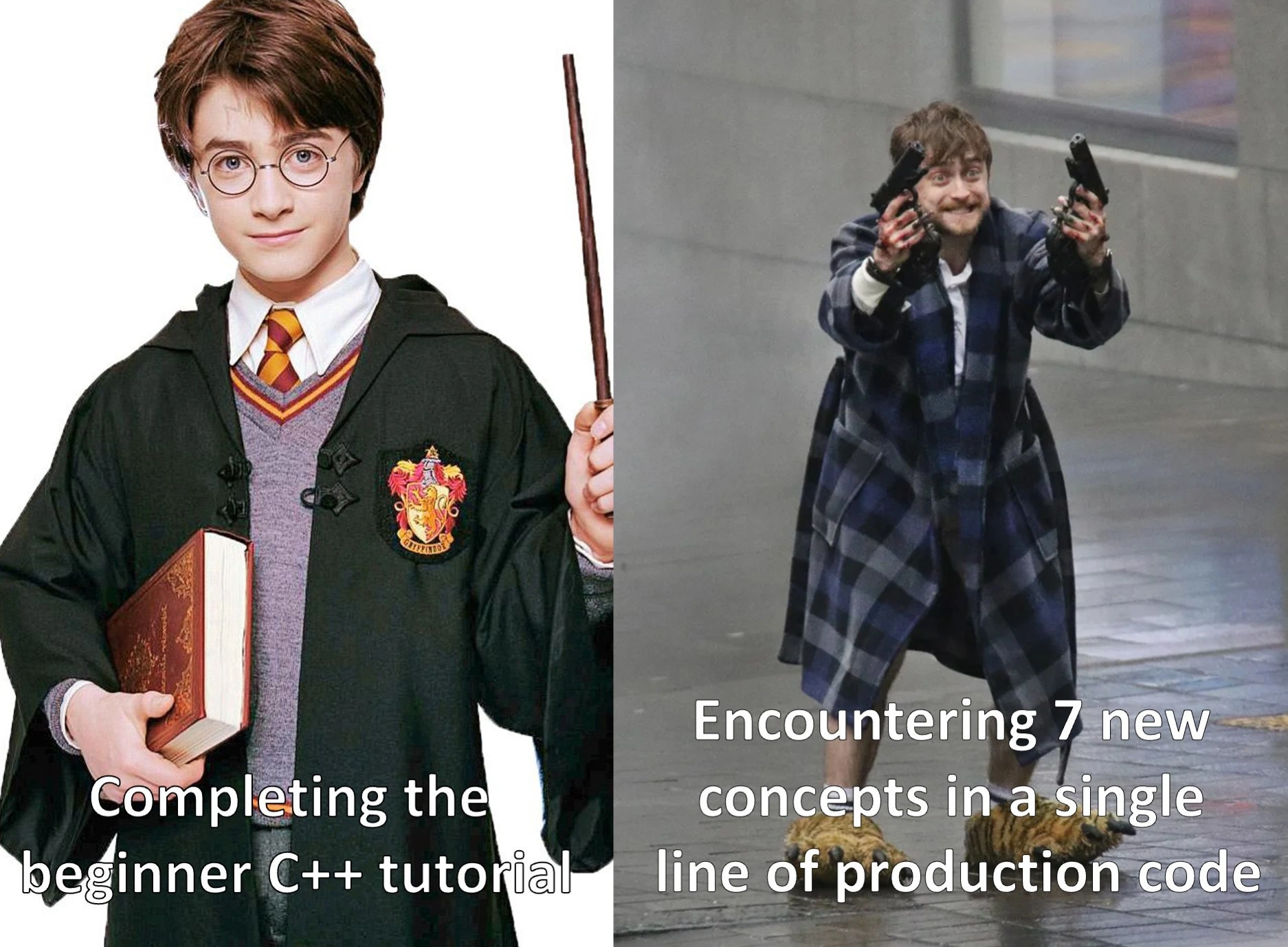
In the left side of the picture, the young wizard (that’s Harry Potter as a student) represents a beginner who just finished a basic C++ coding lesson. It’s like finishing your first magic class. You have a book of spells (the C++ tutorial) and a wand (your new coding skills). You feel confident and magical because you accomplished something small.
Now the right side shows the same person but in a totally different scene: he’s all messy, with a wild look in his eyes, holding two things that look like black sticks (they’re actually guns in an action movie). He’s in the middle of chaos, like a big battle in a city with smoke around. This represents the shock of a new programmer seeing real professional code for the first time. It’s like our young wizard was suddenly dropped into a fierce fight without warning. The phrase below says “Encountering 7 new concepts in a single line of production code.” That means the person looked at one line of real code and found seven things they had never seen before – equivalent to facing seven enemies at once when they only ever practiced with one friendly partner in class.
Why is this funny? Because it’s a big exaggeration that feels true emotionally. It’s like when you study for a test with simple examples, then the actual test has a question that looks totally different and much harder. In everyday terms, imagine you just learned how to ride a bike with training wheels in a quiet backyard (that’s the left side). You feel great riding around. But then someone puts you in a big city street during rush hour on a super fast motorcycle (that’s the right side). You’d be terrified and totally unprepared! The jump in difficulty is huge.
So, the meme is comparing those feelings: first feeling confident and safe because you did a small thing successfully, then feeling overwhelmed and panicked when you see how complicated the real world can be. For programmers, “beginner C++ tutorial” is the safe practice, and “production code” is the crazy real world where everything is moving fast and there’s so much going on in just one line. It’s funny to people who write code because we’ve all been through that moment of “Uh oh, I have no idea what I’m looking at now!”. We laugh at the meme because we remember being that wide-eyed beginner and then quickly realizing we had a lot more to learn – just like a young wizard who thought he was ready, and then finds himself in the middle of an epic battle way above his skill level.
Level 2: Spellbook Glossary
Let’s break down what’s happening in that dramatic “single line of production code” by defining some C++ magic terms. This is the part where we decode the spellbook so even a newer wizard (developer) can follow along:
C++ Templates: Think of templates as generic recipes for code. Instead of writing the same function or class for every data type, you write a template that works for any type, and the compiler creates the specific version you need on the fly. For example,
std::vector<int>andstd::vector<std::string>are two instances of thestd::vector<T>template. Templates allow one piece of code to handle many types (like a spell that adapts to its target). Beginners might not encounter templates until later in their learning, so seeingSomething<OtherThing< int >>is like reading nested parentheses in an algebra equation for the first time – intimidating!Template Metaprogramming: This is using templates not just for containers or functions, but to compute things at compile time. It’s an advanced trick where templates call other templates recursively. For example, you could write a template
Factorial<5>that computes 5! (120) during compilation. It’s as if you asked your spellbook to solve a puzzle before you even cast the spell. This technique can produce extremely efficient programs, but a newcomer seeingstd::conditional< (N>0), std::integral_constant<int, N*Factorial<N-1>::value>, std::integral_constant<int,1> >::type::value(a crazy way to compute factorial) would likely scream “What is this sorcery?!” Because, well, it literally is sorcery from their perspective.Standard Library & Iterators: C++ comes with a rich Standard Library (often called the STL, though strictly that term refers to the older “Standard Template Library” part of it). It provides ready-made classes and functions for common tasks – containers like
std::vector, algorithms likestd::sort, and so on. These are heavily template-based (to work with any data type). Iterators are a central concept: they are objects that behave like pointers to elements in containers. If you have astd::vector<int> numbers;, thennumbers.begin()returns an iterator to the first element. Beginners might have used simple loops (for(int i=0; i<n; ++i)) instead of iterators. So encounteringcontainer.begin()andcontainer.end()is a new concept: it’s how C++ generalizes loops to work with any container type. Iterators allow algorithms likestd::find,std::accumulateto work with any collection. They’re powerful, but if you’ve never seen one,it != container.end()looks slightly cryptic compared to a normal index loop.Lambdas (Anonymous Functions): A lambda is an inline, nameless function you can define on the spot, often to pass into an algorithm. It’s denoted by
[]()syntax. For example,std::for_each(v.begin(), v.end(), [](int &x){ x *= 2; });goes through a vector and doubles each value. The[](){}syntax can look like punctuation soup if you haven’t learned it. Lambdas were introduced in C++11, so a basic tutorial that doesn’t cover modern C++ might not mention them. Suddenly seeing[](const Foo& f){ return f.isValid(); }inside a function call is, for a newcomer, like someone switched the incantation language mid-spell. It’s a compact way to define behavior, but requires understanding functions as first-class objects.auto (Type Deduction): The
autokeyword in C++ lets the compiler deduce the type of a variable. Instead of writingstd::vector<int>::iterator it = numbers.begin();, we can just writeauto it = numbers.begin();. For new programmers,autocan be confusing because it hides the type (especially if that type is a complicated template likestd::unordered_map<std::string, std::vector<MyType>>::iterator– who wants to write that out?). Tutorials often teach explicit types first. When a beginner first seesauto, they might think it’s a magical variable type, but it’s really the compiler figuring out the correct type behind the scenes. In the meme’s context,automight be one of the seven concepts: it’s handy, but it might be the first time our young wizard sees the compiler doing that kind of inference.Smart Pointers and Memory Management: A production C++ codebase likely uses smart pointers like
std::unique_ptr<T>orstd::shared_ptr<T>instead of raw pointers (T*). Smart pointers automatically manage memory (callingdeletefor you) to prevent leaks – this technique is called RAII (Resource Acquisition Is Initialization, an idiom where resource cleanup is tied to object lifespan). If our newbie’s tutorial only coverednewanddeleteor didn’t mention memory at all, stumbling onstd::unique_ptr<MyClass> obj = std::make_unique<MyClass>(args);is overwhelming. That line has the template classunique_ptr, a factory function templatestd::make_unique(which itself uses type deduction to create the right pointer), and the concept of move semantics (make_unique returns a temporary that is moved into obj). It’s a lot! The poor beginner might only recognize there’s aMyClassbeing constructed, but why all the extraunique_ptr< >andstd::move? It’s like discovering your simple levitation charm now involves a whole apparatus of safety nets and harnesses – important for real work, but not obvious in training.Overloaded Operators and Syntax Tricks: C++ allows operators (like
+,<<,*, etc.) to be overloaded for user-defined types. That means code can define whata * bmeans for some classMatrix, or what<<does for output streams (std::cout << xis actually calling an overloadedoperator<<function under the hood). A newbie might have only used<<withstd::coutto print text without knowing it’s an overload. In production code, they might seeobject1 * object2and not realize that’s a custom matrix multiplication, or see something likeitr->second(ifitris an iterator to amap,->secondaccesses the value part of key-value pair) and be puzzled by->second(there’s no.secondin their beginner class notes!). Similarly, the scope resolutionstd::and otherNamespace::Typenotations can make a single line look like it’s littered with colons and arrows. It’s a far cry from the clean, simple examples in tutorials.Production Code: When we say “production code”, we just mean the real code that runs in actual applications or systems, as opposed to sample code written for learning or demo. Production code has different priorities: it values performance, maintainability, and handling edge cases. As a result, it might use advanced language features to optimize things. It also accumulates odd quirks and patterns over time (sometimes due to backward compatibility or previous developers’ styles). For instance, you might encounter macro definitions (
#define) that toggle certain features on/off for different platforms, or template specializations that handle specific types differently for efficiency. To a newcomer, stumbling on a#ifdef DEBUG ... #endifblock in the middle of code, or a template specialization liketemplate<> struct hash<MyType> { ... };(to allow using MyType in anunordered_map) is completely new terrain. It’s as if the language itself expanded beyond what was taught in the introductory class.
All these concepts can indeed appear together in a real code snippet. Consider a single statement that uses a library function which is a template, passes a lambda to it, uses auto for type deduction, and maybe operates on a container of smart pointers. The line might not even be that long physically, but logically it’s dense. Here’s a somewhat packed example:
// Example of a densely packed C++ line (split for readability):
auto transformed = std::transform(vec.begin(), vec.end(), vec2.begin(),
[](const std::unique_ptr<Item>& ptr){ return ptr->value() * 2; });
In one go, this uses: auto (deduce the type of transformed), std::transform (a template algorithm from ), two iterators (vec.begin(), vec.end()), another iterator vec2.begin(), a lambda function [](const std::unique_ptr<Item>& ptr){ ... }, a smart pointer std::unique_ptr<Item> which we dereference with -> to call value(). If you’re fresh from a beginner tutorial, that single statement is massively packed compared to printing numbers in a loop. It’s like reading a whole paragraph in one breath.
The key takeaway for a junior developer: don’t panic when you see such code in the wild. Every seasoned C++ dev was once flummoxed by these things, too. The meme’s exaggeration is funny because it’s rooted in truth: no one is truly “John Wick” with C++ from day one. It takes practice and exposure. Each of those seven concepts (and more) will become clear with time, and one day you’ll read that gnarly line of code and nod, “Got it.” Remember, even the battle-hardened expert in the meme started as a first-year at Hogwarts. The journey from basic “Wingardium Leviosa” (levitation charm) to casting complex spells is the learning curve we all go through. In coding, that journey is challenging but also exciting – there’s always a new “spell” to learn. Keep that spellbook (documentation and reference guides) handy, and soon what looks like gibberish will become part of your vocabulary.
Level 3: Spellbooks vs Firefights
In this panel comparison, our intrepid C++ newbie (left side) has just finished a beginner’s tutorial – essentially their first year at Hogwarts. They’ve learned some basic C++ spells: declaring variables, using std::cout to print, writing simple class definitions, maybe a basic pointer or two. They feel like a wizarding prodigy wearing the robes (the meme even literally shows Harry Potter with his wand and book!). This is the confidence boost every learner gets after printing “Hello, World!” or completing a toy project – I’ve mastered the basics, how hard can the rest be? 🪄
Enter the right panel: reality hits like a John Wick action scene. The same actor (Daniel Radcliffe) is now battle-worn, wielding dual pistols in a chaotic urban warzone – an allegory for diving into a production C++ codebase. That single line of code he’s facing is jam-packed with unfamiliar constructs. It’s as if seven different magical creatures attacked at once. The joke lands because every developer who’s moved from toy examples to real-world projects has felt this. The learning curve of C++ isn’t a gentle slope; it’s more like a cliff that you don’t see until you’re dangling off the edge. One moment you’re a top-of-class student; the next, you’re Keanu Reeves in “Developer Matrix,” dodging template errors instead of bullets.
Why is that one line so intense? In a seasoned C++ codebase (especially one using modern C++11/C++14/C++17 features), developers pack a lot of functionality into succinct expressions for the sake of efficiency and clarity (for those who know the idioms). They use features like smart pointers (std::unique_ptr, std::shared_ptr), range-based for loops or STL algorithms, lambda expressions for inline callbacks, and templates for genericity. This leads to highly abstracted code. For example:
auto it = std::find_if(container.begin(), container.end(),
[](const Item& x){ return x.isValid(); });
A beginner might try to unpack this and find multiple new concepts: auto type deduction (the type of it is deduced by the compiler), the template function std::find_if (which they might not even know exists), iterators from the container, a lambda function as the search criteria, and references (const Item&) all in one statement. It feels like reading a whole chapter of a spellbook crammed into one line.
Many C++ juniors first encounter the infamous “arrow rain” of -> and :: and angle brackets <> in production code and go “What on earth is all this?!”. Perhaps that line is something like:
auto result = someMap[std::string("key")]->second->compute<std::vector<int>>(42);
In this contrived example, in just one expression we have:
- Using
operator[]on amaporunordered_map(templates + operator overloading), - Converting a string literal to
std::string, - Getting a pointer (
->) to an object (maybe a smart pointer, hence another->to call a method), - A method template
compute<std::vector<int>>specialization, - Passing a literal
42(which might invoke anintto some custom type conversion inside).
That’s multiple levels of indirection and template use. If you’ve only seen basic map usage or never saw a function template with an explicit <std::vector<int>> in your beginner course, you’d be as shocked as our meme’s right-side hero with guns blazing and a crazed expression. The humor is that the code might execute just fine, but comprehending it feels like surviving an ambush.
This meme is poking fun at developer experience (DX): the difference between tutorial knowledge and production reality. C++ is notorious for its language complexity and rich feature set — often called both a blessing and a curse. Newcomers usually start with simple examples: a vector of int here, a for loop there. But real codebases use advanced C++ to handle memory safely (smart pointers instead of raw new/delete), to write generic reusable code (templates and the STL instead of repetitive code), and to optimize (bitwise operations, move semantics, etc.).
So when a newbie encounters a single dense line in a mature codebase, it’s not just one new thing to learn — it’s seven new things all interwoven. The feeling is overwhelming. Developers find this funny because it’s so relatable. We’ve all been that wizard student thinking we’re ready, only to have production code shout “Expelliarmus!” and disarm us of our fragile confidence. It’s a comedic exaggeration: of course you wouldn’t literally go from Hogwarts to a gunfight overnight, but reading professional C++ for the first time sure feels like it.
There’s an element of shared trauma humor here too. Seasoned C++ devs have scars: maybe the 500-line template error messages that look like ancient hieroglyphs, or the times they spent hours debugging why std::move was needed to fix a compilation issue. Seeing this meme, the veterans chuckle remembering their own “I thought I knew C++… until I joined this project” moment. It’s the classic learning curve joke — one that happens to be particularly steep with C++.
Also, notice the Daniel Radcliffe casting in both frames. That’s deliberate: the meme-maker used the same actor to represent the before/after transformation. It’s a visual metaphor for the developer’s journey – from bright-eyed student (literally Harry Potter in school uniform) to bloodied survivor of an intense encounter (Radcliffe in a totally different movie role, looking unhinged with guns). For developers, the transformation isn’t physical, but mental: today you’re confidently waving a wand of “I printed my first polymorphic hello world,” tomorrow you’re frantically dual-wielding documentation and Stack Overflow just to parse a single line of your team’s code. It’s both humorous and a bit cathartic – we laugh because it’s true.
This dynamic also highlights a gap in learning and mentorship in our industry. The meme hints at a real issue: tutorials often sanitize examples to teach gently, whereas production code is written for efficiency and maintainability by experienced folks who assume context. Bridging that gap can feel like trial by fire (or by gunfire!). Ideally, one should gradually progress, but in reality many devs will have a story of being thrown into the deep end. Hence the right panel: it’s a baptism by fire (and brimstone and templated bullets). And guess what – after a few years in the field, you too might become the John Wick of C++: highly skilled, battle-tested, with a mental armory of language tricks that would baffle your past self. The meme’s charm is how it captures that “level 1 mage vs level 100 boss” contrast in a way only developers truly appreciate.
Level 4: Arcane Template Incantations
At the highest level of technical wizardry, C++ template metaprogramming is like casting spells that run during compile time. Seasoned C++ sorcerers leverage templates to generate code flexibly, achieving zero-cost abstractions – powerful structures with no runtime overhead. But this power comes with mind-bending complexity. A single line of modern C++ can invoke a whole coven of advanced concepts:
Templates within templates: You might see something like
std::map<std::string, std::vector<int>>. Here,std::mapandstd::vectorare both class templates (generic containers) and they’re nested. The compiler instantiates each template with specific types (std::string,int) - effectively code generation. It’s as if the code is writing new code for each type, analogous to a spell that expands into more spells.Template Metaprogramming: This is an esoteric art. C++ templates are Turing complete, meaning they can perform arbitrary computation while compiling. Developers have famously computed Fibonacci numbers, factorials, or even generated fractals at compile time using recursive templates. It’s as if the wizard (compiler) is doing complex calculations on your behalf before the program even runs. This is why reading a line of production C++ might feel like deciphering runes – the logic might be implicitly executed by the compiler.
SFINAE and Concepts: Deep in the grimoire of C++, there’s Substitution Failure Is Not An Error (SFINAE), a principle that allows one template overload to be chosen over another based on compile-time conditions. It’s like a conditional spell: if one incantation fails, another is tried, but quietly. Modern C++20 added Concepts (not the “concepts” in the meme text’s sense, but an actual language feature!) which act as constraints on templates – a bit like requiring a certain magical ingredient for a spell to work. These ensure that a template is only instantiated for types that meet certain criteria, giving clearer compile errors. For an uninitiated developer, encountering a line with
std::enable_if<..., T>::typeor atemplate<typename T> requires SomeConcept<T>can be utterly confounding – 7 new incantations in one breath.Compile-Time Duck Typing: C++ templates use a form of static polymorphism. Unlike dynamic polymorphism (virtual functions) taught in OOP 101, templates resolve which code to call at compile time. If you see something like
obj.doSomething()inside a template, the actual method invoked depends onobj’s type (determined when the template is instantiated). This is similar to duck typing (if it quacks like a duck…) but done by the compiler. It enables techniques like the Curiously Recurring Template Pattern (CRTP) where a base class template expects to be derived by a specific child class, enabling optimizations that newbies might mistake for black magic.STL Algorithms and Iterators: The Standard Template Library algorithms (like
std::for_each,std::transform,std::accumulate) are highly abstract. One line usingstd::accumulate(v.begin(), v.end(), 0, [](int a,int b){ return a+b; })involves template functions, function objects (the lambda), iterators (which might be pointer-like objects defined by templates), and possibly inlining optimizations. All those<angle brackets>and[]lambda syntax in one expression can feel like an incantation in Latin. Under the hood, the compiler is generating a specialized version ofstd::accumulatefor the exact lambda and container type. It unrolls into loops and pointer arithmetic as efficient as handwritten C – that’s the promise of C++ templates. However, understanding it requires comfort in multiple layers of abstraction at once.
In essence, production C++ isn’t just writing straightforward instructions; it’s often about metaprogramming – writing code that writes code. The meme humorously contrasts a novice who has learned a few basic spells (perhaps just simple loops, printf or std::cout, basic classes) with a battleground of advanced template sorcery. The right panel’s one-liner might hide traits classes, overload resolution, and constexpr logic. It’s the difference between a cute levitation charm and a multi-spell conjuration that summons an army of types at compile time. To the untrained eye, that one-liner looks* impossible – but to the compiler (and experienced mages in C++), it’s perfectly logical, just highly advanced. The humor (and horror) is that C++’s power lets experts compress enormous complexity into a terse “spell” – leaving the apprentice utterly stunned, wand in hand.
Description
The meme is split vertically into two panels. Left panel: a young wizard-school student in black robes (face blurred) proudly holds a spell book and a wand; white text below reads, "Completing the beginner C++ tutorial." Right panel: a battle-worn figure in a blue plaid coat (face blurred) points two pistols while standing in a smoke-filled urban street; white text below reads, "Encountering 7 new concepts in a single line of production code." The visual contrast highlights the naïve confidence gained from introductory material versus the overwhelming complexity of real-world C++ featuring templates, iterators, and metaprogramming tricks. Developers will relate to the sharp jump in cognitive load when moving from simple tutorials to dense production codebases

Comments
6Comment deleted
Finishing the tutorial hands you a wand; production C++ demands you dual-wield decltype(auto) and SFINAE while bullets labeled “ODR violation” fly past
That moment when you realize the senior dev who wrote this line wasn't showing off - they were just trying to meet the sprint deadline and this genuinely seemed like the cleanest solution at 2 AM
Ah yes, the classic C++ journey: you finish a tutorial feeling like you've mastered pointers and classes, then you encounter production code with `std::enable_if_t<std::is_convertible_v<T, U>>` combined with perfect forwarding, CRTP, and SFINAE - all in a single template declaration. Suddenly you're not just learning a language; you're deciphering an arcane spell that would make even Dumbledore reach for Stack Overflow. The real magic isn't the code working; it's understanding why the compiler accepted it in the first place
That “one simple C++ line” that ‘just constructs a thing’ quietly invokes ADL, SFINAE, move/forwarding, allocator_traits, and SBO - then only segfaults with -O3 and noexcept(false) in production
C++ career arc: from "cout << hello" to a one-liner that satisfies seven Concepts, trips ADL roulette, instantiates a small city of templates, and moves a unique_ptr through a coroutine - just to increment a counter
C++ production code: where one line packs SFINAE, perfect forwarding, ADL, and UB - because tutorials forgot to mention the dark arts combo