Skip to content
DevMeme
4765 of 7435
Trying to sleep while imagining Wi-Fi side-channel CPU backdoor espionage
Security Post #5220, on May 24, 2023 in TG

Trying to sleep while imagining Wi-Fi side-channel CPU backdoor espionage

Why is this Security meme funny?

Level 1: Monsters Under the Bed

Imagine you’re trying to fall asleep, but then you remember a scary story you heard. Maybe someone said, “Your Wi-Fi could be used like x-ray vision!” Now you’re lying there in the dark, eyes wide open, thinking your computer in the corner might be secretly looking at you or counting the people in your house. It’s like when little kids worry there’s a monster under the bed – you kind of know it’s not real, but it feels real when you’re alone at night. In this meme, the man can’t sleep because he’s spooked by an idea: that his own computer might be spying on him through invisible radio waves. It’s a funny exaggeration of how our imagination can run wild with high-tech fears. Just like a shadow on the wall can seem like a ghost to a kid, the Wi-Fi signals in the air seem like a sneaky spy tool to this guy. The joke is that the text says “How I sleep…” implying he sleeps soundly, but the picture shows him totally NOT sleeping. We laugh because we’ve all been there – worrying about something unlikely in the middle of the night, turning our own devices into imaginary boogeymen. In simple terms, it’s a high-tech version of a bedtime scary story, and the poor guy in the meme is wide awake because of it!

Level 2: Antenna Anxiety

Let’s break down what’s going on in simpler terms, and why it sounds scary (yet a bit funny):

  • CPU (Central Processing Unit): This is the main brain of your computer. It runs programs and does calculations. If your computer were a person, the CPU is like the thinker or decision-maker.
  • Wi-Fi Chip: A small piece of hardware in your computer that handles Wi-Fi communication (wireless internet). It uses radio waves (invisible energy waves, kind of like light but lower frequency) to send data to and from your router. The antenna (often hidden in your laptop’s frame) broadcasts and receives these signals.
  • Hardware Backdoor: Think of a backdoor as a secret entrance. In computer terms, a hardware backdoor means some part of the computer’s circuitry or firmware that can bypass normal security. It could be something intentionally built in (for remote tech support, for example) or something an attacker added in secretly. It’s like if someone hid a spare key to your house without telling you – if a bad guy finds it, they can get in without breaking the door.
  • Side-Channel Attack: This is a fancy term in security. Instead of attacking a system directly through the expected ways (like hacking a password), a side-channel attack looks at indirect clues. For example, measuring how much power a device uses, the sounds it makes, or the radio signals it emits to figure out what’s going on inside. It’s like figuring out someone is home not by seeing them, but by noticing their lights are on and music is playing. Those are side-channel hints.
  • Using Wi-Fi to Map a Room: Normally, Wi-Fi is just for communication — sending emails, loading websites, streaming videos. But because Wi-Fi uses radio waves, and radio waves bounce off walls and people, you could theoretically use it like a radar. Radar is what ships, planes, or bats use to see by sending out waves and analyzing the echo. With some clever techniques, if you control a Wi-Fi device at a low level, you might send signals and see how the environment changes the signal, thus guessing if there’s someone moving around or how many people are in a room. Real researchers have actually done experiments like this! (For instance, they’ve detected people breathing or walking in a room using just Wi-Fi signals.)

Now, put all those pieces together: The meme suggests your computer’s CPU might have a sneaky hidden program (the hardware backdoor) that takes over the Wi-Fi chip’s antenna and runs a kind of home radar. It would be mapping out your room and seeing how many people are there by analyzing Wi-Fi signal bounces. That’s a pretty wild idea, right? Most of us don’t think of our laptops as extra members of the household that count heads at night!

For someone newer to tech, this scenario sounds both absurd and a bit frightening. On the one hand, it's very unlikely that your PC is secretly doing this — it’s a big stretch of imagination. On the other hand, none of it is completely magic: CPUs do have hidden parts (for legitimate reasons usually), Wi-Fi is basically radio waves, and radio waves can reveal things about the environment. So it’s a mix of truth and exaggeration. It taps into common privacy concerns we all have these days: “Are my devices spying on me?” We put tape over our webcams, we double-check our microphone permissions on apps, and we hear news about smart TVs listening to conversations. This meme just pushes that worry to a new level: What if even the radio signals my computer sends could be used to spy on me?

The picture in the meme (the man wide awake in bed, looking terrified) perfectly captures how it feels when you suddenly start worrying about something like this. You’re supposed to be sleeping, but instead you’re imagining your own computer as an undercover agent. It’s an invasion of privacy fear turned into a joke. If you’ve ever had insomnia because you couldn’t stop thinking about some problem or fear, you’ll relate. Here the problem is super techy, almost like a ghost story for engineers. And that’s why it’s funny: it’s an over-the-top “what if?” that can only keep you awake if you know just enough tech to find it plausible.

In summary, the meme is explaining (in a joking way) that knowing about weird tech vulnerabilities can lead to sleepless nights. For a junior developer or someone learning about security, it’s also a light cautionary tale: the more you learn about how things can go wrong, the more you might worry. But it’s important to keep perspective. It’s good to be aware of security and data privacy issues, but maybe not so much that you can’t get some shut-eye!

Level 3: No Rest for the Paranoid

That caption – “How I sleep knowing my computer’s wifi chip can be used by my CPU’s hardware backdoor as an antenna to map my room and count the number of people in my house” – is dripping with irony. Spoiler: he’s not sleeping at all. Seasoned developers and security folks chuckle at this because it hits close to home. It’s a snapshot of security_paranoia_humor among techies: we joke about it, but we’ve been there. Maybe not exactly fearing a Wi-Fi radar spy, but lying awake after discovering some horrifying exploit or reading an article on how your gadgets might betray you.

This meme resonates especially with those deep in the Security or PrivacyConcerns space. It’s essentially a dude experiencing extreme hardware_backdoor_paranoia. And in tech circles, we’ve all heard something along these lines. Think about the revelations in the past decade: for example, finding out about secret laptop firmware (like Intel’s ME) that can ping the network even when your computer is “off”. Or learning that smartphone sensors (like accelerometers or gyroscopes) can be abused as microphones or to infer your PIN. Each time something like that comes out, a bunch of us collectively go, “Well, there goes my sleep tonight.” This meme is that feeling on steroids: it combines multiple scary ideas into one uber-nightmare scenario.

The humor works because it’s a perfect storm of threat modeling gone wild. The guy in the picture is wide-eyed at 3 AM, essentially living out the joke: “I tried to sleep, but then my brain said: what about that ultra-secret CPU bug that can see me through Wi-Fi?” For veteran engineers, it highlights a known dilemma: once you understand how a system works, you also understand how it might be attacked. The Wi-Fi chip that a normal person uses to check Twitter, a paranoid techie imagines being subverted into a surveillance tool. The CPU that should be crunching game graphics might secretly run spy code. It’s ridiculous, but not impossible, and that tiny plausibility is the itch in the brain.

Real-world precedent: we have no confirmed reports of CPUs actively mapping rooms via Wi-Fi (thankfully!). But the community has seen enough to nod knowingly. Who can forget the day they learned about the NSA’s secret “antenna farms” or the malware that infected hard drive firmware (so it could hide in a place you’d never check)? Or the infamous Bloomberg report (disputed, but legendary) claiming tiny spy chips were found on server motherboards. A senior dev remembers these stories and thinks, “Sure, 99.999% this is fiction… but that 0.001% keeps me staring at the ceiling.”

Another layer is the sheer helplessness of such a scenario, which the meme hints at. If your hardware is compromised at that low a level, what can you do? It’s below the radar of your antivirus, beyond the reach of operating system patches. This triggers a kind of fatalistic humor: the only solution is to don the tin-foil hat or yank the Wi-Fi card out. (And yes, some truly paranoid folks actually do physically remove or switch off components when not in use!). It's funny because it's extreme, but it's poking fun at the Privacy vs. convenience trade-off we live with. We love wireless connectivity, but that convenience opens theoretical doors for spying.

Consider how the same facts look through a normal lens versus a paranoid lens:

Normal Perspective 💤 Paranoid Perspective 😱
My CPU just runs my programs and games. My CPU might also be running a hidden spy program in the background.
My Wi-Fi chip gives me wireless internet. That Wi-Fi chip’s antenna could be an eyes and ears into my room.
Hardware features (like Intel ME) help tech support fix issues remotely. Hardware features like that could be a backdoor for someone to intrude on my system.
Wi-Fi signals are for network data. Wi-Fi signals could be repurposed to scan my home like radar and report what it finds.
I lock my doors and windows for security. I worry even with doors locked, my computer might be letting intruders in through invisible radio waves.

The table above highlights the meme’s exaggeration: it’s flipping everyday tech into spy thriller tech. As experienced devs, we laugh because we’ve all done that mental flip once or twice after reading hacker news. It’s a form of coping mechanism in the security community — we share over-the-top scenarios to lighten the mood about things that, deep down, do concern us.

So why is the guy in the meme so relatable to programmers and engineers? Because many of us have had “brain malware” at night: that persistent thought of “Did I misconfigure something? Is there a vulnerability I overlooked? What about that talk I saw on Wi-Fi signals being used for surveillance…” It might not be literally believing our CPU has a radar mode, but the vibe of sleep_deprivation_meme is real. We joke about it precisely because we value DataPrivacy and security so much that even imagining a breach can keep us up. It’s the classic infosec insomnia. The meme gets a knowing smirk from senior folks: Haha, I feel you — sometimes knowing how the sausage is made (or how the Wi-Fi can be hacked) makes it hard to sleep. And then we double-check that our laptop’s Wi-Fi is off before bed… you know, just in case. 😉

Level 4: TEMPESTuous Emanations

Deep in the realm of Security and Hardware, this meme touches on an almost sci-fi level exploit grounded in real tech principles. It’s riffing on the idea of electromagnetic side-channel attacks and covert surveillance. Essentially, we're talking about a computer’s CPU having a hidden hardware backdoor that can commandeer the Wi-Fi radio to perform indoor radar scanning. Sound crazy? It kind of is, yet it builds on real concepts.

Modern CPUs often include auxiliary microcontrollers (like Intel’s Management Engine or AMD's PSP) that run below the operating system. These are intended for remote management or DRM, but conspiracy-minded engineers worry they could hide backdoors. This hardware_backdoor_paranoia stems from the fact that these subsystems are closed-source and have direct access to memory and devices. If subverted, they could do things the main OS wouldn’t ever know about. That’s where the Wi-Fi chip comes in – a normally benign component that could, in theory, become a spy’s antenna under malicious control.

Wi-Fi operates by sending and receiving radio waves (per IEEE WiFiStandards like 802.11ac). Under the hood, any wireless chip is basically a software-configurable radio. According to physics (hello, Maxwell’s equations 👋), radio waves reflect off objects and people in an environment. This is the same principle radar uses to map a room or detect movement. Researchers in academia and industry have demonstrated it’s possible to analyze Wi-Fi signal disturbances to sense motion, detect breathing, or even count the number of people in a space. They do this by looking at things like Channel State Information (CSI) – fine-grained data about how the Wi-Fi signal propagates. Subtle changes in these signals can reveal if a human body is present or moving. It’s like echolocation: bats use sound; a cunning program could use Wi-Fi.

Now imagine a rogue process in your CPU’s hidden backdoor firmware leveraging this. It could send tailored Wi-Fi pulses and measure the echoes to perform side_channel_mapping of your room. This transforms your Wi-Fi antenna into a sort of SurveillanceTechnology device, a tech that ordinarily is used for communication now doubling as a sensor array. The meme victim’s mind is racing with this scenario: his computer might be silently pinging the room with radio waves to spy on his living space. It’s the invasion_of_privacy_fear taken to an extreme, crossing into almost James Bond territory. What makes it technically juicy (and nightmare-worthy) is that it’s plausible on a theoretical level. Not easy to pull off, certainly, but not against the laws of physics either.

For historical context, this paranoia isn’t born in a vacuum. The idea of machines betraying emanations is old: TEMPEST was a Cold War-era codename for NSA’s efforts to eavesdrop on electronic emissions (like reading what’s on a CRT monitor from radio leakage). Van Eck phreaking in the 1980s showed you could remotely capture what a computer monitor displays by just tuning into its electromagnetic noise. Fast forward: security researchers have used smartphones to detect vibrations in a room via radio signals, and drones with Wi-Fi sniffers to map Wi-Fi networks. So using a PC’s Wi-Fi to radar-scan a room is an imaginative mashup of these concepts. It’s taking known principles of side-channels (unintended information leaks) and covert channels (unexpected communication paths) to a dramatic zenith.

To a highly technical eye, the humor is that PrivacyConcerns here escalate to almost absurd levels, and yet they’re citing real scientific groundwork. The meme shines light on how an overactive ThreatModeling brain can connect the dots between disparate pieces of tech: a CPU backdoor (bad enough on its own) + a Wi-Fi radio (which we normally trust for Netflix and chill) = home radar spy system. The result? security_paranoia_humor gold, especially for those of us who’ve read one too many research papers about cunning exploits. In a world where Spectre and Meltdown (not to mention things like powerline eavesdropping, or ultrasonic cross-device tracking) went from tinfoil-hat talk to reality, it can feel like anything is possible. No wonder the guy in the image looks like he’s seen a ghost – or rather, a ghost in the Wi-Fi.

// Secret 3AM routine your paranoid brain imagines
activate_radio_antenna_mode();        // repurpose Wi-Fi chip as radar
signal = wifiChip.emitWaveform();     // send a Wi-Fi signal pulse
echo   = wifiChip.listenForEchoes();  // listen for reflections bouncing in room
people_count = analyzeSignal(echo);   // analyze the echo to count people
report_to_mothership(people_count);   // secretly transmit findings to spy server

Above is a tongue-in-cheek pseudocode of what our nightmare backdoor might be doing. It highlights how each piece comes together: turning on a hidden antenna mode, pinging the room, analyzing the echoes, and sending the data out via some covert channel (perhaps piggybacking on your network innocuously). It’s a spooky little snippet that our insomniac engineer can’t stop envisioning. The laws of physics (radio wave propagation) and the dark corners of computer architecture are colluding in his mind to create the ultimate boogeyman. Sleep_deprivation_meme material, indeed!

Description

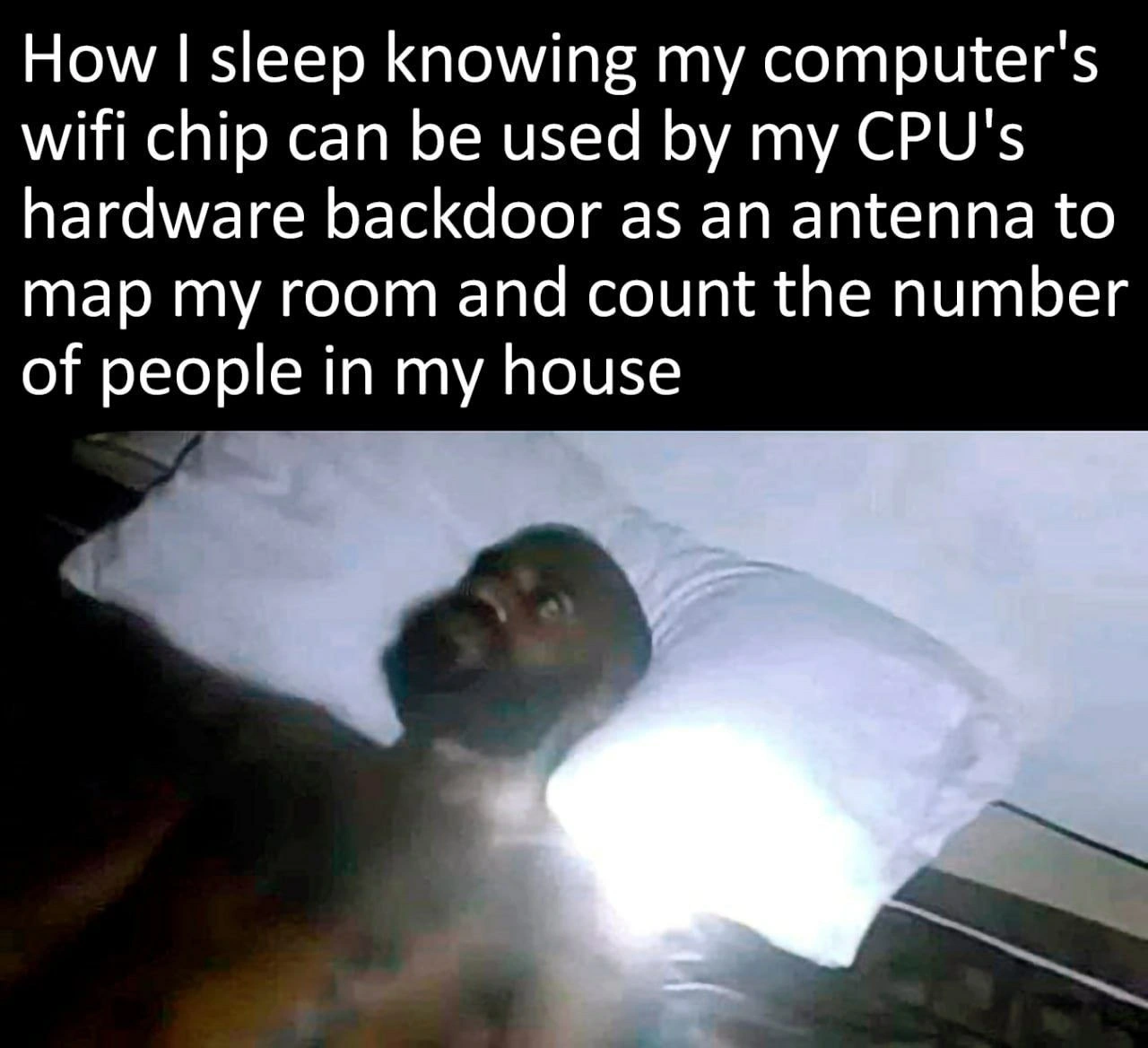
Meme with a solid black banner at the top containing white text: "How I sleep knowing my computer's wifi chip can be used by my CPU's hardware backdoor as an antenna to map my room and count the number of people in my house". Below the caption is a dim, grainy photo of a man lying shirtless on a bed, head on a white pillow, staring wide-eyed at the ceiling with an expression of terrified alertness; a bright light source near his torso highlights the uneasy scene. The humor comes from juxtaposing the word "sleep" with the obviously sleepless subject, poking fun at security-minded engineers who contemplate exotic side-channel attacks that repurpose radio emissions and undocumented CPU features for indoor radar. It references concerns about hardware backdoors, Wi-Fi signal analysis, and the broader anxiety around surveillance and privacy in modern computing hardware


Comments

12
Anonymous ★ Top Pick My threat model graduated from SQL injection to “microcode turns the Wi-Fi PHY into synthetic-aperture radar while I sleep” - and product still triages it as a P4
  1. Anonymous ★ Top Pick

    My threat model graduated from SQL injection to “microcode turns the Wi-Fi PHY into synthetic-aperture radar while I sleep” - and product still triages it as a P4

  2. Anonymous

    After 20 years in the industry, you realize the real backdoor was the friends Intel ME made along the way - and they're all counting your breathing patterns through WiFi channel state information while you debate whether to trust your TPM

  3. Anonymous

    This is the face of every security engineer who's read one too many papers on CPU microarchitectural vulnerabilities and now realizes their threat model includes their own hardware. Sure, you've hardened your software stack, implemented zero-trust architecture, and rotated all your secrets - but have you considered that your WiFi card might be moonlighting as a RADAR system for the IME? Sweet dreams are made of these: knowing that ring -3 has more privileges than your hypervisor, and there's literally nothing your kernel can do about it. At least when we had software backdoors, we could patch them. Now we're stuck wondering if our CPU is running a whole shadow OS we can't even audit, potentially turning every laptop into an inadvertent surveillance device. The real joke? This paranoia is actually somewhat justified, which is why none of us sleep well anymore

  4. Anonymous

    WiFi CSI + ME backdoor: your CPU's stealthy service mesh for home telemetry, no consent required

  5. Anonymous

    I sleep great - the OS is in S3 while Ring −3 uses the Wi‑Fi’s CSI to run occupancy analytics. Turns out my laptop ships with a nanny cam; I just don’t get root

  6. Anonymous

    Threat model update: less concerned about script kiddies, more about Intel ME commandeering the WiFi NIC for 802.11bf CSI and exporting people_in_house_total to Prometheus

  7. @ilovethicktights 3y

    MC RIDE?

  8. @Araalith 3y

    Hope is futile; no one will come.

  9. @electron_volt 3y

    They actually used a mesh of antennas in there

    1. @roped 3y

      idk, they used ai maybe

      1. @electron_volt 3y

        They had to set up 3 transmitter and 3 receiver antennas to get these pics https://arxiv.org/abs/2301.00250

  10. @callofvoid0 3y

    it is what fbi knows about you

Use J and K for navigation