Skip to content
DevMeme
4766 of 7435
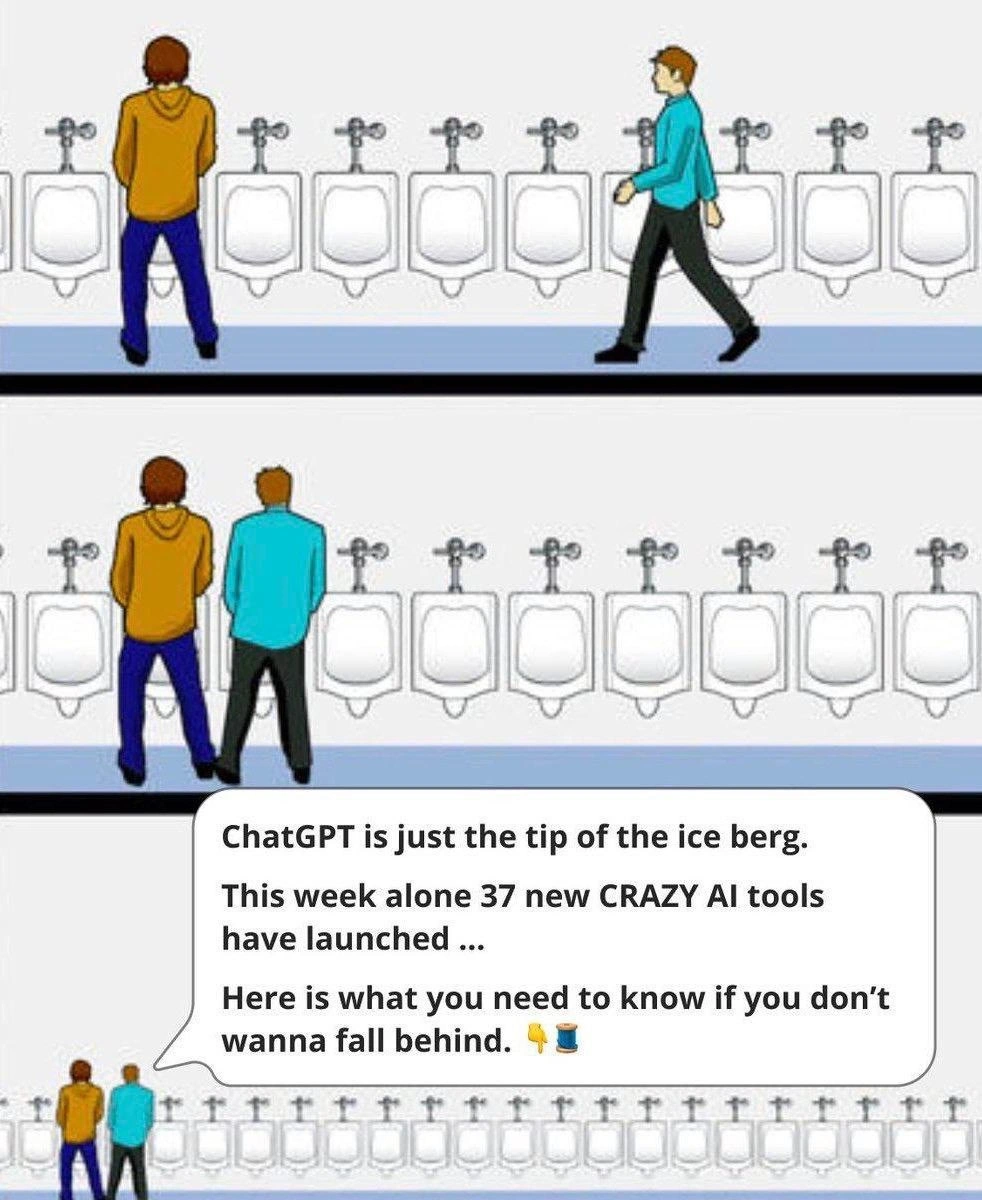
When the LinkedIn AI-guru chooses the urinal right beside you
AI ML Post #5221, on May 25, 2023 in TG

When the LinkedIn AI-guru chooses the urinal right beside you

Why is this AI ML meme funny?

Level 1: Too Close for Comfort

Imagine you’re sitting in a big, empty movie theater, and there are tons of free seats. You pick a nice spot with no one around. Then a stranger comes in, and instead of sitting far away, they plop down right next to you. Kinda weird, right? You’d probably think, “Um, hello… personal space?” Now picture that, but in a bathroom with side-by-side stalls or urinals – it’s even more uncomfortable! That’s what’s happening in this joke. One guy is minding his own business, and another guy unnecessarily stands super close when he doesn’t have to.

But there’s more: once this guy is uncomfortably close, he starts talking really loudly about something trendy – like if a kid from another class ran up to you at recess and started yelling, “Oh my gosh, did you know about these 37 new video games that came out this week?! If you don’t play them, you’ll be so behind everyone else!” He’s basically dumping a ton of info on you that you never asked for, at the worst possible time. It’s funny because it’s such odd behavior. Normally, people give strangers space and don’t act pushy about what they’re excited about, especially not in a bathroom!

So the meme is comparing that situation to what happens online with tech stuff. It’s saying these “AI gurus” (people who won’t stop talking about new Artificial Intelligence tools) are like that stranger with no boundaries. Just like you’d laugh and cringe if someone did that in real life, developers laugh (and cringe a little) when they see those posts online that feel way too in-your-face. In simple terms: the meme jokes that some folks on the internet are getting way too close for comfort, both literally (in the cartoon) and figuratively (flooding your social media feed). It’s funny and relatable because everybody just wants a little space and peace, whether we’re at a urinal or browsing our phone, and this guy just doesn’t get it.

Level 2: Urinal Etiquette 101

Let’s break down the elements of the meme in simpler terms, connecting each part to the developer world. The setting is a men’s restroom with a long row of urinals (those wall-mounted bathroom fixtures). There’s an unwritten rule among guys: if multiple urinals are free, don’t pick one immediately next to someone who’s already using one. You should leave at least one empty urinal of space as a buffer. This is basic personal space courtesy – nobody likes a stranger standing inches away if it’s avoidable. This social rule is so well-known that it’s often called “urinal etiquette.” It’s not taught formally, but most people just know it to avoid awkwardness. In fact, this exact restroom scenario is a classic bathroom_cartoon_format meme template used to joke about all kinds of topics where someone breaks a norm or boundary.

Now, in the first panel of the cartoon, we have a developer wearing a mustard-colored hoodie using one urinal. There are plenty of empty urinals on either side. In a normal situation, if another person walks in, they’d choose a spot a few urinals away to respect that unwritten etiquette. But in panel 2, we see a man in a teal shirt (the “LinkedIn AI guru” character) walking past all the open urinals and deliberately choosing the one right next to the hoodie-wearing developer. That immediately tells us, even before any text appears, that this guy is about to do something uncomfortable or inappropriate, because he’s ignoring a well-understood rule of spacing. It’s a physical analog for someone ignoring social norms online.

Now look at panel 3: both men are side by side, and the teal-shirt guru has a huge speech bubble over both of them. This bubble contains the guru’s monologue, which is basically a parody of those LinkedIn/Twitter thread posts that have been everywhere in the tech world lately. The bubble says:

“ChatGPT is just the tip of the iceberg. This week alone 37 new CRAZY AI tools have launched … Here is what you need to know if you don’t wanna fall behind. 👇🧵”

Let’s unpack that. ChatGPT is an AI chatbot developed by OpenAI that became extremely popular around late 2022 and early 2023. It’s based on a type of AI model called a Large Language Model (LLM), which means it was trained on tons of text data and can generate human-like text. When the guru says “ChatGPT is just the tip of the iceberg,” he’s using a common phrase that means “there’s a lot more beyond what you first see.” The implication is that ChatGPT, despite all the buzz around it, is only a small part of a much larger wave of AI advancements.

Next, he claims “This week alone 37 new CRAZY AI tools have launched …” The number 37 is probably just picked to sound impressively large (and kind of oddly specific for effect). It suggests that literally dozens of new AI tools or products came out in the span of a single week. In the real tech industry, there have been many AI tool announcements weekly in 2023 – new startups, new features from big companies, open-source projects, etc. The guru calling them “CRAZY” (in all caps) is him hyping them up, implying these tools are amazingly innovative or shocking. It’s a bit of an exaggeration, as often many tools aren’t that crazy or useful, but he wants to create excitement and urgency.

Finally, he says “Here is what you need to know if you don’t wanna fall behind.” That line is crucial: it’s basically telling the reader “Pay attention or you’ll be left out.” This is a direct play on FOMO – Fear of Missing Out. In developer terms, falling behind means not keeping your skills or knowledge up to date. And with how fast AI and tech trends move, a lot of developers genuinely worry about staying current. The guru is exploiting that worry. By saying “here is what you need to know,” he’s positioning himself as someone who has done the research on those 37 new tools and will now generously share the highlights (usually in a thread format, indicated by the 👇 emoji pointing down and the 🧵 spool of thread emoji). Those symbols are commonly used on Twitter and LinkedIn to signal “a thread of posts follows, read the replies for all the info.”

So the text in the bubble is a parody of a very specific social media post style: the “thread guru” post. This style became extremely common in the AI community and tech LinkedIn around the time ChatGPT blew up. Self-proclaimed AI experts (or sometimes just opportunistic content creators looking for engagement) would post long threads like “10 AI tools you must know” or “5 ways AI will change programming forever” with a similar tone. They often start with a dramatic hook (“just the tip of the iceberg”, “you have no idea what’s coming”, etc.) and then enumerate tools or tips, each in a separate comment or tweet. The 👇🧵 basically shouts: “I have a lot more to say, click here and keep reading!”

Now, why is this portrayed as someone standing at the urinal next to you? Because in both cases, it feels like an intrusion into your space. Just like in real life you’d be uncomfortable with a person unnecessarily standing elbow-to-elbow with you in a restroom, on social media many developers feel uncomfortable or annoyed when these kinds of posts pop up aggressively. It’s like browsing your feed peacefully and then suddenly someone you didn’t ask to hear from is right there, loudly telling you what you “must” do or know. There’s a sense of “Dude, give me some space!”

In developer communities, especially on Twitter and LinkedIn, there’s a bit of fatigue with these AI hype threads. A lot of devs share the meme’s sentiment that these “gurus” are ignoring the normal community etiquette in a rush to get attention. Normal etiquette online might include things like not fear-mongering, not overselling, and considering whether your audience actually wants this content. The guru in the meme clearly doesn’t care – he’s portrayed as someone so oblivious that he’ll break even obvious real-world etiquette, which implies he definitely would break online etiquette by spamming people’s feeds. It’s a comical exaggeration that equates bad social media manners with bad bathroom manners.

To a junior developer or someone new to these terms, let’s clarify a few definitions being referenced:

  • AI (Artificial Intelligence): This refers to software and algorithms designed to perform tasks that normally require human intelligence, like understanding language, recognizing patterns, making decisions, etc. ML (Machine Learning) is a subset of AI where programs improve at tasks by learning from data. Tools like ChatGPT are part of AI/ML, specifically language models. The meme falls under AIHumor because it’s poking fun at the hype around these technologies.
  • ChatGPT: A specific AI model (chatbot) that can have conversations and answer questions. It became very popular because it can generate coherent, contextually relevant responses, even writing code or essays. It’s often cited as a breakthrough showing how powerful modern AI can be. So everyone’s talking about it. When the meme says “tip of the iceberg,” it insinuates that beyond ChatGPT, there’s a whole iceberg of other AI tools that people are excited (or anxious) about.
  • Hype: In tech, hype means excessive publicity or exaggerated claims about how amazing a technology is. IndustryTrends_Hype refers to how certain trends (like AI in 2023) get hyped up – people say it will revolutionize everything, and you see news about it constantly. The AIHypeCycle is often illustrated by how initial excitement can be followed by disappointment once reality sets in. Right now, we’re in a phase of extreme excitement for AI, and some folks are definitely over-hyping things.
  • FOMO (Fear of Missing Out): This is a feeling everyone can get – the anxiety that you’re missing something important that others know or have. In developer circles, FOMO might be like “Oh no, everyone’s learning this new technology, and I’m not – will I fall behind in my career?” The guru in the meme explicitly triggers FOMO by saying “if you don’t want to fall behind.” It’s essentially telling devs, “learn this or be left in the dust.” That’s a powerful motivator, even if it’s done in a pushy way.
  • LinkedIn AI-guru / thread_bro: This is a bit of a sarcastic term. On social networks like LinkedIn (and Twitter), certain users have gained notoriety for writing threads—a series of posts one after another—usually offering advice, lists, or “hot takes.” A “thread bro” (or “LinkedIn guru”) often has a formula: grab attention with a bold claim, then list a bunch of points or resources. They often do this to gain followers or likes, not necessarily to provide genuinely useful content. They tend to jump on whatever trend is hot (AI right now) and position themselves as experts. The meme specifically calls out the linkedin_thread_guru vibe. It’s basically an archetype of someone who might start a post with “🚨 Developers, Huge AI news! 🚨” and then go on and on. Some of these threads can be useful, but many are shallow or repetitive, and seeing too many of them gets annoying for a lot of developers.
  • Social feed: This is your timeline on a platform like LinkedIn, Twitter, etc., where posts from people you follow (and sometimes posts they liked) appear. A social_feed_invasion is when content you find irritating or irrelevant appears there. Maybe a connection of yours liked the guru’s post, so now it’s in your face. It feels like someone walking uninvited into your conversation space.

So, tying it together: the meme humorously equates “not leaving an empty urinal gap” with “not leaving people alone about the latest AI tools.” Both are a breach of expected etiquette. It’s saying that thread-spammers pushing AI FOMO are as oblivious and cringey as someone who ignores obvious personal-space rules. You wouldn’t want a stranger shoulder-to-shoulder with you in a restroom when there are plenty of other spots. Likewise, developers are expressing that they don’t want every random “AI guru” crowding their social media space with hype, especially delivered in such a thread_bro_energy style.

For a junior dev trying to understand why this resonates: imagine you just started learning programming, and suddenly your LinkedIn is flooded with posts yelling “Learn these 10 AI libraries NOW or you’ll be irrelevant!” It can feel overwhelming and honestly a bit spammy. The meme is a lighthearted way for experienced devs to commiserate and say, “Yeah, those posts make us uncomfortable too – it’s not just you.” It uses the extreme, silly scenario of a loudmouth next to you at a urinal to drive the point home. In other words: unwelcome advice, even if about a hot topic like AI, can be as off-putting as unwelcome proximity.

And in case you haven’t encountered the urinal spacing concept before, here’s a quick “algorithm” (just for fun) that most guys implicitly follow in that situation:

  • Rule 1: If other urinals are free, choose one that maximizes distance from any person already there. (e.g., if someone’s at urinal 3 and there are 10 urinals, you might go to 10 or 1 to be far away.)
  • Rule 2: Never take a spot right next to someone if a more spaced-out option exists. That’s just weird.
  • Rule 3: If the bathroom is crowded and you must take an adjacent spot, it can’t be helped — but you definitely don’t start making conversation beyond maybe a polite nod.

The man in teal violates Rule 2 blatantly (he had many open choices!). And then he egregiously violates what we might call “bathroom small-talk protocol” by launching into a pitch about AI tools. In reality, people generally avoid talking to strangers in restrooms beyond maybe a hello. So that’s another layer of why this scenario is absurdly funny: he’s doing the exact opposite of what normal social behavior dictates, both in terms of space and conversation content. It’s the perfect storm of awkwardness.

Lastly, consider the DevCommunities angle: Developers often share memes like this as a form of bonding over shared experiences. Right now, one shared experience is “Too many AI announcement threads.” It’s become a bit of a running joke. This meme is essentially a friendly PSA wrapped in humor: “Hey, if you’re thinking of being that guy who constantly posts AI hype threads… don’t be. It’s as unwelcome as cornering someone in the bathroom to talk their ear off.” Conversely, for those feeling overwhelmed by all the AI hype, it’s a way to laugh at the situation: “Haha, yes, it does feel like I can’t even get a moment’s peace from AI news!”

The combination of AIHype and a personal_space_meme is what makes this meme clever. It connects a very modern digital annoyance (AI FOMO threads) with a universally understood real-world faux pas (crowding someone who’s peeing). Even if you didn’t fully get the AI angle, the image of someone talking about “37 new crazy tools” at a urinal is so out-of-place that it’s instantly recognizable as a joke about being overzealous and inconsiderate. But as a developer, you likely do get the AI angle, and that makes it even more satisfying because it’s our inside joke about the current state of tech social media.

Level 3: Personal Space Invaders

At the highest level of abstraction, this meme is a commentary on AI hype intrusion in developer communities. It juxtaposes an unwritten rule of real-life courtesy (urinal spacing etiquette) with the unwritten rules of online discourse (not spamming people's feeds with hype). The humor comes from the absurdity of a self-proclaimed LinkedIn AI guru barging in where they clearly don’t belong – both literally, by choosing the urinal right next to someone, and figuratively, by flooding your social feed with exaggerated AI claims.

In the first panel, a developer in a hoodie is peacefully minding his own business (like a dev scrolling quietly through their feed or enjoying some downtime). Enter the guy in the teal shirt – representing the overly eager “AI thought leader” we often see on social media – who picks the urinal immediately adjacent, breaking classic urinal etiquette. This is a perfect visual metaphor for how these AI hype-mongers behave online: they invade your personal space despite there being plenty of room (or many other topics and voices) to occupy. It’s an in-your-face intrusion, much like those breathless AI announcement threads that seem to find you even when you’re trying to avoid them.

By the second panel, the teal-shirted “guru” has posted up right next to the unsuspecting dev. In the digital world, this is akin to an algorithmic feed invasion – you didn’t ask for this content, but the LinkedIn/Twitter algorithm decided to drop it right beside you because it’s trending. The meme brilliantly captures that awkward violation of social norms: just as normal folks would cringe at a stranger sidling up at an adjacent urinal without cause, developers cringe at the thread_bro_energy of someone who plops a long AI hype thread in their timeline. The developer’s face isn’t shown, but we can imagine the side-eye: “Really, dude? Of all the empty space, you choose here?” Similarly, devs on Twitter or LinkedIn often roll their eyes seeing yet another AIHype thread dominating their feed.

In the third panel, we see the speech bubble blasting out of the guru’s mouth over both men. The content is a word-for-word pastiche of the kind of AIHumor-laden hype post we’ve all seen:

“ChatGPT is just the tip of the iceberg. This week alone 37 new CRAZY AI tools have launched … Here is what you need to know if you don’t wanna fall behind. 👇🧵”

This encapsulates the AIIndustryTrends spam perfectly. First, the guru name-drops ChatGPT (currently the most famous AI) and uses the idiom “tip of the iceberg” to imply we’re only seeing a tiny fraction of something much bigger. In reality, everyone in tech already knows ChatGPT by now – it’s practically legendary in AI/ML circles for its large language model capabilities – so starting a post with “ChatGPT is just the beginning” is a way to hook people with a known reference and then dangle the promise of even more. It’s a classic FOMO tactic: suggest that whatever you know so far is insufficient, and there’s a vast ocean of breakthroughs beneath the surface.

Then the guru claims “37 new CRAZY AI tools have launched this week alone”. The oddly specific high number (37!) and the all-caps CRAZY scream of hype marketing. It’s the digital equivalent of shouting in someone’s ear uninvited. Seasoned developers have seen this pattern before. It reminds us of past hype cycles – remember the blockchain bros, the NFT shills, the microservice evangelists? – where every week there was a “revolutionary” new framework or coin, and countless threads listing them. Here we go again, but this time with AI. The exact number doesn’t even matter (there probably weren’t exactly 37 noteworthy AI launches that week); it’s about conveying “there’s an overwhelming flood of new stuff, and you’re behind!”

Finally, the guru says “Here is what you need to know if you don’t wanna fall behind.” That phrase “don’t wanna fall behind” is the ultimate developer_fomo trigger. It’s basically saying: If you aren’t paying attention to these new tools, you’re going to become obsolete. This plays on every developer’s anxiety about keeping up with fast-moving AI/ML innovations, especially in 2023’s frenzy where a new library, model, or API seems to drop daily. The guru is exploiting that anxiety to entice people to read their thread (notice the finger pointing down and spool emoji “👇🧵”, universal on Twitter/LinkedIn for “thread incoming”). It’s a textbook social_feed_invasion tactic — grabbing your attention with a fear-based hook. IndustryTrends_Hype at its finest (or worst).

For veteran engineers, the humor cuts deep: we’ve weathered enough hype cycles to instinctively know that a thread like this rarely delivers anything truly groundbreaking. It’s usually a rehash of known tools (with maybe one or two obscure ones thrown in), or at best it’s information overload that you can’t practically use. The drill is familiar: an “AI guru” brands themselves as your indispensable guide to navigating the avalanche, but often they’re just engagement farming — posting sensational threads to boost their metrics and personal brand. The meme exaggerates this behavior by picturing it in the most inappropriate setting possible. It’s as if the guru has no sense of context or timing, just like how on LinkedIn they’ll drop a 20-tweet-long thread about AI tools while you’re just trying to catch up with friends’ job updates or genuine tech discussions.

This resonates in DevCommunities because developers highly value both their learning time and their personal space. We subscribe to feeds or forums to gain insight, not to be bombarded with anxiety-inducing marketing-speak. The personal_space_meme of the urinal highlights how tone-deaf these hype posts feel: embarrassing, unwanted, and violating an implicit social contract. It’s funny because it’s true — who among us hasn’t thought “give me a break!” when seeing our tenth “Must-know AI tools of the week 👇” thread in a day? Just like the mustard-hoodie dev wanted an empty buffer urinal, we want a little buffer in our feeds — some breathing room between us and the relentless AIHypeCycle.

From a high-level perspective, the meme is poking fun at how ubiquitous and invasive the AI trend evangelism has become. ChatGPT (an advanced LLM by OpenAI) opened the floodgates late 2022, bringing genuine breakthroughs in what AI can do. But it also unleashed a gold rush of new apps, plugins, and wannabe gurus. Suddenly every week, dozens of projects brand themselves “AI-powered,” and every influencer scrambles to publish their “Ultimate AI Tools Thread.” The result? A social media experience where hype posts are as unavoidable (and uncomfortable) as a stranger getting way too close in a restroom.

In essence, the meme satirizes both physical and digital boundary violations. It tells senior devs: “We know you’re fed up with the AI ‘thread bros’ — their behavior is as obviously uncool to us as breaking bathroom etiquette.” The absurd visual of someone delivering a LinkedIn-style AI sermon at a urinal crystallizes that shared annoyance in a hilariously blunt way. It’s a nod and a wink from one battle-weary engineer to another: Yep, those guys who ignore basic courtesy on LinkedIn feel just like this. You can’t even take a bathroom break (literally or figuratively) without someone blowing up your space with a sensationalized AI tool FOMO list. And if you’ve been around long enough, you know that the more someone insists “you MUST know this or else”, the more you can safely assume it’s overhyped. The meme’s dark humor lies in that truth — we laugh, a tad bitterly, because we’ve all been the hoodie-wearing dev just trying to get some peace while the hype men line up right next to us.

Description

Three-panel cartoon meme set in a men’s restroom. Panel 1: a long row of white urinals; a developer in a mustard hoodie is already using one while another man in a teal shirt walks toward the row. Panel 2: instead of leaving space, the teal-shirted man stands at the urinal immediately next to the first, violating the unwritten spacing rule. Panel 3: zoomed-out view of both men side-by-side, overlaid by a large chat bubble that reads, “ChatGPT is just the tip of the ice berg. This week alone 37 new CRAZY AI tools have launched … Here is what you need to know if you don’t wanna fall behind. 👇🧵”. The meme satirizes social-media thread gurus who flood developer feeds with AI hype and FOMO, equating their intrusive posts to ignoring personal space in a restroom
Comments

7
Anonymous ★ Top Pick AI hype bros on LinkedIn are the human form of false sharing: they squeeze into the cache line - sorry, urinal - next to you, blast 37 “must-try AI tools” into your feed, then wonder why everyone’s coherence traffic spikes
  1. Anonymous ★ Top Pick

    AI hype bros on LinkedIn are the human form of false sharing: they squeeze into the cache line - sorry, urinal - next to you, blast 37 “must-try AI tools” into your feed, then wonder why everyone’s coherence traffic spikes

  2. Anonymous

    The guy pitching AI tools has the same spatial awareness as a PM who schedules a "quick sync" during your deep work block - technically there's room, but everyone knows you're violating the buffer zone protocol

  3. Anonymous

    The real engineering challenge isn't choosing between 37 new AI tools - it's explaining to your PM why the 'revolutionary' AI solution they saw on LinkedIn last week is just another wrapper around the same three foundation models, now with 40% more venture capital and a suspiciously familiar API surface. Meanwhile, your production system is still running that regex you wrote in 2019 that somehow handles edge cases better than any LLM

  4. Anonymous

    Every '37 new AI tools' thread is 36 thin wrappers around the same API and one telemetry-heavy Chrome extension

  5. Anonymous

    Like urinal protocol, I maintain distance from 37 new AI tools weekly - hype clusters fail faster than a monolith under microservices envy

  6. Anonymous

    Urinal etiquette is a mutex - no adjacent threads. If you break the lock to pitch “37 new AI tools,” you’re a Byzantine node; I’m initiating a network partition

  7. @yoyatayo 3y

    Every linkedin influencer be like

Use J and K for navigation