Skip to content
DevMeme
4764 of 7435
Obfuscating for security vs hiding atrocious code - we are not the same
CodeQuality Post #5219, on May 24, 2023 in TG

Obfuscating for security vs hiding atrocious code - we are not the same

Why is this CodeQuality meme funny?

Level 1: Hiding the Mess

Imagine two kids, Alice and Bob, each with a big box in their room. Alice puts a lock on her box and hides it in a secret spot. Why? Because inside she’s got all her favorite candy and a map to buried treasure – things she really doesn’t want anyone (especially candy-loving siblings or sneaky pirates) to get their hands on. She’s making sure her precious stuff is safe by keeping it secret and hard to find. Now Bob also has a box, and he throws a blanket over it and shoves it in a dark corner. What’s he hiding? When you peek inside Bob’s box, it’s just a chaotic jumble of broken crayons, old homework with doodles, and a half-eaten sandwich – a total mess 😝. Bob isn’t protecting something valuable; he’s just covering up his embarrassment so nobody sees how messy he is. Both kids are hiding things in boxes, but for totally different reasons: one’s guarding treasure, the other’s disguising a mess. That’s the heart of this joke. In grown-up programmer terms, one developer scrambles their code to keep important secrets safe from bad guys, while another scrambles their code to hide how badly written it was. They might look similar on the surface (hey, both boxes are locked up tight), but we are not the same – one is about security, the other is about shame. And that funny contrast is why we laugh!

Level 2: Readable vs Ridiculous

Let’s break down the terms and tech concepts for those newer to the field. Code obfuscation is when you deliberately make your code hard to read. Imagine removing all the helpful spacing and naming from a program, or even turning it into a puzzle version of itself. For example, you might turn a nicely formatted piece of code into one giant line with variables like a, b, c instead of userName, score, total. If someone tries to read it, their eyes cross. Companies sometimes do this to prevent piracy or cheating – if attackers can’t figure out how the code works, they can’t easily copy it or find weaknesses. In web development, a simple form of this is minifying your JavaScript: all the spaces and comments are removed, long names get shrunk. It’s partly for performance, but it also makes the code a jumbled wall of text that’s tough to reverse-engineer. More advanced obfuscators will even change the structure of the program – for instance, replacing straightforward if-else logic with confusing goto jumps, or math tricks, all while preserving the original behavior. The result is functionally the same app, but reading its source feels like deciphering an alien language. This slows down reverse engineering (which means taking finished software and trying to figure out its inner workings, like a mechanic examining a car engine to learn how it’s built). When done for the right reasons, obfuscation is a security layer: it’s harder for bad guys to steal code or find vulnerabilities if everything looks like gibberish.

Now, on the flip side, we have bad code that’s unintentionally obfuscated – basically code that’s just really hard to read because it wasn’t written with CodeReadability or CodeMaintainability in mind. You might have heard the term “spaghetti code.” That’s a nickname for code with a tangled, twisty structure, much like a plate of spaghetti where you can’t follow one noodle from start to finish. This happens when a program grows without a clear design: functions call each other in weird ways, logic is duplicated everywhere, and variables have nonsensical names. For instance, a newbie might write a single 500-line function called doEverything() that handles user input, database calls, and UI updates all mixed together. It works (on their machine!), but good luck understanding or modifying it. Such code has lots of code smells – indications that something’s off. A smell could be a super long function (hard to digest), or a misleading name (calculate() that actually deletes files – yikes!). Technical debt is what we call it when a team allows these problems to pile up over time. It’s like taking shortcuts in a project – you save time now, but you “owe” time later to fix or clean it. If you never pay off that debt by refactoring (i.e. reorganizing and cleaning the code), you end up with a program that’s as opaque as if you deliberately obfuscated it – except it wasn’t on purpose!

The meme’s joke is using that dramatic text “We are not the same” to contrast two motivations. In simple terms: One developer hides their code because it’s valuable, the other hides their code because it’s embarrassing. The first case (hiding for security) is often deemed somewhat acceptable (or at least understandable) in the industry. The second case (hiding poor quality) is a tongue-in-cheek confession that goes against everything we learn about good CodeQuality. In a healthy project, you want the opposite of obfuscation – you want clarity and openness so other devs (and your future self) can work on it easily. We use clear formatting, comments, and descriptive names to make code maintainable (easy to change) and readable. When someone jokes that they obfuscate their code to hide how bad it is, they’re poking fun at themselves and acknowledging that their code needs improvement. It’s like a student saying, “My handwriting is so bad, I scribble even more so the teacher can’t tell I spelled words wrong.” There’s a lesson under the humor: if you ever feel you have to hide your code from teammates, that’s a big red flag – it might be time to ask for help or do some serious refactoring! After all, in team projects, transparency and refactoring trump any “hiding” strategy. No real engineer (in a professional setting) should actually follow the second approach – it’s joking about a worst-case habit to underscore how important readability is.

Level 3: Obscurity vs Atrocity

On a practical level, developers know there’s a world of difference between purposeful obscurity and an atrocious codebase. The meme nails this by presenting two archetypes:

  • The Security-Conscious Coder: This person obfuscates code on purpose. Why? To thwart reverse engineering and digital piracy. For example, a game developer might run their code through a tool that renames calculateScore() to a, b, c..., flattens logical structures, and inserts fake branches. The goal is to make it painful for someone to peel back the layers and find the business logic or licensing checks. It’s a legitimate strategy when you’re shipping software and worried someone will crack your premium features. In industries like gaming, SaaS, or any place with proprietary algorithms, engineers sometimes sacrifice CodeReadability for protection. The code ends up looking like an encrypted puzzle – but that’s the point. It’s like locking up your intellectual property in a safe: yes, it’s meant to be hard to open. This is the realm of CodeObfuscation tools (think Java’s ProGuard or JavaScript minifiers with mangling options) and anti-tamper tricks. Done right, it can dramatically raise the cost for bad actors to steal or exploit your code.

  • The Technical-Debt Connoisseur: And then we have the developer in the meme who basically says: “I obfuscate my code so nobody realizes how incomprehensible it was to start with.” 😅 This is pure self_deprecating_developer humor. It implies the code was already a snarled mess of CodeSmells and hacks. Maybe it's riddled with global variables, copy-pasted chunks, and function names like doStuff() and processData() that reveal nothing. It’s the kind of SpaghettiCode you get from crushing deadlines and one-too-many "quick fixes" piled on. Instead of refactoring, this dev jokingly opts to hide the horror by making it even harder to read. It’s as if they’re thinking, "If I can’t understand this code sober, I might as well scramble it further so no one can judge me!" Of course, in reality, that’s a nightmare scenario for CodeMaintainability and team DeveloperExperience_DX. Future developers who inherit such a project would rather confront Cthulhu than untangle that logic. The codebase becomes an impenetrable black box – not because it guards a secret, but because it is a dirty secret.

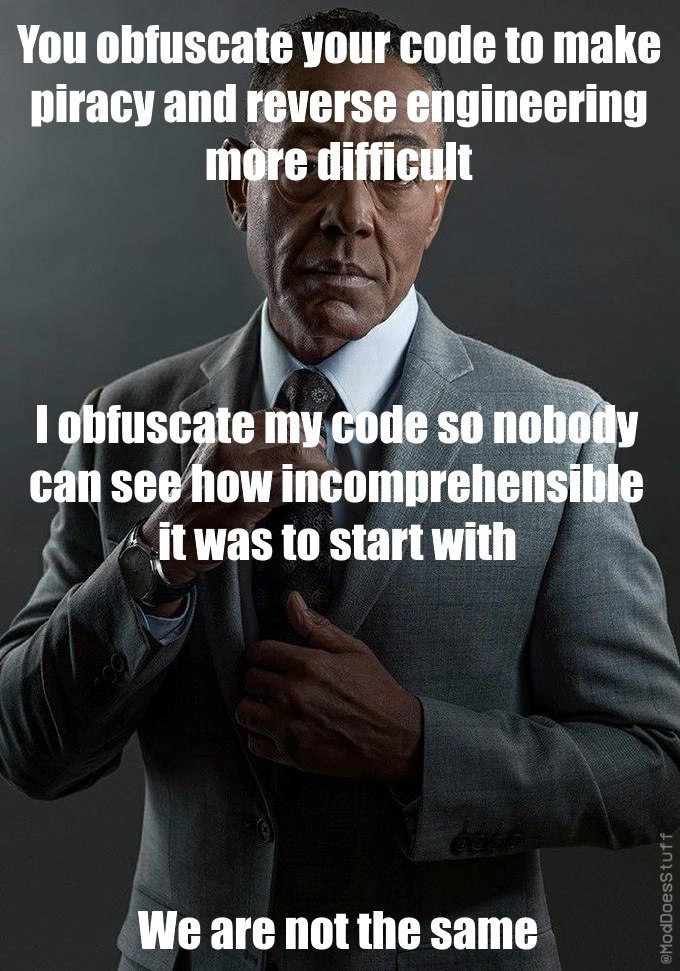
The humor here comes from that we_are_not_the_same_meme format: Both individuals perform the same action (making code illegible), but their motivations diverge hilariously. The well-dressed figure adjusting his tie in the image exudes a professional, almost smug aura – as if both quotes are spoken with pride. “We are not the same,” the meme declares, highlighting the contrast. The first person’s pride is somewhat justified (they’re fending off pirates and hackers – noble cause!). The second person’s "pride" is pure tongue-in-cheek; they’re essentially admitting, my code was so bad I had to pretend it’s purposefully obscure. It’s DeveloperHumor gold because so many of us have been there (or at least fear ending up there). We chuckle because it’s a relatable exaggeration: who hasn’t written something embarrassingly convoluted late at night and half-wished they could just deploy the minified version so no one sees the nonsense inside?

In day-to-day software development, CodeQuality is all about avoiding that latter scenario. We strive for clarity – meaningful names, simple designs, lots of comments (or better, self-documenting code). When code becomes incomprehensible, it usually signals TechnicalDebt accruing interest. That debt can hit you back when adding features or fixing bugs takes twice as long because nobody understands the old code. This is why teams do code reviews, refactoring, and have style guides – to catch the atrocious parts before they land in main. The meme playfully suggests what would happen if we took the opposite approach: just obfuscate the heck out of our shameful code so nobody will ever know how bad it is. It’s sarcasm, of course – a comedic catharsis for anyone who’s stared at their own convoluted function and thought, “maybe I can just tell my boss it’s secure now.” In short, it highlights the gap between best practices and cheeky shortcuts: one approach enhances security at the cost of readability, the other destroys readability to hide a lack of best practices. We are not the same, indeed!

Level 4: Computational Camouflage

At the most theoretical level, code obfuscation can be viewed as a form of computational camouflage. Just as cryptography scrambles data into cipher-text, obfuscation transforms source code into an equivalently functioning program that’s almost indecipherable to humans. In computer science theory, researchers have even explored "indistinguishability obfuscation," which is essentially the holy grail of making two programs that do the same task look mathematically impossible to tell apart. While true perfect obfuscation remains an unsolved problem (and might be as elusive as a proof for P != NP), practical obfuscation rides on the inherent complexity of understanding arbitrary programs. Consider concepts like Kolmogorov complexity: the idea that the shortest description of a piece of data (or code) might be essentially as long as the thing itself if it's highly unstructured. An ideally obfuscated program approaches this — it’s so dense and patternless that there's no shortcut to comprehend it other than stepping through every single inscrutable line. In theoretical terms, reversing a well-obfuscated program can edge toward the limits of undecidability (think Halting Problem vibes) where determining what the code does – or whether two obfuscated pieces do the same thing – becomes provably hard.

This sounds dramatic, but it’s grounded in reality: modern obfuscation techniques leverage everything from runtime polymorphism to opaque predicates (code that always evaluates the same way but looks complex) to make analysis a nightmare. They exploit the gap between how computers execute logic and how humans reason about logic. A compiler might rearrange or inline functions for efficiency, but an obfuscator goes further – injecting bogus control flows, renaming variables to single letters or confounding Unicode lookalikes, and splitting straightforward operations into Kafkaesque sequences of micro-operations. The result? To a decompiler or a person reading the binary, the intention is hidden under layers of mathematically equivalent jigsaw puzzle pieces.

From a high perch, the meme’s contrast highlights an ironic twist on these concepts: one developer’s code is deliberately complex by design (a planned one-way function to protect secrets), while the other’s code is accidentally complex (a one-way trip to confusion because of poor design). In both cases, reversing the code – whether by an adversary or a teammate – inches toward impossible. Security through obscurity and plain obscure code might converge in outcome (unreadability), yet their entropy was introduced for opposite reasons. It’s a tongue-in-cheek reminder that sometimes the barrier between cutting-edge cyber defense and a tangled mess of spaghetti code is just the intention behind the chaos.

Description

Meme image shows a well - dressed person in a dark grey suit adjusting their tie against a neutral studio background; the face is blurred. Large white impact-style captions are stacked in three blocks: top reads "You obfuscate your code to make piracy and reverse engineering more difficult", middle reads "I obfuscate my code so nobody can see how incomprehensible it was to start with", and bottom reads "We are not the same". The joke contrasts professional code-obfuscation for intellectual-property protection with a self-deprecating admission that the author’s code was unreadable from the outset. Technically, it touches on code obfuscation techniques, maintainability, technical debt, and the perennial struggle for readable source while poking fun at developer motivations
Comments

7
Anonymous ★ Top Pick Legal asked if we needed a commercial obfuscator; I reminded them our billing service is 15 years of anonymous SVN merges, Perl embedded in SQL, and feature flags named after ex-employees - anyone who can reverse-engineer that deserves the IP
  1. Anonymous ★ Top Pick

    Legal asked if we needed a commercial obfuscator; I reminded them our billing service is 15 years of anonymous SVN merges, Perl embedded in SQL, and feature flags named after ex-employees - anyone who can reverse-engineer that deserves the IP

  2. Anonymous

    The best obfuscation tool I've ever seen is a junior developer's first attempt at implementing the Strategy pattern after reading half a Gang of Four chapter

  3. Anonymous

    The real genius move is when your 'obfuscated' production code is actually just the minified version of your already incomprehensible source - giving you plausible deniability with management ('it's for security!') while your teammates silently curse your variable names like 'data2' and 'processStuff'. At least with intentional obfuscation tools, there's a deobfuscation strategy; with organically grown spaghetti code, the only reverse engineering tool that works is archaeological git blame and prayer

  4. Anonymous

    Obfuscation: turning 'security through obscurity' into 'job security through amnesia' for that six-month-old refactor

  5. Anonymous

    You obfuscate with Uglify; I obfuscate with DDD + CQRS + event sourcing - by the time you trace a write, the business rules have changed

  6. Anonymous

    ProGuard keeps pirates out; my ProGuilt keeps reviewers from discovering the 3k-line method guarded by a global mutex and five singletons

  7. @mpolovnev 3y

    I write obfuscated code from the scratch. I think it's clear, but collegues say it's obfuscated

Use J and K for navigation