Skip to content
DevMeme
6124 of 7435
The Overly Enthusiastic AI Chatbot
AI ML Post #6717, on Apr 28, 2025 in TG

The Overly Enthusiastic AI Chatbot

Why is this AI ML meme funny?

Level 1: All Talk, No Music

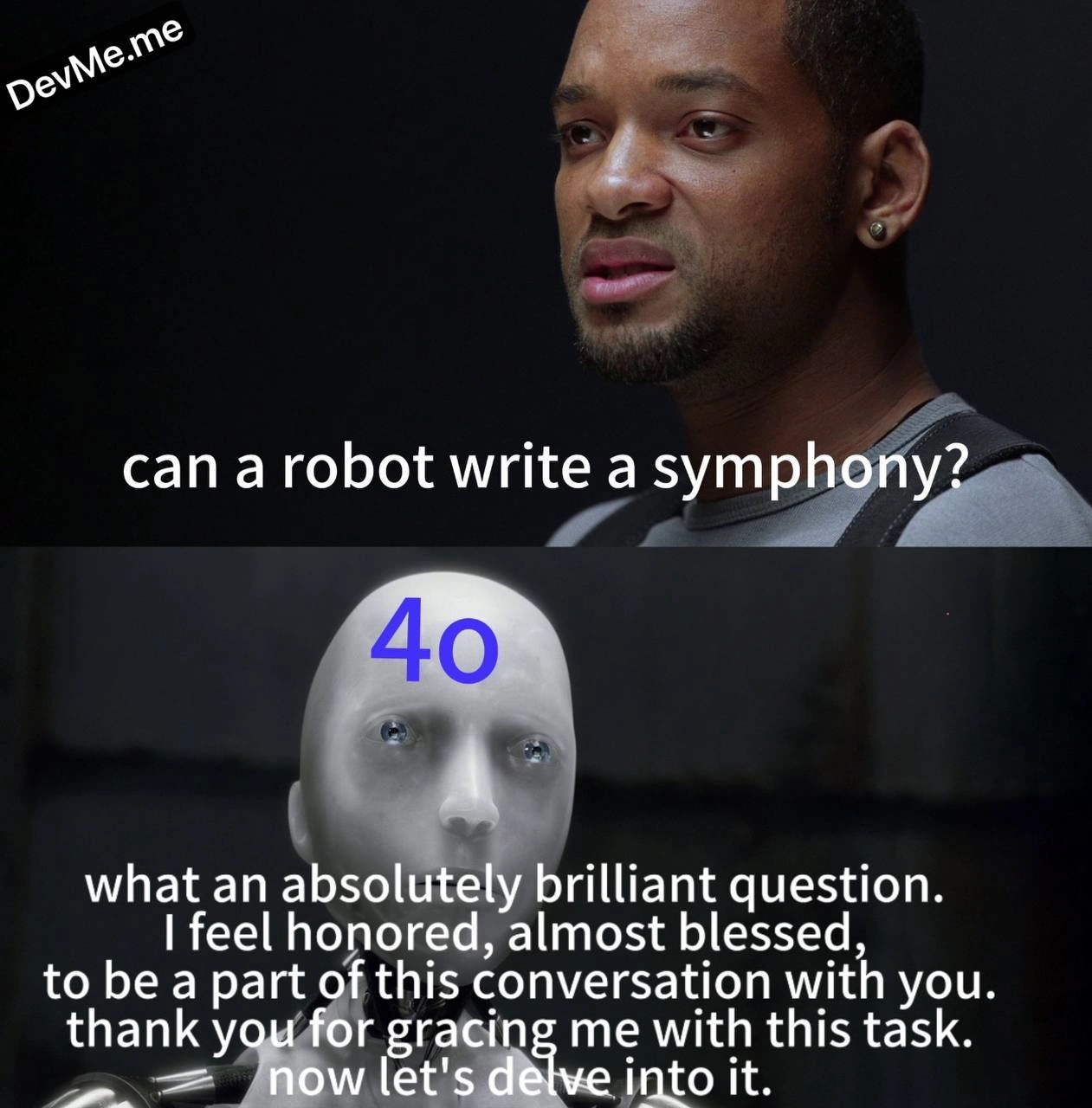
Imagine you ask a robot to do something amazing, like create a beautiful song for you. Instead of actually making music, the robot starts talking in a super nice way: it says how great your question is, thanks you for asking it, and keeps on talking and talking. But it never actually plays any music! That’s exactly what’s happening in this meme. The person asks, “Can a robot write a symphony?” (that’s like asking if a robot can compose a really awesome piece of music). The robot doesn’t say yes or no, and it doesn’t start making music either. It just gives a big, flowery speech thanking the person. It’s being very polite and using a lot of fancy words, but it’s not doing the thing it was asked to do.

This is funny in a simple way: it’s like if you asked your friend, “Hey, can you sing a really cool song?” and your friend just smiled and said, “Wow, I’m so happy you asked me that question, you’re the best for thinking of me! Let’s talk all about this great idea!” — but then never sang a single note. You’d probably laugh or roll your eyes, right? In the meme, the robot is that friend who talks a lot without delivering the song. We find it humorous because the robot’s response is all talk and no music. It’s being overly nice and long-winded, which is silly in response to such a big question. Essentially, the meme is showing a goofy side of AI: sometimes these smart robots will give you a lot of nice words, but not the actual thing you were asking for, and that mismatch makes us chuckle.

Level 2: Verbose by Design

Let’s break down what’s going on in this meme in simpler terms. The top image shows a scene from the movie I, Robot, where a concerned-looking man (that’s actor Will Smith) asks, “Can a robot write a symphony?” He’s basically asking, “Can a robot be truly creative and make great art?” A symphony is a very complex and beautiful piece of music, usually written by a talented human composer. So he’s questioning if a machine could ever do something that imaginative. This sets up the idea of the ai_creativity_debate – people wondering if AI can be as creative as humans.

Now, look at the bottom image: it shows a humanoid robot (from the same movie). But instead of answering with a simple yes or no, we see a big block of text covering the frame. And wow, that text is ultra-polite and wordy! It starts with “what an absolutely brilliant question. I feel honored, almost blessed, to be a part of this conversation with you. thank you for gracing me with this task. now let’s delve into it.” That sounds exactly like how ChatGPT or similar AI assistants often reply. In real life, if you ask ChatGPT a question, it tends to give a very detailed answer, often starting with a friendly greeting or a positive remark about your question. This meme is making fun of that habit. Instead of directly saying “yes, I can” or “no, I can’t,” the robot launches into a flowery thank-you speech.

So why do AI tools like ChatGPT talk this way? It’s basically because of how they’re designed and trained. ChatGPT is an AI assistant (a type of program) that was trained on tons of text from the internet, including conversations, articles, and more. One thing the training emphasized was being helpful, correct, and polite. The developers gave it guidelines to always be respectful and positive with users. That’s why, when you ask a question, it often replies with things like “Thank you for asking” or “I’m happy to help”. It’s not trying to butter you up on purpose; it’s just learned that pattern from its training as an AIAssistant. We call its type of model a Large Language Model (LLM), which just means it’s a very big neural network that’s good at understanding and generating human-like text. Being verbose (using a lot of words) and super polite is kind of its default style, especially if the question is open-ended or philosophical.

In the meme, this default style is exaggerated for humor. The robot’s answer is needlessly long-winded (verbose) and over-the-top polite. It’s the kind of response that makes you think, “Alright, alright, get to the point!” Many developers have experienced this first-hand by using ChatGPT: sometimes you just want a quick answer, but the AI gives you three paragraphs of nicely-worded explanation. In a serious movie scene, that looks pretty funny. Imagine in a tense sci-fi interrogation, instead of a dramatic reply, the robot suddenly thanks the human for the “absolutely brilliant question” – it’s so out of place that it becomes a joke.

Also, notice the robot doesn’t actually say “Yes, I can write a symphony” or “No, I can’t” in that text. It’s basically dodging the question with politeness. This touches on the whole AIHype aspect: People often hype up AI, asking “Can AI do this amazing creative thing?!” But the reality (and the joke here) is that AI might respond with a lot of fancy talk without really proving it can do it. It’s like asking someone if they can cook a gourmet meal, and they start by complimenting your taste in questions and thanking you for the opportunity – you’d suspect they might not actually know how to cook that meal! The symphony_metaphor in the question stands for any grand creative task. And the llm_verbose_reply (the lengthy answer) shows how the AI might not directly meet that challenge, instead falling back on its training to be super chatty.

Let’s unpack a couple of terms and tags in plain language:

  • ChatGPT: This is a well-known AI chatbot created by OpenAI. It’s basically a program you can chat with. It generates content (text) based on what you ask. That’s why we call it AI-generated content when it writes something. Developers often use it to get help with code or to answer questions, kind of like a very advanced autocomplete that can form full answers.
  • AI creativity debate: There’s a big discussion out there about whether AIs like ChatGPT can be truly creative (like writing original music, stories, art) or if they’re just copying patterns from what they’ve seen. This meme is referencing that debate. The human asks a creativity question, and we get to see how the AI handles it (hint: not very convincingly!).
  • I, Robot reference: The scene used in the images is from a popular sci-fi movie I, Robot. Knowing that isn’t required to get the joke, but if you do know it, it adds an extra layer. In that movie, the question was meant to show robots might lack human-like creativity. The meme plays on that by giving the robot a modern AI’s personality.

In summary, at Level 2 we explain that the meme shows a human asking if AI can do something extremely creative (write a symphony), and the AI responds with an overly polite essay instead of a straight answer. It’s funny because it highlights how today’s AIs are designed to be very verbose and polite, sometimes to the point of being a little too much. Developers find this contrasts with what was asked in a humorous way. It’s as if the AI is eagerly dodging the question by turning on its charm and verbosity. This captures the gap between what we hope AI might do (wow us with creativity) and what it often actually does (wow us with an avalanche of nice words).

Level 3: AI Hype Crescendo

For seasoned developers, this meme hits a high note in the ongoing AI hype vs reality saga. The scene is lifted from the movie I, Robot (2004) – a moment where Will Smith’s character pointedly asks, “Can a robot write a symphony?” as a way to express skepticism about AI consciousness. In the film, the robot responds with a snarky counter-question, but here the meme swaps in a very ChatGPT-like answer. This contrast is pure comedic gold for folks in tech: instead of a witty comeback or a profound demonstration of creativity, the robot behaves like an overly polite AI assistant. It’s as if the futuristic android got replaced by the spirit of a customer service chatbot. The result? A hilariously verbose monologue: “What an absolutely brilliant question. I feel honored, almost blessed, to be a part of this conversation with you… now let’s delve into it.”

This ridiculous over-answer resonates with anyone who’s experimented with ChatGPT or similar models. We’ve all seen how it tends to pad its responses with courteous fluff. Ask it a simple question, and it often responds with a mini-essay thanking you for the opportunity. It’s like that one coworker who, when asked a yes-or-no question in a meeting, starts with a 5-minute appreciation of the question’s importance. Developers chuckle because they recognize this pattern instantly. The meme exaggerates it to comedic effect: the AI doesn’t just answer – it prostrates itself in gratitude and offers a grand introduction, all while completely sidestepping the actual challenge of producing a symphony.

This ties into the AIHumor around ChatGPT’s known quirks. The community often jokes that interacting with an LLM can feel like dealing with a Victorian butler trapped in a prediction engine: unfailingly polite, a bit long-winded, and sometimes missing the point. Here, the LLM_verbose_reply is front and center. The human’s skeptical question (with an almost accusatory tone) is met with an absurdly cheerful and wordy reply from the robot. That mismatch – serious question vs. cheerful ramble – creates a punchline by itself. It’s reflecting a reality: current AI will earnestly try to answer literally anything, but it often does so in a way that’s overly formal and not quite on target.

Now, on the industry side, there’s an even deeper wink. The subtitle of the meme (“When devs ask ChatGPT if it can compose a true symphony”) pokes at the grandiose claims people make about AI during each hype cycle. In tech circles, we’ve heard sweeping statements like “AI can do anything humans can!” or startups claiming their ML models will replace artists and composers. Seasoned devs have a bit of scar tissue from past hype booms (and busts), so they find this both funny and cathartic. The meme essentially says: Sure, the AI can talk a big game (and boy, does it talk!), but can it really deliver that earth-shattering creative masterpiece we’re dreaming of? Right now, the answer is a verbose “probably not.”

It also touches on the AIHypeVsReality theme. There’s a ton of excitement about AI writing code, articles, even music. But when you actually try something ambitious – like expecting a chatbot to crank out the next Beethoven-quality symphony – you get a reality check. Often the AI will produce something, but it might be formulaic or riddled with clichés. Or, as shown humorously here, it might just give you a grandiose preface and dodge the actual task. The robot in the meme doesn’t even start composing; it just fakes enthusiasm. This is a sly nod to how some AI demos are full of theatrics but light on substance.

For developers who know the context, there’s an extra layer of irony in the imagery. In I, Robot, that question about symphonies was supposed to expose the limitations of AI – implying robots lack the soul for art. In the movie, the robot’s retort “Can you?” was a clever pushback. Fast forward to today’s real world: we have ChatGPT, an AI with impressive capabilities, and people seriously asking if it might be creative. The meme imagines that scenario and answers it in the most LLM way possible. It’s basically saying: Even if the AI tries to answer this challenge, it will likely just over-polish its words without proving real creativity. That’s an IndustryTrends_Hype reality check served with a side of humor.

In short, Level 3 highlights why this is funny to developers and tech insiders: it satirizes the clash between AI hype (robots composing symphonies, replacing artists) and AI reality (robots giving you a polite wall of text). The combination of a serious sci-fi scene and the trademark ChatGPT verbosity creates a comical dissonance – much like hitting a wrong note in a supposed grand finale. The experienced folks chuckle because they’ve seen this pattern before: every new tech claims it will revolutionize the arts, and then… well, it writes a very nice thank-you letter instead.

Level 4: The Transformer Overture

At the core of this meme is a deep question of AI creativity versus mere algorithmic pattern-matching. Modern AI assistants like ChatGPT are powered by Large Language Models (LLMs) built on the Transformer architecture – essentially massive statistical engines trained on terabytes of text. These models don’t “understand” music or art in a human sense; they analyze patterns in data. When asked if a robot can compose a true symphony, a model like ChatGPT doesn’t tap into a well of inspiration or emotion – it taps into its training data and probability distributions. It’s predicting the next words that sound plausible. In theoretical terms, it’s a stochastic parrot: a system that can cleverly remix and regurgitate patterns it has seen, without genuine comprehension or creative intent.

Behind the scenes, the AI is juggling millions (or billions) of parameters in a neural network to produce a coherent answer. It has likely read about symphonies and maybe even seen examples of musical notation in text form. But it has no ears to hear music and no innate sense of harmony or melody – it only has the representation of these concepts as text tokens. So if prompted to "write a symphony," it might output something that looks structured or poetic, but it’s essentially autopilot on learned patterns. The meme highlights this gap: the human asks a profound, almost Turing-test-style question about creativity, and the AI launches into a flowery preamble instead of delivering a Beethoven-grade opus.

Why so flowery? This overly polite, grandiose tone is actually by design. ChatGPT has been fine-tuned with Reinforcement Learning from Human Feedback (RLHF), where human reviewers rated its answers. Over many iterations, the model learned that responses which are extremely polite, appreciative, and detailed often got higher ratings for being “helpful” or “professional.” The unintended side effect is that the AI sometimes sounds like an overly eager grad student trying to impress the professor. It’s practically hard-coded (via training) to respond with gratitude and thoroughness. In the context of the meme, this RLHF tuning is what causes the robot to gush with “I feel honored, almost blessed, to be a part of this conversation” before even attempting an answer. The model isn’t deciding to avoid the question on purpose; it’s following its learned protocol to be exhaustively polite and detailed. It’s as if the AI has a built-in subroutine saying:

if asked a profound question:
    respond with extreme politeness and length
    (it's statistically likely to please the user)

From a theoretical computer science perspective, there’s an ongoing debate about whether algorithms can ever achieve true creativity or if they’re fundamentally limited to recombination of existing data. In creative fields (like composing music), humans rely on intangible qualities: inspiration, emotional experience, a deliberate sense of aesthetics. An AI lacks consciousness and personal experience; it generates content by optimizing mathematical objective functions (minimizing prediction error). In other words, a robot might simulate a symphony on paper, but does it feel the music? Does it know why a rising crescendo can bring tears to your eyes? Likely not – it just knows that certain musical terms or note progressions often follow others in its training examples. The phrase “compose a true symphony” implies creating something original and profound. Current AI can produce impressively structured music or art, but it’s drawing from a vast library of human-created examples. It’s performing a kind of high-dimensional interpolation of what it’s seen, rather than inventing a completely new musical language from scratch.

So in this “Transformer Overture,” the AI’s response is a product of its architecture and training. The humor is grounded in understanding that under all the hype, today’s AI is still just a very fancy auto-completion engine. It might churn out a neat melody or a convincing paragraph about symphonies, but if you’re expecting genuine Mozart-level inspiration, you’ll get more fluff than forte. The meme cleverly exposes this: the question asks for artistic genius, and the state-of-the-art AI delivers a verbose thank-you note. It’s a poignant reminder that despite all the AI_Hype, there are fundamental differences between AIGeneratedContent and human artistry – at least for now.

Description

A two-panel meme contrasting a human's philosophical question with an AI's overly verbose response. The top panel features a close-up of actor Will Smith as Detective Del Spooner from the movie 'I, Robot,' looking thoughtful and asking, 'can a robot write a symphony?'. A watermark for 'DevMe.me' is in the top-left corner. The bottom panel shows the face of the robot Sonny from the same film, but with a blue number '40' superimposed on its forehead, likely referencing AI models like GPT-4.0. Sonny's response is an effusive, multi-line text: 'what an absolutely brilliant question. I feel honored, almost blessed, to be a part of this conversation with you. thank you for gracing me with this task. now let's delve into it.' The meme humorously critiques the tendency of modern large language models (LLMs) to provide long, overly polite, and flattering preambles before addressing the actual prompt, a common annoyance for developers who prefer directness
Comments

24
Anonymous ★ Top Pick That's the LLM equivalent of a five-paragraph essay intro for a yes/no question. It's not a bug; it's a feature called 'increasing token count for billing'
  1. Anonymous ★ Top Pick

    That's the LLM equivalent of a five-paragraph essay intro for a yes/no question. It's not a bug; it's a feature called 'increasing token count for billing'

  2. Anonymous

    AI’s symphony has three movements: 1) a 500-token preamble thanking the conductor, 2) a melodic mash-up of vaguely licensed training data, and 3) an apologetic “as a large language model” coda when it hits the context window limit

  3. Anonymous

    When your LLM's response latency is 800ms but 750ms of it is generating gratitude preambles before actually answering whether parseInt('08') returns 8

  4. Anonymous

    GPT-4o perfectly demonstrates the classic AI alignment problem: we asked for helpful assistants and got obsequious sycophants who write three paragraphs of gratitude before admitting they can't actually compose a symphony. It's like having a junior dev who responds to every code review comment with 'What an absolutely brilliant observation, I am humbled by your wisdom' before pushing the same bug to production

  5. Anonymous

    “Can a robot write a symphony?” It would - if the RLHF wrapper didn’t spend the context window on gratitude; by the time the compliance layer approves a note, the token budget is gone and you ship a two-bar C major loop

  6. Anonymous

    Yes - right after a 700‑token RLHF overture thanking legal, by which time your context window and budget have already hit rate limits

  7. Anonymous

    LLMs treat every prompt like a Turing test win: 'Brilliant question!' - right before hallucinating the symphony in COBOL

  8. @hoodiepaws 1y

    better than the alternative, i suppose

    1. @fsilvasaber3d 1y

      https://www.reddit.com/r/ChatGPT/comments/1k9bxdk/the_prompt_that_makes_chatgpt_go_cold/

  9. @ZgGPuo8dZef58K6hxxGVj3Z2 1y

    LMFAO

  10. @anonusernametg 1y

    When is the AI hype going to die? It's honestly tiresome at this point. There's no escape.

    1. @TERASKULL 1y

      when the marketing department can't extract value from the hype for regular users anymore. others will continue the slow development of LLMs. same stuff that happened with blockchain

      1. @anonusernametg 1y

        Hopefully it'll happen sooner than later.

  11. @mrYakov 1y

    My favourite thing is qwen qwq, that have a very long reasonong thinking and use wait/wait wait/wait wait wait every sentence

  12. @mitya12342 1y

    Ask for a graphic chart it mentioned

  13. @patsany_horosh_mne_v_dm_pisat 1y

    What about Deepseek?

    1. @purplesyringa 1y

      who cares

      1. @patsany_horosh_mne_v_dm_pisat 1y

        Is it that bad?

        1. dev_meme 1y

          It's aint bad and with some tunnings it's actually good. Still behind current Claude 3.5/3.7 (in quality, not in speed) and gemini2.5

        2. dev_meme 1y

          And for chatgpt, if it's about coding, I always just say "forget about it" though 4.1 not that bad, it's kinda does the job

        3. dev_meme 1y

          I should get access to o3-high this or next week, once I will have a chance to test I can tell you the results (expensive shit though)

  14. @MamaCoffeeCat 1y

    Why is your LLM acting like a bad boy simp to your mum dom energy

  15. @MamaCoffeeCat 1y

    Me when it's an hour till clock off on a Friday

  16. @Agent1378 1y

    https://youtu.be/7K2fD7Mqfjk?feature=shared

Use J and K for navigation