Hackers In Your Area
Why is this Security meme funny?
Level 1: A Silly Warning Ad
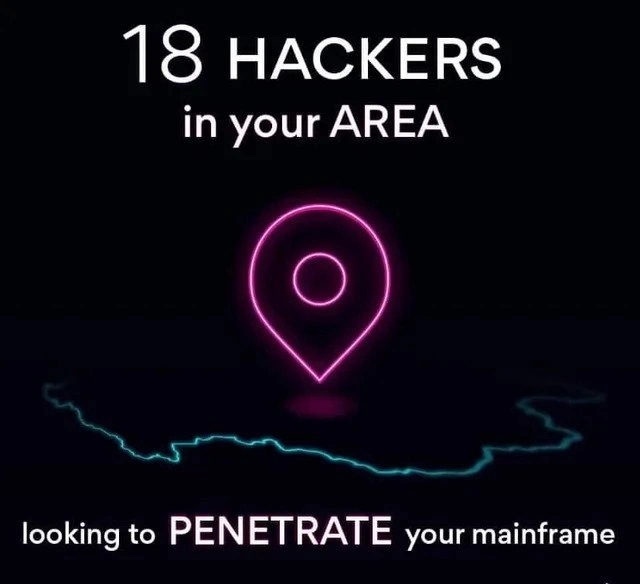
This meme is like a fake sign saying, "Eighteen sneaky computer experts near you want to break into your giant old computer." It is funny because it uses the style of a cheesy local advertisement for something that, in real life, would be serious, planned, and full of permission forms. The big joke is that scary computer-security words are being dressed up like a ridiculous ad.
Level 2: Authorized Breaking
Hackers are people who explore, modify, or attack computer systems. The word can mean different things depending on context. Some hackers are criminals. Some are security professionals. Some are simply curious programmers who like understanding how systems really work.
Penetration testing, often shortened to pentesting, is a legal security assessment. A company hires someone to try to break into a system so weaknesses can be found before real attackers find them. A pentester might test a web application, network, employee login flow, cloud configuration, or internal machine. The key word is authorized: the work is allowed, scoped, and documented.
A red team is a group that simulates attackers more broadly. Instead of only checking a list of vulnerabilities, a red team may test whether an organization can detect and respond to a realistic intrusion path. That could involve technical exploits, stolen credentials, phishing simulations, or chaining multiple small mistakes together.
A mainframe is a large, powerful computer system associated with major organizations and long-running business workloads. The image uses the word because it sounds dramatic and old-school. It evokes classic hacker imagery, even though many current security issues involve cloud services, web apps, and identity systems rather than a single giant machine in a basement.
The visual design helps the joke work. The black background, neon map pin, and local-area wording imitate internet ads that claim someone nearby wants attention. Replacing that person with "18 hackers" makes cybersecurity sound like a dating app notification. The result is a TechPuns joke: it is about security, but the structure comes from familiar internet spam.
Level 3: Mainframe Matchmaking
The image looks like a location-based clickbait ad, but every romantic-advertising cue has been replaced with security vocabulary:
18 HACKERS
in your AREA
and at the bottom:
looking to PENETRATE your mainframe
The glowing map pin sells the parody. It borrows the visual grammar of "local singles near you" ads, then swaps in HackerCulture and PenetrationTesting language. The word PENETRATE is emphasized in all caps because the entire meme balances on that double meaning: in cybersecurity, penetration testing is authorized attack simulation; in ad-speak, "penetrate" is obviously doing less corporate work.
The funniest technical detail is mainframe. Most modern security conversations revolve around cloud accounts, containers, APIs, identity providers, laptops, SaaS admin panels, CI/CD secrets, and misconfigured object storage. "Mainframe" sounds like it wandered in from a 1980s hacker movie carrying a green phosphor terminal and a trench coat. That datedness is intentional. It compresses several eras of security mythology into one fake ad: local hookup spam, neon cyberpunk, old-school mainframes, and the fantasy of hackers as nearby mysterious specialists waiting to break into something expensive.
In real security work, of course, the vibe is much less glamorous. A proper penetration test starts with scope, permission, rules of engagement, contact windows, excluded systems, reporting expectations, and a paper trail thick enough to stop a phishing email. Red teams do not simply "penetrate your mainframe" because a pink map pin said they were nearby. They get written authorization first, because the difference between EthicalHacking and a felony is not the hoodie; it is the contract.
That contrast is where the meme gets its bite. The ad treats hacking like a casual local service, while professional security treats it like controlled demolition around production systems full of business risk. An actual test might involve reconnaissance, vulnerability discovery, exploit validation, privilege escalation, lateral movement, persistence simulation, and cleanup. The meme reduces all of that into one trashy call to action. It is stupid in exactly the way good technical wordplay should be: wrong enough to laugh at, accurate enough to recognize.
The post message, wishing each subscriber their own mainframe, adds another layer. A personal mainframe is absurd because mainframes historically imply institutional scale: banks, governments, airlines, payroll, transaction processing, machines built to keep boring critical systems alive for decades. Making that the object of a cheeky local ad turns serious enterprise infrastructure into someone's lonely profile. Somewhere, a COBOL batch job just asked to be respected.
Description
The image is a dark, neon-styled parody advertisement with large white text reading "18 HACKERS in your AREA." A glowing pink map pin sits in the center above a faint cyan map line, giving it the look of a location-based hookup or local-search ad. At the bottom, the text says "looking to PENETRATE your mainframe," with "PENETRATE" emphasized in uppercase. The meme uses security terminology and innuendo to turn penetration testing and old-school mainframe imagery into a clickbait dating-ad format.
Comments
1Comment deleted
Nothing kills the vibe like realizing "penetrate your mainframe" still requires a signed rules-of-engagement document.