The Hackathon Paradox: 24 Hours of Pure Caffeine
Why is this DevCommunities meme funny?
Level 1: Staying Up All Night
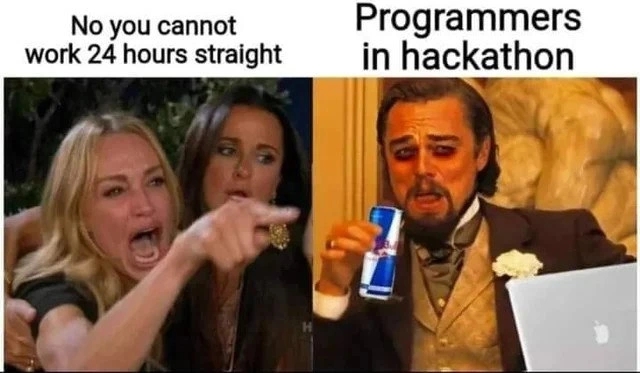
Imagine your mom or teacher tells you, “You can’t stay awake all night, you need to sleep!” That’s like the left side of the meme. Now picture a kid (maybe you or a friend) during a fun sleepover or while finishing a super exciting LEGO build who shouts back, “Oh yes I can!” while holding a big soda can or a candy bar as fuel. They’re determined to keep their eyes open and keep playing or building until morning. The right side of the meme is just like that kid saying “I’ll do it anyway!” In simple terms, the meme is funny because it’s showing a rebellious moment we can all recognize: someone says “you shouldn’t do this,” but you’re so excited and pumped full of energy (or sugar and caffeine) that you do it regardless. It’s the silly bravery of staying up all night to do something you love. We laugh because we know it’s a little crazy – you’ll be super tired later – but in the moment, it feels like an adventure. The programmer with the energy drink is basically having an “up past bedtime” adventure, just with coding. And that mix of good advice and bold defiance is what makes the situation humorous and light-hearted, even a bit heroic in a playful way. It’s like saying: sometimes, when you’re really into what you’re doing, you just don’t want to quit – not even for sleep!
Level 2: Caffeine-Powered Coding
Stepping down a bit, let’s break down what’s happening in this meme for a junior developer or someone new to hackathons. On the left side of the image, someone emphatically says, “No, you cannot work 24 hours straight.” This represents a very reasonable stance: human beings need sleep, breaks, and balance. On the right side, we have a programmer at a hackathon gleefully holding up a can of Red Bull (a famous energy drink). The caption there, “Programmers in hackathon,” implies that, despite the warning on the left, programmers at hackathons are known to attempt exactly that – coding for 24 hours non-stop. It’s a comical contrast between good advice and developer behavior under pressure. Essentially, the meme is saying: In theory, everyone knows you shouldn’t work a full day and night without rest, but in practice, at hackathons, developers often do just that (with a caffeinated grin).
So, what is a hackathon? It’s basically a marathon coding event – the word itself blends “hack” (as in clever programming, not security breaking) and “marathon” (a long endurance event). Hackathons usually last anywhere from a day to a full weekend. The goal is to build a project in a very short time. For example, you might have just 24 hours to create a working app or prototype from scratch. Because the timeframe is so tight, there’s a culture of intense focus and often LateNightCoding. Teams or individual programmers will stay at the venue (or online) day and night to get as much done as possible before the final deadline (when projects are submitted or demoed). This leads to the all-nighter behavior shown in the meme. An all-nighter means you work all night with no sleep – something students might do before an exam or developers do when a deadline looms. In hackathons, pulling an all-nighter is extremely common; it’s almost expected that you’ll be bleary-eyed by morning, running on caffeine and adrenaline. 💻☕️
The left side saying “You cannot work 24 hours straight” could be anyone: a friend, a family member, or an inner voice of common sense reminding the programmer that humans have limits. It’s like someone reminding you to use the sleep function – in life, not just in code. The right side with the programmer raising a Red Bull can is basically him replying, “Watch me!” Red Bull is known for its slogan “gives you wings,” and here it’s literally the fuel keeping the programmer awake and coding through the night. Red Bull and other energy drinks are loaded with caffeine (and sugar), similar to a super-strong coffee or multiple cups of tea. Developers often drink them (or lots of coffee) during hackathons or crunch times to stay awake and alert when they’d normally be sleeping. It’s part of the stereotypical hackathon_culture: alongside laptops and code, you’ll see cans of Red Bull, Monster, or cups of coffee, and maybe some pizza boxes late at night. 🍕
Now, why would programmers ignore the sensible advice and work 24 hours straight? The meme touches on DeadlinePressure and the rush of CrunchTime. In a hackathon, the deadline isn’t some distant date – it’s literally hours away. If you only have one day to finish your project, taking a long break to sleep might mean not having a working demo by the end. Many participants choose to sacrifice sleep for that reason: they want every moment available for coding. There’s also the excitement factor. Imagine being in a room (or chat room) with dozens of other energetic developers, all building cool things frantically – the adrenaline and peer pressure can kick in. It feels like a coding party where no one wants to be the first to nod off.
For a junior developer, this might sound both thrilling and a bit scary. On one hand, hackathons are fun and creative: you get to throw together ideas quickly, learn new things on the fly, and maybe even win prizes or recognition for a clever project. It’s common for beginners to join hackathons to gain experience and for the sheer excitement of it. On the other hand, the meme humorously highlights the extreme side of it – sleep deprivation and chugging energy drinks are not exactly healthy habits. In reality, many hackathons do encourage participants to rest at least a little. Some provide quiet rooms or let you bring a sleeping bag to catch a nap. But the competitive atmosphere often leads people to say “I’ll rest later, I gotta keep coding now.” This is the “crunch” mentality: when a deadline is super close, some developers go into overdrive mode, writing code for absurdly long stretches.
It’s worth noting that in normal software development (outside of hackathons), working too long without breaks usually leads to burnout and bugs. After about 8-12 hours of coding in a day, most people’s brains slow down. That’s why the advice on the left is absolutely correct – you perform better when you’ve slept and recharged. However, the right side (the hackathon programmer) is a familiar sight because in short bursts, people sometimes ignore those limits to achieve a goal. You might recall studying late into the night to finish a school project or meet a deadline — it’s the same idea. In programming, there’s even a bit of legendary glamour in saying “Yeah, we coded through the night to ship this feature.” The meme is funny to developers because we recognize that slightly crazy determination. It’s pointing out: developers know they shouldn’t do it, but at hackathons they do it anyway, often proud and joking about it as they raise their energy_drink in salute.
To put it simply, the meme uses exaggeration to capture a real developer experience:
- No Sleep Rule: Generally, you shouldn’t skip sleep — your brain needs rest to think clearly and write good code.
- Hackathon Exception: But during hackathons (or dire crunch times), programmers often break that rule, armed with caffeine and a deadline, and try to code for 24 hours non-stop.
The woman yelling “No!” represents the rule, and the programmer cheers in defiance, representing the exception. For a newcomer, it’s a glimpse into developer humor around work marathons. It says, “We know this is against common sense, but it’s a thing in our community, and we find it a mix of hilarious and heroic.” Just remember, outside of the joking context, balance is important — even the most hardcore hackathon coders will admit afterwards that they need a good long sleep! 😅 This meme just gives a nod and a wink to that temporary insanity that a tight deadline can inspire in all of us.
Level 3: Overclocking Humans
At the highest technical level, this meme spotlights the crunch culture of hackathons, where developers attempt to overclock their human bodies much like a CPU pushed beyond its safe limits. The left panel’s text (“No you cannot work 24 hours straight”) represents the voice of reason – akin to an operating system’s scheduler insisting on a needed sleep() call – while the right panel (“Programmers in hackathon”) depicts the defiant coder running on caffeine and adrenaline. Experienced engineers recognize this as a satire of DeadlinePressure and the illusion of unlimited productivity. In systems terms, forcing a continuous 24-hour workload is like ignoring thread sleep and expecting no race conditions or memory leaks – in reality, things get messy.
Hackathons are essentially timeboxed coding marathons (often 24-48 hours) that encourage rapid-fire prototyping under extreme deadlines. The humor here comes from juxtaposing sensible constraints (human bodies need rest for peak performance) with the DeveloperHumor of proudly defying those constraints. It’s the classic scenario: a project’s timeframe is absurdly compressed, and against all better judgment, devs treat it as a challenge. Seasoned developers know that LateNightCoding under SleepDeprivation can lead to diminishing returns – after a certain hour, your brain’s garbage collector is overloaded, and each new line of code might introduce more bugs than it fixes. Yet, the all-nighter has an almost legendary status in programming folklore. The meme captures this perfectly with the coder raising a Red Bull like a champagne toast to celebrate the madness. Red Bull (and similar energy_drink cans) have become the unofficial mascot of hackathon_culture, essentially the rocket fuel for these coding sprints.
From a DeveloperProductivity standpoint, the meme hints at the paradox of crunch time: managers, teammates – or your own common sense – might say “don’t code for 24 hours straight” because studies and experience show error rates skyrocket when you’re exhausted. Yet in practice, hackathon participants routinely pull all_nighter coding binges because the ultra-tight deadline leaves little choice. It’s a case of “it works in theory, but not in practice” – in theory, nobody should code for 24 hours; in practice, hackathon-goers do it and even wear it as a badge of honor. The Deadline in a hackathon is immovable (often a demo or judging at the 24-hour mark), so every minute counts, and skipping sleep feels like gaining precious development time. Veteran engineers chuckle (or cringe) at this because they’ve learned that productivity isn’t linear: the code you churn out at hour 20 without sleep might be so hacky and bug-prone that you’ll spend double the time fixing it later. There’s an old joke that “one night without sleep can introduce a week’s worth of bugs.”
Notice the visual cues: the furious woman on the left could be a friend, a manager, or the rational part of your brain insisting on sanity. She’s essentially throwing an exception: “Operation not permitted: working 24h straight.” On the right, the suited man (Leonardo DiCaprio’s meme visage) cheers with a Red Bull, embodying the intrepid programmer who catches that exception and continues anyway. It’s a playful nod to how developers sometimes romanticize crunch mode – coding through the night, fueled by caffeine and lofty goals. For many senior devs, this image triggers war stories of past crunches: deploying a hotfix at 3 AM with bloodshot eyes, or those company hackathons where half the participants end up asleep under desks by morning. We laugh because we know it’s true and a little ridiculous. The CodingHumor here targets that shared experience of celebrating unwisely heroic efforts.
In a more theoretical sense, you can draw parallels to diminishing returns and system reliability. Running a team at 100% for 24 hours is like running a server at 100% CPU usage continuously – eventually it overheats or throttles. Human developers have a kind of “circadian clock” resource; ignoring it leads to context-switch failures (e.g., staring at a bug for an hour that you’d solve in 5 minutes when rested). Still, hackathons intentionally bend these rules: they’re short-term bursts of creativity. The intense deadline can spark innovative hacks as participants throw together code with duct-tape solutions just to get a demo working. Senior engineers understand the appeal – it’s a chance to prototype without red tape – but also the cost. The meme’s comedy stems from how relatable this rebel mentality is, even if it’s technically a terrible idea. In real projects, continuous crunch is unsustainable (hello, burnout!), but in a one-off hackathon, it’s almost tradition. The meme winks at us: “We know we shouldn’t, but we do it anyway.” Every experienced coder has either been the Red Bull-fueled hacker or the voice saying “This is insane” – and often both at different times.
To sum up the contrast in a comedic nutshell, consider the difference between standard advice and hackathon reality:
| Sensible Advice | Hackathon Programmer’s Take |
|---|---|
| “Get at least 8 hours of sleep.” | “Sleep? I’ll sleep when it’s over!” |
| “Take breaks, don’t burn out.” | “Breaks waste time – keep coding!” |
| “Easy on the caffeine late at night.” | “More caffeine = more code, obviously.” |
| “Focus on clean, tested code.” | “If it works for the demo, it’s fine!” |
As the table shows, the hackathon mindset is almost a rebellion against best practices. This is why seasoned developers smirk at the meme: it’s poking fun at that can-do, will-do attitude that’s both the charm and the hazard of hackathons. We’ve been there – chugging coffee at 2 AM, writing what in hindsight is spaghetti code, all for the thrill of CrunchTime. The meme distills that dual reality: the responsible engineer in us is horrified, but the hackathon veteran in us raises a can in solidarity. In code, it would look something like this:
hours_awake = 0
while hours_awake < 24:
build_project() # keep coding non-stop
drink("Red Bull") # caffeinate to stay awake
hours_awake += 1
print("Hackathon done! Now... Zzzz") # finally crashes after the sprint
In the loop above, there’s no time.sleep() at all – exactly like a programmer in a 24-hour sprint ignoring rest. The final print line symbolizes how the coder crashes hard post-hackathon. This snippet, like the meme, is a lighthearted way to illustrate work_marathon mode. Ultimately, the meme is a tongue-in-cheek celebration of that hackathon_culture where CrunchTime is embraced with a grin and a “cheers!”. It resonates with developers because it acknowledges an open secret: sometimes we knowingly trade health and sanity for one crazy coding adventure. And while it’s not a sustainable lifestyle (and not encouraged for regular work!), those wild all-nighters have a special place in programming lore – the source of both proud demo moments and cautionary tales we love to laugh about later.
Description
This is a two-panel meme using a popular format. The left panel shows a distressed woman yelling, with the caption, "No you cannot work 24 hours straight." The right panel, captioned "Programmers in hackathon," depicts an exhausted Leonardo DiCaprio from the film 'Django Unchained,' with dark circles under his eyes, holding a can of Red Bull in front of a laptop. This meme humorously contrasts normal human limits with the intense, caffeine-fueled culture of hackathons, where participants often code for 24 hours or more with little to no sleep. It's a relatable scenario for developers who have pushed their limits in competitive coding events, highlighting the blend of exhaustion, determination, and artificial energy required to survive
Comments
7Comment deleted
A hackathon is just a developer converting caffeine and pizza into a PoC that will later be documented in the README as 'TODO: rewrite this'
Hackathon HA strategy: comment out every sleep() call, run the human event loop on Red Bull, and pray the post-mortem covers circadian outages in “known limitations.”
The real bug in hackathons isn't in the code - it's thinking that the human brain's garbage collector can run efficiently after 20 hours without sleep. But hey, at least our memory leaks are now biological
Hackathon participants operate on a different time complexity: O(caffeine^sleep_debt). While management insists on reasonable O(8) hour workdays, developers at hackathons somehow achieve O(∞) runtime - though the code quality degrades exponentially after hour 16, and by hour 20, they're essentially fuzzing their own cognitive functions. The Red Bull isn't just fuel; it's the critical dependency in their build pipeline, and removing it would cause a catastrophic stack overflow of their consciousness
Hackathon mode is the human version of burstable T-class instances: burn caffeine credits for demo-level TPS, then spend two sprints throttled by sleep debt and unmocked dependencies
Hackathons: turning programmers into distributed systems - eventually consistent on caffeine, but partition-tolerant to sleep
Hackathons: 24 hours to ship a prototype, 24 months to unwind the microservice that Sales already sold an SLA on