Skip to content
DevMeme
The Binary Tree Pants Dilemma: A Foundational CS Problem
CS Fundamentals Post #91, on Feb 11, 2019 in TG

The Binary Tree Pants Dilemma: A Foundational CS Problem

Why is this CS Fundamentals meme funny?

Level 1: One Big Blanket or Lots of Little Ones

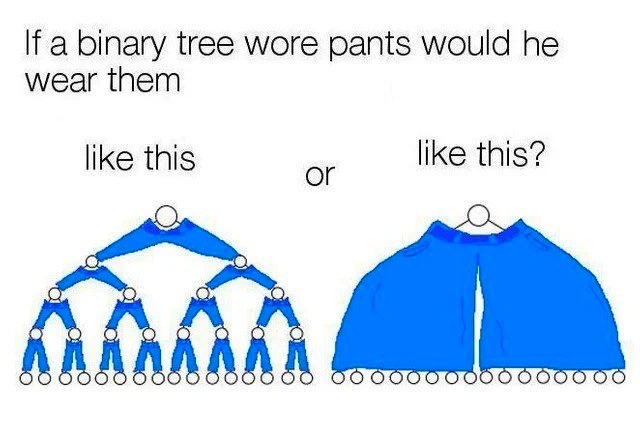
This is the silly old internet question "if a dog wore pants, how would it wear them?" — but asked about a shape that computer people use to organize information, which happens to look like a family tree. Should every little branch get its own tiny pair of pants, or should the whole thing get one gigantic pair draped over the top like a blanket fort? It's funny for the same reason the dog version was funny: both answers look completely ridiculous, yet the moment you see them, you immediately have a strong opinion — and so does everyone else, and nobody will back down, even though the contest is about an imaginary tree wearing imaginary pants.

Level 2: Meet the Tree Behind the Pants

The vocabulary you need to be in on the joke:

  • Binary tree: a way of organizing data where each element (a node) holds a value and links to at most two children — a left one and a right one. Drawn on paper it branches downward like a family tree, which is exactly the shape both pictures decorate.
  • Root: the single node at the top (where the waistband goes in the right-hand version).
  • Leaf nodes: the nodes at the bottom with no children — the two rows of little circles poking out from under both pant configurations like toes.
  • Recursion: solving a problem by applying the same rule to smaller pieces of itself. The left tree is recursion you can see: the whole tree wears pants the same way each smaller subtree wears pants, all the way down.

Binary trees are one of the first data structures every developer learns, and one of the first places recursion stops being scary: "process this node, then do the same for the left child and the right child" is three lines of code that handle a million nodes. If the left picture makes instant sense to you — every part dressed by the same repeating rule — congratulations, you already understand recursive tree traversal better than you think. The meme is a surprisingly decent test: people who've written tree code point at the left without hesitating.

Level 3: Granularity Wars, Now in Denim

The reason this remix of the dog pants meme colonized computer science feeds so thoroughly is that the original question — does the garment follow the anatomy or the silhouette? — is secretly the same question engineers fight about in design reviews every week. Where do you apply the operation: at every node, or once over the whole structure?

That granularity decision is everywhere, and both pants are defensible depending on context:

  • Validation: validate every field recursively (left), or schema-check the whole payload at the boundary (right)?
  • Error handling: a try/catch around each call site, or one giant handler wrapped around main() like a tarpaulin of denial?
  • Caching, memoization, serialization: per-subtree (composable, parallelizable, more overhead) versus whole-object (simple, but any change invalidates everything)?
  • Concurrency: fine-grained per-node locks scale better and deadlock more creatively; one big lock is slow, safe, and looks exactly like the right-hand picture.

The left tree also rewards pedantry, which is the highest form of engagement a data structures meme can achieve: it's a perfectly balanced binary tree, four levels deep, fifteen nodes, every leaf at the same depth — the kind of tree that exists only in textbooks and interview whiteboards, never in production, where your "tree" degenerated into a linked list the day someone inserted sorted data into an unbalanced BST. And the comment threads under this meme reliably reproduce the entire discipline in miniature: someone answers "left, obviously," someone counters that pants go on edges not nodes, someone proposes pants per level (breadth-first trousers), and someone insists the true answer depends on whether the tree is stored as pointers or as an array. There is no consensus. There never is. That's the field.

Level 4: Catamorphic Trousers

The left tree is not just funnier — it's the algebraically correct answer, and proving why touches real theory. A binary tree is an inductively defined data type: a tree is either a leaf, or a node with a value and two subtrees. Anything you define over such a type — size, depth, or pants — is most naturally defined by structural recursion: specify it for the base case, specify it for the constructor case in terms of the subcases, done. The left image is that definition, drawn: each node wears pants whose two legs are exactly its two children. Pants on a tree = pants on the root + (recursively) pants on each subtree. In functional programming terms, the left picture is a catamorphism — a fold over the tree structure, pantsify(Node l r) = Pants(pantsify l, pantsify r) — and the picture even gets the types right, since a pair of pants is structurally a function of arity two: one waist in, two legs out. A binary node is a pair of pants.

The right image, meanwhile, is the non-compositional answer: one operation applied to the aggregate, ignoring internal structure. It treats the tree as an opaque blob — which is precisely how you can't write a recursive function, but exactly how you do write a wrapper, a decorator over the root, or a single synchronized lock around an entire data structure. Per-node pants are fine-grained locking; mega-pants are a global lock. Per-node pants are structural induction; mega-pants are "the proof is left as a tarp." There's even a proof-theoretic reading: to establish a property for all nodes, induction (left) gives you the property everywhere, while the right merely asserts it at the root and hopes the children are covered. They are — but only in the textile sense.

Description

A classic computer science humor meme posing a philosophical question on a plain white background. The top text reads, 'If a binary tree wore pants would he wear them'. Below, it presents two options side-by-side. The first option, labeled 'like this', shows a complete binary tree where each node and its two children are collectively wearing a small pair of blue pants, creating a recursive, fractal-like pattern of pants throughout the tree structure. The second option, labeled 'or like this?', depicts the entire binary tree enveloped in a single, large pair of blue pants, with only the leaf nodes sticking out from the bottom cuffs. This meme humorously applies a mundane, human question to an abstract data structure, a core concept in computer science. The joke resonates with developers by contrasting a recursive, node-by-node interpretation against a holistic, encapsulating one, sparking a debate that's absurd yet amusingly analytical

Comments

8
Anonymous ★ Top Pick The first option is clearly a microservices architecture for pants, while the second is a monolith. We've seen how well the monolith scales
  1. Anonymous ★ Top Pick

    The first option is clearly a microservices architecture for pants, while the second is a monolith. We've seen how well the monolith scales

  2. Anonymous

    Lesson from yesterday’s incident: per-node trousers (left) respect encapsulation, but 200 million tiny Pant objects sent the GC into a 9-minute stop-the-world; we’re shipping the monolithic pant-blob and calling it “aggregate root optimization.”

  3. Anonymous

    The left is clearly how we deploy microservices, and the right is what we tell the board our architecture looks like

  4. Anonymous

    Obviously the left one - pants applied recursively at each node is O(n), but the senior answer is 'depends on whether pants are inherited or composed.'

  5. Anonymous

    This is the kind of existential question that keeps senior engineers up at night - right after wondering if their microservices architecture has too many layers. The real answer? Neither. A binary tree would obviously wear a B-tree because it needs better balance for production workloads

  6. Anonymous

    First: root.left.leg && root.right.leg - invariant preserved. Second: null pantsReferenceException

  7. Anonymous

    Pick per-node trousers - O(n) garments but rotation-invariant; the monolithic pair fails the first AVL/red-black rotation with a very literal breaking change

  8. Anonymous

    Left option is O(n) wardrobe complexity; right option couples your subtrees with a shared waistband - try an AVL rotation and the inseam becomes a breaking change

Use J and K for navigation