Plato's Cave Meets Modern AI
Why is this AI ML meme funny?
Level 1: Tricked by Shadows
Imagine you and your friends are in a dark room watching a shadow puppet show. You see the shadow of a big scary dragon on the wall. đŽ Youâve never seen a real dragon, so you get really worried that itâs real. Instead of turning around to look behind the curtain (where youâd just see your sneaky friends with cut-out dragon shapes and a flashlight đŚ), you ask another puppet on the wall, âHey, is that dragon real?â Now, that puppet doesnât really know anything â itâs just a puppet moving with those same shadows â so it confidently says, âOh yes, absolutely real!â You might giggle at that situation, right? Itâs silly because both you and the puppet are kind of clueless, relying on the shadow which is just an illusion.
Thatâs exactly the funny feeling this meme gives. The developer in the picture is like someone watching shadows on a cave wall and believing they might be real things. The â@grokâ theyâre asking is like that puppet â itâs an AI that sounds super sure of itself, but it might just be repeating the shadow play. The whole joke is a fancy way of saying: sometimes we trust something that looks real but isnât. Itâs funny and a bit like a fairy tale lesson: donât be fooled by shadows! Or in simpler kid terms: itâs like asking your stuffed toy if the monster under your bed is real. The toy might âanswerâ with whatever you imagine, but the real way to know is to bravely peek under the bed and check for yourself (and usually find nothing there but dust bunnies đ). The meme uses this idea to poke fun at how we treat smart computers: no matter how convincing they are, we should remember to check whatâs real with our own eyes.
Level 2: Grokking Platoâs Cave
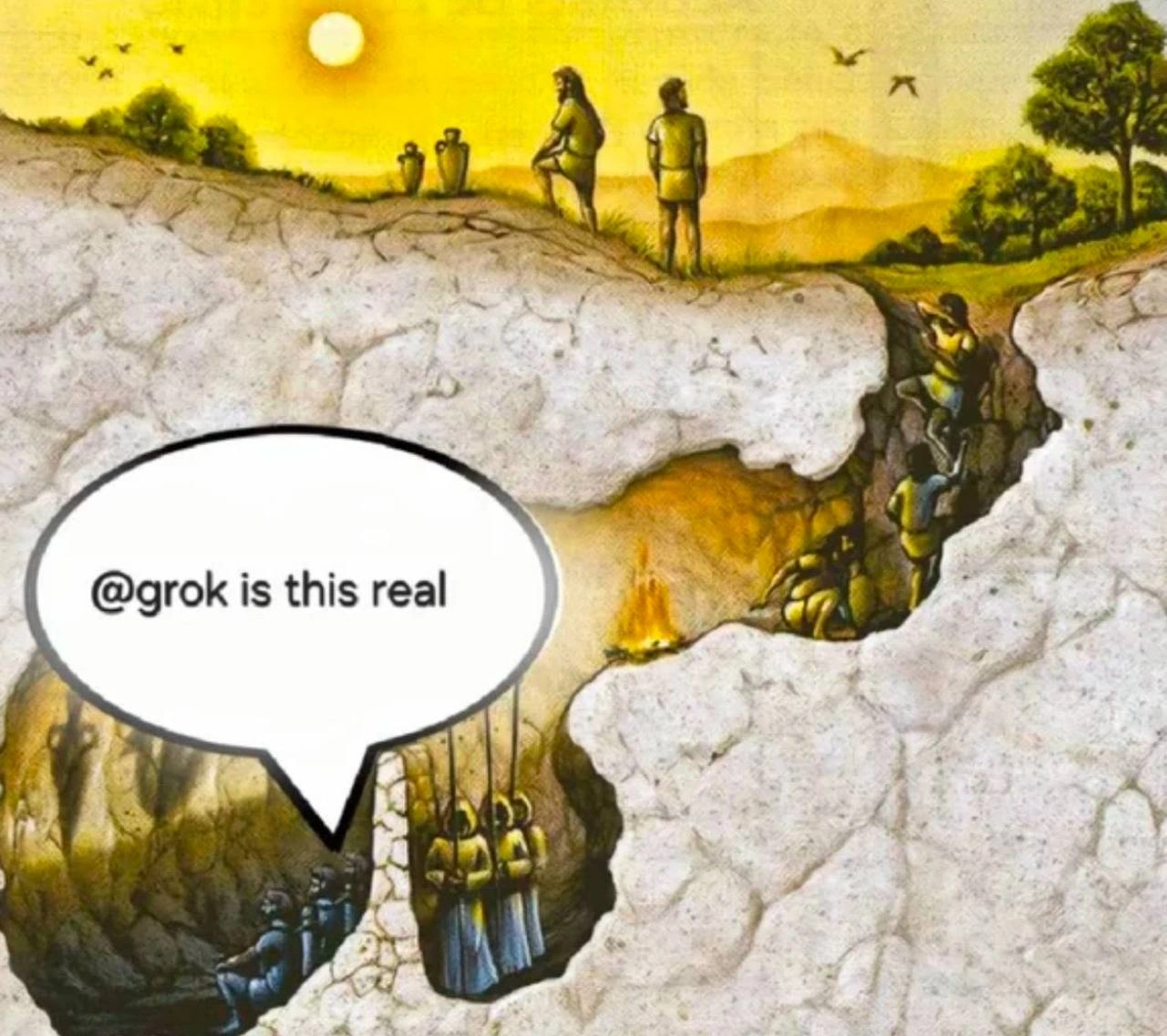
Letâs break down whatâs happening in this meme in simpler terms. The image is a take on Platoâs cave analogy, a famous story from philosophy. In Platoâs tale, a group of people live chained in a cave. Theyâve been there all their lives, so all they ever see are shadows projected on a wall in front of them (caused by objects passing in front of a fire behind them). Because theyâve never seen the outside world, they assume those shadows are real objects, not just shadows. Itâs an allegory about how our perception can be limited: the shadows are like false or incomplete pictures of reality, and the people in the cave donât know any better until one escapes to see the real world outside (the bright sun, trees, people â all the things that were casting those shadows).
Now, how does this relate to software developers and AI? Enter the idea of Large Language Models (LLMs) â these are advanced AI systems (like OpenAIâs GPT-4 or others) that can generate human-like text. Theyâve read a lot of the internet (books, articles, code, you name it) during training, and they can spit out answers or code suggestions. One known quirk of LLMs is something called âAI hallucinations.â No, the AI isnât literally seeing things đ; hallucination in AI means the system might sometimes output information that sounds correct and confident but is actually made-up or incorrect. Itâs like the AI is imagining or guessing answers when it doesnât truly know â a bit like seeing a shadow and guessing itâs a certain object when itâs not. This is a major AILimitations issue: the AI doesnât have a built-in fact-check button, it just uses patterns it learned.
In the meme, we have a developer character inside the cave looking at those shadows. The shadows here represent the AIâs answers or outputs, which might or might not be accurate (just like shadows might or might not resemble the real thing correctly). The developer is asking â@grok is this realâ. This implies the developer is using some AI assistant named Grok (often in chat platforms, you ping a bot with an @ mention, like @grok). So, the developer likely got some information or code from Grok and now is unsure if itâs correct â essentially asking the AI to verify its own answer. Itâs a funny scenario because if the AI has produced a misleading âshadow,â asking it if itâs real might just produce another shadowy answer. The poor developer is double-checking with the same source that gave the potentially false info, which might not help much!
To give a concrete example: imagine youâre a new programmer and you ask an AI helper, âHey, whatâs the best sorting algorithm for this task?â and it gives you an answer that sounds legit. Later you find out it cited an algorithm that doesnât actually work well or even exist as described. In confusion, you go back and ask the same AI, âIs that algorithm real or actually good?â If the AI is prone to hallucination, it might confidently reply âYes, absolutely, itâs widely used!â even if thatâs not true. Youâd be like the cave person seeing a shadow of a unicorn and then asking the shadow if unicorns are real. The reality_vs_shadows context here is exactly about that â confusing the illusion (AI output) with reality (verified truth).
Letâs talk about the name âGrok,â since thatâs a neat part of the joke too. âGrokâ is a term from geek culture that means to deeply understand something. It comes from a 1960s science fiction novel, and developers often say âI grok this codeâ meaning âI really fully get how it works.â So calling an AI assistant âGrokâ suggests it truly understands things deeply. The humor is, in the meme, Grok might not actually understand reality at all â it might just be really good at sounding like it does. So the developer asking â@grok is this realâ is kind of ironic: youâd hope an AI named âGrokâ would know whatâs real, but if itâs an LLM, it might just give you whatever answer matches its training data, truthful or not.
In summary, this meme is showing a developer in a situation of doubt about AIGeneratedContent. Itâs shining a light (pun intended!) on a big trend in the industry: we have these powerful AI tools (AI_ML is transforming development), but thereâs also a lot of IndustryTrends_Hype around them. People hype them up like theyâre infallible oracles, yet developers are learning that you canât just trust every output blindly. You have to step out of the âcaveâ and verify against reality â like checking documentation, running the code, or using external knowledge bases to confirm. The meme uses the platos_cave_analogy to drive home that point in a humorous way. Even if youâre not super familiar with Plato, the image of people mistaking shadows for real things gets the idea across: donât mistake an AIâs possibly distorted answer for the absolute truth. Always be ready to climb out of that cave and double-check in the sunlight of real-world facts!
Level 3: Trusting the Shadows
This meme hits home for senior developers whoâve wrestled with the promises and pitfalls of AI. On the surface, itâs a funny mashup of classical philosophy and modern tech lingo â a dev literally in Platoâs cave saying â@grok is this real.â But the humor cuts deep: it satirizes our tendency to trust AI outputs blindly, even knowing these models can hallucinate. In real dev life, weâve seen AIHypeVsReality moments like this. Picture a team integrating a fancy new AI assistant into their workflow (perhaps a Slack bot named Grok or GitHub Copilot). A junior dev gets some weird code output or an odd fact from it â akin to a flickering shadow on the cave wall â and instead of checking the source (turning around to see whatâs casting the shadow), they ask the AI again to verify its own output: âhey, is this true?â Itâs a circular logic trap that seasoned engineers recognize with a grin and a groan. Weâve learned that AI-generated content can be wonderfully helpful, but also bluff with confidence. When an LLM doesnât actually know something, it doesnât stay silent or admit ignorance; it often produces a plausible-sounding fabrication â the classic hallucination. Thatâs the developerâs dilemma captured here: AI, are you showing me truth or illusion?
PhilosophicalHumor aside, this scenario is painfully relatable in todayâs AI-infused development cycle. Weâre essentially chained to our data and tools. The chained figures in the meme represent developers (or users) who only see the output on their screen â logs, charts, AI answers â without direct context. The puppeteers and fire in the cave? Think of them as the training data and algorithms shaping what the AI shows us. We often donât see the real production environment or raw truth directly; we see summaries, dashboards, and AI explanations (some of which can be as misleading as shadows shaped by puppet masters we donât see). The two figures climbing out of the cave in the image could symbolize skeptical developers or data scientists insisting on verifying with real-world tests and ground-truth data â essentially those who climb out of the AI hype cave to see the actual system behavior or look at the raw database. Meanwhile, the folks already outside under the bright sun are analogous to experts who operate with verified knowledge (like domain experts or senior architects whoâve seen the real system in action and arenât fooled by pretty visualizations or AI anecdotes).
The text in the speech bubble, â@grok is this real,â nails the AIHumor. Itâs clearly a tongue-in-cheek reference to how we might @-mention an AI bot in a chat. The developer has a moment of uncertainty about what theyâre observing (maybe an odd performance metric or a suspiciously good answer?), and instead of cross-checking reality, they ask the very AI that might be creating the illusion. Itâs like asking a magic mirror if itâs telling the truth. 𤨠This highlights the AIHype in the industry: we hype these LLMs as super-intelligent assistants, but in practice weâve also seen them confidently spout nonsense. Seasoned devs recall incidents where someone proudly demoed an AI-generated solution that looked amazingâuntil a live test crashed and burned because the AI had simply fabricated an API that doesnât exist or cited a âfactâ that was totally wrong. Thatâs the RealityVsShadows clash: glossy AI demos (shadows on the wall) versus real system behavior (sunlight outside).
What makes technically inclined folks smirk here is also the meta-irony: Grok is slang for deep understanding (coined in a 1960s sci-fi novel and adopted by programmers to mean âfully comprehend somethingâ). By naming the AI âGrok,â we imply it truly understands reality. Yet the meme slyly asks: does it really? The developer isnât sure if theyâre seeing truth or illusion, so they appeal to âGrokâ for enlightenment. A senior dev reading this immediately thinks of all the times an AI or even a misleading monitoring chart âassuredâ them of something that turned out false. Itâs never a good feeling to find out youâve been coding or debugging in the dark.
In sum, this level of the joke plays on our collective experience: itâs a DeveloperHumor reflection on how we use AI as an oracle and sometimes forget that, without verification, we might all be âchainedâ by our assumptions. The meme basically says: the hype can make us feel like we have the sun of knowledge at our fingertips, but often weâre still just watching shadows on the wall. And if youâve ever been on-call at 3 AM, staring at an alert dashboard (shadows) and asking your automated system âtell me itâs a false alarmâ â you know exactly how that developer in the cave feels! Itâs hilarious and a little sobering: trust, but verify⌠especially when an AI is involved.
Level 4: Allegory of the Algorithm
Platoâs ancient Allegory of the Cave eerily foreshadows our modern tango with AI. In the allegory, prisoners are chained in a cavern, seeing only flickering shadows cast on a wall by objects passing in front of a fire. To them, those blurry silhouettes are reality, since thatâs all theyâve ever perceived. Fast-forward 2400 years: large language models operate in a similar epistemic cave. An LLM (Large Language Model) like âGrokâ is trained on vast amounts of text â effectively it has only ever âseenâ the shadows of knowledge (words and sentences) but not the source of the light (the actual truth out in the real world). The memeâs developer asking â@grok is this realâ is like a cave prisoner asking one of the shadows if the shadow show is true reality. Itâs a delightfully meta moment: an AI named Grok â a word from hacker lore meaning âto deeply understandâ â is being queried about reality itself. Yet a large language model doesnât truly grok reality the way a human escapee of the cave might; it can only regurgitate patterns from its training data. This brings to mind the symbol grounding problem in AI: our model manipulates symbols (words) based on statistical correlations, but those symbols are not grounded in direct experience.
From a theoretical perspective, AI hallucinations are the digital equivalent of seeing shadows on a wall. A transformer-based LLM generates text by predicting plausible sequences from its training corpus (its âcampfireâ). If the training data contains incomplete or distorted information about something (imagine puppet shapes, not the real object), the modelâs answer will reflect those distortions with convincing confidence. Thereâs no inherent truth-checking mechanism in a basic LLM any more than there is a reality-check for the cave prisonerâs perception. Academically, this connects to the challenge of aligning AI outputs with ground truth: without additional tools or feedback loops, the LLMâs world is a closed loop of AIGeneratedContent reflecting and remixing human-written sources â a hall of mirrors, or a cave of shadows.
Itâs fascinating that our industryâs cutting-edge AI quandary parallels a classic philosophical thought experiment. In Platoâs story, only by breaking free and seeing the sunlight outside can one grasp true forms (reality). In AI terms, thatâs like augmenting a model with real-world verification or data retrieval â giving it an escape route from its training cave. The meme cleverly merges these ideas: the IndustryTrends_Hype around AI sometimes portrays models like omniscient oracles, but in truth, they might be oracles of illusion, confident storytellers of the training data lore. The grok_model_reference underscores the irony: weâve named our modern âoracleâ after deep understanding, yet we must ask if it truly understands or just projects shadows on the wall. This highest-level joke tickles the brain: itâs a convergence of ancient epistemology and cutting-edge AI discourse â basically, Platoâs Cave 2.0, now with more silicon and syntax!
Description
This image is a modern adaptation of Plato's famous 'Allegory of the Cave.' The illustration depicts a group of prisoners chained inside a dark cave, able to see only the shadows of objects cast on the wall by a fire behind them. One prisoner is shown escaping towards the sunlit world outside. A speech bubble has been added, originating from the prisoners, containing the text '@grok is this real'. The meme humorously juxtaposes a foundational philosophical concept about perception and reality with the current trend of consulting AI models for answers. It satirizes the growing reliance on large language models like Grok to validate our understanding of the world, suggesting that we might be just as captive to the 'shadows' generated by AI as Plato's prisoners were to theirs
Comments
17Comment deleted
Plato's prisoners had it easy; they just had to question shadows. We have to question a stochastic parrot that's been trained on the entire internet and is still convinced a hot dog is a sandwich
Asking Grok if the shadows are real is the 2024 version of âworks on my machineââ - âonly now the machine is a hyper-confident philosopher burning GPU credits while it hallucinates
Just like debugging production issues, the real problem with AI chatbots is always lurking beneath the surface - except this time it's not a race condition, it's an existential condition where even the AI needs to ask itself if it's real
When your AI assistant becomes the modern Oracle of Delphi, but instead of prophesying the future, it's just confirming that yes, production is indeed on fire - and no, the shadows on your local environment wall won't prepare you for the actual flames. The real Socratic method is asking Grok if your monitoring alerts are hallucinating
Asking Grok if reality is real from inside Platoâs cave is the 2025 equivalent of integrationâtesting your mocks and declaring production âobserved.â
First PR for fire feature: tribe tags '@grok is this deploy real?' before merge to master
Platoâs Cave for SREs: the shadows are dashboards, the fire is sampling bias, and the dev asking â@grok is this real?â is about to be paged by prod
@gork did this happen? Comment deleted
Lame and gay Comment deleted
and what did you even do Comment deleted
Probably got reported by someone he sent dm to Comment deleted
Wake up boomers Comment deleted
how do you wake up a boomer Comment deleted
This picture costed more than sanity Comment deleted
I donât understand Comment deleted
Ask 4chanz, if its still up 𤣠Comment deleted
Engi-neering my limits đ˘ Comment deleted