Academic Humor: A Tough Crowd
Why is this DevCommunities meme funny?
Level 1: When Nobody Gets It
Imagine you learned a really cool new word or a fun fact at school, and you excitedly make a joke about it at the dinner table. You expect everyone to laugh, but instead they just stare at you, confused. They don’t know that word or fact you used, so the joke doesn’t make sense to them. You end up feeling a little embarrassed and sad because what you thought was super clever didn’t get any laughs at all. That’s exactly what happened to the dinosaur on stage – he told a joke only he understood, and the poor guy was left standing there with silence and a tear in his eye, wondering why nobody else thought it was funny.
Level 2: And Others, Explained
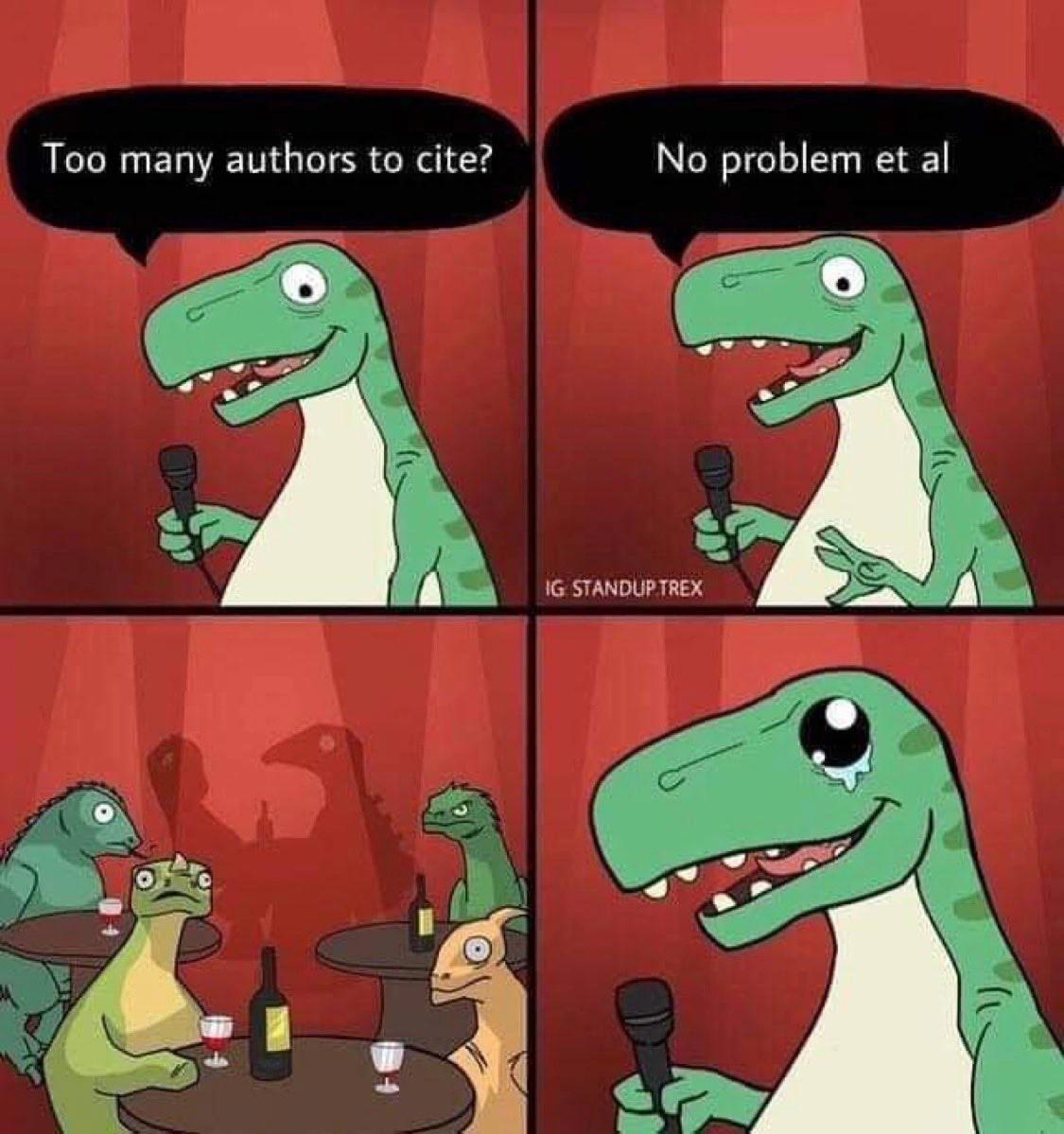
This meme shows a cartoon T-Rex trying to do stand-up comedy with a very nerdy joke. In the first two panels, the dinosaur on stage asks, "Too many authors to cite?" and then immediately answers his own question: "No problem et al." The humor here revolves around the term et al., which is short for a Latin phrase meaning "and others." It's what you use in a citation when there are too many authors to list every single name. For example, if Alice, Bob, Carol, and several others wrote a paper, you might cite it as Alice et al., 2025 instead of writing out all their names. That little abbreviation "et al." basically tells the reader, "Alice and others wrote this." It's a common shorthand in writing and documentation when dealing with multiple contributors.
The T-Rex is making a pun – a joke based on wordplay. In this case, he's playing on the similarity between "no problem at all" (a casual phrase meaning "it's okay, it's easy") and "no problem et al." (which sounds almost the same but sneaks in the citation term). When spoken out loud, "et al." sounds a bit like "at all." So the T-Rex is joking that if you have too many authors to handle, you can just say "et al." and it's "no problem at all" to cite them. It's a cheeky way of saying, "We have a shortcut for that problem!" The punchline only works if you know what "et al." means.
Now, the funny (and awkward) part is what happens next. In the third panel, we see the dinosaur audience at their tables, and none of them are laughing or even smiling. They just look confused. In stand-up comedy terms, the joke fell flat. The room went quiet because probably nobody understood the reference. If you don’t know what et al. means, the T-Rex’s line just sounds like gibberish or a weird ending to his sentence. It would be like someone making a joke about a TV show or a code library you’ve never heard of – you wouldn’t laugh because you don’t get it. The fourth panel shows the T-Rex’s face with a big tear in his eye, realizing his clever joke didn’t connect with the crowd at all. That single tear is a classic cartoon way to show a comedian's heartbreak when a joke bombs and the audience gives blank stares.
This situation mixes two worlds: academic life and everyday conversation. As a new developer or student, you might encounter "et al." when you're learning how to write a research paper or a detailed technical document. It's part of learning proper citation practices – basically, how to give credit to sources in writing. The meme is tagged as DocumentationHumor and AcademicHumor because it’s poking fun at an academic-style documentation habit. If you’ve ever been in a class or an internship where they asked you to list references for a project, you might recall someone explaining, "If there are more than two or three authors, just use the first name followed by et al. in your citation." It feels like a neat little hack when you first learn it.
However, outside of those contexts, not everyone knows this trick. A junior developer focused mostly on coding might not immediately recognize a reference joke like this, and non-technical folks almost certainly wouldn’t. The meme highlights that learning these conventions (like what et al. stands for) is a bit like learning a secret handshake. Until you learn it, a joke that uses it will zoom right over your head. So the T-Rex basically made a joke in "citation language" to an audience that didn’t speak that language. The result? Awkward silence and a lesson learned. He discovered that even a fun shortcut in documentation can become a total mystery to others if they haven’t encountered it before.
In plain terms, the T-Rex tried to show off a clever solution from academic writing during a comedy show. Using "et al." is a real solution when writing papers or documentation – it saves space and keeps things tidy when citing many names. But turning that solution into a joke only works if the listeners know about it. This meme is giving a wink to anyone who has been that person excited about a niche technical joke. It’s saying, "We’ve all been there – thinking we said something brilliant, then realizing only we understood it." If you’re new to this kind of humor, it also shows the kind of insider knowledge you pick up as you dive deeper into documentation and academic reading. Now you’re in on the joke too: et al. means "and others," and it was the key to a pun that our poor T-Rex thought would bring the house down, but instead just brought on confused silence.
Level 3: Scholarly Silence
In this four-panel comic, a green cartoon T-Rex attempts an AcademicHumor routine and learns the hard way that niche jokes can lead to an awkward silence. The T-Rex’s joke hinges on a bit of scholarly writing shorthand: et al.. This Latin abbreviation (short for et alia, meaning "and others") is commonly used in academic papers and technical documentation to cite a source with multiple authors without listing them all. On stage, our dino comedian poses the setup and punchline in two speech bubbles:
T-Rex: "Too many authors to cite?"
T-Rex: "No problem et al."
He’s essentially compressing “No problem, I'll just use et al. (and others)” into a punchline. It’s a clever twist that mashes up a casual reassurance ("no problem at all") with formal reference formatting ("et al."). The humor is derived from recognizing this wordplay: the phrase "et al." doubles as a scholarly citation trick and a sound-alike for "at all." Fittingly, et al. comes from Latin – a language as ancient (and dead) as the dinosaurs themselves – which makes the reference feel doubly esoteric. Only someone steeped in scholarly writing or documentation practices would immediately catch why that’s funny. It’s the kind of inside joke you’d share with lab mates or fellow engineers who spent too long formatting bibliographies. In other words, prime DocumentationHumor.
The next panels reveal the comedic crash. Three other dinosaurs in the audience sit at tables with drinks, reacting to the joke with blank, unamused stares. No laughter, no applause – just palpable confusion. This is the dreaded moment every stand-up fears: the joke bombs. The room has no idea what he’s talking about. Our T-Rex is left wide-eyed on stage with a tear rolling down, clutching the mic as he realizes his brilliant reference gag landed with a thud. It’s a MetaHumor moment: a joke about a joke failing because it was too inside.
For seasoned engineers or researchers, this scenario is painfully relatable. It captures the experience of mixing AcademicLife quirks with everyday communication. Many developers who’ve written a thesis, contributed to scholarly articles, or even maintained thorough project documentation have encountered et al. It’s basically the citation world’s version of a code shortcut – the textual Don't Repeat Yourself (DRY) principle applied to author lists. If you've ever had to cite a seminal paper with a dozen co-authors, discovering "just write et al. after the first name" feels like a life-saver. Basking in a perfectly formatted reference list is a special kind of nerd joy. We geeks quietly celebrate these hacks: “Too many names? Slap an et al., problem solved!” So when the T-Rex drops this line, he expects a certain breed of nerdy chuckle from those in the know.
The humor arises from that intersection of worlds: stand-up comedy and precise documentation practices. It’s an absurd crossover. Imagine a developer at open mic night cracking a joke about LaTeX bibliography formatting – that’s precisely what’s happening here. The meme is poking fun at how a reference formatting trick – something usually confined to research papers or meticulous docs – is utterly lost on a general audience of dinosaurs (literally!). It underlines the idea that a joke can fail not because it’s logically bad, but because the audience doesn’t share the required knowledge. The T-Rex’s punchline was effectively an inside joke targeting those fluent in citation-speak. Everyone else in the crowd? They hear “No problem et al” and likely think, “No problem... what?” They might not even realize a joke was attempted, beyond noticing the T-Rex paused expecting a laugh that never came.
This comic resonates with developers because it mirrors our own communication pitfalls. In tech, we constantly balance jargon with clarity. A senior engineer might drop a reference to an algorithm or a git command as a joke in a meeting, only to be met with crickets from colleagues who don’t know those specifics. The T-Rex made the same miscalculation on stage. It’s a gentle reminder to even the most experienced coder: know your audience. If you’re writing documentation for new hires or giving a presentation to non-experts, loading it with highly specialized references (or Latin abbreviations) might just get you blank looks. For the dinosaur on stage, it doubles as a learning experience – a stark lesson that not everyone has learned the same niche things we find funny.
The tear on the T-Rex’s face in the final panel adds a layer of dark comedy that veteran devs might chuckle at. Who hasn’t felt that sting of a DeveloperHumor attempt that only you found funny? It’s reminiscent of proudly showing off a complex one-liner or a sly code comment, only for everyone else to frown or ignore it. The dino’s wide, teary eye is basically the cartoon embodiment of "Ouch, tough crowd..."
There’s even an ironic historical undertone. et al. has been in academic use for centuries; it’s old-school Latin, just like our Jurassic jokester. That archaic pedigree adds to the absurdity. It survived in the scholarly world as a useful convenience, but when you haul that antique piece of academic culture into a casual comedy club, it feels out of place. It’s as if a developer started telling a Donald Knuth or lambda calculus joke at a JavaScript meetup – unless you have the context, it’s not going to land at all.
Ultimately, this meme humorously highlights the chasm between specialized knowledge and general understanding. It satirizes what happens when you assume everyone has the context that you do. When the T-Rex says "No problem, et al," he’s solving a documentation problem in a comedic way. But the only problem he actually solved was ensuring no one laughed. For those of us who straddle the worlds of software engineering and academic learning, the joke is a gem. We see both the cleverness and the folly: it’s smart and it's a total flop, all at once. That blend of brainy and cringey is exactly why this mash-up of DeveloperHumor and AcademicHumor hits home in both coding meetups and research labs alike.
Description
A four-panel comic strip featuring a green T-Rex performing stand-up comedy. In the first panel, the dinosaur comedian holds a microphone and asks the audience, 'Too many authors to cite?'. In the second panel, he delivers the punchline with a confident smile: 'No problem et al'. The third panel cuts to the audience, a group of various dinosaurs sitting at tables, who stare back in stony, unimpressed silence. The final panel is a close-up of the T-Rex comedian, a single tear welling up in his eye, crushed that his joke has bombed. The humor is a niche pun based on the Latin phrase 'et al.', which is an abbreviation for 'and others', commonly used in academic and scientific citations when a source has multiple authors. The joke plays on the phrase sounding like 'at all', but the specific reference is lost on the prehistoric audience, symbolizing the pain of making a clever, niche joke to the wrong crowd
Comments
13Comment deleted
This is the face you make after dropping a brilliant CAP theorem analogy in a product strategy meeting and the only response is the VP of Sales asking if 'CAP' is an acronym for 'Customer Acquisition Pipeline'
Design review tip: slap “et al.” on the author slide - it’s the Jurassic-era equivalent of git-blame --ignore-revs
Just like our microservices architecture - started with three authors on the design doc, ended up with 47 contributors across 12 teams, and now everyone just calls it 'the platform et al.' At least academic papers have the courtesy to list the first author before giving up
This perfectly captures the moment when you realize your research paper has 47 co-authors and you're desperately trying to fit them all into your documentation's 'References' section before the CI/CD pipeline times out. Just slap an 'et al.' on it and call it a day - though your colleagues might give you the same look as that audience when you abbreviate their names out of existence in the commit history
'Et al.': academia's git log --oneline for bloated contributor lists
In architecture docs, “et al.” is our lossy compression for accountability - great for page count, terrible for blame routing
In the enterprise we mark the ADR “Author: et al” - Latin for “18 stakeholders, zero owners,” aka consensus achieved, accountability deferred
meme channel looks inside dad joke Comment deleted
Since I became dad last year it means you are 💯% factually correct Comment deleted
but it was fun indeed Comment deleted
LinkedIn is not real, it can't be Comment deleted
This feels more like throwing shade at a coworker Comment deleted
avoid multiplication 40=5×8 use bit shifting instead 40=5<<3 Comment deleted