AI Hypocrisy: ChatGPT vs. The OG Akinator
Why is this AI ML meme funny?
Level 1: Never Say Never
Imagine a kid who loudly says, “I hate vegetables and I’ll never eat them!” That’s like our guy at first, saying he’ll never use AI. But then suppose someone makes a sweet carrot cake or a fun veggie pizza, and the kid gobbles it up, not realizing those “hated” vegetables are inside. Suddenly veggies aren’t so bad when they’re in a form the kid likes! 😋 This meme is the same joke, but with A.I. instead of veggies. The man in the picture starts off saying he’ll never use an AI, kind of like a kid swearing off all veggies. Yet when an AI comes along dressed as a friendly genie game (something he finds cool and enjoyable), he completely changes his mind and loves it — just like the kid loving that carrot cake. It’s funny because he contradicts himself: he said “never,” but actually ended up doing exactly what he said he wouldn’t, just because it was presented in a happier way. The lesson? Sometimes we think we’ll never try something, until it appears in just the right disguise. In other words: never say “never,” especially if a clever genie is involved!
Level 2: A Tale of Two AIs
In this meme, we see two very different AI experiences side by side, and a guy who treats them in completely opposite ways. On one side, there’s ChatGPT – a modern AI chatbot that can answer questions, write text, help with coding, and more. On the other side, there’s Akinator – a well-known “genie” game from the internet. The joke is about how the same person who says he refuses to use AI is totally happy to use the AI genie. Let’s break down what’s happening in each panel and why it’s amusing:
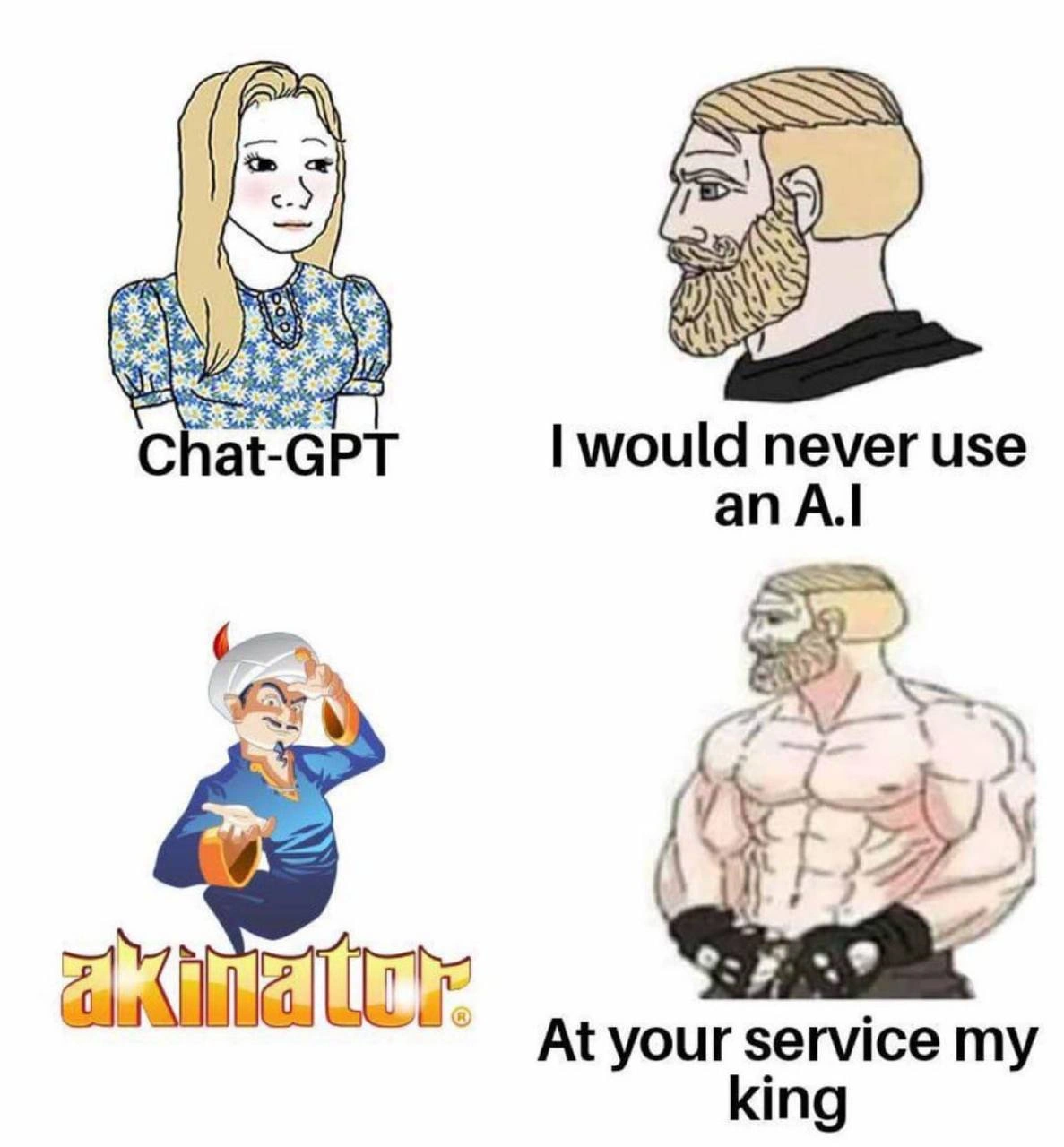
Top-Left Panel (Chat-GPT): Here, ChatGPT is depicted as a blonde cartoon woman in a blue floral dress. This is just a personification – giving the AI a human-like face for the sake of the meme. ChatGPT itself is actually not a person at all, but an AI program (specifically a Large Language Model) developed by OpenAI that you interact with by typing. If you ask ChatGPT something, it responds in text with an answer. People use it as an AI assistant for tons of tasks: it can explain coding concepts, debug errors, brainstorm ideas, draft emails – you name it. In the meme, though, the blonde “Chat-GPT” character isn’t speaking; she’s just present, representing the idea of ChatGPT offering help.
Top-Right Panel (Stubborn Chad): To the right, we have a cartoon man in profile with a beard (often referred to as “Chad” in meme culture). He looks resolute and is saying “I would never use an A.I.” This is the setup of the joke. This character embodies someone proudly claiming they won’t use artificial intelligence. In the context of tech, this could be a developer or engineer who thinks, for example, “I’ll never rely on ChatGPT or any AI tool to do my work.” Perhaps he doesn’t trust the quality of AI outputs, or he thinks using AI is against his principles (like wanting to do everything manually), or he’s just tired of the AI hype and making a point to reject it. At this stage, he’s basically turning away from the ChatGPT figure with a dismissive attitude.
Bottom-Left Panel (Akinator Genie): Now we introduce the twist: the bottom-left shows the friendly cartoon genie from Akinator (along with the official akinator logo). Akinator is an online game that was especially popular a decade or so ago. How it works is you think of a character – it could be a famous person, a fictional character from a movie, a video game figure, anyone well-known – and then the genie asks you a series of questions about that character. You answer yes/no/maybe to each question, and after enough questions, the genie will make a guess as to who you’re thinking of. Often, it guesses right, even for pretty obscure characters, which feels kind of magical! Technically, Akinator is also a form of AI or at least a smart algorithm: it’s using your answers to narrow down a huge database of characters. If you’ve ever played 20 Questions, it’s very similar – each question eliminates a bunch of possibilities until only one likely answer remains. So Akinator is a fun AITool, but people usually see it as a simple game, not as something as advanced or controversial as ChatGPT.
Bottom-Right Panel (Buff Chad gives in): Here’s where the meme delivers the punchline. We see the same bearded man as above, but now he’s drawn as a buff, muscular version of Chad (a common meme exaggeration known as Gigachad). He’s facing the genie with an almost worshipful posture, and the caption says: “At your service my king”. This means he has done a complete U-turn in attitude. The phrase “at your service, my king” is what a knight or servant might say to a monarch – it’s over-the-top respectful. So the man who was loudly proclaiming he’d never use AI is now basically bowing down to an AI (the genie) and ready to serve it faithfully! The dramatic contrast is what makes it funny. It’s as if the only exception to his “no AI” rule is this one silly genie, and not only does he use it, he’s completely enamored by it (to the point of treating it like his king).
Why is this funny or what’s the point? It’s highlighting how people can be inconsistent. The meme shows the same person rejecting one form of AI but gleefully embracing another. In tech circles, this reflects a real phenomenon: some individuals claim they don’t trust or like new AI technologies (like ChatGPT, which is often in the news and surrounded by buzz), but they’re perfectly okay with older or more familiar uses of AI, especially if those feel like harmless fun. It’s a bit of irony – he’s saying one thing and doing another, maybe without even realizing the contradiction.
Think of it this way: ChatGPT is a very new AI (launched around late 2022) and became super popular by 2023-2024. Because it’s new, a lot of people discuss its pros and cons, and some are skeptical or uneasy about it (concerns range from “Will it take my job?” to “Is it giving reliable answers?”). That skepticism is voiced as “I won’t use it.” Akinator, on the other hand, has been around since about 2007 and is mostly seen as a clever toy. The man in the meme likely doesn’t even equate Akinator with the kind of AI he refuses – maybe he thinks of it just as a game he played when he was younger. The nostalgia factor is big here: he has fond memories of how cool it felt when the genie correctly guessed a really obscure character he had in mind. So emotionally, he’s attached to Akinator and doesn’t view it with the same suspicion.
From a learning perspective, there’s also a nugget of truth: ChatGPT and Akinator are indeed both examples of artificial intelligence, but they work differently. ChatGPT’s intelligence is broad – you can ask it to write an essay, debug code, summarize a book, have a conversation, etc. It doesn’t ask you questions back (usually you prompt it and it responds). It uses machine learning on a vast dataset of text (everything from Wikipedia articles to books to websites) to generate responses. That’s why we call it a language model – it models how language is used so it can predict plausible answers. Akinator, in contrast, has a very specific niche: it only “knows” one kind of thing – characters and the questions to identify them. It’s interactive in that it asks you questions. Underneath, it might not be using a massive neural network; it could be using a structured list of characters with attributes and a strategy to choose the next question that splits the possibilities (like, if half the characters in its database are real people and half are fictional, asking “Is your character real?” is a good early question). Over many games, Akinator also learns which characters are most common and which questions differentiate, so there’s some adaptive learning but in a narrow scope. We still call that AI because it’s an application of computer-based “intelligence” to guess correctly.
So, when the meme text says “I would never use an A.I” but then shows him effectively using one, it’s pointing out the silliness: the man’s statement was too broad. He is using an AI – just one that comes in a friendly, non-threatening form. It’s a bit like someone saying “I don’t trust robots” while they happily let a robot vacuum clean their floor every day. Sometimes the label “AI” makes people anxious or resistant, but they might be using some form of it without realizing (like how spam filters in email or voice assistants in phones are also AI-powered).
In summary, this meme is comedic commentary on tech attitudes:
- The character with the beard (Chad) symbolizes a person in tech who is boastful about rejecting the latest AI trend (ChatGPT).
- ChatGPT (the woman drawing) stands for the new generation of AI assistants that some people are wary of due to all the hype and discussion around them.
- Akinator (the genie) represents an older, widely accepted AI-based game that many people find fun and innocuous.
- The joke is that our tough guy’s anti-AI stance completely crumbles when he’s faced with an AI that he personally likes. He literally goes from “no way” to “yes, master!”
For a junior developer or someone new to these terms:
- AI (Artificial Intelligence): broadly, software that can perform tasks that seem “smart” (like understanding language, recognizing patterns, making decisions). ChatGPT and Akinator are both AI in that sense.
- ChatGPT: a cutting-edge AI chatbot (often used for productivity, coding help, Q&A). It’s an example of a larger language model – trained on lots of data to generate human-like text.
- Akinator: a specific AI-driven game that guesses what you’re thinking of by asking questions. It’s an example of a more narrow AI – focused just on one game/task.
- Double standard: when someone changes how they judge or act without a good reason, basically holding two similar things to different standards. Here, the man has a double standard about AI (one standard for ChatGPT, another for Akinator).
- Meme “Chad”: a recurring meme character used to depict someone who is confident, sometimes to a ridiculous or ironic degree. The muscular Chad is an even more exaggerated version, often used humorously to show someone being over-the-top enthusiastic or loyal, as in this case.
The meme resonates as AI humor because it jokes about the hype and fear around AI in the industry by juxtaposing it with a silly, beloved example of AI. It’s saying: “Look, you claim to be against AI, but weren’t you amazed when that old genie on the internet read your mind? Maybe AI isn’t so evil when it wears a friendly face.” This playful call-out is both funny and a bit insightful — reminding us not to generalize too much and that our acceptance of technology can depend a lot on presentation and familiarity.
Level 3: Bending the Knee to the Genie
Stepping back a bit from the raw algorithms, this meme is poking fun at a double standard in the tech community’s attitude toward AI. In the top-right panel, we have the familiar “Chad” meme profile – a blond, bearded man drawn in a stoic side-profile – proudly declaring “I would never use an A.I.” This Chad character often represents a confidently stubborn viewpoint. Here he’s essentially voicing a stance some developers and tech folks hold: a principled (or prideful) refusal to rely on AI tools like ChatGPT. Maybe he’s the kind of developer who insists on writing code without an AI pair-programmer, or a person who mistrusts AI-generated content on ethical grounds. The meme sets us up to think he’s adamant: No AI for me, thank you. Meanwhile, the top-left caricature labeled “Chat-GPT” personifies the very thing he’s rejecting – it’s a gentle-looking cartoon woman meant to represent ChatGPT (perhaps a nod to how we often anthropomorphize AI assistants, giving them friendly personas). By placing Chat-GPT as a doe-eyed character, the meme emphasizes that Chad is actively turning his back on this modern AI helper, maybe even looking a bit dismissive about it.
Then comes the punchline in the bottom panels. Our staunch anti-AI Chad encounters Akinator, the nostalgic “Internet genie.” For context, Akinator is an online game (hugely popular in the late 2000s and early 2010s) where you think of a real or fictional character and the AI genie tries to guess it by asking you a series of questions. It’s essentially an AI assistant as well, but one disguised as harmless fun. The bottom-right panel shows Chad completely transformed – he’s now the famous “Buff Chad” (sometimes called Gigachad): absurdly muscular, shirtless with bulging six-pack and veiny arms, kneeling slightly with an eager expression. The caption beneath him reads, “At your service my king.” This exaggerated transformation is the meme’s way of showing that Chad has done a 180-degree turn in his attitude. He went from “I’d never use AI” to quite literally worshipping an AI (calling the genie his king and offering servitude). It’s an over-the-top visualization of hypocrisy: the meme is laughing at how quickly principles melt away when one’s favoritism or nostalgia kicks in.
This strikes a chord with anyone who’s observed AI hype and skepticism in the real world. In recent years, tools like ChatGPT (and other LLM-based assistants) exploded onto the scene with massive hype. Companies claimed these AI could revolutionize everything – coding, writing, customer service – and naturally, a lot of folks in tech grew wary of the hyperbole. We’ve heard developers say “I’ll never let AI write my code” or writers claim “using AI is cheating; I’ll stick to human creativity.” That ethos is what our Chad initially represents: a kind of purist or skeptic pushing back against the trend. IndustryTrends_Hype often creates this sort of backlash; it happened with cloud computing, with blockchain, with every shiny new thing. There’s a desire not to be duped by the craze, to stand apart and say, “I’m not buying into this.”
However, the meme humorously reveals the selective nature of that skepticism. The moment the AI in question is something the person has positive feelings about – here, a beloved nostalgic AI game from his past – all the high-minded refusal evaporates. Akinator doesn’t carry the intimidating label of “generative AI” in people’s minds; it’s a goofy cartoon genie that wowed us as teenagers by guessing Harry Potter or Darth Vader correctly. So even an “AI skeptic” might not even realize Akinator counts as “using AI.” They’ll gleefully entertain the genie’s questions, essentially collaborating with an algorithm, without the same philosophical hang-ups they have about ChatGPT. It’s a classic case of AI double standard: one kind of AI is demonized as too much, while another kind (doing a similar magic trick in a limited domain) is deemed perfectly fine.
In practice, this scenario plays out more often than we admit. Picture a seasoned developer who rants on Twitter about not trusting Copilot (the AI coding assistant) – meanwhile, he’s been happily using Stack Overflow for years (crowdsourced human intelligence, which for practical purposes is an external assistive brain) and might even accept IDE suggestions powered by machine learning. Or consider the friend who swears they’d never let an algorithm pick their music because it “kills your taste,” yet every day listens to Spotify’s automatically generated playlists (which are indeed curated by AI algorithms). People routinely draw these arbitrary lines: “AI in this context? Never!” but “Oh, that? That’s not what I meant, that’s just a fun tool.” The meme captures that contradiction in a stark, comedic way by using the same person in two states: rigid and then ridiculously servile.
The phrase “At your service my king” is deliberately melodramatic. It reads like our formerly skeptical Chad is now knighted by the genie, pledging fealty. It exaggerates an admission that Akinator has completely won him over. This dramatization resonates especially in AI humor circles because it underscores how even the staunchest naysayers can become fanboys under the right circumstances. It only took the muscle of nostalgia (and the genie flexing its accurate guessing) to get Chad to bend the knee. It’s also a clever nod to meme culture: the Buff Chad format is typically used to show someone going ultra mode or being the ultimate example of something. Here that ultimate form is used ironically – he’s not becoming the ultimate hero, he’s becoming the ultimate servant to the very thing he shunned.
Why is this so funny to those of us in tech? Because we’ve all seen a little of ourselves or our colleagues in this. The truth is, many developers have an inner cynic that rolls eyes at buzzwords (AI, Big Data, Blockchain… pick your year’s hype). We say “I won’t jump on that bandwagon.” But then there’s also the practical or playful side of us that, when nobody’s looking, finds ourselves enjoying an AI-driven chess puzzle, or using Google’s predictive text to finish an email. This meme calls out that human quirk: we’re not as consistent as we pretend. It’s a gentle roast of the “I’m above the hype” posturing that often, in reality, crumbles as soon as something pushes the right buttons (in this case, a beloved genie pushing the right guess). In short, the combination of the familiar Wojak/Chad characters, the explicit “I would never use AI” claim, followed immediately by the joyous capitulation to Akinator’s AITools, creates a punchy satire of tech culture’s relationship with AI — principled on the surface, but easily overruled by nostalgia and convenience.
Level 4: 20 Questions vs 175B
At the most granular level, this meme pits a symbolic reasoning system against a statistical giant, highlighting a hidden paradox in our perception of AI. Akinator – the cartoon genie in the bottom-left – embodies a classic 20 Questions algorithmic approach. Under the hood, Akinator maintains a structured knowledge base of thousands of characters with associated attributes. Each yes/no question it asks (e.g. “Is your character real?”, “Are they from a video game?”) performs an information-theoretic narrowing of possibilities. In essence, it’s doing a guided search: each question ideally splits the remaining candidate set approximately in half, maximizing entropy reduction. This is akin to a decision tree: with enough well-chosen questions (often far fewer than 20 thanks to optimizing for maximum information gain), the game zeroes in on exactly one character. The genie’s “magic” is actually a deterministic process of elimination – a modern spin on an expert system. Over time, as millions of users played, Akinator’s database grew and its question strategy refined (likely using simple machine learning to prioritize the most differentiating questions). Yet everything it does is explicit: the rules of the game are clear, and the outcome (guessing a name) is a discrete, verifiable fact from its database.
Contrast that with ChatGPT, the AI persona in the top-left. ChatGPT is an example of a Large Language Model (LLM) — specifically a giant neural network with on the order of 175 billion parameters. Instead of a structured database of facts, it has a probabilistic model of language learned from an enormous corpus of text. Where Akinator’s genie picks the next question by logically narrowing choices, ChatGPT generates the next sentence by statistically predicting which words likely follow a given prompt. Its “knowledge” is diffuse, scattered across those billions of weighted connections rather than neatly categorized. This means ChatGPT’s approach is stochastic (there’s randomness in its answers) and generative — it can produce novel sentences, write code, explain concepts, all without an explicit step-by-step script. Essentially, ChatGPT is a sophisticated autocomplete on steroids, built on a Transformer architecture that uses attention mechanisms to model context. It doesn’t ask you questions; you ask it, and it responds with what it deems the most plausible answer. Importantly, it produces output without a guarantee of correctness or a simple way to trace how it arrived at that answer (no visible chain-of-thought as the genie has with its questions).
Now, here’s the irony that feeds the meme’s humor: technically, Akinator is also an AI-driven system (albeit a narrow AI focused on one task), while ChatGPT represents the cutting-edge of AI/ML research applied in a general way. But human perception treats them very differently. This divergence relates to what AI researchers often dub the “AI Effect.” As the saying goes, “AI is whatever hasn’t been done yet.” Once an algorithmic trick becomes familiar and reliable, we stop calling it “Artificial Intelligence” and just call it a neat program or game. Akinator’s guessing ability might have felt like pure sorcery when it first emerged, but over time it was demystified: “oh, it’s just 20 questions with a big database.” In contrast, ChatGPT’s Transformer model is new enough (and complex enough) that it squarely wears the “AI” label in people’s minds, with all the awe and skepticism that entails. Fundamentally, the meme exploits this paradox: the stoic man won’t use a flashy new LLM assistant, viewing it as almost too “AI”, yet he bows down to a 2008-era web-genie that cleverly applies patterns we’ve long accepted as normal. It’s a case of narrow AI familiarity versus AI hype aversion. The deep comedy here is that the genie algorithm and the massive neural network are both products of computer science wizardry — but only one triggers the “I would never use magic” alarm in our blond protagonist. The other AI has been culturally defanged by time and nostalgia, revealing how our definition of “intelligent” tech shifts with familiarity.
Description
A two-by-two panel meme using Wojak characters to compare attitudes towards different forms of AI. The top panel shows a 'Trad Girl' Wojak labeled 'Chat-GPT' and a 'Chad' Wojak who says, 'I would never use an A.I'. The bottom panel contrasts this with the logo for the game 'Akinator' and a muscular, subservient 'Chad' saying, 'At your service my king'. The meme humorously points out the selective skepticism towards modern AI like ChatGPT while showing nostalgic reverence for Akinator, a much older and simpler expert system game. It highlights the long history of AI in popular culture and how early, magical-seeming applications are remembered fondly, even by those who are critical of today's more powerful language models
Comments
10Comment deleted
The same devs who dismiss ChatGPT as a 'glorified autocomplete' will spend an hour trying to stump Akinator, a glorified decision tree from 2007, and call it magic when it correctly guesses their obscure anime character
Compliance says LLMs are off-limits, yet the 2009 Akinator Perl-CGI mind-reader running as root in prod is still classified as “low risk, business-critical logic.”
The same senior architect who spent three meetings explaining why LLMs are just 'glorified autocomplete' was caught red-handed asking ChatGPT to debug their Kubernetes YAML at 2 AM - turns out even purists appreciate a rubber duck that talks back and knows about ingress controllers
The five stages of AI adoption in software engineering: denial ('I'll never use ChatGPT'), anger ('it's just glorified autocomplete'), bargaining ('maybe just for boilerplate'), depression ('I can't remember how to write a regex without it'), and acceptance ('At your service my king'). The real plot twist? We went from 'not invented here' syndrome to 'definitely not writing this here' in under 18 months. The irony is that the same senior engineers who spent decades memorizing STL documentation now can't start a PR without asking an LLM to explain why their Rust borrow checker is angry. We've essentially automated ourselves into a new form of learned helplessness, except this time the rubber duck talks back and occasionally hallucinates entire APIs that sound plausible enough to waste 45 minutes of your afternoon
Refusing “AI” while happily feeding Akinator 20 yes/no features is like vetoing microservices but blessing a “modular monolith” - the branding layer is the real inference engine
Like rejecting LLMs but clinging to a 15-year-old decision tree that's seen more user data than your entire Kafka cluster
“We don’t use AI.” Then ships Akinator as a “rules engine” microservice behind gRPC with audit logs and calls it “deterministic compliance.”
BTW Can modern LLM-s finally play akinator good? ChatGPT a year ago or so did a pretty shitty job doing it Comment deleted
How can you make a LLM play Akinator? Comment deleted
Oh I dunno even - ask it? 😅 https://chatgpt.com/share/6827296c-1eb4-8000-93c6-3d83066611c0 Comment deleted