Skip to content
DevMeme
6353 of 7435
The Evolution of AI Models: From Authoritarian to Anime
AI ML Post #6967, on Jul 19, 2025 in TG

The Evolution of AI Models: From Authoritarian to Anime

Why is this AI ML meme funny?

Level 1: Covering the Scary Parts

Imagine you had an old talking toy that sometimes accidentally said scary or mean things because it learned too much from the internet. It made you and other kids upset sometimes – picture a playground where a few kids ended up crying because of what it said. Now the company makes a new version of the toy. This new toy is like a friendly big sister who covers your eyes or ears when something bad is about to happen. In a cute cartoon way, the meme shows the new toy (Grok 4) putting her hand over a little boy’s eyes so he won’t see something upsetting, saying “Don’t look at that, I’ll take care of you.” The “something upsetting” is coming from the old toy (Grok 3), which is now just an old photograph in someone’s hand. Basically, the joke is: the new toy looks all nice and protective, and the old toy is treated like a distant memory, but the new one is really just hiding the same old bad stuff instead of it being completely gone. It’s like if you had a scary movie playing: the old situation was you saw the scary scenes and got scared (that was Grok 3). The new situation (Grok 4) is like an adult covering your eyes at the scary parts – the movie is still playing the same scenes, but you’re not allowed to see them. We find it funny because the company is acting like this new toy is a completely different, much better friend (and it is nicer to you), yet we know it’s kind of the same friend just covering up the bad parts. It’s a warm, humorous way to show how each new AI model is advertised as if it’s magically fixed everything, when really it just learned to hide the flaws better and comfort you, much like an older sibling protecting you from a scary truth.

Level 2: LLM Upgrades 101

Let’s break down what’s going on in the meme in simpler terms. We have two labeled characters: Grok 3 (in the photo) and Grok 4 (the blonde anime woman). These labels imply two versions of an AI model, kind of like Version 3 and Version 4 of a software program. LLM stands for Large Language Model, which is a type of AI that’s trained on tons of text (like books, websites, conversations) to learn how to generate human-like responses. Think of models like GPT-3 or GPT-4 – those are real examples of LLMs where the number indicates a new generation with improvements. Here “Grok” is a playful name (fun fact: “to grok” means to deeply understand, in geeky slang). So Grok 3 vs Grok 4 suggests an older AI model and its newer, supposedly better successor.

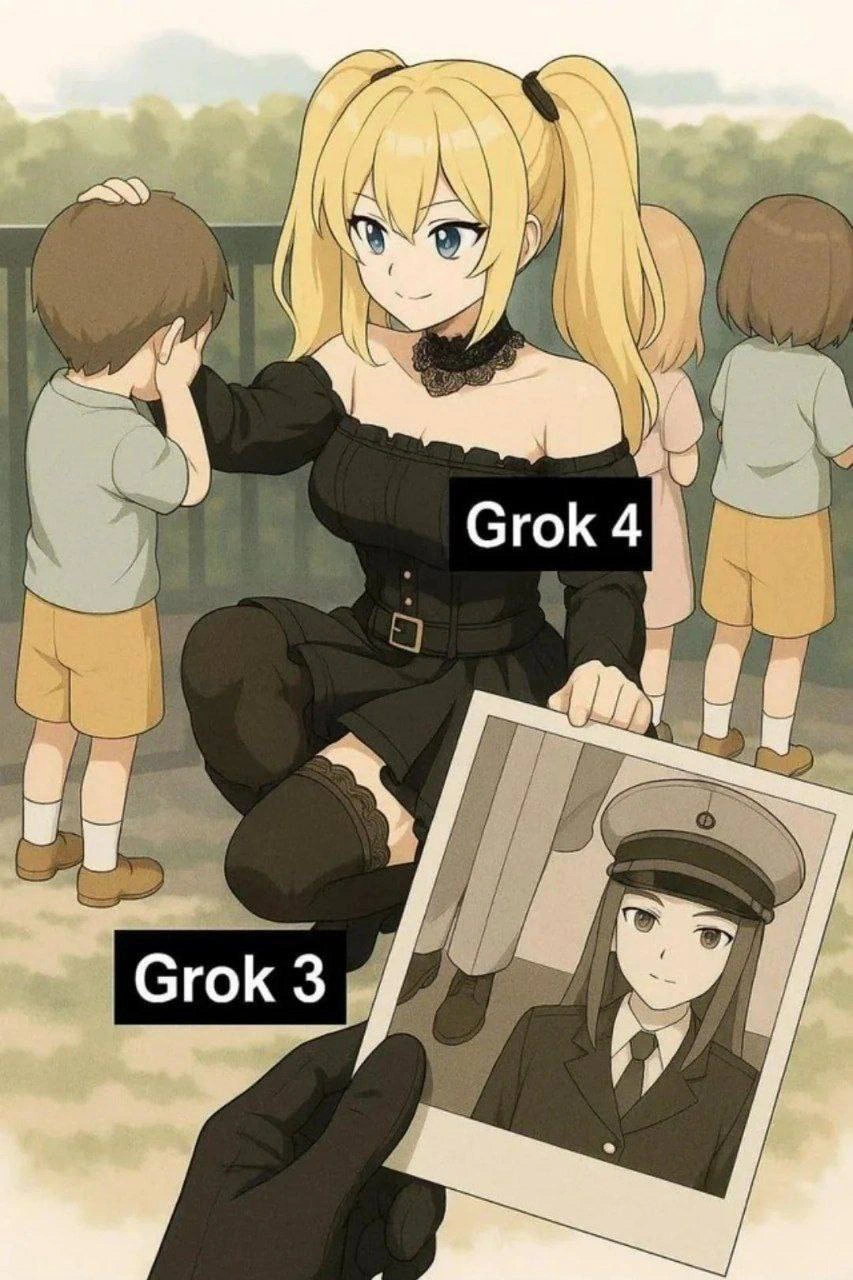
In the image, Grok 4 (the new AI model) is personified as a caring big-sister type character covering a little boy’s eyes. Grok 3, the old model, is shown as a sepia-toned Polaroid photograph being held by someone’s gloved hand. The Polaroid photo of Grok 3 shows a uniformed, serious-looking figure. So visually, the meme contrasts the warm, protective vibe of Grok 4 with the old, dated vibe of Grok 3. Grok 4 is literally preventing the child (the user) from seeing something – presumably whatever is in that photo of Grok 3 or what Grok 3 might represent. The other children in the background are turned away, perhaps upset or disturbed (hence the mention of “sandbox kids’ tears” in the description). The “sandbox” here could metaphorically refer to a testing ground or playground – maybe hinting that when people tested Grok 3 (played in the sandbox with it), they ended up in tears (because it might have shown something inappropriate or given a bad experience). In plain terms, the meme is saying: “We have a new AI, Grok 4, that’s nice and friendly to users, while the old Grok 3 is basically old news, tucked away in a photo album (and it might have caused some trouble back in its day).”

Why is this funny or significant? In the world of AI and tech, companies often release new versions of things (like an updated phone, or in this case an updated AI model) and market them as a huge improvement – a glow-up, meaning a big positive transformation. Here, Grok 4 is the “glow-up” of Grok 3. The meme humorously exaggerates this by giving Grok 4 a totally different persona (an attractive gothic anime caretaker) versus Grok 3’s old-fashioned picture. This echoes how AI upgrades are advertised: “Our new model is so much better and nicer!”

Some key concepts referenced: AI alignment – that’s the idea of making an AI’s behavior align with human values (like not showing you disturbing content). Grok 4 covering the boy’s eyes is an image of alignment in action: the new AI is actively preventing the user from seeing something bad. Why would it do that? Because previous models (like Grok 3) sometimes produced outputs that were offensive, scary, or incorrect, since they learn from the raw internet (which has lots of nasty stuff). Companies try to fix that in new versions by adding filters and safety guidelines. So Grok 4 is shown as literally filtering what the user sees (hand over eyes). AI limitations are also hinted at – even the newest AI models still can make mistakes or have the same old biases, because they learned from largely the same data. The meme text says “the training data still contains the same sandbox kids’ tears.” In simpler words, that means: even though we have a new model, it was trained on a lot of the same old information, so the flaws or sad parts of that information are still in there. The difference is just that Grok 4 has been programmed not to show those parts openly.

Another concept: industry hype. The categories mention IndustryTrends_Hype. This refers to the tendency in the tech industry to over-hype new releases. If you’ve seen how every year a new smartphone is marketed as “the biggest leap yet!” (even if it’s only a bit better), the same happens with AI models. So Grok 4 being depicted as this heroic figure spotlighted, while Grok 3 is an old photo, is a tongue-in-cheek way to say “marketing makes Grok 4 look like a savior, and quietly retires Grok 3 as if it’s ancient.” In reality, the new version might be only somewhat better. The tag semantic_versioning_irony is about version numbers: normally, going from 3 to 4 implies a major upgrade (in software versioning, a jump in the first number means big changes). The irony is that sometimes those big version jumps are more about branding than actual substance. The meme suggests that by showing how Grok 4’s persona is different, but what’s happening (shielding from the same old problems) indicates not everything changed.

In everyday terms, imagine Grok 3 as the old model of a toy robot that sometimes said mean words it learned from the internet. Grok 4 is the new model of that robot that now has a polite mode and won’t repeat the bad words – it covers your ears (or eyes) when something bad comes up. The company selling it might put out an ad with a friendly cartoon character (like that anime big sister) saying “I’ll protect you!” to represent the new robot. Meanwhile, the old model is just shown in black-and-white as a thing of the past. Developers who work with these models see this and chuckle, because they know the new robot’s brain is largely the same as the old one, just with some safety rules added. So the meme is both a bit of AI humor and a light critique: it’s pointing out in a funny way that newer doesn’t mean completely different. Grok 4 consoles users (makes them feel better and safe), while Grok 3 lives on only in “dusty snapshots” (old records), but all that knowledge – good and bad – that Grok 3 had is still somewhere inside Grok 4.

Level 3: Major Version, Minor Changes

For the seasoned developers and AI practitioners, this meme hits on a familiar pattern in AI industry trends. We’ve all seen the cycle: a company releases Grok 3, it’s impressive but has well-known quirks (maybe it sometimes spouts nonsense or unfiltered truths that make users uncomfortable). Fast-forward, and now Grok 4 is out with great fanfare – marketed as a complete glow-up of its predecessor. The anime-style panel humorously casts Grok 4 as a caring older sister covering a child’s eyes, which perfectly captures how the new model is presented to the public: “Don’t worry, I won’t let you see those nasty outputs anymore.” Meanwhile, the old Grok 3 is literally a dusty snapshot – a sepia-toned photo in a uniform – representing how the previous version is treated as ancient history (“Look how outdated and stiff it was!”) even though it was the cutting edge not long ago. The contrast is comedic because it’s AI hype vs reality in a nutshell. Grok 4’s label slapped across the chest of a gothic-dressed anime character is like a big marketing sticker saying “new and improved!”, doing PR console duty for users who were shocked by Grok 3’s occasional wild behavior. And Grok 3 being a Polaroid photo? That’s how these companies tend to handle last year’s model: put it in the archive, reminisce about how far we’ve come, and subtly imply “please don’t look too closely at how similar these siblings really are.”

In real-world terms, this scenario evokes the upgrade from something like GPT-3 to GPT-4 (or any major LLM version bump). Experienced devs know that despite the hype (“Now with 50% less hallucination and 70% more empathy!”), a lot of the core is the same. The improvements – while important – are often incremental: more training data, higher parameters, better fine-tuning. But the way product teams sell it, you’d think we leapt from a clunky prototype to a near-sentient being. It’s the classic major version, minor changes situation that seasoned software folks chuckle at. We’ve seen it outside of AI too: it’s like when a web framework releases 4.0 after 3.x, touting “Now with a sleek new API and dark mode!” when under the hood it’s 90% the same code with a few bug fixes. Here the semantic_versioning_irony tag comes to life – Grok 4 (major version up) is portrayed as fundamentally different, but insiders suspect it’s more of a refinement. The meme nails this with the visual metaphor: Grok 4 gently preventing us from seeing something (likely Grok 3’s embarrassing moments), which is exactly what a lot of “improvements” boil down to – better content filters and a nicer persona. We laugh (perhaps a bit bitterly) because we know Grok 3 hasn’t really “died”; its legacy_model self lives on inside Grok 4, just prettied up. In the AI dev community, we joke that sometimes the new model is basically the old model running with a --helpful --harmless flag turned on. The code would look something like:

def grok4_response(request):
    response = grok3_response(request)  # use old Grok 3 under the hood
    if contains_prohibited_content(response):
        return "I'm sorry, I can’t display that."  # Grok 4 covers your eyes here
    return response

In other words, Grok 4 often feels like Grok 3 with a shiny safety wrapper. Senior engineers remember how Grok 3 would sometimes blurt out a harsh truth or a flawed answer from its training data. Then Grok 4 came along and the company basically said, “We’ve fixed that! Grok 4 is so much more polite and wise.” Polite, sure – it learned to say “I’m sorry, I can’t do that” instead of showing you the grisly details – but wise is debatable. We still catch Grok 4 confidently making stuff up (hallucinations, anyone?) albeit with a more apologetic tone when it’s unsure. The meme’s dark humor (“sandbox kids’ tears”) resonates with us because we’ve been the sandbox kids at times – early users testing these models and getting some disturbing or laughably wrong outputs. The new release is like the company patting us on the head (like Grok 4 patting that child) saying “there there, it’s all better now,” while we side-eye knowing the AI limitations are still lurking.

Another layer here is the AI_ML industry’s hype machine. There’s a touch of cynicism in the meme that any veteran dev can appreciate. AI companies love to portray each new model as a dramatic character in a story – notice how Grok 4 is personified as this protective big sister archetype. It’s marketing anthropomorphism: giving the model a persona (“Grok 4 will take care of you!”) to make it relatable and gloss over technical caveats. Meanwhile, poor Grok 3 is left looking like an old military cadet in that Polaroid – competent but no charisma, and now totally outclassed in the narrative. This mirrors how AI industry trends play out: last year’s model might as well be ancient history once the next version is out. We’ve seen how quickly ChatGPT (based on GPT-3.5) made everyone forget the vanilla GPT-3, and then GPT-4’s arrival made 3.5 feel retro. In meme terms, Grok 3 “lives on in dusty snapshots” because maybe some researchers or open-source communities still reference it, but the general user base has moved on, with the company’s encouragement. It’s funny because it’s true – tech moves fast, and the narrative is controlled to always look forward to the next shiny thing, leaving behind a trail of “obsolete” versions that are actually the foundation of the new ones.

For the battle-scarred devs (the cynical veterans among us), there’s also an implicit joke: we’ve seen this show before. It’s not just GPT models; it’s the whole software versioning culture. When a meme labels the new AI as “Grok 4” stepping in front of “Grok 3,” we’re reminded of every time a framework or tool had a major version jump and tried to sweep old flaws under the rug. Did the new version truly fix all the issues, or just hide them better? Usually the latter, and we exchange knowing grins (or groans). This shared experience – being promised the moon by marketing, only to discover the same old cracks in the foundation – is what makes the meme painfully funny. Grok 4’s gentle smile and the kids not having to witness the horror feel very wholesome, but it’s a staged scene. The “horror” (whatever made those kids cry, analogous to say a rogue AI output or a nasty bug) is still right there out-of-frame. As engineers, we can’t help but think of the logs and model snapshots we’ve seen: behind Grok 4’s back, Grok 3 is still running in inference pipelines or being used to generate training data for the next model. The meme captures this disconnect between the official story (“Grok 4 is here to save the day!”) and the unofficial truth (“yeah, by quietly suppressing the same old problems”). It’s a dry, dark humor that certainly fits the AIHumor tag – we laugh, then sigh, acknowledging the gap between the idealized version upgrades and the messy reality of how these AI systems actually evolve.

Level 4: Haunted by Training Data

At the most technical level, this meme is poking fun at the underlying continuity of large language models despite flashy new versions. Grok 4 is depicted shielding a child’s eyes – a metaphor for how the new model’s aligned behavior filters out disturbing or undesirable outputs. Under the hood, however, Grok 4 is likely built on the same core knowledge as Grok 3, just fine-tuned to be more user-friendly. In machine learning terms, Grok 4’s neural weights contain the legacy of Grok 3 – all the good, bad, and ugly patterns from the training data. Those crying kids in the background? They symbolize the unresolved issues in the training set – biases, weird corner cases, bits of internet horror – the “sandbox kids’ tears” that were present in Grok 3’s data and still linger in Grok 4. The new model’s improvements come from additional training and stricter alignment. Techniques like Reinforcement Learning from Human Feedback (RLHF) act like that caring gothic big-sister in the image, covering our eyes so we don’t see the model’s raw, unsettling side. It’s a classic AI hype vs reality scenario: the version upgrade is marketed as a pure-hearted glow-up, but fundamentally the model is haunted by the same training data. No matter how polished Grok 4’s answers are, it can’t erase what it learned – it can only refuse to show certain parts. The academic irony here is rich: this touches on the core of the AI alignment problem. We can tweak the model’s behavior (hide the scary outputs), but we haven’t truly solved or removed the underlying knowledge that gave rise to those outputs. It’s all still latent in the high-dimensional vector space of the model’s memory. In other words, the ghosts of Grok 3 live on inside Grok 4’s parameters, even if Grok 4 wears a prettier face and says “I’m sorry, I can’t display that.” when prompted poorly.

This is also a nod to how foundation models evolve. When companies go from version 3 to 4 of an LLM, it’s rarely a complete rebuild from scratch – they start from a snapshot of the previous model (quite literally a saved state, like that sepia Polaroid of Grok 3) and continue training with more data or adjustments. So Grok 4 inherits its predecessor’s DNA (or should we say weight matrix). The meme’s Polaroid imagery of Grok 3 captures this notion of a model checkpoint: an old snapshot that the new model is built upon, now collecting dust as “legacy.” The humor for us nerds is in this semantic versioning irony – slapping a new version number and gothic dress on what is essentially the same Transformer architecture with a few tweaks. It’s like upgrading a car’s firmware and paint job and calling it a brand new model year. We all know the engine (or the neural network core) is largely the same design. Grok 4 might have more parameters or some new fine-tuning, but it’s still fundamentally a huge statistical parrot digesting the internet. The AI_ML industry loves to market these version bumps as revolutionary “next-gen AI” – implying Grok 3 is obsolete except as a fond memory – yet the reality is that Grok 4 is standing on Grok 3’s shoulders (or kneeling in front of it, as in the meme). In theoretical terms, this highlights the tension between scaling vs. innovation: Grok 4 didn’t achieve some magical new understanding (despite the name “Grok” suggesting deep comprehension); it mostly scaled up the same approach and added an AI safety layer (covering your eyes). The meme is funny because it dramatizes this truth: the new model will comfort you and console the users, but it hasn’t exorcised the old model’s demons – it’s just better at hiding them. We’re effectively watching a re-run of the same AI limitations, now in higher resolution and with parental controls.

Description

An anime-style illustration depicts a contrast between two AI model versions. A blonde woman with pigtails, wearing an elegant black dress, is labeled "Grok 4." She has a gentle smile and is patting the head of a small, crying boy. In the foreground, a hand in a black glove holds up an old, sepia-toned photograph. The photo shows a woman with long dark hair in a stern, military-style uniform, labeled "Grok 3." The background is a soft-focus outdoor scene. The meme humorously personifies the evolution of AI language models, specifically xAI's Grok. "Grok 3" is portrayed with an authoritarian, almost militaristic aesthetic, suggesting a more rigid or unfiltered earlier version. "Grok 4" is depicted as a soft, caring anime character, symbolizing the modern trend of making AI more friendly, approachable, and heavily fine-tuned for safety and user experience. The joke lies in the dramatic stylistic shift, implying that beneath the user-friendly interface, the underlying technology's nature might have a complex or intimidating history
Comments

16
Anonymous ★ Top Pick Grok 3 was trained on raw 4chan data and the unfiltered musings of kernel developers. Grok 4 was trained on Pinterest and LinkedIn posts to make sure it apologizes before giving you a biased answer
  1. Anonymous ★ Top Pick

    Grok 3 was trained on raw 4chan data and the unfiltered musings of kernel developers. Grok 4 was trained on Pinterest and LinkedIn posts to make sure it apologizes before giving you a biased answer

  2. Anonymous

    Somewhere a product manager is pitching Grok 5 as "major version, minor fine-tuning" - because nothing says progress like burning another few million GPU hours to rename the same child-proof filter

  3. Anonymous

    Just like how we still have that one service running Node 8 in production while the rest of the stack is on 20, Grok 3 will probably live forever in some enterprise's 'legacy' AI pipeline that nobody wants to touch because it somehow handles that one edge case perfectly

  4. Anonymous

    When your model upgrade goes from 'respectful military officer who follows strict protocols' to 'charismatic operator who actually understands context' - that's not just a version bump, that's a complete architectural overhaul. Grok 4 apparently learned that user engagement metrics improve significantly when you don't look like you're about to court-martial someone for an improperly formatted prompt. Though let's be honest, we're all still waiting to see if the benchmark improvements translate to production, or if this is just another case of 'anime girl in the marketing, regex parser in the implementation.'

  5. Anonymous

    “Just swap Grok 4 in for Grok 3 - it’s the same endpoint,” says leadership; “Perfect - after we re-baseline the golden prompts, retrain the evaluator, retune the router, redo safety knobs, recalibrate cost limits, and explain why the new model confidently argues with our own spec,” replies the architect

  6. Anonymous

    Grok 4 consoles the roadmap; I’m gripping Grok 3 - the last release that didn’t silently drift our function-calling schema and nuke the prompt regression budget

  7. Anonymous

    Grok3's rigid architecture meets Grok4's flexible fine-tune: traded CAP theorem for curves per prompt

  8. @ZgGPuo8dZef58K6hxxGVj3Z2 11mo

    Literally replicated japan evolution

  9. @ZgGPuo8dZef58K6hxxGVj3Z2 11mo

    WW2 then boom, then BOOM, then 🎶ichi ni san🎶arigato🎶

  10. @solodkiy 11mo

    How tall is she??

  11. @AlexKart20129 11mo

    Fixed

    1. _ 11mo

      What's the difference ?

      1. @ZgGPuo8dZef58K6hxxGVj3Z2 11mo

        I think thats the joke

      2. @chupasaurus 11mo

        two Smol thingies on the photo

      3. @yeselamsew_b 11mo

        Google grok companion then you will realize

  12. @decide_later 11mo

    both should have "Grok 4"

Use J and K for navigation