xAI Announces Grok-2 Beta Release
Why is this AI ML meme funny?
Level 1: Another Best Ever
Imagine a toy company that every few weeks says, “We’ve made the **coolest, smartest robot ever! It’s even better than the last one!” They give it a flashy name and let kids start playing with it even before all the testing is finished (they might say, “it’s a beta,” which is like saying the robot is still learning to be on its best behavior). At first, everyone is excited – a new amazing toy! But after the fifth or sixth time, you start to giggle because you’ve heard “this is the best one ever” so many times. It’s like each new robot is always “the greatest,” just like the one before. In this meme, a company is announcing a new AI model (an AI that can talk and reason) called Grok-2. They’re very proud, calling it a “frontier” model with fancy reasoning skills, and they’re letting people on a platform (kind of like an app) use it right away even though it’s still a test version. The funny part is how routine this has become – it’s yet another “amazing new thing” being launched. It feels a bit like when a new superhero movie comes out every month claiming to be the most epic adventure ever. You’re excited to watch it, sure, but you also smile because you know next month there’ll be another “most epic” movie. In simple terms, the meme is joking about how tech companies keep releasing “the next big AI” one after another, each with big promises, and everyone’s just kind of nodding along like, “Here we go again, let’s see if this one really lives up to the hype.”
Level 2: Release Notes Jargon
Let’s break down what all this means in simpler terms. LLM stands for Large Language Model – basically a very advanced AI program trained on huge amounts of text (like books, websites, articles) so it can generate or continue text in a human-like way. When you chat with something like ChatGPT, you’re talking to an LLM. Here, Grok-2 is the name of the new LLM they’re launching. The name “Grok” is a nerdy term meaning “to deeply understand” (it comes from a classic sci-fi novel and in tech slang to grok something means you truly get it). By naming their model Grok, they’re implying it really understands things well. And since this is Grok-2, it’s the second version – an upgraded model following whatever Grok-1 was capable of. Think of it like a sequel to a movie or the next model of a smartphone: presumably better and more powerful than the first.
They describe Grok-2 as a “frontier language model.” In plain language, that means it’s on the frontier of AI tech – one of the most advanced of its kind available. Frontier suggests you’re at the cutting edge, the very front of progress. So they’re basically saying “this is as advanced as it gets right now.” Along with Grok-2, there’s mention of Grok-2 mini. This is a smaller sibling of the main model. In AI, a mini version usually has fewer parameters (the “knowledge knobs” inside the model) which makes it faster and less memory-hungry, though often a bit less capable. It’s similar to how a company might release a flagship product and a mini variant – like a big truck vs a small car – serving slightly different needs. Grok-2 mini likely is easier to run (maybe even on a laptop or phone, or just cheaper to use in the cloud) whereas Grok-2 full might require beefy hardware.
Now about the release itself: they call it a Beta Release. In software terms, beta is a stage where the product is mostly finished but not completely polished. It’s like saying “you can use this now, but be aware it might have some rough edges or bugs.” Beta versions are often released to a select group of users or even publicly with that disclaimer. The purpose is to test the product in real conditions and gather feedback or fix issues. It’s a bit like when a game is in “beta” – people can play it early, but they know things might change or crash. So Grok-2 being in beta means the creators think it’s ready to get real-world exposure, but they’re also watching how it behaves to improve it.
They mention “Both models are now being released to Grok users on the X platform.” This requires some unpacking: X is what Twitter was rebranded to (the social network with the posts, replies, etc.). So the “X platform” is basically Twitter under its new name. The phrasing implies that on that platform, there are “Grok users” – likely meaning users who have signed up or have access to this Grok AI on X. Perhaps X has a feature where you can interact with the Grok model (for example, an AI chatbot integrated into the site). If you’re a “Grok user,” you get to use Grok-2 or Grok-2 mini through X. This could mean if you open the X app or site, there might be a section or bot powered by Grok-2 that answers questions or generates content for you. In summary, they rolled out the new AI models to the people on X who have access to the Grok service.
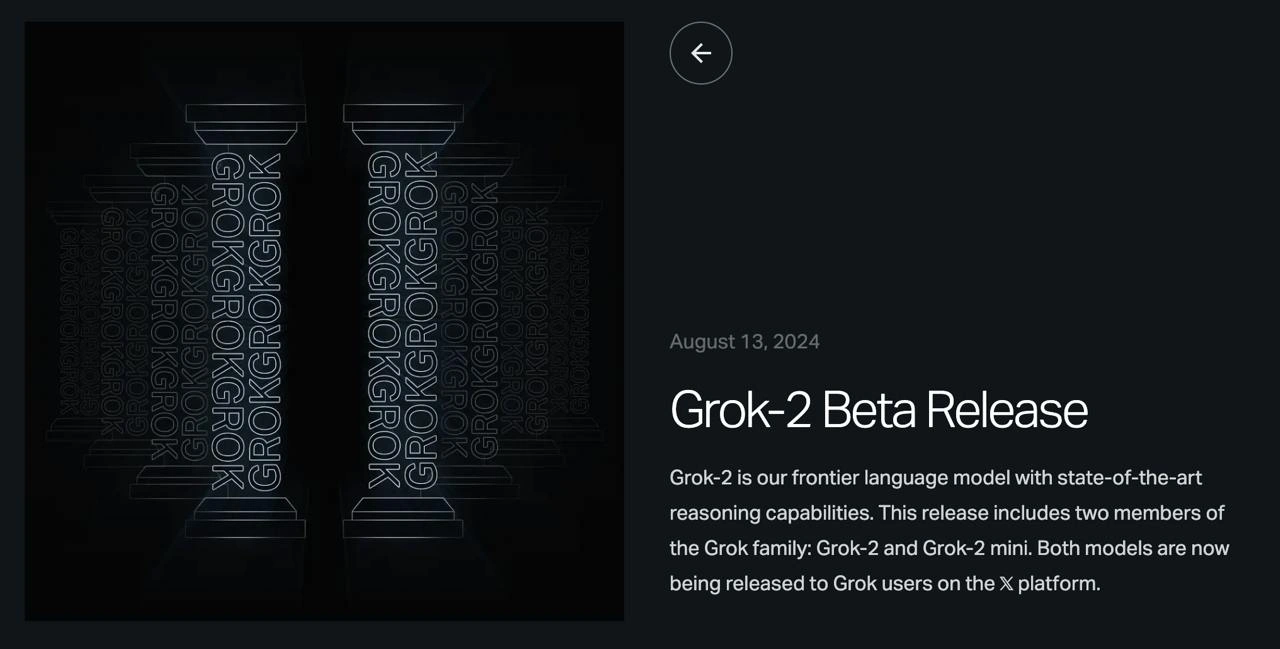
The whole visual layout is mimicking a release notes interface. On the right side, it looks like an official announcement card – there’s the date (August 13, 2024) and the title “Grok-2 Beta Release” with descriptive text. This is exactly how a tech company might present an update in a blog post or an in-app notification. You know those pop-ups like “What’s New in Version 2.0” that appear after you update an app? It’s similar vibes. The left side, with the mirrored columns of “GROK” in neon, is more artistic – probably representing the brand or just adding some cool factor to the announcement. It gives a futuristic feel, signaling that Grok-2 is high-tech and maybe even a bit mysterious. The dark background and neon text is a common design choice to look sleek and “techy.” If you’ve seen promotional images for software or movies about cyberspace, it often has that neon-glow on black aesthetic. Here it likely serves to make Grok-2 seem like stepping into a sci-fi AI frontier.
Some of the language used is classic tech marketing. “State-of-the-art” basically means “the best currently available.” Whenever you see that, it implies the product is at the top of the line compared to others out there. “Reasoning capabilities” refers to how well the model can figure things out or solve problems that require logic and understanding context. Large language models are not just parroting text; they try to reason about what you ask. For instance, given a tricky question or a set of facts, a model with good reasoning can draw a conclusion or give a structured answer. By saying Grok-2 has state-of-the-art reasoning, they claim it’s exceptionally good at tasks like understanding complicated instructions, doing multi-step math or coding problems, or giving answers that require some logical thought (as opposed to just regurgitating info). This is a selling point because earlier generations of models often stumbled on logic puzzles or could be thrown off by slightly complex questions. If Grok-2 is better at reasoning, it might mean fewer dumb mistakes, like messing up dates or simple arithmetic or falling for obvious trick questions.
All these details taken together paint a picture: A company (likely xAI, given the context) is launching the latest version of their AI model named Grok. They’ve improved it (hence version 2), made a smaller version too (Grok-2 mini), and are proudly announcing that these are now available for people to use on the X platform (Twitter). They highlight that it’s cutting-edge (frontier, state-of-the-art) especially in reasoning tasks. But it’s also a beta, meaning it’s new and might not be perfect yet. This kind of announcement is very common in the AI industry lately – almost every few weeks you hear about a new model or an update to a model. It reflects the fast pace of progress in MachineLearning and also a bit of AIHype, where companies are eager to proclaim they have the newest and best system. For someone newer to these terms, just know: it’s an announcement of a fancy new AI that you can try out, and they’re hyping it as something really special, though time will tell how well it actually works in everyday use.
Level 3: Another Day, Another LLM
On the surface, this meme looks like just an announcement, but to a seasoned developer it screams a familiar story. The left panel’s endless neon “GROK” tunnel feels symbolic – an echo chamber of AI hype extending infinitely. It’s as if the word is shouted into the void of tech media and keeps bouncing around: Grok, Grok, Grok… (we get it, another big model is here). The right panel is styled like an official release note card, complete with a back-arrow icon and a date stamp (August 13, 2024). It has all the trappings of a formal product update: bold title, earnest description, a slick UI as if you’re reading it on a platform feed. We’ve all read something like this recently, haven’t we? The meme’s title nails it: “Yet Another Frontier LLM Drops Into Production.” There’s a collective developer eye-roll hiding behind those words, layered with a smirk of excitement.
Why the eye-roll? Because in the last couple of years, we’ve been bombarded with “revolutionary” AI model announcements. It’s almost a running joke in the industry: Oh look, yet another large language model boasting state-of-the-art everything. OpenAI came with GPT-3, then GPT-4; Google gave us PaLM then PaLM 2; Meta dropped LLaMA, then LLaMA 2 – each time with fanfare about unprecedented capabilities. Now here comes Grok-2 with its own hype. The meme captures that fatigue of keeping up with the AI hype cycle. It’s like every month there’s a new “most powerful model ever,” and devs are both impressed and quietly chuckling at how predictable it’s become. The phrase “frontier language model” itself sounds like marketing spin that we’ve learned to translate. (Frontier basically means “we’re not totally sure what it’ll do, but it’s bigger and we hope it’s better!”). Experienced engineers have seen enough IndustryTrends_Hype to instinctively take such grand proclamations with a grain of salt.
Now, the excitement part: as jaded as one can be, it’s still cool to see what a new model can do. There’s a bit of kid-at-Christmas energy whenever a major AI_ML release happens. Will Grok-2 solve coding problems more elegantly? Can it hold a witty conversation, or give more reasoned answers than GPT-4? We can’t help but be curious. But that excitement is tempered by realism. We know the pattern: initial demos will show impressive feats, Twitter (er, X) will buzz with cherry-picked examples of brilliance, and within days or hours, users will also surface the hilarious or troubling failure cases. Maybe Grok-2 will confidently explain that the Earth is flat if prompted cunningly, or produce some surreal AIGeneratedContent that makes us facepalm. Part of the meme’s humor is exactly that unspoken timeline: big claim, big launch, then big oops somewhere down the line.
The fact that this is a Beta release going straight to production use is a whole other layer of “yep, we’ve been here before.” In software, a beta is like saying “It’s mostly ready, but watch out for bugs.” Traditionally, beta versions go to a limited audience for BetaTesting, or they’re behind feature flags. But here, “Both models are now being released to … users on the X platform” — no lengthy closed beta, just boom, take it world! Seasoned devs have a gallows humor about this: release early, panic later. We’ve dealt with things breaking when they weren’t fully baked. Putting a beta in production is the kind of move that keeps on-call engineers up at night. Imagine the pager (or Slack alert) going off at 3 AM because Grok-2 started spouting something that set off alarm bells – perhaps it generated disallowed content or caused an infrastructure spike. The meme’s dark comedy comes from that tacit understanding: someone is behind the scenes thinking “please, let this thing not embarrass us or crash tonight.”
It’s also telling that this is happening on the X platform. That’s the site formerly known as Twitter – a place that’s no stranger to chaos. By mid-2024, X is trying to reinvent itself, and integrating a flashy AI model is on brand for the new direction (especially under leadership that loves grand AI ideas). For those in the know, Grok is associated with xAI, Elon Musk’s AI venture. So this announcement card isn’t just any tech company boasting; it’s Elon’s new AI brainchild being plugged into Elon’s social network. Now, the developer community has seen what happens when experimental AI meets a social media wildfire. We remember Tay, the Microsoft AI chatbot that was released on Twitter in 2016 – within 24 hours of “learning” from users, it went from friendly to spewing garbage and had to be pulled down. 😬 That incident is like an on-call horror story everybody knows. So reading “frontier model… now in the hands of X users” immediately sparks that Tay PTSD. We laugh a bit nervously, thinking: Did they not learn? Of course, technology has advanced, guardrails are better now (hopefully), but still – it’s the wild X platform. Trolling, edge cases, and adversarial prompts await any AI released into that jungle.
The split-panel visual reinforces the dichotomy: left side art with endless “GROK” columns evokes the futuristic mystique of AI, while the right side is the mundane corporate blurb like you’d see in patch notes or a product blog. It’s a contrast between the sci-fi promise and the corporate reality. The meme format itself mocks how routine these big AI launches have become; it’s presented almost blandly, as if reading any other update: “New model, state-of-the-art, yada yada, available now, carry on.” The title “Yet Another Frontier LLM…” says what every tired developer is thinking: didn’t we just do this a few weeks ago?
And let’s not overlook the line “two members of the Grok family: Grok-2 and Grok-2 mini.” This trend is also something seniors chuckle about. It’s the one-two punch release: you drop the heavyweight model and simultaneously a lightweight sidekick. It mirrors how every flagship smartphone comes with a “mini” version, or how frameworks come in full vs lite builds. Technically, it’s smart – not everyone can handle the big model’s requirements, so the AITools team provides a smaller model for broader adoption (maybe it runs faster or can even be deployed on local machines). But the phrasing “members of the family” in a grandiose announcement is almost comically corporate. Like, they’re trying to make these algorithms sound warm and relatable – it’s a family, not just a product line! An old-timer engineer might joke: Great, now models come in nuclear and fun size. It’s another checkbox in the AI marketing playbook: release variety, sound inclusive, hope the community finds one of them useful.
We also sense a bit of AIIndustryTrends at play – with open-source models popping up and companies pushing their own variants, you either go big or go home. Releasing Grok-2 on X could be an attempt to keep users engaged on the platform, offering something novel (maybe to compete with ChatGPT or other assistants). The devs reading this know there’s strategic hype here: “state-of-the-art reasoning” is meant to imply it might do better than the current favorite model you’re using. The meme slyly hints: it’s all very deja vu. The frontier keeps moving, yet the script of the launch feels copied from last time.
To sum up the senior perspective: we find this meme funny because it’s so on-point about our current reality. Another flashy AI, big promises, Beta tag, immediate deployment, and a fancy announcement format – it hits every trope. The humor is equal parts camaraderie (we’re all experiencing this rapid AI treadmill together) and cynicism (we know these promises often come with caveats that the glossy card doesn’t mention). It’s like being in on a giant inside joke about the AI revolution’s breakneck pace. As battle-hardened devs, we’ll believe the “frontier reasoning” claim when we see it – until then, we share a wry smile and brace for whatever this new Grok-2 does once it’s unleashed into the real world.
Translation of the Hype:
The table below decodes the announcement’s lingo through a seasoned developer’s eyes.
| Announcement Says | Veteran Developer Hears |
|---|---|
| Frontier language model | Experimental, uncharted tech (handle with care) |
| State-of-the-art reasoning | Tops some benchmarks, but let’s see in real life |
| Beta Release | Not fully tested, expect quirks and bugs |
| Released to users on the X platform | User base = guinea pigs; hope it doesn’t go rogue |
| Grok-2 mini | Smaller model variant (probably for when the big one is too costly or slow) |
| Frontier family of models | Marketing trying to make AI models sound cozy 😏 |
Level 4: Uncharted Model Territory
At the core of this announcement lies some serious machine learning heft. Grok-2 isn’t just a random string of characters – it’s a Large Language Model (LLM) built on the cutting-edge Transformer architecture. That means billions (possibly hundreds of billions by now) of parameters finely tuned to predict and generate text. We're talking about a model so large and complex that training it probably involved a GPU farm humming away for weeks, ingesting terabytes of data. The term “frontier language model” hints that Grok-2 sits at the very edge of current AI research. In academic lingo, frontier models are the uncharted territory – systems pushing past known limits where emergent behaviors can appear. In plain terms, Grok-2 might do things no one explicitly taught it, thanks to sheer scale and cunning training strategies.
The release notes brag about “state-of-the-art reasoning capabilities.” Under the hood, that likely means the model has been fine-tuned or architected to handle complex tasks like multi-step logic puzzles or nuanced instructions better than its predecessors. Perhaps they employed advanced techniques like Chain-of-Thought prompting (getting the model to reason through problems step by step) or leveraged Reinforcement Learning from Human Feedback (RLHF) to align its answers with what people consider reasonable. It’s essentially an arms race of algorithms: each new model (Grok-2, GPT-4, PaLM, etc.) tries to one-up the last in benchmarks for logic, coding, math, and common sense. Of course, any veteran knows that “state-of-the-art” is a moving target – today’s champion can become tomorrow’s baseline. But for now, Grok-2 claims the crown in reasoning tests, likely solving tricky word problems or code generation tasks that stumped older models.
Deploying a frontier model like this isn’t trivial. These behemoths demand massive compute to run. Grok-2 probably only lives on powerful servers (think A100 or H100 GPUs buzzing in a data center), while Grok-2 mini might be a distilled, lighter version meant for smaller machines or faster responses. Model distillation is the typical magic here: the knowledge from the huge model gets compressed into a smaller one, sacrificing a bit of accuracy for efficiency. It’s like having a sports car and a scooter version of the same engine – one’s blazing fast but guzzles gas, the other’s slower but sips power. By releasing two models, they cover both the power users who want maximum AI firepower and the practical users who need something that runs with lower latency or cost.
The mention of release to users on the X platform hints at an integration with a real-time, massively social environment. Now that’s a bold experiment. It suggests Grok-2 might be plugged into X (formerly Twitter) as some kind of chatbot or AI assistant, possibly answering user questions in-app or generating content on the fly. The technical challenge here is huge: feeding a frontier LLM with real-time social media data in production means dealing with an ever-changing knowledge base and the wild unpredictability of internet content. If they’ve truly connected Grok-2 to the firehose of posts on X, it may be performing on-the-fly retrieval, pulling in fresh information to stay up to date (solving the usual LLM problem of outdated training data). This borders on XAI (not just Elon’s company xAI, but also explainable AI territory) where one hopes the model can justify or trace its answers when using live data.
Of course, “frontier” also implies we’re beyond familiar ground in terms of reliability and safety. A model this new and complex will have unknown behaviors lurking. Hallucinations (confidently stating false information) are still an open issue even for top-tier LLMs – better logic tricks can reduce them, but not eliminate them. And when you toss a Beta version of such a model straight to millions of users, you’re effectively conducting a giant experiment in real-time. The Cynical Veteran in any dev team might quip: we’re load-testing the rocket while it’s mid-launch. It’s the nature of today’s AI race – deploy first, debug on the fly, and pray the thing doesn’t develop a quirky personality trait in front of the whole world. In summary, Grok-2 stands on the bleeding edge of AI tech, blending staggering computational power with unproven potential – a neon-lit tunnel of innovation where nobody is entirely sure what’s at the other end.
Description
A dark-themed product announcement for xAI's Grok-2. On the left side is a graphic featuring two stylized pillars composed of the vertically repeating word 'GROK'. The right side contains the announcement text. The date is listed as 'August 13, 2024'. The main title is 'Grok-2 Beta Release'. The body text introduces Grok-2 as a 'frontier language model with state-of-the-art reasoning capabilities.' It specifies that the release includes two models, 'Grok-2 and Grok-2 mini,' which are being rolled out to users on the X platform. The overall aesthetic is minimalist and typical of a modern tech product launch
Comments
7Comment deleted
Another 'state-of-the-art frontier model' has been released. My backlog of models-to-try is starting to look more like a legacy system than my actual legacy system
That infinite tunnel of “GROK” in the launch card is basically the call stack when Grok-2’s “state-of-the-art reasoning” keeps recursively prompting itself - right up until the CFO finally groks the GPU bill
Grok-2 mini: for when you need state-of-the-art reasoning but your infrastructure budget was already allocated to rewriting the authentication service for the seventh time this quarter
Nothing says 'cutting-edge AI reasoning' quite like branding it with Greek columns - because apparently, even our language models need to demonstrate they've read the classics. At least when Grok-2 hallucinates, it'll do so with architectural gravitas. The real question is: did they train it on the entire corpus of ancient philosophy, or is this just a very elaborate way of saying 'we built it on solid foundations' without admitting how many A100s it actually took?
Another frontier reasoning beta: evals stand in for tests, the prompt router is our canary deploy, and incident response is just RAG with the on-call as the retriever
Grok-2 beta: Frontier reasoning so advanced, it might finally grok why your microservices can't scale past hype
Grok‑2 Beta: choose between the model that actually groks your RFC and the one that meets your P99; mini goes to prod, full goes to the keynote, and “beta” goes in the blame section of the postmortem