The AI Arms Race: Free Million-Token Context vs. Melting GPUs
Why is this AI ML meme funny?
Level 1: Big Chefs, Clever Cook
Imagine three big famous chefs in a huge fancy kitchen. They’re trying to cook the world’s largest cake using these giant high-tech ovens. The ovens are running super hot – so hot that the kitchen feels like a furnace. The chefs are sweating, panicking, and even crying because their machines are overheating and breaking down from the effort. They keep complaining, “Our ovens are practically melting from how hard they’re working!” It’s a total disaster for them despite all their money and fancy equipment.
Now picture just outside that kitchen, there’s a clever home baker – a calm, confident guy who doesn’t have a giant oven, but he has a smart idea. He builds his own special cooking setup in a simple way that doesn’t overheat. This baker goes ahead and bakes an even bigger and more amazing cake than what the fancy chefs were trying to make! And here’s the kicker: when he’s done, he brings out this magnificent huge cake and says, “Everyone can have a slice for free!” Meanwhile, those three chefs peek out, all exhausted and stunned, seeing that this one guy just outdid them.
The reason this is funny and satisfying is that the big chefs (with all their resources) were struggling and kind of failing – their approach was literally too hot to handle. But the lone baker, being ingenious, not only succeeded in making something even grander, he did it without all the drama, and he shared it generously with everyone. It’s the classic underdog wins story: the big players were complaining their task was impossible (“our ovens are melting!”), then the little guy comes and achieves the “impossible” casually and for the good of all. In real-life terms, it’s like a small hero stepping up when the giants fall short, which makes everyone cheer.
Level 2: GPUs vs 1M Tokens
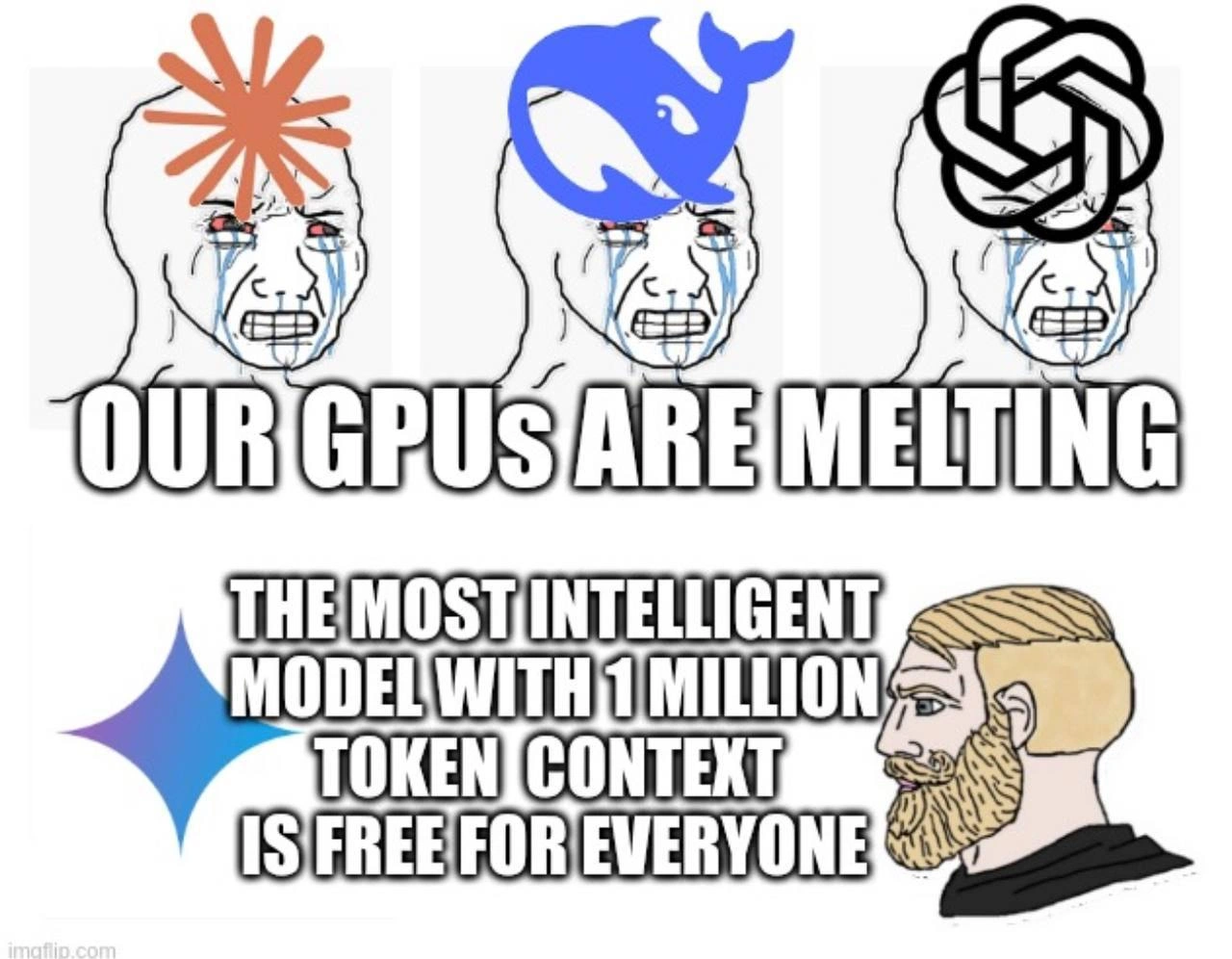
Let’s break down what’s happening in this meme in simpler terms, and clarify the tech jargon and imagery. The meme is in a two-panel format. In the top panel, there are three crying cartoon faces (these are known as Wojaks or specifically the “soyjak” style, often drawn with tears and a pained expression). Each of these crying characters is labeled with a different AI company’s logo. The first has an orange starburst-like logo, the second has a blue whale silhouette, and the third has a black knot icon. These logos stand for some big AI labs or companies – for example, the black knot is the logo of OpenAI, a very prominent AI company. The others likely represent similar major players in AI (the meme doesn’t use the official logos of, say, Google or Anthropic directly, but uses symbolic look-alikes – an orange starburst could hint at Anthropic, and a blue whale might be a playful way to denote another big “whale” in the AI industry).
Underneath them in bold text it says: “OUR GPUs ARE MELTING.” This part is showing that these big companies (the ones the logos stand for) are upset and complaining that their GPUs are “melting.” Now, what does that mean? A GPU, or Graphics Processing Unit, is a specialized computer chip originally made for rendering graphics (like in video games) but nowadays absolutely essential for AI/ML tasks. GPUs are great at doing many calculations in parallel, which is exactly what you need to train or run large neural networks. When the meme says melting, it’s using hyperbole – obviously the chips aren’t literally turning into liquid metal, but it feels like they are burning up. In real life, if you run GPUs at full capacity for a long time (for example, training a big AI model), they produce a lot of heat. Data centers that handle AI models require robust cooling to keep those GPUs from overheating. Sometimes engineers joke that their server room feels like a sauna when big experiments are running. So “GPUs are melting” is a humorous way to say “our hardware is overwhelmed (overheating and overworked) by the load we’re putting on it.” It implies these companies are pushing their equipment to the absolute limit (probably by training extremely large models or using very long inputs) such that the GPUs are as hot as if they might melt. The crying Wojak faces emphasize that this is a problem for them – they’re struggling, frustrated, perhaps on the verge of a breakdown because their approach to AI is really hard on the hardware.
Now, the bottom panel is the punchline: it flips the situation. Here we see the Chad meme character – he’s the blonde guy with a confident demeanor, often drawn with a beard and a smug or stoic expression in profile. The Chad represents someone who is calm, capable, and unfazed. Next to him, there’s a “radiant blue-purple sparkle icon.” This likely symbolizes some open-source project or just the general idea of something magical and positive happening (sparkles often indicate something special or impressive). The big caption with him reads: “THE MOST INTELLIGENT MODEL WITH 1 MILLION TOKEN CONTEXT IS FREE FOR EVERYONE.” This is a bold statement. Let’s unpack it:
- “Most intelligent model”: This implies a very advanced AI model, presumably something at the cutting edge of capability (intelligence here refers to how good or powerful the AI is).
- “1 million token context”: This is a technical feature. In language models, context (or context window) refers to how much text the model can take into account at once. A token is like a word or a piece of a word. For example, the sentence “Hello world!” might be broken into two tokens “Hello” and “world!” (depending on the tokenization). Models like GPT-3 have a context of about 2048 tokens, meaning they can “read” that many tokens of input at once (roughly corresponding to maybe 1-2 pages of text). Some newer models have larger contexts – e.g., 8000 tokens, 32000 tokens, and even experimental ones with 100,000 tokens (which could be like a whole book). Now, 1,000,000 tokens is huge. That would be like the AI could read hundreds of pages or even an entire small library of text all in one go. It’s far beyond the usual limits we’ve seen. So a “1 million token context” claim is basically saying this model can handle an enormous amount of text at once, more than practically any mainstream model by an order of magnitude (or several).
- “Free for everyone”: This indicates that unlike the big companies that might charge for using their AI models or keep them private, this model is being given out openly. It suggests an open-source release, where the model and its capabilities are available to the public at no cost. In the software world, “open-source” means the code or in this case the model’s weights and code are freely accessible, modifiable, and usable by anyone. It’s the opposite of proprietary. So “free for everyone” drives home that this is a community gift, not a corporate product.
Putting that together: the Chad character is basically announcing, “Hey, I created this incredibly powerful AI model that can handle a context of 1,000,000 tokens, and I’m making it available to all of you without charge.” The tone is confident and generous, in stark contrast to the top panel’s tone of despair and complaining.
So why is this funny to developers and people in the AI community? It’s the contrast and irony:
- The top shows big, wealthy, presumably cutting-edge AI labs struggling and crying about technical limits (“our GPUs can’t handle this, they’re melting down!”).
- The bottom shows a single open-source developer or community (characterized as the Chad) who just bypasses those limits and even surpasses them (“I made an even better model with way more capability, and I’m giving it out for free”), and he’s doing it with swagger and ease.
This plays into a common meme format known as “Virgin vs Chad” or “Soyjak vs Chad.” In that format, one side (here the crying Wojaks, often termed “soyjaks”) is depicted as weak, whiny, or lamenting, and the other side (the Chad) is depicted as strong, competent, and confident. It’s used to humorously compare two approaches or groups, usually to mock one and praise the other. Here, the big AI companies are being playfully mocked as the ones whining despite all their resources, while the open-source community hero is praised as the Chad who delivers results without complaining.
From a technical standpoint, even a junior developer might know that GPUs and hardware can indeed overheat if overworked – think of how a gaming PC’s fans go into overdrive when running a heavy game or how a phone might get hot with a demanding app. In AI, the analogy is training huge models, which is like running something 1000 times more demanding than a video game continuously; it’s easy to imagine things getting too hot or systems failing if pushed to extremes. And the idea of a “million token context” might not be familiar to everyone starting out, but one can grasp that it means dealing with a lot of information at once – an almost ridiculously large amount. It hints at a system so powerful it could read and consider an entire Wikipedia article (or many) in one go. For comparison, 1 million tokens might be roughly equivalent to 800,000-1,000,000 words (since tokens are around 0.75 words on average, very roughly). That’s like the model could take in multiple novels’ worth of text as input. So, the Chad’s claim is basically: “I’ve built the ultimate AI that doesn’t even break a sweat with super long inputs.”
Open-source vs big labs is another theme: newcomers should understand that big AI labs (like OpenAI, Google, etc.) often do not release their full models openly – instead, they provide APIs or limited access (you typically have to pay or have restrictions). In contrast, the open-source community (which might include academic researchers, independent AI enthusiasts, smaller companies) often releases models that anyone can download and run if they have the hardware. This meme clearly sides with the open-source crowd as the admirable one.
So in simpler summary: The meme is depicting a scenario in the AI world where the large companies are having a hard time because their hardware is under immense stress (GPUs running hot) due to trying to run or train large AI models. Meanwhile, an open-source developer (the “Chad”) proudly announces that he has made an even more advanced AI model (with a unbelievably large ability to handle text) and he’s sharing it freely. It’s a humorous commentary on how sometimes the underdogs or community-driven efforts in tech can outperform or at least embarrass the big players, all while being more generous. The use of cartoon meme characters (crying Wojaks vs cool Chad) is a visual shorthand to amplify that contrast – it’s basically saying “Big corporate AI guys = crying and failing; Open-source guy = winning and magnanimous.”
This resonates as LLM humor because within the last few years, there have indeed been moments where open projects replicated expensive closed AI models at a fraction of the cost. Developers who keep an eye on AI trends love these stories, and the meme exaggerates it in a comical way (with the “million tokens” as a cherry on top of the joke, since that number is deliberately over-the-top). Even if you’re new to AI, you can appreciate the underdog narrative: one side is complaining about expensive equipment failing, the other side just says “here, I solved it and you can all have it.” It’s like a tech fairy tale where the little guy outsmarts the giants.
Level 3: All Hype, No Chill
For seasoned engineers, this meme lands as a commentary on the AI arms race between huge corporate labs and the scrappy open-source community. In the top panel, we see the classic trio of crying Wojak faces wearing the logos of major AI players (the meme has a stylized orange starburst, a blue whale silhouette, and a black knot icon – these likely represent well-known AI labs or companies). The black knot, for example, is unmistakably the logo of OpenAI (the folks behind GPT-4 and ChatGPT). The others might be nods to companies like Anthropic (which has an orange-ish logo) or maybe DeepMind or some big cloud AI provider (the blue whale could be a tongue-in-cheek symbol for a “big fish” in AI, or possibly a specific company’s mascot). The exact identities aren’t critical – the idea is they’re hyperscaler AI labs, the ones with huge budgets, massive GPU farms, and closely-guarded proprietary models. And yet, here they are drawn as crying Wojaks, whining that “OUR GPUs ARE MELTING.” This is hilariously relatable to anyone who’s followed recent AI news: these companies keep announcing bigger models (more parameters, larger context windows, fancier capabilities), but behind the scenes we hear about the insane hardware strain and costs. Running state-of-the-art AI at scale is not cheap – we’re talking thousands of high-end GPUs, enormous electricity consumption, and even rare hardware failures. Seasoned devs smirk at the phrase “GPUs are melting” because it captures that feeling of running a job so intense that your data center starts to feel like a furnace room. It’s exaggeration, but not without truth – deploy a gigantic model and you’ll watch power meters spin and cooling systems struggle. There have been anecdotes of GPU scarcity where big labs buy up so many NVIDIA cards that smaller folks can’t get any – and even then, those labs still complain it’s not enough because their appetite for compute is endless. So the top panel nails an inside joke: the richest AI labs on Earth, with all their fancy toys, are essentially screaming “It’s so hot! We’re burning through our GPU clusters!” It’s the AIhypeCycle at its peak absurdity – pushing for ever larger models and contexts until even their hardware screams for mercy. Any engineer who’s been on an on-call rotation when servers overheated or who’s watched a GPU farm hit thermal limits will chuckle darkly at this. (No chill, indeed – both literally no cooling chill, and figuratively no one in management “chilling out” on the insane demands.)
Now contrast that with the bottom panel: the Chad meme character (square-jawed, confident, unbothered) sporting an emblem of a radiant sparkle. The Chad is labeled with an outrageous claim: “THE MOST INTELLIGENT MODEL WITH 1 MILLION TOKEN CONTEXT IS FREE FOR EVERYONE.” This is the open-source hero moment. To experienced devs, this immediately brings to mind how open-source communities often undercut the big players in the most spectacular way. It’s David vs Goliath, tech edition. While the giants pour billions into secret projects (then moan about the gargantuan bills and technical headaches), an open-source group of researchers or even a lone enthusiast swoops in and releases something that sounds even more impressive, and does it for free. We’ve seen this story before: think about how Stable Diffusion, an open-source image generator, came out and stole the thunder from proprietary models like DALL-E by being free and customizable. Or how Meta’s LLaMA model (leaked to the open community) led to a flood of fine-tuned openSource LLMs that approximated the likes of GPT-3 on much smaller hardware. The meme captures that familiar scenario in the context of 2025’s industryTrends_hype: big labs (like OpenAI, Anthropic, etc.) are in an arms race to build bigger and “smarter” AI (some bragging about 100k token contexts, ultra-huge models, etc.), and they emphasize how hard it is – requiring special hardware, multi-million dollar training runs, you name it. Then out of left field, an open-source Chad announces something crazy like a one-million token context model that’s “free for everyone.” It’s both a flex and a bit of a troll. For veterans, the humor also lies in the tone: the Chad is calm and magnanimous (“free for everyone!”) as if what he’s done is no big deal, whereas the rich lab folks are losing their minds and crying despite all their resources. The Chad vs Soyjak format is a well-known meme template symbolizing this exact dynamic: Soyjaks (the crying, frustrated guys) represent the “virgin” or the overhyped, underwhelming side, and the Chad character represents the cool, effective side who effortlessly outclasses the other. Here the Soyjaks are the big corporate labs – depicted as hand-wringing whiners – and the Chad is the open-source developer who upstages them easily. Engineers in the know will grin at this because it rings true: often corporate bureaucracy and profit motives slow the big labs down or make them ultra-cautious, whereas open-source folks can iterate quickly, experiment wildly, and share their results openly, garnering community acclaim.
The text “1 million token context” is a key comedic exaggeration. In real terms, by 2025 some closed models (like Anthropic’s Claude) were boasting about something like 100K token context windows – a huge leap but also a very challenging feature to support (it requires lots of memory and custom tricks). The meme says, fine, you have 100K? The open-source Chad raises you to 1,000,000 tokens. It’s poking fun at the hype escalation: if one side says they have the biggest number, the other side can always claim a bigger number (even if practically it might be borderline absurd). It satirizes how tech announcements sometimes become a numbers game (more FP32 teraflops! more parameters! more context length!) that leaves outsiders rolling their eyes and insiders quietly sweating about how to actually make use of those numbers. An experienced developer also reads between the lines: how did the open team achieve this million-token context? Possibly they didn’t, not in the straightforward way – maybe they used some clever compromise as discussed, or maybe it’s partially tongue-in-cheek. But the meme doesn’t need to explain; the humor is in the claim and the reaction it provokes. It also highlights a bit of an open-source ethos: “free for everyone.” Big labs often restrict access to their best models behind APIs, paywalls, or beta waitlists (understandable, since they foot huge bills to create them). The open-source community, by contrast, believes in democratizing AI – releasing the model weights, letting anyone run it locally if they have the hardware, and encouraging collaboration. So the Chad’s proclamation hits a nerve: it’s effectively saying knowledge and power to the people, which is a feel-good rallying cry in tech. Many senior devs have a soft spot for open projects because we’ve seen how they can drive the industry forward (and also because we’ve all benefited from free tools and libraries in our careers).
The humor here has a slight rebellious edge: it’s the garage hacker outdoing the megacorp. There’s a shared understanding of the irony that the most “intelligent model” might come not from a corporate research lab with $100 million budget, but from some open collaboration. It might remind industry veterans of past episodes – for example, how the open-source Linux system won out in servers over proprietary UNIX, or how Mozilla (open-source) challenged Internet Explorer back in the day. In AI, things move faster: the moment a breakthrough paper is published, there’s a community reimplementation or improvement available often within weeks. So the meme is satirically plausible. We nod and think, “Yeah, I can see this happening. Big Corp spends a fortune and complains about operational costs, meanwhile some brilliant open-source team finds a more efficient way or simply doesn’t care about cost because they’re doing it for the LOLs and the glory, then drops it on GitHub for everyone.” And then Twitter/Reddit would be ablaze with engineers cheering on the open model and poking fun at the closed providers. The “Chad” character’s cool confidence (“the most intelligent model… is free for everyone”) also implicitly mocks the marketing language of AI releases. It reads like a grand announcement, the kind we see in flashy keynotes – except it’s coming from the anti-establishment figure. AI_hypeCycle culture is such that every few months there’s a new “most powerful model” proclaimed; this meme plays on that, implying the real winner is the one who makes it free and accessible, not just the one who claims superiority behind closed doors.
Summing up from a senior perspective: this meme is LLMHumor gold, mixing truth and satire. The truth: training and running large AI models pushes GPUs to their limits (we’ve seen actual ai_training_costs debates, models requiring special cooling, even talk of supply chain issues because everyone’s buying GPUs). The satire: an open-source “Chad” comes in and coolly one-ups the big players, offering something even more extreme (1M context!) without the drama and tears. It reflects a bit of the industry zeitgeist – where many developers are increasingly skeptical of AI hyperbole from big companies and are rooting for open alternatives. Finally, it’s worth noting the emotional undercurrent: there’s a sense of schadenfreude (pleasure in the misfortune of the mighty) and hero worship of the open-source underdog. We’ve all dealt with bloated enterprise systems at some point, and it’s cathartic to imagine a nimble open project outsmarting those. The meme nails that feeling in a way only a Chad vs. Soyjak format can.
To crystallize the contrast, consider this tongue-in-cheek comparison of the two sides depicted:
| Major AI Labs (Closed Source) | Open-Source Hero (Community) |
|---|---|
| Boast about state-of-the-art models, then groan under GPU workloads and giant power bills. | Casually releases impressive models leveraging community and clever hacks, no charge. |
| Guard their best models behind APIs, citing costs and safety, often monetizing access. | Publishes model weights on GitHub or Hugging Face, letting anyone tinker, improve, or run it locally. |
| Push the limits of hardware – thousands of GPUs in a data center running hot, with engineers on edge to prevent meltdowns. | Pushes the limits of creativity – finds ways to do more with less, maybe slower or at lower precision, but avoids needing a nuclear-powered server farm. |
| Engages in PR and hype cycle promises (“best ever AI!”), then struggles with scaling reality (delays, downtimes when gpu_melting happens). | Engages in open collaboration – when a breakthrough comes (like longer context), shares it freely, generating buzz in developer communities (and sometimes scaring the big labs!). |
It’s openSource culture versus corporate AI culture in a nutshell. The meme gets a knowing laugh from experienced folks because it captures how each side reacts under pressure. The big labs are sweating bullets over performance and cost (no chill, literally), while the open-source Chad is as cool as a cucumber, handing out powerful tech like it’s candy. If you’ve ever been in a high-stakes engineering project, you recognize both the pain of the top panel and the almost comical relief of the bottom panel. The performance struggles, the hardware headaches, the industry trends of open vs closed – it’s all baked into this one image. And at the end of the day, it jokes that maybe the real hero of AI isn’t the billionaire-funded lab, but that generous coder who says “Here you go, world – enjoy this open-source LLM with insane specs, on the house.” AIhumor often carries an edge of truth, and that’s exactly why this meme hits home for so many developers.
Level 4: The Quadratic Curse
At the extreme technical level, this meme highlights a fundamental scaling problem with large language models: handling a 1 million token context pushes current algorithms and hardware to their breaking point. Modern LLMs (Large Language Models) typically use the Transformer architecture, where the cost of self-attention grows quadratically (O(n²)) with the number of tokens n in the context. That means if you double the context length, you quadruple the computational work and memory required. So, imagining a sequence of one million tokens – an utterly massive input – the model would need to compute attention across $10^{12}$ token pairs. That’s a trillion comparisons in a single forward pass, a mind-boggling number. Even the latest high-end GPUs (Graphics Processing Units) would choke on such a workload. We’re talking about needing potentially terabytes of memory just to hold intermediate results; a full attention matrix for 1,000,000 tokens would have $10^{12}$ entries. Storing even one byte per entry would be ~1 terabyte of data! No surprise that if you naively attempted this, you’d see out-of-memory errors or worse – your hardware might start running so hot you’d think the GPUs are melting. The meme’s phrase “OUR GPUs ARE MELTING” humorously exaggerates this: of course the silicon isn’t literally liquefying, but it feels that way when you max out GPU memory and compute – the devices draw enormous power, heat skyrockets, and everything throttles or crashes under the strain. In data-center terms, running a million-token transformer would be like firing up a small power plant just to feed your server rack – it’s way beyond normal limits. This is the quadratic curse of transformer models: monstrous context windows lead to monstrous performance pain. Seasoned machine learning engineers (the battle-scarred kind who’ve watched training jobs consume all resources) know that scaling context isn’t a simple linear tweak; it’s an exponential money burner. If someone seriously tried to brute-force a million-token context, not only would their ai_training_costs blow through the roof, they might also end up heating the building like a furnace (hence the meltdown imagery). This is AI_humor with a strong grounding in performance reality – any experienced systems researcher can tell you that such an unbounded context window is practically a token tsunami guaranteed to swamp hardware.
Of course, the open-source Chad boasting about a 1M-token model isn’t likely using a vanilla transformer algorithm for all million tokens – that would be computational suicide. The cutting-edge (and somewhat experimental) research in AI/ML has been inventing clever ways to extend context length without computing every pairwise token interaction. For instance, there are sparse attention mechanisms (like those in models such as BigBird or Longformer) which skip most token-to-token comparisons and only focus on local neighborhoods or a fixed pattern of connections. There are also hierarchical approaches that summarize chunks of text and then have the model attend to those summaries (reducing the effective sequence length). Another approach is using RNN-style recurrent memory or segmented processing: instead of truly ingesting 1,000,000 tokens at once, the model processes chunks of, say, 2048 tokens at a time and carries over some compressed state or summary to the next chunk – a bit like how you or I might read a very long book chapter by chapter, remembering key points rather than every single word. Some open-source long-context projects experiment with ideas like ALiBi or RoPE extrapolation (techniques to allow models to generalize to longer sequences than they were trained on), or memory-efficient attention algorithms (like FlashAttention or chunking strategies) that at least make the quadratic cost less brutal on caches and memory. The point is, achieving a "1 million token context" likely involves heavy-duty algorithmic tricks or trade-offs – maybe the model isn’t doing full attention across all million tokens, but treating it in segments or using retrieval mechanisms (like looking up relevant info from those tokens on the fly). An expert might eye such a claim skeptically and ask: “Did they really solve the fundamental scaling problem, or is it a gimmick?” This is where the industryTrends_hype comes in: big numbers are often touted for bragging rights, and a veteran engineer will raise an eyebrow until they see actual benchmarks. Still, the meme runs with the hype cycle humor: the open-source hero isn’t constrained by profit or propriety, so they can drop an outrageous-sounding model just to one-up the corporate labs. It’s a bit tongue-in-cheek: the openSource community might claim a million-token LLM (Large Language Model) context as a wild experiment, knowing full well it’s pushing the boundaries of what today’s hardware can do without bursting into flames. The underlying message for those in the know is that hardware limitations (GPU memory, bandwidth, and heat dissipation) and fundamental algorithm complexity form a wall that the big labs are slamming against. If you naïvely try to go through that wall, you get “meltdown” – so the open-source solution presumably had to go around the wall (with smarter algorithms or accepting slower performance). In summary, on a theoretical level this meme is poking fun at the perversity of scaling laws in AI: the closed-source giants are crying because they’re hitting the ceiling of what’s feasible (GPUs on the brink of combustion trying to support huge models and contexts), while some clever rebel appears to leapfrog the problem, implying they found a way to vastly extend context (like 1e6 tokens) perhaps by sidestepping the dreaded quadratic scaling. It’s a classic joke about how fundamental constraints (like computational complexity and energy usage) make the big guys sweat, while an open-source wiz comes along and acts as if they solved it casually (whether or not they truly did). This juxtaposition is both absurd and satisfying to those of us who understand the gargantuan technical challenge behind that one-million-token boast. It’s the ultimate flex in LLMHumor: beating the GPU-melting challenge in theory, with a wink and a grin.
Description
This is a two-panel Wojak comic meme illustrating the intense competition in the AI industry. The top panel features three crying Wojak characters (Soyjaks) with distressed, red-rimmed eyes. Each has a logo superimposed on its head, representing different AI companies: an orange asterisk (possibly Perplexity AI), a blue whale (DeepSeek), and a black knot (Anthropic's Claude). Below them, the bold text reads, 'OUR GPUS ARE MELTING,' symbolizing the high operational costs and computational strain of running powerful AI models. The bottom panel provides a stark contrast, showing a confident, blonde-haired Chad Wojak next to the purple and blue star logo of Google's Gemini. The text proclaims, 'THE MOST INTELLIGENT MODEL WITH 1 MILLION TOKEN CONTEXT IS FREE FOR EVERYONE.' The meme humorously depicts the market disruption caused by a tech giant like Google releasing a state-of-the-art model for free, effectively commoditizing a feature (large context windows) that competitors were struggling to offer as a premium, paid service. For senior developers, this captures the brutal reality of the AI space, where massive capital and hardware resources can instantly change the competitive landscape, making other companies' expensive R&D efforts seem futile
Comments
34Comment deleted
The best part about a free 1M token context window is you have enough space to paste the entire EULA you're ignoring, which explains how your prompts are now training data for their next model
Proof that you don’t need a warehouse of H100s - just some Flash-Attention, a rotary-patched RoPE, and the audacity to hit ‘publish’ before the CFO sees the power bill
After spending $2M on H100s and another $500k on cooling, you realize the intern just signed up for Claude's free tier and shipped the same feature in an afternoon using their API key
When your startup's entire GPU cluster is subsidizing some kid's 900K token fanfiction generation at 3 AM because 'democratizing AI' sounded good in the pitch deck. Meanwhile, your on-prem team is explaining to finance why the data center AC bill tripled and the GPUs are thermal throttling harder than a MacBook Pro rendering 8K video. The real innovation isn't the transformer architecture - it's convincing VCs that burning $10 in compute per free API call is 'growth hacking.'
Everyone loves the “free 1M-token context” until attention’s O(n^2) turns the KV cache into a space heater and your SLOs into aspirational poetry
“Free” 1M‑token context translates to O(n^2) attention, KV cache > HBM, autoscaler thrash - and a CFO severity‑one
Inference at scale: Proprietary services melt GPUs on long prompts; Llama just melts your illusions of needing them
Google's Old School data harvester goes brrr Comment deleted
all of 4 present are collecting it, but google is giving AI for free so i dont care Comment deleted
This one is actually a nice point Comment deleted
let them train on my ai slop. i am happy with the most intelligent model with the most context window for free. Comment deleted
Use ollama and run them on your own hardware with full control Comment deleted
well, they increased and enhanced their TPU infrastructure for decades and always was good in AI things. also Google are the ones who invented transformers, on which almost all modern LLMs are based, and made pertained LLMs before it was mainstream Comment deleted
>> always was good in AI things No? They invented transformers and were not on a frontier since then (till now) even their bigggest 1M context -- it was useless fake due to model's inability to actually utilize it in any meaningful way Comment deleted
AI ≠ LLMs, and i am too lazy to actually check rn but an LLM confirmed their good results in NLP: Yes, Google has continued to develop and release several NLP models that have achieved State-of-the-Art (SOTA) results since BERT. Here are some notable examples: * Transformer-XL (2019): This model extended the Transformer architecture to handle longer sequences of text by introducing segment-level recurrence and relative positional encoding. It achieved new SOTA results on several language modeling benchmarks. * T5 (Text-to-Text Transfer Transformer) (2019): T5 revolutionized the approach to NLP by reframing all tasks as text-to-text problems. It achieved impressive results across a wide range of tasks using a single model and was considered SOTA in many areas at the time of its release. * Meena (Announced 2020): While focused on conversational AI, Meena demonstrated significant advancements in building more empathetic and human-like chatbots. It set a new benchmark for open-domain conversational models. * LaMDA (Language Model for Dialogue Applications) (Announced 2021): LaMDA focused on improving the conversational abilities of language models, particularly in terms of fluency, specificity, and consistency. It showcased impressive capabilities in open-ended dialogue and was considered a major step forward in conversational AI. * PaLM (Pathways Language Model) (2022): PaLM was a massive language model that demonstrated remarkable few-shot learning capabilities and achieved SOTA results on a wide variety of challenging NLP tasks, including reasoning, code generation, and understanding nuanced language. * PaLM 2 (2023): This was an improved version of PaLM, showcasing enhanced multilingual capabilities, improved reasoning, and better performance across various benchmarks. It was considered SOTA in many NLP areas upon its release. * Gemini (2023/2024): Google's latest flagship model is a multimodal AI that also boasts significant advancements in NLP. Different versions of Gemini have demonstrated SOTA performance across a range of language understanding and generation tasks, often outperforming previous models. It's important to note that the field of NLP is constantly evolving, and what is considered SOTA changes over time. However, the models listed above represent significant contributions from Google that achieved top performance in various NLP tasks at their respective times of release. Comment deleted
Just read every achievement after * T5 (Text-to-Text Transfer Transformer) (2019) They all language models. This is exactly what I'm talking about Comment deleted
And none of those in the list was top1 even *on release* Comment deleted
SOTA results ≠ results on real tasks Benchmarks we had till recently were more like a joke that didn't tested anything closer to what we actually expect to name as an AI Comment deleted
It must be in r/lies Comment deleted
GPUs are meant to be played on, goddamit! 😡 Comment deleted
How can you get it for free? Comment deleted
You didn’t know about aistudio ? Comment deleted
aistudio.google.com, openrouter.com, requesty.ai Comment deleted
I knew about openrouter but wasn’t aware the model was available there. Thanks bros Comment deleted
They were incredible quick to add it! Comment deleted
Now carefully inspect the codebase including submodules and find why I can't see cards, while doing it, be consise Comment deleted
I can't hate openai right now because 4o's image gen is pretty uncensored Comment deleted
Benefit of specialized TPUs: significantly lower heat and power draw Comment deleted
Btw, Amazon doesn't have their TPU for matrix multiplications? Only Gravitons? Comment deleted
I don't think so, not until recently Graviton is a CPU/SoC and EC2 instances with TPUs are ridiculously expensive and relatively new Comment deleted
Where`s the catch in this? Sounds too good Comment deleted
What you want to get is one of the new Tenstorrent boxes Comment deleted
meoe Comment deleted
meow Comment deleted