Leaked 'Claude Max' AI Subscription Tiers Reveal High-Usage Pricing
Why is this AI ML meme funny?
Level 1: Candy Shop Surprise
Imagine you have a favorite little candy store where a small lollipop costs just a few coins – easy for you to buy with your pocket money. You’ve been buying one every week, and no one notices because it’s such a tiny expense. Now one day, the store introduces a giant chocolate mega-cake that’s 20 times bigger and super delicious. You get excited and say, “I want that one!” But then you see the price tag: it’s so expensive that if you bought it, your parents would immediately get a notification on their phone that their credit card was charged a huge amount. They’d rush in saying, “Wait, what did you just buy for $$$?!”
In this story, the lollipop is like the basic $20 AI plan – cheap, fun, harmless to the budget. The giant chocolate cake is like the fancy $250 AI plan – a huge upgrade but costing so much that the family’s “money boss” (like a CFO in a company, whose job is to watch the money) would instantly pay attention. The meme is laughing about that moment when a small, sneaky treat suddenly becomes a big, obvious expense. It’s funny because we don’t expect something we think of as a minor toy (or tool) to blow up into a serious purchase. It’s like turning on a game and seeing an option to buy a new character for the price of a real-life bicycle – you’d do a double-take and imagine your parent going, “Excuse me, you want to spend how much on that?!”
So, the simple joke: a developer was happily playing with a cool AI tool (like a kid in a candy store). It used to cost so little it was like buying candy. But then they saw a shiny new feature (more power, more context, more something) that costs a lot – so much that the company’s money guardian (the CFO, like the parent with the wallet) would definitely notice and freak out. It’s humor about sticker shock – being surprised by a high price – and about how grown-ups (or bosses) get alarmed when a fun hobby starts burning a hole in the pocket. In kid terms: “It was just a toy, but now it’s as pricey as a treasure – better ask mom or dad first!”
Level 2: Token Tiers & CFO Fears
Let’s break down what’s going on in simpler terms. We have a screenshot styled like an App Store listing – you know, the kind of pop-up you see when a mobile game shows you options to buy extra coins or unlock premium features. Only here, the “game” is an AI service called Claude. Claude is a Large Language Model (LLM), similar to ChatGPT – basically an AI that can read and write a lot of text. Anthropic, the company behind Claude, offers it as a product with different subscription tiers (levels).
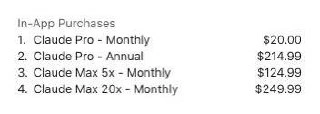
The listed tiers are:
- Claude Pro – Monthly — $20.00: This looks like the basic paid plan (monthly subscription) for using Claude. Think of this like the “Pro” version of an app or service. For example, ChatGPT has a Plus plan at $20 which gives faster responses and priority access. Claude Pro likely offers some enhanced capabilities over a free version – maybe more usage per day or access to a more powerful model. $20/month is relatively low, almost like a personal or pocket change expense for a developer’s tool. Companies often let employees expense such small subscriptions without much fuss.
- Claude Pro – Annual — $214.99: This is the same as Claude Pro, but billed annually at a slight discount (paying for a year upfront). Many services knock a bit off the price if you commit for a year. $214.99 per year is roughly $17.92 per month, which is about a 10% discount on the monthly rate (12 * $20 would be $240). It’s common to see annual options like this in SaaS (Software as a Service) pricing.
- Claude Max 5x – Monthly — $124.99: Now it gets interesting – “Claude Max 5x”. This sounds like a higher tier plan. The “5x” could imply some multiple of capacity. Given the context, it likely means something like 5 times larger context window or 5 times more usage. The context window is basically how much text the AI model can take into account at once (input + output). If Claude Pro allows (for example) 100k tokens of context, a “5x” might allow ~5 * 100k = 500k tokens. Tokens are chunks of text (pieces of words); 500k tokens is huge – you could feed maybe 300-400 pages of text in one go. $124.99 a month is a big jump from $20. It suggests this Claude Max plan is for heavy-duty use, probably aimed at power users or teams who really need the AI to handle large documents or lots of data in one go.
- Claude Max 20x – Monthly — $249.99: This is the top tier. “20x” implies an even greater capacity – possibly 20 times the context or usage of the base Pro plan. Sticking with the earlier example: if Pro was ~25k tokens, 20x could be ~500k tokens of context. Or it might allow more concurrent usage (like multiple heavy queries at once). Either way, this is the big gun plan. And the price $249.99/month reflects that – it’s an enterprise-level expense. This isn’t something an individual dev would casually pay out of pocket. It’s meant for organizations with serious needs (and budgets to match).
Now, the meme text says: “When the prompt token bill graduates from pocket change to CFO alert.” Let’s unpack that:
- Prompt tokens: Every time you use an AI like Claude or GPT, the input text and output text are measured in tokens. It’s like word count, but for AI billing. Many AI services charge based on how many tokens you process, especially if you’re on a pay-as-you-go or have limits per month. So your “prompt token bill” is basically the invoice for using the AI – how much all those interactions cost.
- Pocket change: an idiom meaning a very small amount of money – something you could pay with the coins in your pocket. $20/month might be seen as pocket change in a tech company’s budget. It’s low enough that it doesn’t hurt.
- CFO alert: CFO stands for Chief Financial Officer – the person in a company who manages finances and budgets. If something “alerts the CFO,” it means it’s a large or unusual expense that catches their attention. Typically, CFOs get involved when costs become significant or start to grow unexpectedly. The joke is that at $20, nobody outside engineering cares, but when the bill increases to a point, the CFO is like “Hold on, what are we spending here?!”
So the meme paints a scenario: You had this AI service that cost about as much as a couple of fancy coffees a month (no big deal). But then requirements grew – maybe you needed more advanced features, like processing huge documents with the AI (that’s the extra context window story). To get that, you switched to “Claude Max 20x” or something similar, which is over 10 times the price. Suddenly, that minor expense line in the budget blows up. What was once trivial (“pocket change”) is now a few thousand dollars a year per user, which definitely triggers the CFO’s budgeting radar. It’s the difference between buying a few office supplies vs. buying a high-end workstation – different approval levels!
AI Tools and Budget Constraints: This is a common theme in the tech industry right now. There’s a ton of AI tools out there promising to make work easier – code assistants, writing helpers, data analyzers, you name it. Many start off cheap or free for basic use. But serious usage – like a whole team using it daily, or using it on big projects – often requires a paid plan. That’s where budget constraints come in. Teams have to ask, “Is this tool worth the cost? How do we fit it into our budget?” If a tool’s cost jumps a lot for the features you need, there might be internal friction: engineers want the fancy AI assist, but finance (the CFO’s team) might push back on the extra spend, especially if it wasn’t planned.
SaaS subscription tiers: The structure “Pro, Pro Annual, Max 5x, Max 20x” looks like a typical SaaS offering with tiered subscriptions. Usually:
- “Pro” is for individuals or small teams.
- “Max” or “Enterprise” is for heavy users or larger organizations, offering more capacity or features (often at a much higher price). This mirrors things like cloud services (AWS has bigger instance types for more money), or even consumer things (think of Dropbox free vs paid vs business plans). The meme is funny because it uses the innocuous App Store interface to present what is likely a very enterprise-y pricing scheme. It’s like finding out you can buy a sports car through an in-app purchase screen – the context feels mismatched in a comic way.
In-App Purchases metaphor: Why specifically show an App Store style image? Likely to emphasize how transactional and gamified this all is. In mobile games, you might see:
- 100 gems – $0.99
- 1000 gems – $4.99
- 10000 gems – $19.99 And you chuckle at the $20 “best value!” pack. Here we have $20, $125, $250 – scaled-up numbers for a scaled-up “product.” It subtly suggests that buying AI resources (tokens, context) might become as seamless (and temptingly easy) as buying extra lives in a game. The dev humor lies in the absurdity: “Oh great, now I’m buying AI capacity like I buy Candy Crush coins. Next, my boss will see a $249 App Store receipt and wonder which mobile game I got addicted to – but it’s actually our AI dev tool!”
CFO’s perspective: In a company, the CFO isn’t literally seeing an App Store pop-up. But they will see the spend in financial reports. So an engineer might feel like clicking “buy 1 Claude Max 20x – $249.99” is as casual as an in-app buy, but at scale (multiple engineers, over months) it accumulates. CFOs set up alerts or reviews for new subscriptions above a threshold. Many companies require manager or finance approval if a SaaS subscription is above, say, $100/month. So indeed, that jump from $20 to $250 could trigger a whole procurement process. This is why the meme says the bill “graduates” to a CFO alert – it “grows up” from being a kid’s toy purchase to a serious grown-up expense that needs scrutiny.
In summary, at this level:
- Claude is an AI service with subscription tiers, and higher tiers let you do bigger, more powerful things (like handle more tokens or more queries).
- The base tier costs about as much as a typical personal tech subscription ($20), but the top tier is an order of magnitude more ($250), aimed at enterprise use.
- The meme finds humor in how something seemingly small can escalate into something that finance folks worry about.
- It’s highlighting the tension between AI tools’ awesome capabilities and the practical budgeting that companies have to enforce. As a junior developer, it’s a clue: always be aware that using more cloud or AI resources might be easy technically, but it has real costs that someone will care about!
Level 3: Auto-Scaling Sticker Shock
For seasoned developers, this meme hits on a familiar pattern: the comfy $20/mo AI tool that everyone expensed without a second thought has suddenly sprouted an “enterprise” tier that makes your finance team spit out their coffee. The image mimics Apple’s App Store in-app purchases screen, listing “Claude Pro” at $20 and then jaw-dropping “Claude Max 5x” and “Claude Max 20x” tiers at $124.99 and $249.99. The humor here is that escalating from $20 to $250 monthly feels like your AI usage just went through an auto-scaling event – and now the CFO is getting emergency alerts about a mysterious new line item in the budget. It’s a classic case of AI hype meets budget reality.
We’ve seen this movie before in cloud services. It starts innocently: a team adopts a nifty SaaS tool or cloud API with a modest subscription. Productivity soars, everybody’s happy. But then usage ramps up – more data, bigger requests, higher tiers – and suddenly the monthly bill looks like a phone number. In cloud computing, it might be an app that auto-scales on AWS and unexpectedly runs up the EC2 bill; in AI land, it’s an LLM that happily chews through millions of tokens (units of text) once you give it a bigger context window. That jump from $20 to $249.99 isn’t arbitrary – it’s parodying how costs explode when you go from a freemium/pro plan to the top-tier enterprise plan. The meme specifically labels these as in-app purchases, which is cheeky: it frames serious enterprise AI features as if they were a mobile game power-up. It’s like saying, “For just $229.99 more, unlock the Mega Context Pack (20x)! Impress your CFO today!”
For a senior engineer, there’s a lot rolled into this joke:
- Usage-Based Pricing Gotchas: Many AI services (and cloud services in general) lure you in with a flat monthly fee or free tier, but real power is metered. Here, “Claude Pro” might give you some fixed capacity, but “Claude Max 20x” suggests you’re paying for a much higher usage or capability (likely those huge context lengths or more compute-intensive model calls). It resonates with anyone who’s watched a cloud bill skyrocket because an app started handling 20x more data overnight. The phrase “graduates from pocket change to CFO alert” nails it: at first the cost was so low it was like paying out of petty cash; now it’s big enough that the CFO (Chief Financial Officer – the person in charge of the money) is directly concerned. In a company, a recurring charge of $20/month might fly under the radar, but $250/month per user (or per account) will definitely get noticed and require approval.
- AI Hype vs Reality: During the hype phase, management is excited: “Wow, our devs are using AI to speed up coding/research. $20 a month for genius-level assistance? No-brainer!” That’s the AIHypeVsReality tag – the rosy view that AI tools will cheaply revolutionize work. But reality bites when the team says, “Actually, to have the AI read our entire codebase or all our documentation at once, we need the Max plan… which costs as much as a high-end SaaS license.” Cue the CFO’s raised eyebrow. The optimistic narrative of “AI will save money and time” meets the invoice that shows “AI will also consume your budget if you’re not careful.”
- Vendor Lock-In and Upsell: The structure of these tiers is a textbook vendor lock-in strategy. You start on Claude Pro, integrate it into your workflows, maybe even build internal tools around it. By the time you crave the higher context (like having the AI handle larger files or more complex tasks), you’re already tied to that vendor’s ecosystem. The meme hints at this with the existence of named tiers – a sign that the vendor (Anthropic, in this case) has planned a smooth upsell path for power users. Senior folks recognize this pattern from other tools: get teams hooked at a low price, then when they need scale or advanced features, the price jumps significantly. If your developers have grown dependent on Claude’s capabilities, management might feel pressured to approve that pricier plan. The CFO alert facetiously implies an internal email or meeting: “Why are we suddenly paying $250/month per developer for this AI thing? Can we cut that down?”
- Budget Constraints and Cloud Cost Parallels: In big organizations, any monthly charge that balloons will trigger discussions about cost optimization. The meme’s commentary about “autoscaling your AI habit straight into the finance department’s threat model” is gold. It likens the situation to a security threat, but for finances: the CFO starts treating uncontrolled AI usage as if it were a risk that needs mitigation. This resonates with engineers who’ve been on calls explaining cloud expenses (“Yes, the containers scaled up to handle load; yes, it ran on 64 XL instances over the weekend; no, we didn’t expect that much traffic…”). Here it’s “Yes, we asked the AI to analyze the entire database schema; yes, it had to use the ultra context mode; no, we didn’t expect it would cost a few hundred bucks per run…” Experienced devs might chuckle (or groan) remembering those post-mortems of surprise bills. Now AI brings that same old cloud cost chaos into the realm of prompt tokens and context windows.
- The Specific Case – Claude Max and 500k context: The post caption mentions unannounced “Claude Max” plans and speculates about a 500k context. This is a nod to very recent industry trends: companies like Anthropic and OpenAI are racing to offer larger context models that can handle truly enormous inputs (imagine pasting a whole code repository or a lengthy contract and the AI processes it in one go). Cursor (referenced in the post) is an AI-powered code editor that integrated Claude. Not long before this meme’s date, developers noticed Cursor gained support for a super-long context model (rumored at 100k or even 500k tokens). So it’s quite plausible that “Claude Max 20x” corresponds to that ultra-long context version of Claude. In other words, Claude Max could let you have conversations or analyses with 20 times more text than the standard Claude Pro. A junior might think, “Great, more is better!” But a senior dev sees the subtext: 20x more context likely means 20x (or more) increase in resource usage, hence the >10x price jump. The meme exaggerates it as an App Store pricing leak, but it’s effectively highlighting how these advanced AI features get monetized quickly. There’s always a bigger fish — and that bigger fish comes with a bigger invoice.
- Engineers and CFO Dynamics: The scenario practically writes itself. An enthusiastic team lead signs up for Claude Pro at $20/month per headcount. Productivity boosts, maybe they integrate it into CI pipelines or code review. Impressed by results, they decide to invest in the new “Claude Max 20x” so the AI can handle full project specs or massive logs in one go. Next finance review, the CFO spots a line: “Anthropic Claude Max – $249.99 x 10 licenses = $2,499.90/month” and immediately calls up the engineering director: “What on earth is this?!” Now engineers must justify that expense — or find a way to throttle usage. Suddenly there’s talk of budget constraints on something as futuristic as AI. It’s a funny contrast: cutting-edge AI workflows meeting the age-old corporate mantra of “do more with less.” The meme captures that collision perfectly in a tiny App Store-style screenshot. We’re essentially laughing at the fact that even the fanciest AI cannot escape the gravity of corporate budgeting.
The senior perspective takeaway: this meme isn’t just mocking Anthropic’s pricing; it’s winking at every dev who’s watched a tiny experimental AI tool turn into a significant monthly cost. It’s about the speed at which a shiny new AITool can go from being a trivial line item to a CFO-monitored expense. It underscores a truth in today’s tech industry hype cycle: even revolutionary tech like LLMs will get squeezed into spreadsheets and ROI calculations sooner than later. In the end, no matter how advanced the AI, someone has to pay those GPU bills — and that someone (or their boss) will definitely care about the difference between $20 and $250 a month.
Level 4: The Cost of Context
At the bleeding edge of AI/ML, giving a Large Language Model an ultra-long memory comes with steep technical demands. A transformer's self-attention mechanism has to consider every pair of tokens in the prompt and response. This typically scales on the order of $O(n^2)$ in time and memory complexity, where n is the number of tokens. In plain terms, doubling the context window (the text the model can hold in mind) can quadruple the compute required. Now imagine stretching a context from a few thousand tokens to hundreds of thousands – it’s a staggering jump.
If Claude Max 20x indeed means a ~20x larger context than the standard Claude Pro, we might be talking about context lengths on the order of hundreds of thousands of tokens. For perspective, 500k tokens is like the text of an entire novel or the code of a large repository stuffed into one prompt. A vanilla transformer would need to process on the order of $500{,}000^2$ token relationships – that’s 250 billion pairwise interactions – for a single forward pass! Even with optimizations like FlashAttention (an algorithm to make attention more memory-efficient) or chunked processing, handling such a massive context likely requires either enormous GPU memory or clever architectural tweaks (think long-range sparse attention, retrieval augmentation, or other research-grade strategies).
All that extra compute and memory doesn’t come cheap. High-end GPUs or TPUs working overtime to crunch giant token sequences rack up a hefty cloud bill. The meme’s parody “In-App Purchases” list isn’t just poking fun at App Store pricing – it’s hinting that supporting a 20x context window might literally cost an order of magnitude more in infrastructure. In a way, the pricing tiers here reflect real technical scaling laws: more context = more compute = more $$$. The CFO alert is mathematically justified by the combinatorial explosion under the hood. The jump from a $20 plan to a $249.99 plan aligns with the reality that a model using a gigantic context window could be consuming hundreds of times the resources of the base model. AI researchers have been racing to extend context lengths, but physics and algorithmic complexity impose a harsh tax. Anthropic (the company behind Claude) likely needs to offset the GPU time, memory bandwidth, and engineering magic that a 5x or 20x context requires. In essence, they’re monetizing the hard-won capability to hold more of your prompt history or data in the model’s “working memory” at once.
So under the hood, Claude Max isn’t just a marketing gimmick – it represents serious engineering to push the boundaries of how much an AI can remember in one go. And when you push boundaries, whether in distributed systems or giant neural networks, the costs scale up fast. This is why the meme’s exaggerated App Store pricing for higher tiers feels plausible: it’s translating an advanced technical feat (say, a context window so large it could take in an entire codebase or a hefty spec document) into the familiar language of subscription fees. The humor hides a hard truth: if you want an AI with a superhuman memory, be ready to swipe a superhuman credit card. The “pocket change” of a basic plan buys only so much context; for that enterprise-grade memory span, you’re paying enterprise prices because, in computational terms, you’re effectively renting a slice of a supercomputer.
Description
This image is a minimalist screenshot displaying a list of 'In-App Purchases' for an application, presumably Anthropic's Claude. The list details four subscription tiers with their corresponding prices. The plans are: '1. Claude Pro - Monthly' at '$20.00', '2. Claude Pro - Annual' at '$214.99', '3. Claude Max 5x - Monthly' at '$124.99', and '4. Claude Max 20x - Monthly' at '$249.99'. The text is plain, black, and set against a stark white background, typical of an Apple App Store listing. This screenshot serves as an information leak, revealing a new, multi-tiered pricing strategy for a major AI model. For senior engineers and technical leaders, this signals the maturation of the AI market, where providers are moving beyond simple pro-tier subscriptions to granular, usage-based pricing ('5x', '20x') aimed at power users and enterprises. It reflects the high computational cost of serving state-of-the-art models and the industry trend of monetizing intensive usage, such as large context window processing or high-volume API calls

Comments
10Comment deleted
The 'Claude Max 20x' plan is perfect for enterprises that need to generate twenty times the amount of boilerplate code before realizing the requirements were wrong
Apparently the real context-window limit isn’t 200k tokens - it’s the moment your finance team opens the App Store Connect report and sees you’ve quietly upgraded to “Claude Max 20x.”
Remember when we complained about $99/year IDE licenses? Now we're casually dropping $250/month for an AI that occasionally hallucinates our code into existence while we pretend it's not just Stack Overflow with confidence scores
When your AI assistant costs more per month than your junior developer's AWS bill, you know we've entered the 'AI-as-a-luxury-good' era. That $249.99/month Claude Max 20x tier is basically saying 'we know you're billing this to the client anyway.' The real question is: at what multiplier does the AI start negotiating its own raise?
Turns out the mythical 20x engineer is a billing tier - higher TPM, zero procurement, and RPS that scales exactly with the Amex swipe
Claude Max 20x: Because nothing says 'enterprise scale' like a $3k/year rate limit that still hallucinates your microservices architecture
‘Claude Max 20x’ is basically Horizontal Pod Autoscaler for your prompt budget - scale your pair programmer via credit card until the CFO trips the circuit breaker
Gemini is free btw Comment deleted
Oh dear, the April 1st was a couple of days ago Comment deleted
https://t.me/dev_meme/6629?comment=148886 Comment deleted