Skip to content
DevMeme
6386 of 7435
GPT-5 Coding Benchmarks: The Gap Widens
AI ML Post #7000, on Aug 7, 2025 in TG

GPT-5 Coding Benchmarks: The Gap Widens

Why is this AI ML meme funny?

Level 1: More Pages, Better Grade?

Imagine you have a friend who didn’t study for a test but hopes to get a good grade by writing extra-long answers to each question. They’re basically thinking, “If I fill five pages, surely I’ll score better than if I write just one page.” 📝 Now, sometimes explaining more can help – maybe they’ll stumble onto a correct thing to say – but if they don’t actually know the material, all those extra words won’t magically make the answers right. They might just be very long wrong answers. This meme is laughing at that kind of idea, but with an AI twist. It’s like saying: “We made the AI talk more, so now it’s suddenly a genius!” – which is a funny claim. We all know that if someone talks and talks without understanding, it doesn’t mean they’re smarter, it just means there’s more talking. In simple terms, the joke here compares being verbose with being correct. Just as a student writing a bunch of fluff won’t guarantee an A, an AI spitting out tons of text doesn’t guarantee it truly fixed the problem. It’s a humorous reminder that quality, not quantity, makes an answer good – whether it’s on a test or in code debugging. So, the meme is funny because it pretends that giving an AI a bigger notepad to write on has miraculously turned it into an expert, which in real life would be as silly as thinking you’ll ace homework by doubling its length with gibberish.

Level 2: More Tokens, More Magic?

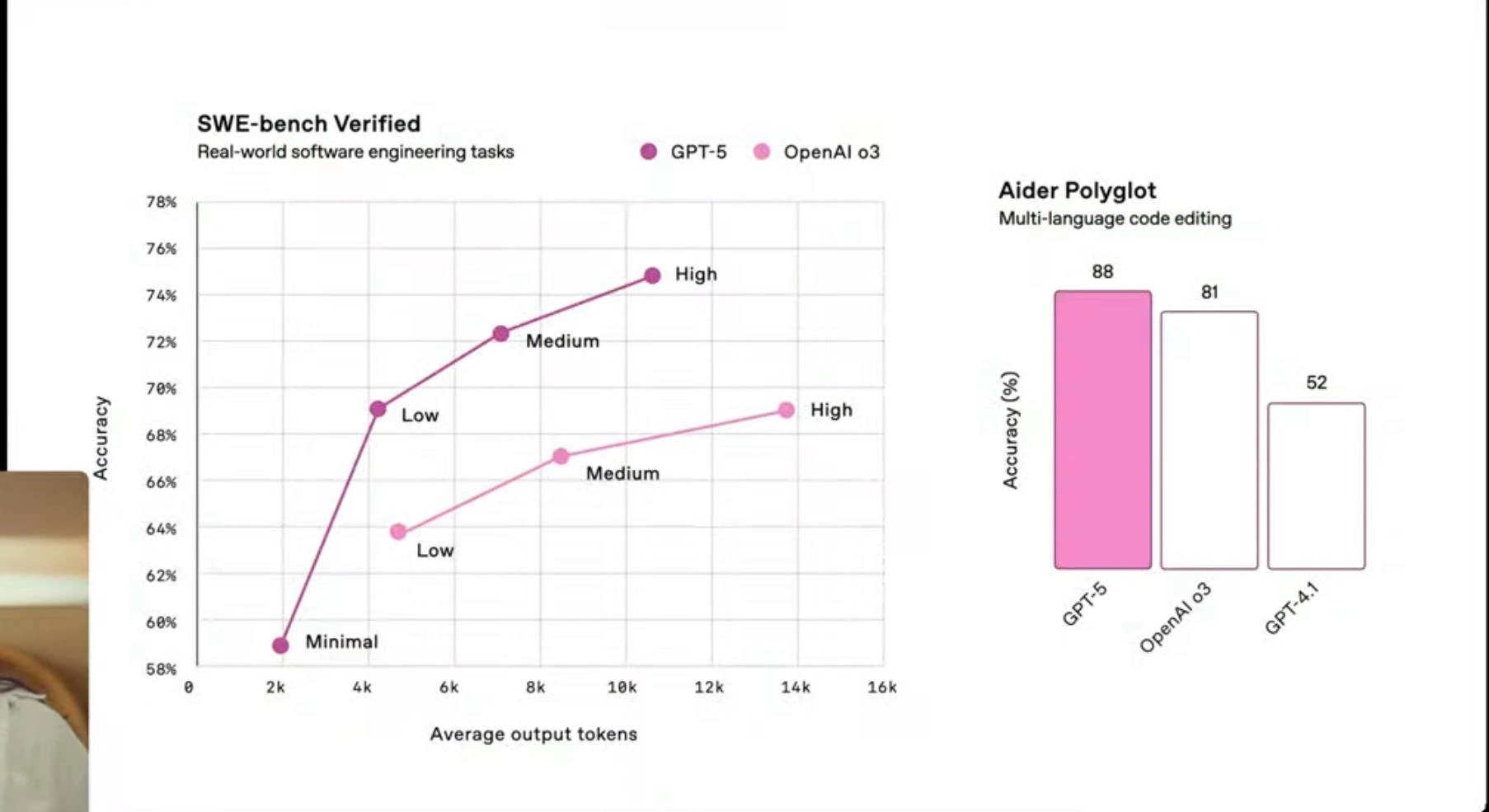
Okay, let’s break down what’s going on here in simpler terms. The meme shows what looks like a conference slide comparing some AI models on coding tasks. It’s parodying how companies announce new AI models with fancy charts. Here, the imaginary new model is GPT-5 (the hypothetical next-generation of GPT-4), and it’s being compared to something called OpenAI o3 (likely a placeholder name for another model, maybe an OpenAI baseline or competitor). The key idea on the left chart is relating “Average output tokens” to “Accuracy” on a benchmark called SWE-bench.

First, what are tokens? In AI terms, tokens are pieces of words or characters that models read and write. Think of tokens like word chunks. A token budget means how many tokens the AI is allowed to output or how large its “attention span” is. If average output tokens go from 2k to 14k, that means GPT-5 is giving much longer answers or solutions compared to when it was limited to shorter responses. The x-axis “Average output tokens” from 2k to 14k suggests they tested the model at different answer lengths: maybe Minimal (short answer), Low, Medium, High (very detailed answer). The y-axis is accuracy (%) – basically how often the model’s answer was correct in those tests. SWE-bench stands for “Software Engineering Benchmark” (with “Verified” hinting that the answers were checked, probably by running code or tests). So, real-world coding tasks might include things like: “Given this code with a bug, fix it,” or “Implement a function to do X.” If it’s “Verified,” likely they run the code to see if it works – a pass/fail for each task contributing to that accuracy percentage.

On the chart, GPT-5 (dark magenta points) climbs quickly: at Minimal (maybe ~2k tokens output), it’s around mid-60s% accuracy. By High (~12k tokens output), it’s reaching upper 70s%. Meanwhile, the lighter magenta line (OpenAI o3) is always below GPT-5 and tops out around 70% at best. The labels Minimal, Low, Medium, High indicate different settings or scenarios of how much the model was allowed to say or perhaps how much context it was given. The meme suggests that GPT-5’s secret sauce is simply that it can produce more text (or consider more context) which leads to higher accuracy. In plainer words: “If we let the AI talk more, it solves more problems.” This feels ironic because usually we’d think a smarter model comes from better training or new algorithms, not just gabbing a lot. It’s a bit like if a student wasn’t doing well with short answers, so the teacher said “okay, write a longer answer,” and suddenly the student’s score went up. Sometimes, explaining in detail does help catch mistakes – and AI can work similarly. In AI research, indeed, letting the model explain its reasoning (“chain-of-thought”) often makes it do better on math or logic puzzles. Here, SWE-bench being real-world tasks implies things like debugging or code generation, where step-by-step reasoning could help the AI not skip important details. GPT-5 presumably excels at this; the competitor model doesn’t gain as much from talking more (its curve is flatter). This paints GPT-5 as more capable of using a big context window effectively.

Now, the right side chart: Aider Polyglot – Multi-language code editing. Aider is an actual open-source tool (OSS) that helps you use GPT models to edit code. “Polyglot” means it can handle multiple programming languages in one session. For example, with Aider you might have the AI suggest edits in a Python file and then in a Java file, within the same context. This requires the model to be flexible and carry context across different languages’ syntax. The bar chart shows accuracy percentages for GPT-5, OpenAI o3, and GPT-4.1. GPT-4.1 presumably is a minor improved version of GPT-4 (which we know as an advanced model available around 2023-2024). GPT-4.1 sits at only 52% accuracy on these multi-language editing tasks – meaning it got about half of them right. OpenAI o3 did better at 81%, and GPT-5 is highest at 88%. So in this scenario, GPT-5 nearly closes in on perfection (100% would mean it always edits correctly). The meme exaggerates these to make a point: it’s unlikely such a huge jump would happen so easily, but it mocks how every new model claims big improvements.

For a junior developer or someone new to these AI terms: GPT is a series of LLMs (Large Language Models) by OpenAI that can generate text and code. They’re trained on vast amounts of data. Each version (GPT-3, GPT-4, etc.) got more powerful. GPT-5 here is fictitious (as of the meme’s posting) – it stands for the next big leap people anticipate. OpenAI o3 isn’t an official name we know; it might be a placeholder or a jokey reference (maybe “OpenAI model 3” or some open-source model). The essence is comparing “our new fancy model vs the previous generation.” Accuracy on coding tasks usually means how many of the solutions were correct (the code passed all tests). Token budget (or context length) means how much text the model can handle. GPT-4 had versions with 8k and 32k token contexts (approximately ~6,000 and ~24,000 words respectively). The meme suggests GPT-5 might routinely handle ~14k tokens output – that’s huge, like the model writing the equivalent of a 20-page report as an answer!

This speaks to an ongoing trend: companies increasing the context window of AI models. Why? Because developers want models that can take into account the entire code file or multiple files when suggesting fixes. If you’ve used something like GitHub Copilot, you know it sometimes gets confused if the file is long or the relevant info is elsewhere in the project. A bigger context AI could, in theory, read your whole project or a large chunk of it and make more informed suggestions. So token_budget_vs_accuracy as a concept means: if we allow the AI to consider more information and produce more detailed output, will it actually solve tasks more accurately? The meme’s fake slide answers “Yes, dramatically so!” – which is a bit tongue-in-cheek.

From a developer experience standpoint, the idea of GPT-5 being this good is exciting but also a little humorous in its presentation. Imagine a tool like Aider telling you “GPT-5 fixed 88% of the issues in your code across 5 different programming languages.” It sounds amazing – maybe too amazing. We’ve learned that with current AI, you can’t blindly trust every fix. So an experienced junior dev might think, “Great, it’s higher, but I still have to review those fixes, especially the 12% it gets wrong.” There’s also the practical side: if GPT-5 outputs a very long explanation or code patch, the developer has to read all that to understand the change. It’s not as straightforward as a human colleague just saying “Add a null check on line 45.” AI might instead generate a lengthy rationale and a refactored code snippet. Sometimes that verbosity is helpful (it explains its thinking), other times it’s overkill.

The meme’s joke lies in this slightly absurd oversimplification: just add more tokens and stir. People in AI often joke about how companies tout numbers – like parameter counts (“Our model has 100 billion parameters!”) or context size – as if bigger automatically means better. It’s similar to the AIHype where every new model is marketed with “Now 20% better on benchmark X!” If you’re new, it’s important to know these benchmarks (like SWE-bench here) are specific tests; a model doing well there doesn’t mean it flawlessly handles every coding problem. It might nail common algorithmic tasks or known bug patterns but still falter on something unorthodox. DeveloperProductivity gains from AI are real (Copilot, for example, can speed up writing boilerplate code), but the meme hints not to be too gullible with bold claims. After all, an imaginary_gpt5_benchmarks slide is by definition not proven in the real world – it’s parodying what marketing might claim.

In summary, at this level: The meme is showing a fake but polished comparison where GPT-5 outperforms others by using a larger token window and giving more detailed answers. It’s making light of the current trend to push LLM capabilities (like longer context) and how those get spun into grand claims. A junior dev reading this should take away that while AI tools are improving and can be super helpful, one should always maintain a bit of healthy skepticism. Just because a slide (especially a promotional one) says something is “verified” and super accurate, you’ll want to try it yourself on your own tasks. In the real developer world, AIHumor like this reminds us not to believe all the lofty slides until we see the AI handle our messy codebase without breaking a sweat!

Level 3: Slideware Sorcery

To an experienced developer, this meme screams “slideware” – those slick conference slides where every new product’s graph shoots up and to the right. Here we have an imaginary GPT-5 absolutely crushing a benchmark (“SWE-bench Verified”) by the simple magic of a bigger token budget. It’s a tongue-in-cheek jab at the AI hype trend: the industry’s habit of equating bigger numbers (more tokens, more parameters) with actual smarter performance. The line chart on the left has all the hallmarks of a hype presentation: neat magenta lines, labels like Minimal, Low, Medium, High implying some easy dial-up of capability, and GPT-5’s curve sharply outpacing an “OpenAI o3” model. It implies that developer productivity on “real-world software engineering tasks” has been dramatically improved just by allowing GPT-5 to generate longer answers. Seasoned devs chuckle here because it’s never that simple. We’ve seen IndustryTrends_Hype slides before – whether it was 10x engineers, silver-bullet frameworks, or AI that will finally handle all our legacy code – and we’ve learned to ask: okay, but what’s the catch?

The catch, hidden behind those rosy curves, is that real software engineering doesn’t magically resolve itself with verbose answers. Sure, the chart suggests that at 2k tokens (perhaps a short answer) GPT-5 was only ~66% accurate on tasks, but by ~12k tokens (a much longer answer) it’s hitting ~75-78% accuracy. In plain terms, if GPT-5 is allowed to produce a much longer response – maybe explaining its reasoning step by step or examining more of the code – it solves more tasks correctly. This smells of the well-known chain-of-thought effect: we developers discovered that if you prompt an LLM to “think step by step” or provide a detailed explanation before final code, it often catches mistakes and improves the result. It’s like the model is doing its own little code review or rubber-duck debugging by talking more. The meme ridicules this by implying the only thing needed for GPT-5 to dominate was a bigger context window and output allowance. Veteran engineers find that funny because we know solving software problems is not just about spitting out more text. We’ve all encountered that junior dev (or intern) who, when unsure, writes a 50-line muddled solution where a 5-line precise fix was needed. More code isn’t automatically better code. Likewise, an AI generating a novel-length answer might just be confidently wrong at length. The phrase “token budget magically fixes accuracy” drips with irony – it’s a sardonic way to say “yeah, right, if only it were that easy.”

Look at the right side: the bar chart for “Aider Polyglot – Multi-language code editing.” Here GPT-5 shows 88% accuracy, trouncing “OpenAI o3” at 81% and poor old GPT-4.1 at 52%. This implies that in a tool like Aider (an open-source AI assistant that helps with code in multiple languages), GPT-5 can handle multilingual code edits almost twice as well as the last-gen model. That’s a DeveloperExperience_DX dream: an AI that can fix your Python and your JavaScript and even your C++ bugs seamlessly. But experienced devs raise an eyebrow – a jump from 52% to 88% in one generation? That’s enormous. We suspect there’s some benchmark cherry-picking going on. Perhaps GPT-5 was specifically fine-tuned on the type of tasks in SWE-bench and Aider’s test suite. It’s common in these comparisons to choose scenarios where the new model particularly shines. It doesn’t mean GPT-5 will be 88% accurate on your weird legacy code or that it won’t still produce some nonsensical fixes. It reminds us of those optimistically biased demos: like a live on-stage coding assistant that flawlessly writes a trivial function – impressive, until you try it at home on a real codebase and spend an hour debugging the AI’s output.

The humor also resonates with the collective experience of developers using current AI tools like Copilot or ChatGPT (GPT-4). They’re amazing, but they’re not infallible. We’ve all seen them confidently suggest a solution that looks legit but is subtly wrong. Often, if you prompt them further or let them generate a longer explanation, they might correct themselves – or just double down on the mistake in florid language. So when we see GPT-5’s accuracy skyrocketing by letting it output more tokens, it satirizes that dynamic. It’s basically saying, “Look, we didn’t really make the AI smarter, we just let it talk longer and voila – higher score!” Every senior dev has a bit of that battle-scarred skepticism: we know real software engineering tasks involve more than can be captured in a neat graph. Did GPT-5 actually understand the code better, or did it just brute-force its way through the problem with sheer verbosity and a huge internal knowledge base? The meme suggests the latter with a wink. After all, AIHype often involves attributing almost magical capabilities to new versions: “Now it can do everything – it even makes coffee!” Here the magic power is apparently “polyglot code editing at 88% accuracy,” which sounds impressive until you recall that 12% of the time it’s still wrong. And as any dev lead will tell you, 12% of bug fixes being wrong is a lot of bugs to sift through.

This slide’s style – minimalist white background, sleek pink/magenta accents – parodies the polished decks from AI conferences and Big Tech keynotes. It’s so perfectly corporate-trendy that one can imagine a keynote speaker proudly narrating it: “On real-world SWE tasks, GPT-5 achieved 78% accuracy, far surpassing our previous OpenAI model. And on multi-language editing, it’s now at 88% – a new state of the art!” The audience might applaud, but the developers in the back are exchanging knowing glances and slight smirks. We’ve sat through presentations where the graphs always improve, yet the next day we try it and go, “Huh, it still struggles with my tricky use-case.” In other words, slideware_AI can make any improvement look groundbreaking with the right scale on the axes. Notice the y-axis here starts around 58% and tops out at 78%. That narrow range visually exaggerates the gap. It’s a classic trick: even a modest gain looks huge when you zoom in the chart. So while GPT-5’s line is higher, a cynical eye sees that and thinks, how much better is it really in absolute terms? Maybe just a dozen more problems solved out of 100 – helpful, yes, but not the revolution the slide implies.

The meme plays on the insider knowledge that AI_ML benchmarks can be gamed or at least glossy. The tag token_budget_vs_accuracy is basically the meme maker’s way of saying “Look, they’re bragging that just giving the model more leeway with tokens solved things.” It feels like when a manager says, “We’ll fix the project by throwing more people at it.” Seasoned devs know Brooks’s law: adding more manpower to a late software project makes it later. Similarly, throwing more tokens at a fundamentally hard problem (like understanding complex code) might not yield proportional gains – sometimes it even produces more verbose errors. We also recognize the imaginary_gpt5_benchmarks aspect: since GPT-5 doesn’t exist (as of that meme’s date), this is entirely a parody of how it would be marketed. This adds another layer of humor – it’s speculative satire. The community often jokes that whenever the next GPT is released, the first thing we’ll see is a bunch of benchmark graphs claiming human parity on everything short of writing Shakespeare. This slide pre-empts that, essentially saying: “We bet the launch slides for GPT-5 will claim huge real-world coding prowess, and here’s how ridiculous that might look.”

Finally, consider the developer experience (DX) angle: if an AI really did output 14k tokens on average to solve a task, what’s it like to use that? Probably like drinking from a firehose. As a developer, do I want an essay every time I ask for a bug fix? The slide doesn’t mention it, but we all know who has to read and vet those 14k tokens – a human developer. That’s potentially pages of code and explanation. DeveloperProductivity might actually dip if the dev must wade through a swamp of AI-generated text to find the actual fix. In practice, we prefer concise, correct solutions over verbose ones. The meme implicitly nods to this mismatch: boasting about average output tokens going from 2k to 14k as if that’s an achievement is itself humorous. Imagine a boss saying, “Our team’s bug reports are 7x longer now, so our solutions must be 7x better!” You’d laugh, right? More output can mean more information, but it can also mean more fluff. The experienced perspective is that quality matters far more than quantity. So this meme gets a chuckle from senior devs and AI practitioners because it satirizes the AIHumor of our times: bigger models, bigger context, bigger promises – but we’re left wondering if it’s just a bigger helping of the same AIhype we’ve seen before.

Level 4: Infinite Context, Finite Sense

On a fundamental level, this meme pokes at the theoretical limits of Large Language Models (LLMs) by suggesting that simply expanding the model’s context window – essentially giving it more “memory” to work with – will magically boost its intelligence. Modern LLMs like GPT-4 (and this hypothetical GPT-5) are based on the transformer architecture, where the amount of text (or tokens) they can consider at once is fixed. Increasing that limit from, say, 2k to 14k tokens means the model can read and generate much more text in one go. In theory, a larger token budget allows more complex reasoning: the model could, for instance, take in an entire codebase or produce a very detailed step-by-step solution without forgetting earlier details. Researchers have indeed explored this – chain-of-thought prompting lets models “think out loud” by generating intermediate steps, often improving accuracy on math or coding challenges. This slide’s magenta chart hints that GPT-5, with its longer output, follows that idea: more tokens spent on reasoning yields higher accuracy on real-world software engineering tasks (the SWE-bench domain). It’s like giving the model a bigger scratch pad to solve a problem.

However, the academic reality is more nuanced. Attention is All You Need – or so the famous paper claimed – but attention has a price: computational complexity grows roughly as $O(n^2)$ with sequence length. Doubling the context isn’t a free lunch; it’s exponentially heavier to process. At some point, simply throwing tokens at the problem runs into diminishing returns. If an LLM doesn’t truly understand the code, letting it read more files or write more explanation might just produce a longer wrong answer. There’s a difference between memory and mastery. In machine learning theory, we talk about scaling laws: models get better as they get more parameters, more data, or more context, but the gains typically follow a log curve – each additional boost gives a smaller improvement. The near-linear accuracy jump shown for GPT-5 (from ~65% at Minimal to ~76% at High tokens) feels almost too good, as if unlimited context alone cracked hard coding problems. Real research on ultra-long contexts (like experiments with 100k-token windows) shows new challenges: models can struggle to focus on relevant parts of a huge input, and positional encodings (how a model knows where it is in the text) can get fuzzy over very long sequences. Without special techniques (like better positional embeddings or adaptive focus), a 14k token input might cause the model to lose coherence or pay a lot of attention to irrelevant details. In short, there’s an implicit joke here about AI alchemy: turning up the context dial to 11 won’t transmute a so-so coder AI into a genius software engineer by itself. You might get more verbose answers and slight accuracy bumps, but fundamental leaps require more than just a longer attention span.

Deep down, the meme is critiquing a kind of AI hype that glosses over these nuances. It’s reminiscent of earlier moments in computing history where raw resources were seen as a cure-all – like early CPU design where simply raising clock speed hit a wall due to physics. Here the “wall” is cognitive: no matter how much code you stuff into the model’s input, an LLM still operates as a probabilistic pattern matcher, not a deterministic reasoner. It leverages correlations in its training data (maybe it’s seen many bug fixes before) but doesn’t truly understand programs the way a human or formal method would. For example, if a bug requires understanding the intention behind code (which isn’t explicit in text) or reasoning about runtime behavior, a longer context won’t magically impart that insight. In formal terms, an LLM lacks a true model of the world or an internal symbolic logic engine; it’s constrained by what it learned during training. So while giving GPT-5 more tokens lets it regurgitate more learned patterns and perhaps temporarily hold more facts in “working memory,” it doesn’t guarantee a qualitative shift in problem-solving capability. The slide’s promise that token count alone fixes accuracy borders on perpetual motion science: appealing but suspicious to anyone versed in ML theory. The underlying physics (or mathematics, in this case) still apply – more data helps, but only up to a point, and only if the model can effectively use that data. In reality, increasing context window yields diminishing returns unless paired with genuine leaps in model architecture or training. That’s the deeper insight tickling the seasoned AI researcher’s funny bone: the graph makes it look like we found a cheat code for higher accuracy (just let the model babble more!), but experienced folks know that real intelligence doesn’t scale infinitely with context.

Description

A presentation slide featuring two distinct data visualizations comparing the performance of OpenAI's AI models. On the left, a line graph titled 'SWE-bench Verified' plots Accuracy against 'Average output tokens' for 'Real-world software engineering tasks.' It shows two ascending lines, one for GPT-5 and one for OpenAI o3, with GPT-5 consistently achieving higher accuracy at every token level, ranging from 'Minimal' to 'High' complexity. On the right, a bar chart titled 'Aider Polyglot' compares the 'Multi-language code editing' accuracy of GPT-5, OpenAI o3, and GPT-4.1. GPT-5 leads with 88% accuracy, followed by OpenAI o3 at 81%, and GPT-4.1 significantly behind at 52%. These charts are classic benchmark slides from a tech product launch, designed to quantitatively establish GPT-5's superiority in practical software development scenarios. For experienced engineers, this data is significant as it demonstrates advancements in concrete, valuable skills: solving real-world coding problems (SWE-bench) and sophisticated code manipulation (Aider Polyglot), signaling a new level of capability for AI-assisted development tools
Comments

7
Anonymous ★ Top Pick These benchmarks are impressive, but I'm waiting for the 'Correctly Interprets Vague Jira Ticket' benchmark before I'm truly sold
  1. Anonymous ★ Top Pick

    These benchmarks are impressive, but I'm waiting for the 'Correctly Interprets Vague Jira Ticket' benchmark before I'm truly sold

  2. Anonymous

    If scaling to 14k tokens turns GPT-5 into a 78 % SWE-bench genius, I’m emailing finance to triple our AWS bill - clearly context windows are the new team of senior engineers

  3. Anonymous

    GPT-5 achieving 88% accuracy on polyglot code editing is impressive until you realize the remaining 12% is probably just missing semicolons in JavaScript that would've worked anyway

  4. Anonymous

    Ah yes, GPT-5 achieving 88% accuracy on code editing - finally, an AI that can refactor legacy code almost as well as the senior engineer who wrote it can remember why they made those architectural decisions in the first place. Though I notice it still needs 10k tokens to reach 'High' difficulty, which is roughly the same amount of context I need to explain to stakeholders why we can't just 'make it work like the demo.'

  5. Anonymous

    SWE-bench says accuracy climbs with output tokens - the only curve where verbosity beats minimalism; expect Finance to invent “prompt budgets” right after we approve 10k-token ADRs

  6. Anonymous

    More tokens boost accuracy like verbose PRs: occasionally fixes bugs, always hikes the bill

  7. Anonymous

    Apparently SWE-bench accuracy is just f(tokens); in prod the gradient gets clipped by timeout=30s and CFO_limit=medium

Use J and K for navigation