Skip to content
DevMeme
6385 of 7435
GPT-5 vs. Predecessors on Coding Tasks
AI ML Post #7001, on Aug 7, 2025 in TG

GPT-5 vs. Predecessors on Coding Tasks

Why is this AI ML meme funny?

Level 1: Top of the Class

Imagine three students in a coding class taking the same big test that covers all sorts of tricky problems. One student is the new prodigy, another is a solid performer, and the third is an older star from last year. When the tests are graded, the teacher makes a bar chart of their scores on the board. The new student (let’s call them GPT-5) scores 88%, the solid performer (OpenAI o3) gets 81%, and the older star (GPT-4.1) only gets 52%. The new kid doesn’t jump up and down or brag about the score – they just sit quietly, maybe with a little smile. But that chart on the board is doing the talking for them: it’s super clear who nailed the test. The whole class can see that the quiet newcomer outperformed the others by a good margin. In simple terms, the meme is showing a report card where the new genius student quietly proves they’re top of the class, letting the high score speak for itself.

Level 2: LLM Report Card

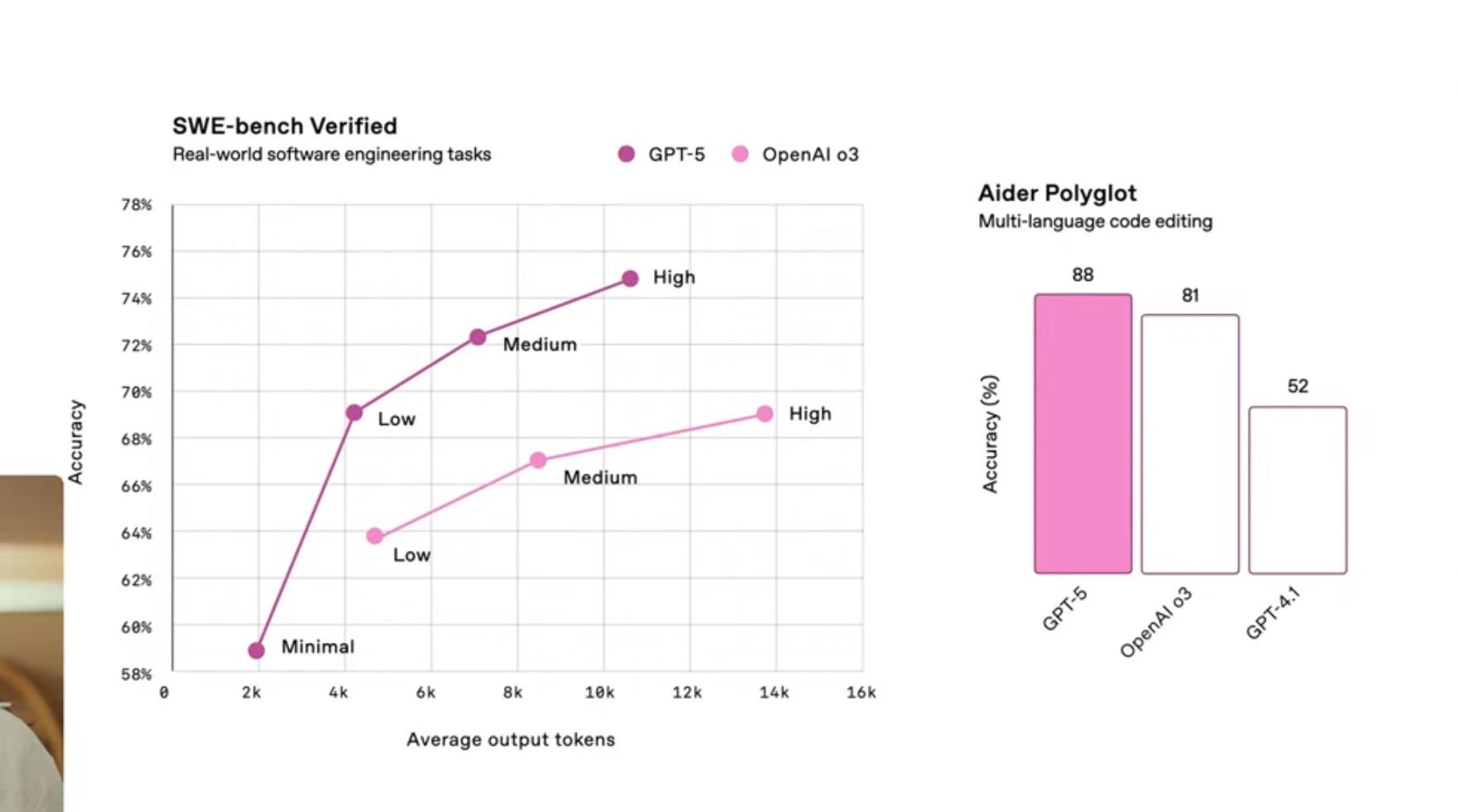
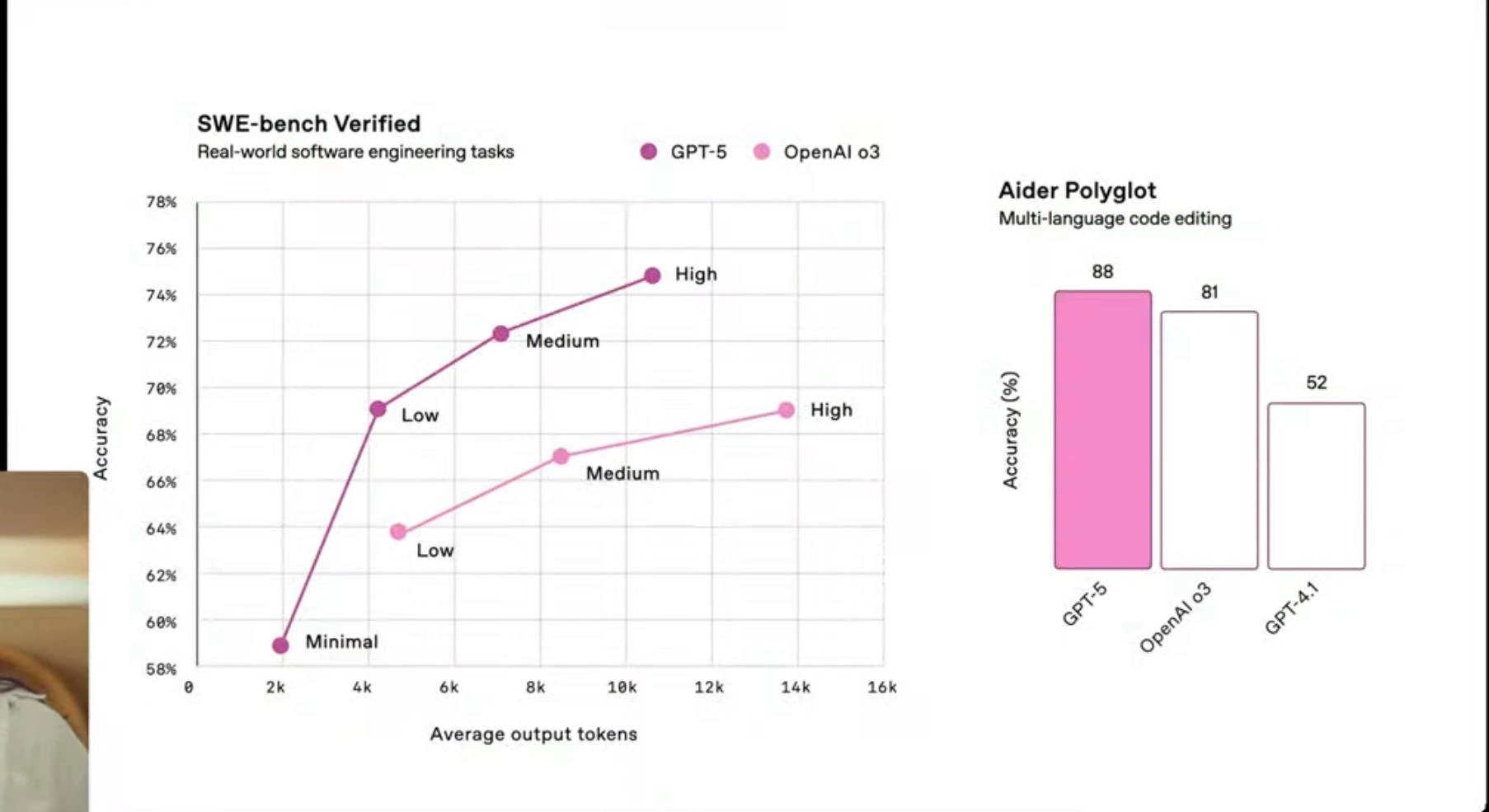
What we have here looks like a report card for three AI coding assistants, showing who’s scoring best at programming tasks. The meme image shows two charts side by side, comparing GPT-5 (the newest big AI model in the GPT series) to OpenAI o3 (another model from OpenAI’s lineup) and GPT-4.1 (an improved version of the earlier GPT-4). All of these are LLMs (Large Language Models) – basically very advanced AIs trained on tons of text and code so they can help with things like writing programs, debugging, and answering technical questions. The chart on the left, titled “SWE-bench Verified,” is like a big exam for real-world software engineering tasks. Verified means when these AIs answered each coding problem, their answers were actually checked to see if they were correct – for example, by running the code they wrote and making sure it passes all the test cases. On this chart, the y-axis shows accuracy (%), which you can read as the score (imagine it as the percentage of tasks the AI got right), and the x-axis shows “Average output tokens,” which is basically how long their answers were on average. In AI terms, a “token” is a piece of text (it could be a word or just part of a word/code). So if an answer has more tokens, it’s a longer, more detailed answer. The labels “Minimal, Low, Medium, High” on the graph correspond to how much the AI was allowed to write for its answer.

Now, looking at the lines on that graph: GPT-5 is the dark magenta line, and OpenAI o3 is the lighter magenta line. Both of them start somewhere around 60% accuracy when only a minimal answer is given (think of this like the AI giving a very short answer). As the allowed answer length increases (Low, Medium, up to High, meaning the AI can give a longer and more detailed answer), both models’ accuracy goes up. By the time we get to the High setting (which might be letting the AI write something pretty lengthy, say the equivalent of several paragraphs or a big chunk of code), GPT-5 is getting around 76% of those tasks correct, whereas OpenAI o3 is around 70%. Essentially, if you let GPT-5 explain itself or write more code, it solves more problems correctly than if you force it to give a very short answer. This makes sense: often a complex coding problem can’t be solved in one or two lines, and GPT-5 seems to do better when it can give a more detailed solution. The key takeaway from the left chart is that GPT-5 outperforms OpenAI o3 at every answer length, and particularly when it can elaborate. It’s like seeing two students improve when they show their work on a math test, but one of them (GPT-5) consistently gets a few more problems right than the other, especially on the tougher questions that need more writing.

The chart on the right is titled “Aider Polyglot – Multi-language code editing.” This one is a simpler bar chart comparing how the three models perform on tasks that involve editing code in multiple programming languages. Polyglot means “multi-language” (usually used to describe a person who can speak many languages; here it’s about programming languages). The bars show their accuracy on these coding tasks. GPT-5 has a bar reaching 88%, OpenAI o3 is a bit lower at 81%, and GPT-4.1 is much lower at 52%. In plain language, GPT-5 got an 88 out of 100 on the multi-language coding test, OpenAI o3 got 81/100, and GPT-4.1 got 52/100. This tells us that GPT-5 is much better at dealing with code across different languages than the older GPT-4.1 was. For example, earlier models might have been really good at Python (a very common language in their training data) but not so great at, say, C++ or JavaScript. A score of 52% for GPT-4.1 suggests it was struggling or making a lot of errors in many languages. GPT-5 scoring 88% means it handled most of the tasks correctly, whether the code was in Python, Java, JavaScript, or another language. And OpenAI o3 at 81% is in between – quite good, but still not as high as GPT-5. For a developer using these AI tools, a higher number is like a measure of trust: if you’re using GPT-5 to help you with code, you can be more confident that it will give a correct answer or a good edit in whatever language you’re working with, compared to using an older model.

So, put together, these charts are showing that GPT-5 is currently the top performer on two respected coding benchmarks. One benchmark (SWE-bench Verified) measures how well it handles realistic programming tasks when its answers are checked for correctness, and the other (Aider Polyglot) measures how well it edits code across different programming languages. Developers and researchers use such benchmarking tools to decide which AI model is more reliable or advanced. It’s similar to how you’d compare two cars using a speed or safety test – here we’re comparing AI models using coding tests. GPT-5 quietly leading in both charts is significant because it means the newest model could make the life of programmers easier. If you’re a newcomer, imagine having a super-smart assistant who can help write or fix code in almost any language, and it’s right nearly 9 out of 10 times. That’s what these numbers suggest. In terms of developer experience, it implies less time spent debugging the AI’s mistakes and more time building features or solving creative problems. The meme basically takes these dry numbers and frames it as GPT-5 “quietly flexing” – in other words, letting its good grades speak for themselves. Even if you don’t know all the details of the tests, you can see from the bars and lines: higher is better, and GPT-5 is on top. It’s a fun way to show how far these AI assistants have come in helping with programming tasks, and why people are excited about the improvements in GPT-5.

Level 3: Metrics Humblebrag

To an experienced software engineer, these pink charts are the equivalent of a humblebrag in a team meeting. Instead of saying “our new AI model is the best,” the slide just quietly plots the numbers to let everyone else figure it out – a classic metrics-driven flex. We’ve got GPT-5 and OpenAI’s o3 model going head-to-head on what look like serious coding tasks, and GPT-5 is clearly winning without making a lot of noise about it. The humor here comes from how quiet and clinical the presentation is. It’s all neat labels (“Minimal”, “Low”, “Medium”, “High”) and tidy magenta markers, almost like a startup’s pitching its growth stats. But what those stats say is basically: “Hey devs, GPT-5 is kind of crushing it at coding tasks.” For seasoned folks who’ve lived through countless tech hype cycles, there’s an almost meme-worthy contrast between the calm presentation and the significant leap in capability being shown off. It’s a metrics humblebrag — the facts and figures are doing the boasting in a way that feels both sly and satisfying.

Think about what’s being benchmarked. “Real-world software engineering tasks” in SWE-bench Verified likely means things like debugging actual code, writing a function based on a spec, or refactoring a module – the kinds of tasks software engineers do at work, not just textbook exercises. Traditionally, an AI assistant might do okay on simple examples but stumble on messy, real-world code (the kind full of edge cases, weird legacy patterns, and incomplete requirements that human engineers deal with every day). Seeing GPT-5 climb into the mid-70s% accuracy on such tasks means it’s handling a lot of those messy details correctly. If you’ve ever used an AI coding assistant like GitHub Copilot or even earlier GPT-4-based tools, you know the drill: they’d often get you ~80% of the way, then leave some bizarre bug or oversight that you (the human) had to fix. It’s a mix of amazement and annoyance. So when a veteran dev sees “76% accuracy, verified by tests” for GPT-5, it's both impressive and a bit funny – like, wow, the AI might finally handle the boring parts without as many facepalm moments! It’s quietly flexing because it doesn’t need to shout; passing unit tests speaks louder than any marketing department could.

On the right side, the “Aider Polyglot” results strike a chord with anyone who’s had to juggle multiple programming languages. Many of us have a primary language we’re fluent in, and a few languages where we muddle through with Google and Stack Overflow at hand. GPT-4 was a bit like that too – fantastic in, say, Python, but it might start flailing with languages it wasn’t as well trained on. The chart shows GPT-4.1 languishing at 52% on the polyglot test. That’s like a developer who’s great at one tech stack but is pretty lost when asked to debug a random piece of code in another language. GPT-5 hitting 88% here is a game changer: it’s as if we hired a new team member who knows all the languages our team uses and can jump into any codebase with confidence. The joke among devs might be, “Did GPT-5 just make itself the most well-rounded coder on the team?” Because we’ve all met that one colleague who can fix the frontend JavaScript, refactor the Java service, and even script the deployment pipeline – they’re rare, and everyone quietly admires (and maybe envies) them. GPT-5 is positioning itself as that person, except it’s an AI model. It’s a flex, but a quiet one: the chart is essentially GPT-5’s resume, and every senior engineer reading it raises an eyebrow and nods, equal parts skeptical and impressed.

This understated brag also taps into developer culture. We often tease each other or show pride through data. Imagine a pull request in which someone attaches these charts saying, “No big deal, just hitting 88% on multi-language code editing, carry on.” It’s tongue-in-cheek. The meme exaggerates that vibe, as if GPT-5 is in the room modestly sliding over its benchmark results for us to notice. Seasoned devs find it funny because we’re used to grand claims about “AI revolutionizing programming” plastered everywhere, often with a lot of hype. Here, the “announcement” is basically a low-key slide deck graphic of results that, if you understand them, are actually jaw-dropping. It’s like someone solved a famously hard coding interview question and then just shrugged as if it were nothing — the results speak loudly, even if the presenter doesn’t.

Of course, every experienced engineer will mix a pinch of skepticism with their grin. We know that benchmarks and real projects can be two different beasts. 76% on a controlled benchmark might still leave you in a lurch on that bizarre production bug that no one saw coming. And 88% accuracy means about 12% of the time the AI is making a mistake – and Murphy’s Law says that could happen at the worst possible moment. So part of the laugh here is also, “Alright GPT-5, nice numbers… but let’s see you handle our tangled legacy codebase on a Friday afternoon deploy.” It’s the classic dev double-take: acknowledge the achievement, but verify it in the wild. In the end, these charts give us hope. Maybe we really will get an AI pair programmer that doesn’t drive us crazy, one that actually boosts our developer productivity. We’re excited — just in a characteristically low-key, show-me-the-data way. It’s a geeky kind of humor: we’re smiling because we know how much effort and breakthrough is behind each of those percentage points, and seeing GPT-5 casually outperforming its predecessors is both thrilling and slightly surreal. The chart says it all, and that’s both funny and fantastic to those of us in the field.

Level 4: Context is King

Deep inside that left-hand chart lies a secret of modern LLM performance: a token budget tradeoff that would make AI researchers nod in agreement. The x-axis labeled “Average output tokens” (ranging up to 16k) hints at how much explanation or code the model is allowed to produce, and the y-axis is the accuracy on real-world tasks. The upward climb of the GPT-5 series (dark magenta) shows a clear pattern: the more tokens GPT-5 is permitted to output, the higher its accuracy on complex software engineering problems. This isn't just luck — it reflects advanced techniques like chain-of-thought prompting and extended context windows that GPT-5 likely employs. In practical terms, GPT-5 can “think” out loud more extensively, writing longer solutions or step-by-step reasoning, which helps it solve problems more reliably. It's leveraging a fundamental scaling law of transformers: with greater context and more tokens to work with, these models can capture more details and avoid mistakes that come from overly terse answers. Context is king here, because being able to consider and produce a larger chunk of information (say, reading a longer piece of code or writing a more in-depth answer) allows the model to be more precise and thorough.

The fact that GPT-5’s accuracy approaches ~76% at the “High” token budget, topping OpenAI o3’s ~70%, suggests some cutting-edge improvements under the hood. Possibly GPT-5 uses a refined self-attention mechanism or architectural tweaks that preserve coherence across very long outputs. Earlier-generation models often struggled as their responses grew lengthy — like their attention span was too short — causing them to lose track of the problem. GPT-5 seems to conquer that, effectively handling a 12k+ token output (a massive amount, equivalent to dozens of pages of code or text) while still maintaining correctness. Think of it this way: GPT-5 can run a reasoning marathon, carrying all the necessary details from start to finish, whereas older models could only sprint through a short answer before getting winded or drifting off-topic. This endurance in reasoning is a technical flex born from both training on vast code corpora and possibly new model optimizations. There’s an academic echo here of research into longer-context models (like explorations of sparse attention or external memory for transformers) – GPT-5 might be quietly validating those ideas by demonstrating that yes, if you let an AI write more and remember more, it actually does a better job on complex tasks.

Over on the right chart, titled “Aider Polyglot – Multi-language code editing,” we see another advanced capability being showcased. GPT-5 clocks in at 88% accuracy, comfortably surpassing OpenAI o3 at 81%, and absolutely dwarfing the older GPT-4.1 at 52%. This isn’t just incremental progress; it’s a multi-language tour de force. Handling code editing in many programming languages (hence Polyglot) requires the model to generalize its understanding beyond one code syntax. Each programming language has its own quirks — think of Python’s indentation, C’s pointers, or JavaScript’s asynchronous callbacks. GPT-5’s high score implies it has developed a remarkably general internal representation of programming concepts, one that transcends any single language. In machine learning terms, GPT-5 likely benefits from a diverse training set (perhaps it ingested massive open-source repositories in dozens of languages) and could be employing advanced transfer learning, where mastering debugging in Java also improves its ability to edit, say, C# or Go. Achieving nearly 90% accuracy in a multi-language code editing benchmark means GPT-5 is rarely tripped up by switching languages — it can follow the logic of a piece of code and make correct modifications whether the code is written in Python, Java, or something more esoteric. That proficiency hints at a highly generalized neural knowledge of programming. It’s as if one single AI model embodies a whole team of polyglot programmers at once.

What’s particularly technical (and impressive, if you’re an AI eval nerd) is that these results are verified. The left chart explicitly says “SWE-bench Verified,” suggesting that for each task, GPT-5’s output was automatically checked — likely by running unit tests or validation scripts to confirm the solution actually works. This is akin to how competitive programming challenges or LeetCode problems are evaluated: the AI can’t just produce plausible-looking code, it has to produce code that passes all the tests. Running an AI-generated solution through a compiler or interpreter with test cases is a rigorous way to measure correctness. The fact that GPT-5 passes ~76% of such real-world-inspired challenges with verified correctness is an achievement grounded in solid AI benchmarking practice. It’s not just writing code that looks right at first glance; it’s writing code that truly functions as intended, most of the time. For AI researchers and seasoned developers, that distinction is huge — each percent gained here likely required significant model improvements. It underscores why GPT-5’s quiet lead on these charts is more than just pretty pink lines. It's evidence that under heavy scrutiny and realistic conditions, the model’s performance holds up. In summary, these side-by-side pink charts aren’t just aesthetic; they encapsulate a wealth of advanced progress: longer-context reasoning paying dividends, and a single model mastering a whole spectrum of programming languages. GPT-5 is quietly flexing indeed, with data that speaks to how far machine learning has pushed the envelope in developer-centric tasks.

Description

A presentation slide with two charts comparing AI model performance on software engineering tasks. The left chart, 'SWE-bench Verified,' is a line graph showing that GPT-5 consistently outperforms OpenAI o3 in accuracy on 'real-world software engineering tasks' as the complexity ('average output tokens') increases. The right chart, 'Aider Polyglot,' is a bar chart for 'multi-language code editing,' where GPT-5 scores 88%, beating OpenAI o3 (81%) and GPT-4.1 (52%). This slide is a clear marketing and technical statement from an OpenAI presentation, designed to demonstrate the significant leap in coding proficiency with GPT-5. For senior developers, this data is crucial for evaluating the practical utility of new AI models as coding assistants, promising more reliable and accurate AI-driven development workflows, from complex problem-solving to everyday code editing
Comments

7
Anonymous ★ Top Pick I see GPT-5 is better at coding. Can it handle a pull request comment that just says 'pls fix'?
  1. Anonymous ★ Top Pick

    I see GPT-5 is better at coding. Can it handle a pull request comment that just says 'pls fix'?

  2. Anonymous

    Looks like the real lesson is: if you want higher accuracy, just keep feeding the model tokens - much cheaper than feeding yet another full-stack team after the deadline pizza runs out

  3. Anonymous

    GPT-5 achieving 88% accuracy on multi-language code editing is impressive until you realize the remaining 12% is probably just missing semicolons in JavaScript that would've worked anyway

  4. Anonymous

    GPT-5 achieving 88% on Aider Polyglot while GPT-4.1 struggles at 52% is the AI equivalent of a senior engineer refactoring a junior's code - same task, vastly different execution. Though with GPT-5 burning 11k tokens to reach 'High' complexity on SWE-bench, I'm starting to think these models learned efficiency from our sprint planning meetings: more tokens, more accuracy, but at what cost to the context window budget?

  5. Anonymous

    Multi-lang SWE-Bench: Claude 5.2%, GPT 4.1% - finally, a benchmark where models live up to their version numbers

  6. Anonymous

    Apparently accuracy scales with token budget - GPT-5 tops the chart as long as Finance approves a bigger context window, the LLM equivalent of fixing latency by adding more pods

  7. Anonymous

    Accuracy climbs with output tokens - finally a benchmark that rewards rambling; call me when it also charts rollback rate after GPT-5 edits the monorepo

Use J and K for navigation