Skip to content
DevMeme
5990 of 7435
AI Model Pricing: The Leap from GPT-4o to 4.5
AI ML Post #6559, on Feb 27, 2025 in TG

AI Model Pricing: The Leap from GPT-4o to 4.5

Why is this AI ML meme funny?

Level 1: Fancy vs Regular Ice Cream

Imagine you walk into an ice cream shop with some allowance money. There are two choices: one is a regular ice cream cone that tastes pretty good and is affordable. The other is a super fancy ice cream sundae with extra toppings, gold sprinkles, the works – it might taste a bit better, but when you look at the price tag, your eyes go wide. The fancy sundae costs like 30 times more than the regular cone! You can maybe buy one on a special day, but if you tried to get that fancy ice cream often, your piggy bank would be empty in no time. You laugh and think, “No way I’m spending that much just for ice cream!” In the same way, this meme is joking that a new super fancy AI is kind of like that expensive sundae – it might be awesome, but it’s so pricey that developers are shocked and amused. They’ll probably stick with the “regular ice cream” version of the AI most of the time, so they don’t run out of money, and save the fancy one only for very special uses. The humor comes from that feeling we all recognize: sticker shock – when something new and shiny has a price so high that all you can do is giggle and decide to be more sensible with your choice.

Level 2: Counting the Tokens

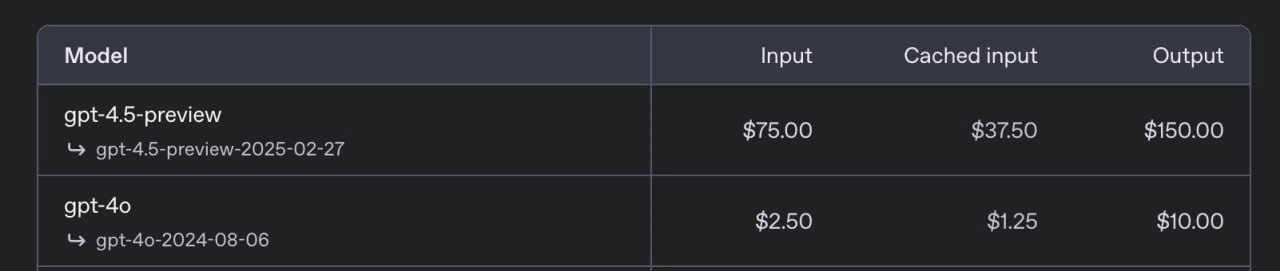
So what exactly are we looking at in this screenshot? It’s basically a price list (or usage summary) for two different OpenAI models. Think of these models as intelligent text generators. The table has columns for Input, Cached input, and Output, with dollar amounts, which corresponds to how much money it costs to use each of those models for processing text. OpenAI’s API charges by tokens – which are like chunks of words or characters. (For example, the word "developer" might be split into develop and er as two tokens by the system.) When you send text to the model (that’s the input tokens) or get text back (output tokens), each token has a price. The numbers in the meme are shockingly different for the two models: GPT-4.5 Preview vs GPT-4o. The first row for gpt-4.5-preview-2025-02-27 shows costs around $75 for input, $37.50 for cached input, and $150 for output (these are likely rates per a large block of tokens, say per million tokens, given how round those numbers are). The second row for gpt-4o-2024-08-06 – which looks like an older or “ordinary” GPT-4 model from August 2024 – shows much lower costs: $2.50 (input), $1.25 (cached), $10.00 (output) for the same number of tokens. In simpler terms, using the fancy new GPT-4.5 model costs about 30 times more for each input token and 15 times more for each output token compared to using GPT-4o! That’s a dramatic token cost comparison.

Let’s break down those columns:

  • Input: This is the text you send to the model. For instance, if you prompt the AI with "Explain quantum computing in simple terms.", those words count as input tokens. The table shows how much you pay for them. With gpt-4.5-preview, input tokens are quite pricey (e.g., $75 per million tokens); with gpt-4o, they’re much cheaper ($2.50 per million tokens).
  • Output: This is the text the model generates in response. If the AI answers with a paragraph, all those answer tokens count towards the output cost. Notice output is charged more than input, especially for GPT-4.5 ($150 vs $75). That’s typical in these APIs – generating text (having the model “think and write”) is considered heavier work than just reading the prompt. So output tokens cost a bit more.
  • Cached input: This one is interesting – it means some of the input tokens were recognized as repeats from before and didn’t cost full price. “Cached” implies the system had those tokens stored or processed already. For example, imagine you have a lengthy instruction you send with every request, like a big chunk of boilerplate or context that doesn’t change. The API might cache that so you don’t pay the full rate every single time. In the table, cached input is half the cost of normal input for both models. So instead of $75, cached tokens for GPT-4.5 are $37.50 (half), and for GPT-4o they’re $1.25 (half of $2.50). It’s like a discount for reuse – the service is saying “we’ve seen this part of the text already, so we’ll charge you less to process it again.” This encourages developers to reuse prompts or conversation context efficiently.

Now, why are people reacting with “lol” at this? Because the price difference is huge. gpt-4.5-preview is presumably a newer, more advanced model (the name suggests it’s an early preview release as of 2025-02-27). Being a hot new thing, it has a high price tag – kind of like a next-gen gadget that’s just come out. gpt-4o is an earlier model (from the date 2024-08-06) or maybe a cost-optimized version of GPT-4. It’s much cheaper to use, albeit likely with somewhat lower performance or fewer features. Developers integrating these LLM models into their apps have to be mindful: if you choose the high-end model, your costs will multiply quickly. Model selection becomes about balancing capabilities and cost optimization. With a limited budget (say you have only so much money to spend on API calls per month), using the cheaper model might let you serve 100x more users for the same cost, whereas using the fancy model might give better answers but could drain your budget after only a small number of requests. The meme highlights this trade-off in a humorous way by essentially saying: “Look at how absurd this is – if we go with GPT-4.5 everywhere, our budget constraints are going to be blown out of the water, haha… (nervous laugh).” It’s a very cloud era developer problem: you always have to watch those usage numbers climb on a dashboard, and it’s almost funny how choosing one API over another can be the difference between a coffee money expense and a second mortgage!

To put it in everyday terms: imagine sending roughly the same text to both models. For maybe 1 million tokens of input+output (which is like about 750k words, or roughly 1500 pages of text), GPT-4o might charge around ~$12.50 total. GPT-4.5 would charge around ~$225 for that same volume of text. So one option is like buying a budget phone that does the job for $12, and the other is like a high-end phone that costs $225 – both will make calls and send texts (or in this case, generate answers), but one is clearly much more of a luxury. The API usage dashboard screenshot is essentially the bill, showing how much was spent on each model. It’s as if the developer tried both and is now comparing the receipts side by side, leading to this slightly panicked humor. After all, seeing a big $150 vs $10 in the output column is exactly the kind of thing that makes you double-check if you left some test running by mistake!

Level 3: Champagne Model on a Beer Budget

For seasoned developers, this meme hits like a billing department horror story wrapped in dark humor. The usage table – resembling an OpenAI cost dashboard – shows gpt-4.5-preview racking up charges as if it were a champagne-soaked celebration, while gpt-4o sips quietly on a budget beer. The sticker shock is real: you’ve got budget constraints, yet here’s a shiny new model that’s orders of magnitude more expensive. That cheeky “Ahem, lol?” in the post text is the laugh of someone who just saw their cloud costs explode and can only nervously chuckle. We’ve all been there: maybe you enabled an expensive logging setting or forgot to turn off a cloud VM – next morning the bill gives you a heart attack. In this case, switching to the fancy preview LLM without considering the per-token pricing is the culprit. The meme exaggerates it to comedic effect: input tokens jumping from $2.50 to $75, output tokens from $10 to $150 – numbers so high you’d think it’s a typo. But nope, it’s real, and it’s the kind of surprise that makes a developer gulp and mutter, “This is fine… 😀🔥.”

What’s being satirized here is the classic trade-off between quality and cost in AI APIs. The new gpt-4.5-preview model likely offers better responses, maybe more accurate or with a larger context window, something every dev team dreams of using to wow their users. But the moment you see the cost, you have that senior-engineer epiphany: we can’t afford to use this everywhere! It’s a scenario straight from the playbook of Cloud Cost Optimization. You start strategizing: use the expensive model only for the really crucial tasks, and let the cheaper gpt-4o handle the bread-and-butter queries. This kind of tiered model deployment is common – like running an A/B test where most traffic goes to the efficient model and a trickle goes to the fancy one for special cases. Veterans in the field know the drill: when a new high-end model API drops, you always run the numbers. How many tokens do we expect per month? Multiply that by $0.000075 vs $0.0000025 per token – uh oh, that difference might burn through the quarter’s budget in a week. It’s a model selection trade-off in practice: do we really need GPT-4.5’s extra IQ points for every user query, or can we cache and reuse results, or get by with a cheaper model most of the time?

Speaking of caching, notice the meme’s nod to cached input costing half as much. An experienced dev looks at that and gives an approving nod – caching is always a lifesaver. It implies the person behind this dashboard was smart enough to reuse prompts or context so that repeated content didn’t fully count against them. In real terms, this could mean they kept a conversation ID or reused a system prompt so the API charges less for those recurring tokens. That’s a pro move to optimize costs. It’s analogous to how senior devs design systems: if you have a computation or data that’s used frequently, you cache it to avoid recomputation (and here, recomputation costs money each time!). The humor also hides a bit of trauma: many developers have faced a situation where an implementation detail – like failing to cache or using an overly powerful service by default – led to a surprise bill. This meme is everyone nervously laughing because it’s “too real.” We joke that GPT-4.5 must be running on a gilded supercomputer that charges by the ounce of silicon. The AI humor in this post is really a coping mechanism for the anxiety of potentially blowing the project’s budget.

In essence, the meme’s message to the developer community is: be careful what you wish for. Sure, you can have the top-of-the-line model, but cost optimization cannot be an afterthought. The difference between gpt-4o and gpt-4.5-preview is so dramatic that it forces a serious discussion with the product manager or CTO – is that extra accuracy or longer context worth a 15x cost increase? Often the answer is no, or not for every call. Seasoned engineers might quip, “We’ll use GPT-4.5 for the premium users or critical analyses, and GPT-4o for the rest. Also, let’s implement caching yesterday.” If not, you risk reenacting the classic “because of one configuration, our cloud bill went to the moon” war story. The meme lands as a sly commentary on how modern development isn’t just about writing code – it’s also about keeping an eye on that invoice. We grin at the absurdity ($150 vs $10 output cost!), but we’re also reminded: always mind the budget. In an era where calling an API can cost more than hosting your own server, today’s devs inherit a new role – part programmer, part accountant – ensuring that using amazing tech like GPT doesn’t accidentally make the CFO spit out their coffee.

Level 4: Scaling Laws & Tokenomics

At the cutting edge of AI/ML, bigger models often mean exponential cost scaling. The enormous price gap between gpt-4.5-preview and gpt-4o hints at the underlying compute intensity of the new model. Large Language Models (LLMs) like these require massive clusters of GPUs to churn through each token. As model size and complexity grow (think billions -> trillions of parameters), the inference cost per token can skyrocket. This is because each token generated involves countless matrix multiplications across many layers of the neural network. If gpt-4.5-preview has a larger architecture or longer context window than gpt-4o, it might be performing far more operations per token, hence the eye-watering price per million tokens. In essence, it’s bumping against the scaling laws of model performance: you get slightly better answers, but you pay disproportionately more for them. Researchers often talk about diminishing returns – beyond a certain point, each extra % of accuracy or fluency from a bigger model costs 10x% more compute. OpenAI’s pricing reflects this reality: the bleeding-edge model is bleeding expensive because under the hood it’s likely leveraging more GPUs, more memory, and more power for each query.

Interestingly, the table shows a “Cached input” price at half the normal rate. This points to some serious engineering wizardry in the API. Caching in this context likely means the system isn’t recomputing from scratch for repeated input tokens. In transformer architectures (like GPT), earlier layers’ computations for given tokens can be reused – akin to how memoization in programming saves results of expensive function calls. If the same prompt (or portion of it) is sent multiple times, the API may only need to reuse stored embeddings or attention key-values rather than crunching numbers all over again. By charging ~$0.0375 per unit for cached tokens (exactly half of $0.075), OpenAI might be passing on the savings from not having to recompute those tokens fully. It’s a glimpse into token-level optimization: the first time you pay the full price to encode those tokens into the model’s layers, but subsequent calls can skip redundant work – a bit like how your web browser caches files so it doesn’t download the same image twice. For developers, this is a sign that the API is optimizing behind the scenes with advanced techniques (possibly preserving context server-side or using reference pointers for repeated text) to lower the marginal cost. It’s a classic computer science trade-off: use more storage or smarter algorithms to save on compute time – here manifested as real dollar savings in an API usage dashboard.

All of this underscores a principle of tokenomics (token economics) in cloud AI: the more powerful the model, the more each token “costs” in computation. We can visualize an equation for the inference cost:

$$ \text{Cost per query} \propto \text{(tokens in + tokens out)} \times \text{(compute per token)}~, $$

where a model like GPT-4.5 has a much larger “compute per token” factor. This is why using the latest preview model is like moving from a sedan to a Formula 1 race car: you’ll go faster (or smarter), but the fuel costs (in GPU time and dollars) shoot through the roof. Engineers and data scientists must wrestle with this reality, balancing model selection trade-offs. Do you deploy the heavyweight champ for every request, or find a lighter contender for most jobs? The meme’s dramatic price comparison is a tongue-in-cheek reminder of a very real technical constraint: state-of-the-art AI isn’t cheap, and those fundamental scaling laws of neural networks mean someone (here, the developer or their company) must foot a hefty bill for marginal gains in intelligence.

Description

A screenshot of a pricing comparison table for two AI models, presented in a dark mode UI. The table has columns for 'Model', 'Input', 'Cached input', and 'Output'. The first row lists 'gpt-4.5-preview' with a date of 2025-02-27, showing costs of $75.00 for input, $37.50 for cached input, and a staggering $150.00 for output. The second row lists 'gpt-4o' with a date of 2024-08-06, with significantly lower costs: $2.50 for input, $1.25 for cached input, and $10.00 for output. This image is a meme that satirizes the rapid and often extreme escalation in the cost of next-generation AI models. It humorously projects a future where accessing a preview of a slightly more advanced model is exponentially more expensive, a relatable concern for developers and companies who rely on these APIs and must manage their costs carefully


Comments

18
Anonymous ★ Top Pick The gpt-4.5-preview's price is so high because it includes the cost of the therapist you'll need after you see the first invoice
  1. Anonymous ★ Top Pick

    The gpt-4.5-preview's price is so high because it includes the cost of the therapist you'll need after you see the first invoice

  2. Anonymous

    A single line in the model-name field: from gpt-4o to gpt-4.5-preview - never seen YAML turn into a board-level spending request so fast

  3. Anonymous

    Remember when we complained about AWS egress charges? Now we're paying $150 per million output tokens and calling it 'investing in innovation' while the CFO quietly updates their LinkedIn to 'open to opportunities'

  4. Anonymous

    When your CFO sees the GPT-4.5-preview pricing and suddenly becomes very interested in 'technical debt reduction' by sticking with GPT-4o. Nothing says 'bleeding edge' quite like a 30x price multiplier - at $150 per million output tokens, that's not a language model, that's a subscription to having an existential crisis every time someone hits your API endpoint. Suddenly that 'we should cache everything' architecture decision doesn't seem so premature after all

  5. Anonymous

    Those prices made prompt caching an architecture principle - we call it CFO‑driven design: POC on gpt‑4.5, production quietly on gpt‑4o

  6. Anonymous

    We implemented Mixture of Expenses: a prompt router uses 4o for 99.9% of tokens and only trips to 4.5 behind a rate-limited circuit breaker with a CFO webhook

  7. Anonymous

    Cached prompts in GPT-4: Because re-tokenizing your architecture doc should cost full price every time

  8. @Diotost 1y

    What am i looking at?

    1. @farstars 1y

      https://openai.com/api/pricing/

    2. dev_meme 1y

      Pricing for gpt 4.5 per 1M tokens

    3. @DIRECTcut 1y

      a joke

  9. @Valithor 1y

    Garbage

  10. @somaliprincee 1y

    why would they even release this, like its not even close to some game - changer but costs 10 godzillion dollars

  11. @DIRECTcut 1y

    hopefully

  12. @Pancake2x2 1y

    Thank God I never became an aibro

  13. @gmayv 1y

    They really want us to use the reasoning models

  14. @Diotost 1y

    It reminds me about one of those mobile ads.

  15. @LastStranger 1y

    Journalist that has lower price per word: 💀

Use J and K for navigation