Skip to content
DevMeme
5989 of 7435
The Deployment-to-Disaster Pipeline
Deployment Post #6558, on Feb 27, 2025 in TG

The Deployment-to-Disaster Pipeline

Why is this Deployment meme funny?

Level 1: Always Breaking Things

Imagine a kid trying to help out by carrying a stack of dishes to the kitchen. They mean well, but every time they try, crash! They drop the dishes and make a big mess. Now everyone has to rush to clean up the broken pieces. In this meme, the developer is like that kid, and the “dishes” are the updates they are adding to a live website or app. The joke is saying that whenever this person tries to put new changes onto the real site (which should be a good thing), they always end up breaking something important. The picture shows a skeleton lifting heavy weights, which is a silly way to show how drained and defeated the developer feels after so many accidents — it’s like they have no energy or life left, just bones, from all those late-night messes. It’s funny because it’s an exaggeration of a real feeling: trying your best to do a job (ship new features), but somehow creating a disaster each time. Essentially, it’s a playful way of saying, “Whenever I try to improve things, I end up yelling ‘oops’ and scrambling to fix the chaos I caused!”

Level 2: Release Fitness Fail

Let’s unpack the joke in simpler terms. The phrase “my body is a machine that turns deployment into an accident” riffs on a popular developer saying: “I turn coffee into code.” Usually, that motto means “I’m efficient at coding (thanks to coffee)”. Here it’s flipped self-mockingly: “I’m somehow efficient at turning deployments into disasters.” In plain English, whenever this developer deploys (releases new code to the live product), something goes very wrong — an accident in the form of a bug or outage. It’s self-deprecating humor about deployment failures. Instead of a brag, it’s an admission: every time I try to update the app, I break it. This resonates with anyone who’s accidentally pushed out a bug that took a site down. If you’ve ever updated a system thinking "This will make things better," and then heard "Um, everything’s on fire now," you know the feeling. The meme exaggerates it to every single deployment for comic effect.

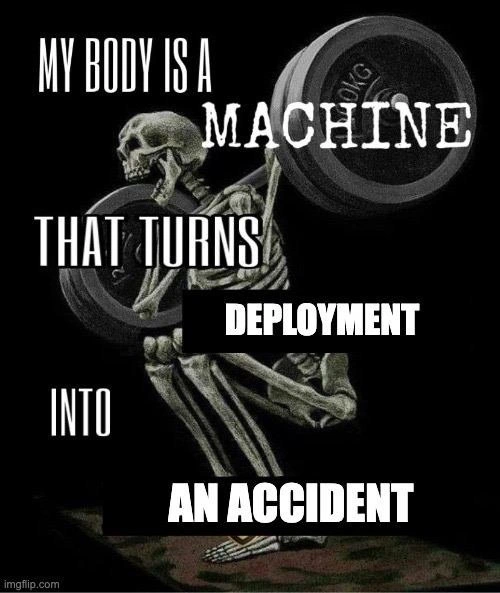
In the image, a skeleton doing a heavy squat stands in for the developer. Why a skeleton? It’s an over-the-top way to show someone who is completely exhausted or burnt out. In many memes, a skeleton implies you’ve been waiting forever or you’re so done that you’ve practically turned to bones. Here, it suggests the developer has been through so many all-nighters and on-call emergencies that they feel like a lifeless skeleton. The heavy barbell with those 20 kg weight plates symbolizes the weight or burden of a deployment. Each software release carries a lot of pressure and potential risk, much like lifting a heavy weight at the gym. If your technique or preparation is off, you can seriously hurt yourself lifting; similarly, if your deployment process or testing is off, you can seriously hurt the system. The joke is that this skeleton of a developer isn’t a well-oiled athletic machine at all – instead of turning protein shakes into muscle, they turn code releases into outages. It’s highlighting the absurdity that a process meant to deliver improvements is consistently delivering production issues instead.

Let’s define a few terms to make sure it’s clear: Deployment in tech means taking the new code you wrote and putting it on the servers or cloud so that the real users see the changes. That live environment is what we call production. An “accident” here means a big problem like the website crashing, users seeing errors, or some feature breaking in a way that causes chaos. So when the meme says the body turns “deployment into accident,” it means every time this person updates the live site, they inadvertently cause a serious production bug or outage (an incident). It’s like saying, “No matter what I do, whenever I try to release new code, something breaks badly.”

The humor also touches on DevOps and SRE culture. DevOps engineers and SREs (Site Reliability Engineers) are the folks who try to make deployments routine and reliable through automation, monitoring, and good practices. They’re the ones who set up CI/CD pipelines and alerts. Despite all that, even the best teams hit the occasional landmine – maybe a config file wasn’t updated, or the testing didn’t cover a weird real-world scenario. When that happens, the on-call engineer (the person responsible for fixing issues at odd hours) has to jump in. On-call duty means if something breaks at 2 AM, your phone rings and you’re the one who has to address it. Now, after a string of such stressful incidents, a developer might joke that they’re basically a machine geared for disaster. It’s a way to cope with the fact that even though we try our best to make deployments boring and safe, sometimes they explode spectacularly.

For a newer developer, the meme is a mix of warning and commiseration. It says: Deployments can be tricky — treat them with respect. If you skip steps (like not testing enough or deploying at a risky time like late Friday), you could end up like that skeleton, holding a heavy problem on your shoulders with no support. “Friday deployments” have a bad reputation in the industry for this reason: nobody wants to break production right before the weekend when the team has gone home. The phrase “deployment anxiety” refers to that nervous feeling right before releasing changes, especially if you’ve been burned before. The meme exaggerates one person’s bad luck to make others laugh and say “oh man, I’ve been there.” It’s basically sharing a painful lesson with a sense of humor: even something as routine as shipping code can turn into a fiasco if you’re unlucky or careless, and every developer eventually learns that lesson (though hopefully not every single time!).

Level 3: CI/CD to CPR

In a well-run software shop, continuous integration and deployment (CI/CD) is supposed to smoothly turn code changes into production features. For our skeleton friend, though, that CI/CD pipeline is basically a Rube Goldberg machine rigged to trigger the next production incident every single time. The meme’s tagline, “MY BODY IS A MACHINE THAT TURNS DEPLOYMENT INTO AN ACCIDENT,” is a dark parody of the classic developer boast “I turn coffee into code.” Instead of bragging about productivity, this line is a brutally honest confession that each release reliably yields chaos. It's a tongue-in-cheek form of DevOps humor that nods to a painful reality: whenever this developer ships code, it immediately breaks something critical in production. This is on-call humor at its finest (or worst) – the kind that makes seasoned ops engineers chuckle nervously because they’ve lived it.

Any battle-scarred SRE (Site Reliability Engineer) or developer who’s been in an on-call rotation can relate: deployments often feel like weightlifting in the dark. You prepare thoroughly, double-check everything, and think you’ve warmed up with all the tests and staging deployments. Yet the moment you hit the “deploy to prod” button, you hear the proverbial crack – something somewhere snaps under the pressure. It could be a latent bug that escaped your integration tests, or a misconfigured environment variable that only blows up in the live environment. The result? A sudden spike in pager alerts, Slack blowing up with “Site is down!” messages, and you frantically performing CPR on your production environment. In those moments, that developer’s "machine" of a body – depicted as a skeleton, perhaps because they feel dead inside from so many prior mishaps – seems optimized for one thing: converting new code into a fresh production accident.

For comedic effect, you could imagine the deployment script has a failure step built-in:

def deploy_to_production():
    push_new_code()
    verify_system_health()
    if system_health_ok:
        # Oops, something still goes wrong...
        trigger_incident("Deployment accident on prod")

Obviously, no real pipeline includes a trigger_incident function, but when you’re living this meme, it feels like it’s there automatically. Every deploy is followed by alarms. It’s as if the code pipeline pumps iron and then immediately pumps out incidents.

Look at the image: a skeleton doing a heavy barbell squat with those big 20 kg weight plates. The squat is a classic “heavy lift” exercise where form and preparation are everything – do it wrong and you can seriously hurt yourself. This parallels deployment: if you overlook a critical detail (a missing database migration, a hidden bug, a version mismatch), the whole system’s knees buckle under the load. The visual gag is that our lifter has no muscles or flesh, highlighting how exhausted and stripped-down a developer can feel after repeated 3 AM firefights. It’s a macabre exaggeration of the toll constant deployment failures and production issues take on engineers. After enough sleepless nights nursing broken systems, you might joke that only your skeletal determination remains. The skeleton imagery is common in meme culture to signal “I’ve been waiting forever” or “I’m utterly drained”, which fits perfectly here. Perhaps this poor soul has been crushed by so many late-night outages that only a skeleton is left to do the heavy lifting.

And speaking of late nights, there’s a reason veterans adopt rules like “no Friday deployments.” Ship something major at 4:59 PM on a Friday and you might spend your weekend in an incident war room, doing the on-call deadlift all alone. The meme hits a nerve because it’s only slightly an exaggeration. Too many of us have merged a seemingly innocent Pull Request and then spent the next day (or week) cleaning up the fallout. It pokes fun at that familiar surge of deployment anxiety — the sneaking suspicion that despite all your quality checks, this push might be the one that brings production to its knees. For senior engineers, this skeletal weightlifter is like looking in a mirror: we preach about automated testing, observability, and building resilient systems, but deep down we know one misstep in our release process and we’ll be sweating bullets trying to hold up a collapsing app. In short, the meme is both a cathartic laugh and a wince of recognition: some pipelines pump iron, ours pumps out incidents.

Description

A meme featuring an image of a skeleton lifting a heavy barbell against a black background. The image is overlaid with bold, white text, arranged in a disjointed, chaotic manner. The text reads, 'MY BODY IS A MACHINE THAT TURNS DEPLOYMENT INTO AN ACCIDENT'. The word 'DEPLOYMENT' is on a black block that partially obscures the skeleton's torso. This meme humorously personifies the developer as a self-sabotaging machine, one whose very nature leads to catastrophic failures during the critical process of deploying code to production. It's a relatable expression of imposter syndrome, anxiety about breaking things, or the simple fact that deployments are high-stakes events where small mistakes can have large consequences. The skeleton visual adds a touch of dark, self-deprecating humor


Comments

8
Anonymous ★ Top Pick I'm not saying my deployments are bad, but our Site Reliability Engineers have started referring to my pull requests as 'controlled demolition proposals'
  1. Anonymous ★ Top Pick

    I'm not saying my deployments are bad, but our Site Reliability Engineers have started referring to my pull requests as 'controlled demolition proposals'

  2. Anonymous

    Deployments have become DevOps powerlifting: every “harmless” squat gets halfway up, turns into a clean-and-jerk of a SEV-1, and suddenly the incident channel is spotting your form

  3. Anonymous

    After 20 years in tech, I've learned that deployments are just elaborate rituals where we sacrifice our sanity to the production gods, hoping they'll accept our offering of hastily-written rollback scripts instead of our souls

  4. Anonymous

    This perfectly captures the existential dread of every SRE who's watched their carefully crafted deployment pipeline transform a Tuesday afternoon into a 3 AM war room. The skeleton metaphor is apt - by the time you've survived enough production incidents, you've aged approximately 47 years per deployment. The real joke is that we've invented blue-green deployments, canary releases, feature flags, and chaos engineering, yet somehow still manage to find creative new ways to turn 'git push' into 'resume-generating event.' At least the skeleton is getting a workout; most of us just develop a Pavlovian stress response to Slack notification sounds

  5. Anonymous

    At this org, kubectl apply is basically a thin wrapper around PagerDuty’s create-incident API

  6. Anonymous

    Zero-downtime deploys mastered after 20 years; my L4-L5 disc remains the legacy monolith refusing migration

  7. Anonymous

    Our release process is idempotent: any number of deploys produces the same state - a blameless postmortem and an error budget of zero

  8. @blade_prime 1y

    On Friday in particular

Use J and K for navigation