Skip to content
DevMeme
4936 of 7435
Python: The Ultimate Performance Benchmark Punchline
Performance Post #5403, on Sep 7, 2023 in TG

Python: The Ultimate Performance Benchmark Punchline

Why is this Performance meme funny?

Level 1: Racing a Turtle

Imagine you have two kids trying to show who’s faster. One kid practices every day, puts on running shoes, and tries really hard to run as fast as possible. They want to beat the best runners. The other kid doesn’t really practice running at all. Instead, they secretly choose to race against a turtle. 🐢 Naturally, racing a turtle is easy – the kid just jogs lightly and still wins by a huge margin. Then that kid boasts, “Look how fast I am! I’m a champion because I can beat a turtle in a race.” The first kid might roll their eyes, because beating a turtle wasn’t hard work or a real test of speed at all.

This meme is joking about the same idea, but with computer code. One person is like the kid who trains – they optimize their code, trying different tricks to make it run really fast. The other person in the meme is like the kid racing the turtle – he just compares his code to something he knows is slow (Python), so that no matter what, he’ll look fast. It’s funny because he’s acting very proud and confident (dressed in a nice suit and adjusting his tie like he’s super cool) for doing something that was kind of a cheat. Essentially, it’s saying: why do hard work to be truly the fastest, when you can just pick an easy opponent and still claim victory? Everyone laughs because it’s obviously a silly way to brag – it’s not a real accomplishment, but he’s treating it like one.

Level 2: Interpreted vs Compiled

Let’s break down the technical ideas behind this joke. First, Python is a popular programming language known for its readable syntax and quick development cycle. It’s considered an interpreted language, meaning Python code is generally executed by an interpreter (like CPython) that reads and performs each instruction on the fly. This makes writing programs easier, but it also adds overhead at runtime. Every Python operation – even something simple like adding two numbers in a loop – involves extra steps (like type checking, bytecode interpretation, and sometimes managing memory through Python’s garbage collector). As a result, Python tends to be slow for computationally heavy tasks compared to languages that are compiled into machine code.

When we say a language is compiled, like C or C++ or Go, it means a compiler translates the code directly into low-level machine instructions beforehand. That compiled program runs directly on the CPU. There’s no need for an interpreter to read each line because it’s already in the form the computer’s hardware understands. So, compiled programs often run much faster. For example, if you write a loop to sum a million numbers, a compiled C++ program might blaze through it in a few milliseconds, whereas a Python program might take significantly longer (dozens or even hundreds of milliseconds) to do the same job. This isn’t because Python is doing something fundamentally different algorithm-wise – it’s mostly because the Python interpreter is doing a lot of work behind the scenes for each operation.

Now, benchmarking is the practice of measuring the performance of code. A benchmark usually involves running a piece of code and timing how long it takes or how much memory it uses. Developers use benchmarks to compare different approaches or languages. The meme’s text “I benchmark it against Python” implies the person runs their code (likely written in a faster language like C, C++ or maybe an optimized version in any language) and measures its speed relative to the same task done in Python. Because Python is typically much slower for raw computations, almost any code written in a faster language will show a big win in such a comparison. It’s like saying, “Look, my solution is 10 times faster than the Python solution!” as a proof of being fast.

The humor is that this is a bit of a performance trick. Python is known to be a slowpoke in the world of programming languages when it comes to execution speed. Developers often joke about Python’s slowness (there’s even a running gag that if something is slow, “it’s probably because it’s in Python” or Premature optimization might be bad, but no optimization and then comparing to Python is just cheeky.”). Of course, Python has strengths – it’s quick to write, has tons of libraries, and is great for many tasks – but raw speed is not its claim to fame. So comparing your code to Python’s speed is almost like comparing your sprint time to someone who’s walking. It’s technically a comparison, but not a very fair or meaningful one if you’re trying to prove how fast you are overall.

This relates to performance trade-offs. Python trades execution speed for other benefits: developer productivity, simplicity, readability, a huge ecosystem, etc. Many startups, for instance, start by writing programs in Python because it lets them develop features quickly. If later they hit a performance wall (the code runs too slowly), they might rewrite some parts in a faster language like C++ or Rust. It’s well-known that a direct rewrite in a low-level language can immediately give big performance gains — sometimes 10x, 20x, or more for CPU-heavy parts. That’s why the meme suggests someone “calls it a day” after benchmarking against Python: they know if something is fast compared to Python, it’s probably “good enough” and they stop there, without digging into more fine-grained optimizations.

We also see a bit of language comparison culture here. Developers love to compare languages on speed. For example, sites exist where common algorithms are implemented in many languages to see which ones run fastest. Python often ranks near the bottom in those pure speed comparisons (with notable exceptions when using special libraries written in C). Tools like Python’s timeit module or benchmarking frameworks in other languages allow you to measure how long functions take to execute. A microbenchmark specifically is a very focused benchmark on a small piece of code (like timing just a sorting function or a loop). Such microbenchmarks might show, for instance, that sorting 100,000 numbers takes 0.05 seconds in Python but 0.005 seconds in C++.

The meme plays on this by having the well-dressed man effectively say: “Why do the hard work to truly optimize at a low level? I’ll just show my code is faster than Python and call that optimized.” It’s poking fun at a superficial approach to performance. In reality, if you’re a junior developer, it’s good to understand that beating Python in speed is not the ultimate goal in optimization — it’s often expected if you use a faster language or method. True optimization might mean beating an existing C++ implementation, or handling 10x more load with the same hardware, or reducing memory usage while keeping speed, etc. In other words, context matters in benchmarking. You always have to ask: faster than what and does it matter? Here the “what” is a relatively slow baseline, so the boast doesn’t carry much weight among experienced folks.

To put it simply: optimizing code means making it run faster or more efficiently, often by improving the code itself. Benchmarking means measuring performance, which is great – but you need a good baseline for those measurements. If someone only ever compares to a slow baseline (like pure Python), they’ll always look great, but it doesn’t necessarily mean their code is objectively fast in an absolute sense. The meme humorously reminds us that context in performance metrics is key. It’s a gentle jab at those who might be a bit too easily satisfied with a low bar. After all, if your only claim is “at least it’s not as slow as Python,” that’s a backhanded compliment to your own work!

Level 3: Microbenchmark Machismo

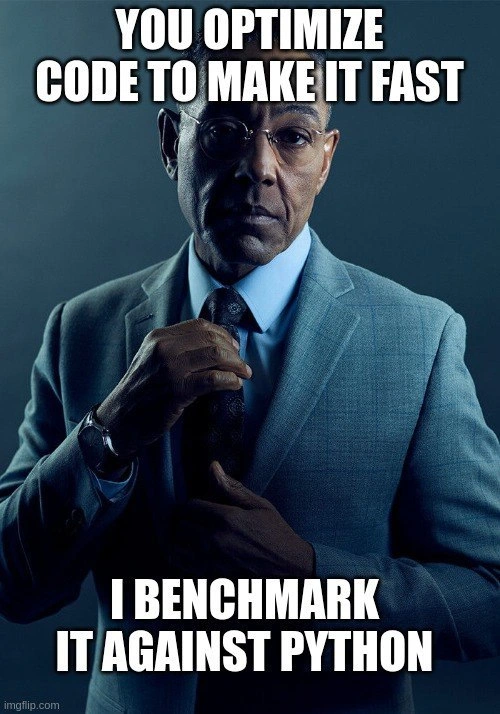
In the software performance arena, this meme wryly highlights a benchmarking trick that seasoned developers recognize instantly. The top caption says, “You optimize code to make it fast,” implying someone is painstakingly improving algorithms or fine-tuning code for speed. The bottom retort, “I benchmark it against Python,” is the suave guy’s boastful shortcut: he doesn’t bother with serious low-level performance optimization at all – he just compares his code to a notoriously slower baseline (Python) and declares victory. It’s a tongue-in-cheek portrayal of microbenchmark culture and language comparison one-upmanship.

Why is this funny to an experienced engineer? Because comparing almost anything to Python’s speed is setting the bar comically low. Python is a high-level interpreted language famous for its ease of use and flexibility, but also infamous for being relatively slow in execution. By default, Python code runs in the CPython interpreter, which processes one bytecode instruction at a time and manages dynamic types on the fly. In contrast, languages like C++, Rust, or even Java – which compile down to machine code or highly optimized runtime – can easily run circles around Python for CPU-intensive tasks. So when Mr. Blue Suit confidently adjusts his tie and says he “benchmarks against Python,” he’s essentially bragging about outrunning the slow kid on the playground. It’s a classy form of benchmark bravado, an elegant suit-and-tie flex built on a trivial comparison. We, as developers, chuckle because we’ve seen this “trick” before: a team claims their new service is blazing fast because “it’s 50x faster than the old Python script!” Well, of course it is – doing the same work in a low-level language often yields an order-of-magnitude speedup without any special genius. The meme skewers that self-congratulatory attitude.

This relates to the classic wisdom that premature optimization is the root of all evil.” In real projects, you shouldn’t obsess over micro-optimizations until you know they’re needed. But here our smug protagonist isn’t even optimizing prematurely or otherwise – he’s sidestepping the hard work entirely. It’s a sardonic twist: rather than optimize code the proper way (by profiling hotspots, using better algorithms or data structures, leveraging CPU cache efficiently, etc.), he just chooses a slow benchmark opponent. It’s like winning a race by picking an opponent who’s wearing weighted boots. Performance tradeoffs and genuine efficiency improvements aren’t part of his equation; he’s calling it a day after the simplest possible test. This satirizes a real industry pattern: sometimes developers or companies proudly announce performance feats that are technically true but contextually unimpressive. For example, “Our new C++ module is handling requests 30x faster than the old Python version” – while neglecting to mention that the Python version was not optimized at all, and a fair comparison would be against another optimized system or a realistic requirement.

Benchmarking tools can measure code speed precisely, but the value of those measurements depends on what you compare. A microbenchmark focusing on a tiny snippet (say, iterating a loop or adding numbers) will invariably show languages like C or Go trouncing Python in raw speed. The meme’s humor comes from this trivial truth: any routine can look lightning-fast if you measure it against Python doing the same work. Senior devs grin at this because it’s a jab at superficial performance claims. It underscores a subtle truth in engineering: context matters. Boasting “my code is fast because it beats Python” ignores the bigger picture – what if the real competition or requirement is much tougher? The meme character’s smugness pokes fun at that complacency. We’ve all met that one engineer who shows dazzling bar charts where their code annihilates a Python script in throughput and acts like they achieved rocket science, while everyone who’s been around the block knows it’s an apples-to-oranges comparison.

Finally, the image of the sharply dressed man (actor Giancarlo Esposito in a suit, exuding confidence) adds to the joke. He represents the ultimate confident professional who doesn’t sweat the small stuff. The contrast between his polished appearance and the underhanded simplicity of his method amplifies the irony. It’s the “we are not the same” meme format: You actually grind and improve your code’s efficiency; I, on the other hand, just pick a convenient baseline (Python) and appear superior. In developer culture, this is a lighthearted dig at those who take shortcuts to claim high performance. The experienced crowd laughs because they value true efficiency – shaving milliseconds with better algorithms or systems design – not just convenient comparisons. In short, the meme uses the well-known python_vs_c_speed gap as comedic ammunition. It reminds us that anyone can look like an optimization guru if they choose a slow enough yardstick, and that real performance work is about more than beating Python in a trivial benchmark.

Description

This image uses the 'We are not the same' meme format, which features actor Giancarlo Esposito (as his character Gus Fring) adjusting his tie with a look of superiority. The top text, in a bold white font, reads, 'YOU OPTIMIZE CODE TO MAKE IT FAST'. The bottom text reads, 'I BENCHMARK IT AGAINST PYTHON'. The meme humorously contrasts two different approaches to performance. One developer engages in the complex and serious work of optimizing code for speed. The other, portrayed as smugly superior, takes a shortcut by benchmarking their code against Python, a language notoriously slower for many CPU-intensive tasks compared to compiled languages like C++ or Rust. The joke is that almost any compiled code will appear fast when compared to Python, making it a low and almost meaningless bar for proving performance, and thus not a real achievement

Comments

27
Anonymous ★ Top Pick Benchmarking against Python is the performance equivalent of 'works on my machine' - technically true, but proves absolutely nothing to anyone who matters
  1. Anonymous ★ Top Pick

    Benchmarking against Python is the performance equivalent of 'works on my machine' - technically true, but proves absolutely nothing to anyone who matters

  2. Anonymous

    Nice flex: your C++ loop is 300× faster than Python - too bad p99 latency is still owned by the network hops and the feature-flag service

  3. Anonymous

    After 20 years in the industry, you realize the real optimization was choosing Python in the first place - not for speed, but for the velocity of shipping features while your competitors are still debugging their segfaults and fighting with build systems

  4. Anonymous

    The real power move is benchmarking against Python 2.7 running on a Raspberry Pi Zero - suddenly your O(n³) algorithm looks like it's been touched by the hand of Knuth himself. Bonus points if you're comparing a compiled language with -O3 optimizations against an unoptimized Python script that imports pandas just to add two numbers. It's the performance engineering equivalent of winning a race against someone who's still tying their shoes, but hey, the charts look impressive in the architecture review

  5. Anonymous

    Why profile hotspots when Python's GIL turns every benchmark into a gold medal for 'not the slowest'?

  6. Anonymous

    If the perf KPI is “beats Python,” congratulations - you optimized the benchmark, not the algorithm; call me when it outruns CPython+NumPy on a cold cache with the same complexity

  7. Anonymous

    Benchmarking against CPython's single-threaded loop is the perf engineer's version of fixing a Sev-1 by changing the SLO: the graphs go green, the architecture stays slow

  8. @SmirnGreg 2y

    А потом такие шутники пишут на "быстрых" языках n^4 алгоритм для того, что нампай из коробки делает за n.

    1. @Araalith 2y

      ...but slower.

    2. @SamsonovAnton 2y

      Use of right tools alone does not make the outcome right. (Applies to both compiled languages and numpy.)

    3. @RiedleroD 2y

      use English please @SmirnGreg

      1. @SmirnGreg 2y

        Sorry, always forget for this chat 😢 -- Later, the same folks: develop n^4 algorithm on a "fast" language, where numpy has n out of the box

        1. @azizhakberdiev 2y

          if I understand you correctly, then there's little difference between n^2 and n^4. I would say only e^n makes real difference

          1. @SmirnGreg 2y

            There is quite a difference. Of course, exponent is always worse. But there is a big difference between polynomes. Imagine, function calculates something based on immediate use input. Current scope is to display the user 1 week of data, and it takes 0.1s to process. Then, the product is going to update, and the time range increases to 1 month. Or 6 months. 1 month is 4 weeks, so n^2 will be 16 times slower — 1.6 second — barely tolerable. n^4 will be 256 times slower — 26 seconds(!!) — absolutely impossible.

    4. @deadgnom32 2y

      or they make it even O(n), but still 2000 times slower than numpy.

      1. @RiedleroD 2y

        remember, everything is O(1) if you just always check every possible option regardless

    5. Алексей 2y

      ну во-первых, как-то агрессивно, во-вторых - так для питона почти все либы ж и написаны на плюсах, разве нет? сам питон это чисто АПИшка к нему, если так можно выразиться

      1. @mekosko 2y

        WRITE IN ENGLISH PLEASE

        1. Алексей 2y

          Didn't see you telling that to the first commentator here🤯Sorry

          1. @mekosko 2y

            Somebody else told

      2. @SamsonovAnton 2y

        That's what the very first comment is about: simply writing math in C does not make it really fast, unless you care about optimization. And that's why using finely tuned libraries even from interpreted languages like Python may be faster, not to say it's less prone to errors.

  9. Deleted Account 2y

    Hi everyone im just learning Python

  10. @develdd 2y

    I am a junior and not a Python dev, so want to ask: I heard that Python's main issue is performance, which is resolved with a help of a superset language Mojo. So, the meme means that a person benchmarks code against Python because Python is labeled the slowest nowadays, or it implies that Python has good benchmark rates? Thanks in advance.

    1. @callofvoid0 2y

      first

    2. dev_meme 2y

      Which doesn’t make it a bad language or whatever

    3. @SmirnGreg 2y

      Python is less forgiving. Compiled languages become more and more declarative as compilers become better: you write a loop with a condition inside, compiler resolves it to masking and vectorized operation, everyone is happy. Python is slower by itself because every Python object is a C structure with a lot of function calls on any event. On top of that, there is (normally) no compiler for Python which would optimize native Python code both algorithmically and reducing it to direct CPU instructions. There are solutions to make Python faster. Most notably, Python can link and execute compiled C code on runtime. This is how numpy is working. You create a numpy array, which from a python view is just a pointer to a normal C array with some metadata, and then numerics is outsourced to C solution or even MKL. Of course, it does not work if you do pythonic [np.sin(a) for a in arr] instead of np.sin(arr) — then python becomes extremely slow.

      1. @develdd 2y

        Thanks a ton!

Use J and K for navigation