A Blissful Depiction of Google Stadia's Performance
Why is this Google meme funny?
Level 1: Cloudy Gaming, Clear Funny
Imagine you have a shiny new toy that everyone says is the future of fun – let’s say a special video game box that doesn’t need a disc or a powerful computer, because it runs on the internet “cloud.” Sounds cool, right? But when you try it, uh-oh… the games barely move and look kind of fuzzy. It’s like watching a cartoon that only changes the picture a few times per second – so instead of smooth movement, it jerks forward in big hops. And the picture looks like an old TV from grandma’s house (not clear like today’s HD screens). Plus, when you press a button to make your character jump or run, there’s a little pause before it happens, which feels weird – like if you said “jump” and your character said “huh?” and then jumped a moment later.
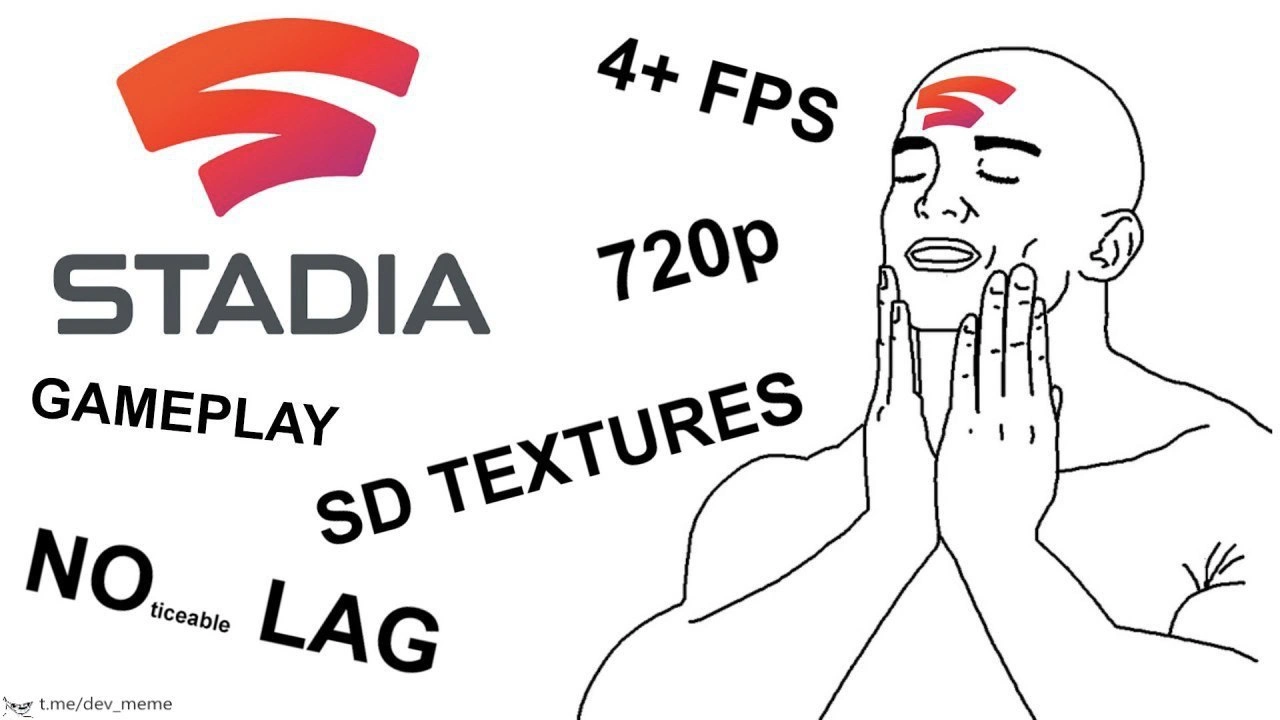
Now, imagine someone making an advertisement that pretends all those bad things are actually awesome. They proudly say, “Wow, 4 frames per second and 720p resolution – what a glorious experience!” (That’s as if a car ad bragged, “Goes up to 10 miles per hour!”). They even claim “no noticeable lag,” winking as they say it, when you can clearly see the delay. And to top it off, there’s a goofy picture of a bald guy with a blissful smile, rubbing his cheeks like he’s in heaven, as if these awful game qualities are the best thing ever.
It’s funny because it’s like calling a really bad video game experience a “pure cloud perfection.” In plain terms, the meme is joking, “This new cloud gaming service is supposed to be amazing, but look – it’s slow, blurry, and lags…and we’re totally loving it (not!).” It’s that upside-down humor where you say the opposite of reality with a big grin. Even if you’re not techy, you can get the gist: the game stream is performing poorly, and the meme makes fun of it by acting overly satisfied. It’s like if you took a bite of burned toast and deadpanned, “Mmm, gourmet cuisine!” while making a happy face. People who know what good games should be like (fast, responsive, clear) will laugh because Stadia was giving almost the worst experience, and here the meme treats it like a gold-star feature list. In short, it’s poking fun at a cloud gaming flop, using exaggeration and sarcasm to show how silly it is to call something so laggy and low-quality “perfection.”
Level 2: The Lag Is Real
Let’s break down what this meme is saying in simpler terms. Google Stadia was a service that let you play video games over the internet via the cloud. Instead of running the game on a console or PC at your house, the game runs on Google’s servers (powerful computers in a data center). The server sends you the game’s video as a stream, and you send back your controller inputs. The meme jokingly lists Stadia’s “ultimate” specifications, but each spec is actually highlighting a problem:
4+ FPS – FPS means frames per second, basically how many images are shown every second in a video or game. More frames = smoother motion. Most games aim for 60 FPS or at least 30 FPS to look decent. 4 FPS is incredibly low (think of a flipbook you’re barely flipping– it would look super choppy). By saying “4+” (four plus), the meme is sarcastically insinuating that Stadia might struggle to get even 5 or 10 frames per second at times. That’s an experience akin to a slow slideshow rather than a fluid game. In reality, Stadia was advertised to run at 60 FPS, but if someone had a bad connection, it might have felt as slow as 4 FPS. So this part of the meme is calling out low frame rates that make gameplay look like it’s stuttering.
720p – This is talking about the resolution of the video stream. 720p is 1280x720 pixels, often just called “HD”. It’s actually the lower end of HD; by 2019, 1080p (1920x1080) or even 4K (3840x2160) were the norm for clear, sharp images in games. If a game is only 720p, it looks less detailed and a bit blurry on a modern display, especially large TVs or monitors. Stadia was pitched to deliver up to 1080p for free users and 4K for paid users under ideal conditions. But many users ended up getting 720p streams, especially if their internet wasn’t very fast or stable. The meme lists 720p as if it’s a bragging point – which is funny because to gamers that sounds like a big downgrade. It implies that the “awesome cloud service” might actually be giving you last-generation console quality.
SD TEXTURES – In games, textures are the image files that give surfaces their detail (like the pattern on a wall or the clothing on a character). SD stands for Standard Definition, which is a throwback to pre-HD television (think older TVs with fuzzy picture quality). So “SD textures” means very low-resolution, blurry graphics in the game. It’s basically saying the game’s art looks muddy, as if the cloud is using low-quality assets. Why would that happen? Possibly because to keep the game running smoothly over a slow connection, the server might lower the graphics settings (less detailed textures, simpler effects) or the video compression might smear out the fine details. Either way, it’s highlighting poor visual quality. Listing it boldly is the joke – no game would proudly advertise “low quality graphics!” on their spec sheet. It suggests Stadia delivered a subpar image fidelity compared to playing the game locally.
GAMEPLAY – Dropping a generic term like “GAMEPLAY” into the spec list is a tongue-in-cheek way to say “hey, at least it functions as a game, sorta.” Normally, you wouldn’t list “gameplay” as a spec (that’s a given – if it’s a game, it has gameplay). By including it, the meme mocks how little there is to boast about; it’s like they’re filling space with something obvious. For a junior dev or someone new to the joke, think of it this way: if you saw a new smartphone advertised with bullet points: “- Makes Phone Calls! - Text Messaging! - Battery Included!” you’d be puzzled because those are expected. That’s the effect here – listing “gameplay” means Stadia doesn’t have much else to show off except the basic fact you can play a game on it. It underscores the underwhelming nature of the service.
NO ticeable LAG – This one is a bit of visual wordplay. Read it as intended: “No noticeable lag.” Lag in gaming terms is the delay between your action (like pressing a button) and the game’s response on screen. Noticeable lag means you can feel that delay, which is bad because it makes the controls feel unresponsive. The meme has capitalized NO separately to slyly imply the opposite: that there is noticeable lag. It’s making fun of any claim that there’s zero lag when using cloud streaming. For a cloud gaming setup, network latency (the time it takes for data to go to the server and back) is unavoidable. If you’re playing a game on your own PC/console, the input delay is maybe a few milliseconds – you won’t notice it. But with cloud gaming, even a fast internet might have 30-50 milliseconds of latency (and worse if your connection is slow or if you’re geographically far from the server). That can make the game feel sluggish. So, this part of the meme is confirming what many experienced: there was noticeable lag on Stadia, contrary to what one might hope. The oversized “NO” is pure sarcasm.
Now, all these points together paint a picture: Instead of amazing performance, Stadia often gave an experience comparable to an old or underpowered system struggling to run a game. For a junior developer unfamiliar with Stadia: imagine you’re running a heavy 3D game on a very weak laptop. The frame rate might tank (single digits FPS), you’d lower resolution to try to keep it playable (down to 720p or less), textures might look bad because the laptop can’t handle high detail, and there’s an overall delay in response because the system is overtaxed. Stadia’s twist was that the “weak laptop” in this analogy was actually the network conditions. The hardware on Google’s side was strong, but the internet connection issues made the end result similar to a weak setup.
Cloud streaming quality really depends on your bandwidth and stability. Stadia’s idea was that you don’t need a good PC or console; you just need a good internet connection. This meme is basically saying: if your internet isn’t top-notch, the “ultimate” cloud service becomes pretty disappointing. Developers who worked on streaming tech know how challenging it is to deliver consistent high-quality interactive video. If bandwidth drops, the service will adapt by reducing quality (hence 720p or SD visuals) or dropping frames (resulting in very low FPS). Also, any network congestion introduces lag – which you will notice in a game, because timing and quick reactions matter.
To give a concrete example for context: let’s say you’re playing an action game on Stadia. You press the jump button. On a local console, your character would jump almost instantly. On Stadia, that button press travels maybe hundreds or thousands of miles to a Google server, the server processes it and renders the next frame of the game where the character is mid-jump, then that frame is encoded to video and sent back to you. Even moving at nearly the speed of light through fiber cables, that round trip might take 100 milliseconds or more — a tenth of a second. It might not sound like much, but in fast games you can feel that. That’s game_streaming_latency in action. Now if something causes extra delay (like a Wi-Fi hiccup or the server being busy), the lag might stretch to 200ms or more, which is absolutely noticeable (imagine a noticeable half-beat lag on every action).
The meme format itself, with the blissful bald character (often known in meme culture as the “Feels Good” or “satisfied guy” face), adds to the humor. It’s showing a person rubbing their cheeks in ecstasy as if these terrible specs are the most wonderful thing ever. It’s pure sarcasm: no real gamer would be happy with 4 FPS and lag. But the meme pretends there is someone who’s totally zen and saying “yes, this is fine, I love it” — which makes us chuckle because it’s so absurd. It’s like a parody of a marketing person or a blindly loyal fan trying to spin bad news as good.
By referencing CloudGaming and Google’s product, the meme also subtly jabs at the idea that not every problem can be solved by throwing things into the cloud. Performance isn’t guaranteed just because it’s on a server; if anything, you’ve introduced new problems (network dependency). For someone starting out, the takeaway is: high-performance games are tricky to stream. The cloud can augment a lot, but networkLatency and bandwidth are the Achilles’ heel. Stadia’s failure (yes, it was eventually shut down in early 2023 after struggling to find a user base) is often attributed to these technical challenges and a lack of must-have games or clear audience. This meme zeroes in on the technical side with humor.
In developer terms, think of it as a witty bug report or performance review: “Expected 60 FPS @ 1080p, got ~4 FPS @ 720p with noticeable lag – works as intended 😅.” It’s labeled “pure cloud perfection,” which everyone reading understands to mean the exact opposite. The categories Cloud, Google, Games all intersect here, since it’s about a cloud service by Google in the gaming domain. And tags like PerformanceIssues and NetworkLatency are basically the root causes being highlighted in a joking manner. So the meme is funny to developers and gamers because it calls out those issues plainly and with a dose of irony.
To summarize at this level: Each bold term on the meme is a sarcastic “feature” pointing out Stadia’s shortcomings (low frame rate, low resolution, low quality graphics, and yes, lag). The guy in bliss is mockingly thrilled about this bad performance. It’s a humorous reminder that sometimes the latest tech, especially in the cloud, can promise a lot but end up delivering something that looks like earlier, inferior tech. And as devs, we often have to manage those expectations (or in this case, laugh when a giant company learns a lesson we suspected all along).
Level 3: Slideshows as a Service
From a senior developer or industry perspective, this meme is a roast of Google Stadia’s overhyped promises colliding with reality. It lists features like a sarcastic product brochure: “4+ FPS, 720p, SD textures — pure cloud perfection.” Any experienced dev or gamer immediately catches the satire here. 4 FPS (frames per second) is an absurdly low frame rate – practically a flipbook or slideshow rather than smooth motion. Modern games are expected to run at 60+ FPS for fluid gameplay (many PC gamers insist on 144 FPS or higher), so bragging about single-digit FPS is ridiculously tongue-in-cheek. The meme effectively says, “Behold, the future of gaming: performance roughly equivalent to a PowerPoint presentation!”
The 720p resolution spec is equally facetious. In 2019, when Stadia launched, the gaming world was talking about 1080p as standard and pushing into 4K (2160p) for high-end experiences. Stadia’s marketing indeed touted up to 4K streaming for Pro subscribers. So seeing 720p (a mere 1280×720 pixels, aka old HD from the mid-2000s) on the “ultimate spec sheet” is a huge red flag – it implies the real delivered quality was far below the glossy promises. It’s like advertising a sports car but delivering one that tops out at 30 mph. SD textures adds extra snark: “SD” stands for Standard Definition, the kind of low-detail graphics you’d find on a PlayStation 2 or an old DVD, not on cutting-edge cloud hardware. In game development, textures are the images that skin the 3D models; high-res textures make games look crisp and realistic. By saying Stadia has “SD textures,” the meme suggests the visuals were muddy and dated, as if the cloud was serving up last-decade graphics. It’s a jab at the streaming quality issues – when bandwidth was limited, Stadia might’ve reduced texture detail or video bitrate so much that the picture got blurry.
The item labeled “GAMEPLAY” in bold is particularly humorous in context. Listing “Gameplay” as a feature is like advertising a car by saying it comes with “Wheels!” – it’s so fundamental it shouldn’t even need stating. By including “GAMEPLAY” among the specs, the meme mocks how basic and underwhelming the selling points have become: “Well, at least it has actual gameplay, folks!” It hints that beyond the technical issues, Stadia didn’t offer much exclusive or compelling content – so the meme jokingly treats the mere fact that you can play a game at all as a bullet point. This resonates with developers who’ve seen grand projects fail by not delivering on core experience; here the core experience (gameplay) is presented as if it’s a special feature in absence of any real technical wow-factor.
Then there’s the brilliant “NO ticeable LAG” bit. At first glance you read “NO LAG,” but the tiny letters slyly turn it into “noticeable lag.” This is a classic tongue-in-cheek marketing parody. It riffs on the corporate language where a company might claim “no noticeable lag” in their cloud service. Many of us heard Google insist that Stadia’s NetworkLatency would be practically unnoticeable thanks to their optimizations. But gamers and devs were skeptical (and rightly so). The meme emphasizes “NO” as a bold claim, but literally annotates that lag is noticeable. It’s like the meme is whispering, “Actually, there is lag and you will absolutely feel it.” That oversized “NO” feels like corporate spin, and the undermining “ticeable” is the reality leaking through. For anyone who has worked on or used streaming tech, this hits home: you can’t completely hide latency. Even a 50-100 ms delay can throw off the snappiness of game controls, especially in fast-paced Games. Many players reported that Stadia’s controls felt muddy or slow – e.g., tap a jump button and the character might leap a split-second later than on a local console. That is noticeable lag, and it can ruin competitive play or any action-heavy game. The meme calls it out in the form of a faux marketing blurb, which is both funny and painfully accurate.
This whole spec sheet reads as if Stadia’s flaws were being sold as features. It’s a form of sarcastic marketing copy that developers find hilarious because it’s so close to the truth. There’s a sense of “we’ve been there” schadenfreude: many devs remember other overhyped tech that under-delivered. Cloud gaming itself isn’t a new idea – veterans recall services like OnLive (circa 2010) that tried and failed due to the same challenges. History repeated with Stadia: huge promises of cutting-edge Cloud infrastructure eliminating the need for costly hardware, only to run into the wall of real-world internet performance. By late 2019, early adopters and game developers were sharing war stories of Stadia sessions dropping resolution to potato quality or freezing mid-action due to PerformanceIssues. The meme’s “4 FPS, 720p” joke is likely referencing those anecdotes where a high-speed game became virtually unplayable when the connection hiccuped.
For developers, there’s also an underlying commentary on trade-offs in system design. Stadia’s architecture offloaded everything to the server side — great, you don’t need a console or gaming PC locally. But the trade-off is total dependence on network quality for every frame and input. It’s an architecture that favors convenience over performance reliability. Many senior engineers recognize this pattern: you centralize computing in the cloud (thin client model) and inevitably you have to contend with latency and bandwidth as your new “boss level” problems. The meme resonates because it confirms what skeptics suspected all along: that a cloud-first approach to gaming might yield inferior results to good local hardware, especially in areas with average internet. Google is known for moonshot projects, and devs often joke about the disconnect between ideal conditions vs. messy reality. Here, the “pure cloud perfection” tagline ironically underscores how idealized the pitch was, versus the grainy, laggy reality users experienced.
And of course, there’s the Feels Good Man style character on the right, blissfully rubbing his cheeks with the Stadia logo on his forehead. This bald, contented figure (a popular meme face indicating euphoric satisfaction) is used ironically. It implies that someone (perhaps Google’s marketing team or a die-hard fan) is in heaven with these terrible specs. It’s poking fun at the idea of being delusionally happy with an inferior product. For developers, it’s easy to imagine this as a dig at how some higher-ups might celebrate a launch despite glaring flaws because they’re swept up in cloud hype. Or it could represent a tiny subset of users convincing themselves “It’s fine!” even when the experience is clearly subpar. The contrast between the blissful expression and the abysmal specs is the crux of the humor. It screams TechHumor and GamingCulture in-joke: only in a meme would someone be thrilled about 4 FPS and lag – it’s pure sarcasm.
In summary, at this level we see the meme as a commentary on CloudGaming realities versus promises. It humorously enumerates Stadia’s weaknesses as if they’re features, highlighting the gulf between expectation and execution. Developers and gamers who lived through Stadia’s launch (and eventual flop) nod knowingly: this “ultimate spec sheet” might as well have been what we actually got. In fact, not long after, “GoogleStadiaRIP” became a trend when Google announced Stadia’s shutdown – the service was deemed a product_failure. The meme was ahead of its time in calling out why Stadia would struggle. It’s a senior-level smackdown of overhyped tech: a reminder that performance can’t be conjured from the cloud without consequences. And frankly, it’s fun to see those hard truths packaged in such a darkly comic, memeable way.
Level 4: Lag, Loss, and Light-Speed
At the most granular level, this meme highlights the harsh physics and network realities that Google Stadia tried to overcome. Cloud gaming essentially takes a high-performance video game and runs it on a remote server, then streams the visuals to your device in real-time. This is a distributed system problem with strict low-latency requirements – a sort of telepresence for video games. But no matter how advanced the infrastructure, the speed of light remains undefeated: there’s an irreducible delay (latency) when sending input data to a distant data center and streaming frames back. Stadia attempted to minimize this using Google’s massive global network, yet players still felt the lag due to plain old network latency and jitter.
The technical bottlenecks go deep. Stadia’s servers encode game frames into a video stream (using codecs like VP9 or H.264) and send them over the internet. Encoding at high resolution (say 1080p or 4K) at 60 frames per second is computationally intensive – even with dedicated hardware, there’s an encoding delay per frame. Those frames then travel across the internet, possibly via protocols like UDP (to avoid TCP’s congestion stalls) or even WebRTC in Chrome. If packets arrive late or out of order, the client may drop frames or show compression artifacts (blurry or blocky image patches). The meme’s joking spec of “4+ FPS” hints at extreme frame drop – essentially the game degenerating into a slideshow when the network can’t keep up. This can happen if, for example, only keyframes (full images every second) make it through and the delta frames are lost due to packet loss. In streaming video terms, it’s like only receiving an occasional I-frame and none of the in-between P-frames, resulting in a measly few updates per second on screen.
Bandwidth is another cruel limiter. To stream even 720p resolution with decent quality and 60 FPS, you need a steady several megabits per second of throughput (and much more for 4K). If a user’s connection can’t sustain that, Stadia’s architecture would downshift to a lower resolution or bit-rate. That’s where those “SD TEXTURES” and 720p come in – the service might reduce texture quality or resolution on the fly, effectively sending you a lower-fidelity feed to avoid stalling completely. It’s akin to how YouTube drops to 480p or 360p when your connection is slow, but here it’s happening in an interactive context. The result: muddy textures and a fuzzy image, the opposite of the crisp HD gaming experience players hoped for.
The “NO ticeable LAG” quip is a jab at the impossibility of eliminating input delay in cloud gaming. Some of Stadia’s early hype included ideas of “negative latency” (pre-rendering frames or predicting player actions using machine learning). In theory, the system could guess what you’ll do next to mask the delay – a bold (some say comical) attempt to cheat physics. In practice, consistent sub-20ms input-to-photon latency over the internet is nearly unattainable for everyone. The phrase “NO ticeable LAG” with a huge NO is a satirical way to say “Actually, you’ll notice the lag for sure.” Even with adaptive buffering and fancy netcode, physical distance (signal propagation), queueing delays in routers, and decoding time on the client all add up. Buffering too much can make the stream smooth but increases latency; buffering too little keeps controls responsive but risks stuttering – a devil’s trade-off. Under real-world conditions (variations in Wi-Fi, peak-hour congestion), hiccups were inevitable. The meme exaggerates to 4 FPS and 720p to epitomize those failure cases when the cloud service struggles – the worst-case scenario where the game feels unplayably choppy and blurry.
In short, from a systems perspective this “ultimate spec sheet” mocks how cloud-first architectures for games run smack into fundamental constraints: limited bandwidth, encoder/decoder delays, network unreliability, and that pesky 186,000-miles-per-second speed limit. The humor is that Google’s cutting-edge CloudGaming platform, backed by data centers and fiber optics, could still deliver an experience reminiscent of dial-up internet days. PerformanceIssues that developers (and network engineers) anticipated – high latency, low frame rates under load, downscaled resolution – all manifested in Stadia’s real-world usage. This meme simply collects those pain points into a faux-spec sheet, underlining that no amount of marketing spin or cloud magic can completely erase packet loss or ping times. The result is a tongue-in-cheek reminder that even in tech, you can’t have your cake and eat it too: if you move all computation to the cloud, you’re going to pay the latency tax and sometimes get a laggy, low-res bill in return.
Description
This meme satirizes the performance issues of Google's cloud gaming service, Stadia. It features the 'Feels Good' Wojak meme, which is a simple line drawing of a bald man with a blissful, serene expression, holding his hands to his cheeks. In this version, the Google Stadia logo (a stylized red 'S') is placed on his forehead. Surrounding him are various text labels written in a scattered, chaotic manner, ironically listing the service's perceived flaws as if they were desirable features. These labels include the official 'STADIA' name, 'GAMEPLAY', '4+ FPS' (a very low frame rate), '720p' (a low resolution for the time), 'SD TEXTURES' (low-quality graphics), and 'NOticeable LAG' with the 'ticeable' part smaller to cleverly twist the marketing phrase 'no noticeable lag'. The meme humorously captures the community's disappointment with Stadia's failure to deliver on its promises of high-quality, low-latency game streaming, a significant engineering challenge that involves massive infrastructure and networking complexities

Comments
7Comment deleted
Stadia was a bold experiment in distributed systems that successfully proved the CAP theorem's fourth, unwritten constraint: Consistent, Available, Partition Tolerant, and Playable. You can only pick two
Stadia’s proud 4 FPS at 720p proved one thing: if your rendering pipeline is a Kubernetes deployment stretched across three continents, you’ve officially confused “eventually consistent” with “playable.”
Google spent billions proving that the speed of light is still a constraint in distributed systems, but at least they got a killer postmortem out of it
Stadia promised 'negative latency' through predictive AI, but delivered positive latency through unpredictable networking - turns out you can't machine-learn your way around the speed of light, and no amount of edge computing can fix a 4 FPS experience that makes Doom on a pregnancy test look like a technological marvel
Stadia was the first production system where frames were eventually consistent - p50 looks fine in demos, p99 arrives after the credits
Stadia: we optimized the median; p99 frametime is 250 ms (aka 4 FPS), but the dashboard still says “no noticeable lag.”
Stadia's 'no noticeable lag' - because at 4 FPS, the stutter achieves nirvana-like frame blending