TypeScript's Verbose Rebuttal to JavaScript Fans
Why is this Languages meme funny?
// JavaScript (dynamic typing, no compile-time errors)
function greet(name) {
return "Hello, " + name.toUpperCase();
}
console.log(greet(42));
// This will run in JavaScript, but at runtime it throws
// TypeError: name.toUpperCase is not a function (because 42 is a number)
// TypeScript (static typing catches the mistake)
function greet(name: string): string {
return "Hello, " + name.toUpperCase();
}
greet(42);
// Error at compile-time: Argument of type 'number' is not assignable to parameter of type 'string'.
In this example, JavaScript would only complain after you run the code (and something goes wrong), whereas TypeScript stops you before running it, with a clear error message. That’s the core difference: JavaScript is lax until execution, TypeScript is strict from the get-go.
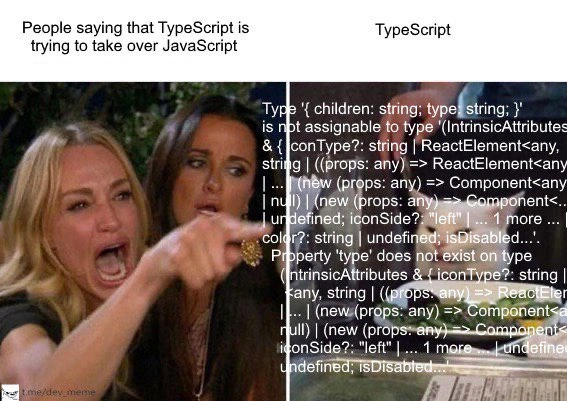
Now, tie this back to the meme. When the people say “TypeScript is trying to take over JavaScript,” they’re voicing a worry that this strict style of coding (with all its rules and errors) is replacing the more free-form JavaScript style. And how does TypeScript respond? With exactly those strict rules, exemplified by the giant error message. It’s as if TypeScript is proving their point in a comedic way: “Take over JavaScript? I’m too busy throwing errors about your code!” The CompilerErrors are TypeScript’s form of communication.
For a newer developer, the meme is showing the frustration vs. benefit of TypeScript. The frustration is that when you use TypeScript, you can’t just quickly run your code if there’s a type mistake – the compiler will literally yell at you with a lot of text. The benefit (hidden in the humor) is that these errors are catching problems early. In the React example from the meme, TypeScript prevented a potential bug – maybe passing a wrong prop could have caused a runtime error or unintended behavior in the app, but TypeScript’s error ensures the developer fixes it before shipping the code. It’s tough love: it feels like scolding, but it’s for a good cause.
Lastly, the reason this is funny is because of the exaggeration. TypeScript error messages can feel like they’re paragraphs long, and indeed the meme shows one that’s cut off because it’s so long. It’s overwhelming, especially if you’re not familiar with the terminology. It almost looks like TypeScript is angrily ranting in tech jargon. Pair that with the image: a person yelling (complaints about TS) and a cat (normally quiet) now “yelling” back with text – it’s a visual punchline. Once you’ve seen a few of these errors in your own coding, you appreciate the joke: TypeScript doesn’t need to literally take over anything; it already dominates you by the sheer volume of its compiler messages! And yet, those of us in FrontendDevelopment knowingly accept this trade-off, often joking about how TypeScript is like a strict guardian for our JavaScript code. The meme makes that strictness both relatable and ridiculous at the same time.
Level 1: Teacher’s Red Pen
Imagine you have to write a story for class, and there’s a very strict teacher who will check it. Some kids complain, “Ugh, that strict teacher is taking over our fun creative writing!” — that’s like people complaining about TypeScript taking over JavaScript. Now, you hand in your story, and when you get it back, it’s covered in red ink corrections. Every little grammar mistake or spelling error has a red mark with a note. It looks really scary and overwhelming, like a big wall of “you did this wrong.” That red-marked paper is just like the giant error message TypeScript gives when something in the code isn’t quite right.
In this analogy, JavaScript was like the easygoing teacher who didn’t mark any mistakes on your paper – sounds nice, right? – but that also means you might never notice your errors until the final exam (or until the program crashes). TypeScript is the strict teacher who marks everything: it feels harsh because you’ve got a paper full of corrections (just like the screen full of error text), but it’s actually helping you learn and avoid those mistakes in the final story.
The meme’s joke is basically showing this scenario: people are yelling that the new teacher (TypeScript) is trying to take over, and the teacher “responds” by slamming down a pile of graded homework with tons of corrections. It’s funny because the teacher isn’t literally arguing back – they’re just doing their job in a comically overzealous way. The emotional core here is frustration meets irony. The people are mad at TypeScript, and TypeScript “replies” by being super strict and fussy, as if to say, “If I’m in charge, I’m gonna do it my way!”
In the end, even though it’s annoying to see so much red ink, we know the teacher’s goal is to make the story better. Similarly, TypeScript’s long error messages might feel like it’s yelling at you, but it’s actually pointing out all the issues now so your program doesn’t break later. The meme makes us laugh because it captures that feeling of being scolded by your tools – a mix of “Ouch, alright already!” and “I know it’s for the best…”. It’s a playful way to show that sometimes the things that keep us safe (like safety rules or type checks) can also drive us a little crazy with how strict they are. But in the battle of TypeScript vs JavaScript, sometimes the strict side “yelling” is exactly what we signed up for, whether we’re ready for it or not!
Description
This meme uses the two-panel 'Woman Yelling at a Cat' format. On the left, a distraught woman points and yells, with the caption 'People saying that TypeScript is trying to take over JavaScript'. On the right, a confused-looking white cat sits at a table, labeled 'TypeScript'. The cat's 'response' is a massive, multi-line TypeScript error message overlaid on the image, starting with 'Type '{ children: string; type: string; }' is not assignable to type '(IntrinsicAttributes & { iconType?: string | ReactElement<any, string | ...'. The joke contrasts the dramatic, simplified accusation with the cold, complex, and pedantic reality of a TypeScript compiler error. For experienced developers, the humor lies in the relatability of wrestling with such notoriously verbose and intricate type errors, which serves as TypeScript's unintentional, yet perfect, defense
Comments
7Comment deleted
TypeScript isn't trying to take over. It's just leaving a 3-page static analysis report on your PR to gently suggest you might have misunderstood the type relationship between a string and a string
Relax, JavaScript - TypeScript isn’t staging a coup; it’s just trying to explain, in 300 lines of conditional-type algebra, why your <Button type='submit'> is actually a contravariant existential crisis
TypeScript's error messages read like a senior architect explaining why your seemingly simple change breaks the entire monorepo's type inference chain across 47 transitive dependencies you didn't know existed
The real TypeScript takeover isn't about replacing JavaScript - it's about replacing your terminal output with an unreadable wall of generic type constraint errors that make you question every life decision that led you to add 'as any' just to ship on Friday
TypeScript isn’t conquering JavaScript - it’s busy writing a 200‑line brief explaining why our ButtonProps union intersected with IntrinsicAttributes can’t accept { type: string }; verdict: “Property ‘type’ does not exist on type.”
TypeScript's 'any' in React props: the compiler's polite way of saying, 'Sure, but children still need a proper lineage check before joining the component tree.'
TypeScript isn’t taking over JavaScript - it’s filing a three-monitor conditional-type injunction because '{children, type}' isn’t assignable to JSX.IntrinsicAttributes