From beach castles to Docker sandboxes: growing up as a developer
Why is this Containerization meme funny?
Level 1: Never Stop Playing
Remember how when you were a little kid, you’d play in a sandbox so you wouldn’t make a mess everywhere else? Developers do the same thing, but with computers! The meme is saying that as a kid you played with real sand, and as an adult programmer you “play” in a sandbox on your computer. It’s funny because it shows the adult doing essentially the same sort of thing as the child. As children, we build sandcastles in a little box of sand; as grown-ups, developers build test projects in a protected part of the computer. In both cases, the idea is the same: you can be creative and even fail safely within that space, and nothing outside gets ruined. The grown-up still gets to play, just with code instead of sand. So the joke here is that growing up as a developer means you actually never stop playing in the sand – you just trade your plastic shovel for a keyboard! It’s a warm, relatable comparison that makes us smile, because it reminds us that deep down, even adult professionals are kids at heart, still having fun building stuff in their own sandboxes.
Level 2: Sandbox 101
So, what exactly is this “sandbox” idea the meme jokes about? In software development, a sandbox environment is a safe testing space. It’s like a private playground for your code. When developers want to try out something new or risky, they won’t directly do it on the main system or the live product (that could be as messy as dumping sand all over a living room). Instead, they use an isolated environment – often a container using tools like Docker – that imitates a real system but is cut off from the important stuff. If the code crashes or misbehaves in the sandbox, no real harm done. It’s the computing equivalent of a kid playing in a sandbox: the kid can build, destroy, and get messy, and all the mess stays in the sandbox without ruining the whole yard.
Docker is specifically a popular technology for containerization. Containerization means packaging an application along with its dependencies and environment into one neat unit (a container), which can run reliably anywhere. Think of a container like a little box (or, humorously, like a little sandbox) that holds an app – it contains the code, runtime, system libraries, everything needed, so that the app runs the same no matter where you launch that container. This is great for testing: you can fire up a Docker container on your machine that perfectly mimics a small version of the production environment. It’s isolated from your host OS, thanks to Docker’s use of low-level kernel features (the container can’t mess with your host system files or settings). Developers often say, “I’ll test it in a container” or “I’ll use a sandbox environment,” meaning they’ll try it somewhere safe first.
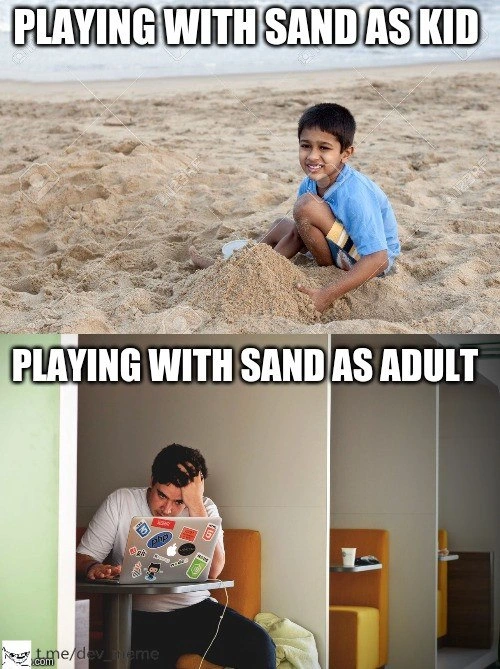
The meme’s top image is straightforward – a little boy playing in real sand, probably building a sandcastle. The caption “PLAYING WITH SAND AS KID” just describes that familiar childhood activity. The bottom image shows an adult programmer at his laptop; he’s coding away, perhaps setting up a dev environment or running a sandboxed app. The caption “PLAYING WITH SAND AS ADULT” is jokingly calling the developer’s coding work playing with sand. Why? Because in developer lingo, “playing in the sand” refers to working in a sandbox – an isolated test environment. It’s a play on words (a fun double meaning) that connects a childhood pastime with an adult tech task.
Let’s break some of the terms and visual cues: The laptop is covered in tech stickers – developers often adorn their laptops with stickers of their favorite programming languages, tools, or memes (you might spot logos like Docker’s whale, the Kubernetes wheel, or others). It’s a bit of techie culture and pride. The coffee cup nearby signals the stereotypical developer fuel: caffeine, since coding sessions can be long. The office booth setting suggests a modern tech workplace where working on a laptop all day is the norm. So, that adult isn’t literally playing with beach sand; he’s writing code, possibly in a Docker container or a virtual machine – that’s his “sand” now. In many companies, you might even hear environments named “Sandbox,” “Staging,” or “QA” – all indicating places you can test things out freely before they go to production (the real-world live system).
In simple terms, developers maintain sandbox environments to experiment. This improves the Developer Experience (DX) because you can try things out quickly without fear. If you break something in the sandbox, you can just reset it or throw it away and start fresh – much like dumping out a bucket of sand and refilling it to build a new castle. This meme is developer humor because it connects that technical concept to a universally understood childhood activity. Even if you’re new to coding, now you know: a sandbox, in tech, is just a safe place to play with new code. And yes, thanks to tools like Docker (and its cute whale logo), setting up these sandboxes has become super common and relatively easy. The result? As adults, we’re still “playing with sand,” just the digital kind – and having a blast doing it.
Level 3: Castles to Containers
This meme hilariously captures a core truth of the developer experience: even as adults, we’re still playing in sandboxes! The top panel shows a kid blissfully building a sandcastle on the beach, and the bottom panel shows a programmer hunched over a sticker-plastered laptop, likely spinning up a Docker container or a virtual machine. The punchline is a clever play on words: “playing with sand” as a child is literal, whereas as an adult developer it’s metaphorical — referring to working in a sandbox environment. Every seasoned developer knows the importance of having a safe, isolated space (be it a local dev environment, a Docker container, or a VM) to tinker with code without affecting the real world. That bottom-panel developer is probably deploying code in a container, running integration tests in a sandbox, or debugging some “it works on my machine” issue. In other words, they’re doing the grown-up version of building sandcastles: creating something elaborate in a contained area, knowing it can be knocked down and rebuilt freely.
The humor works on multiple levels. For one, it’s relatable humor for anyone in tech — we chuckle because yeah, our day job sometimes does feel like playing with virtual sand. The meme also highlights containerization culture in modern DevOps. Ever since containers became mainstream, developers have been obsessed (in a good way) with setting up isolated test environments for everything. Spinning up a fresh Docker container to test a new library? That’s basically indulging your inner child: you’re given a fresh pile of sand (clean environment) to shape something, experiment, and destroy it when you’re done, all without consequence. This is a cornerstone of good testing practice: “Don’t deploy untested code to production.” Instead, we play with it safely first. The meme’s two-panel comparison (kid vs. adult) nails this contrast and evolution.
Another layer of the joke is how developers never really grow out of their toys, they just get more expensive and complex ones. The child has a simple plastic shovel and bucket; the adult developer’s “shovel” is a CLI and their “bucket” is a container image registry. We even talk about “building” and “tearing down” environments using Terraform scripts or Kubernetes manifests, which sounds a lot like building and smashing sandcastles. A senior engineer can definitely identify with the shared experience of setting up a personal dev sandbox or a full-blown staging environment — it’s practically a rite of passage in developer culture. Remember the first time you accidentally broke something on the production server because you didn’t test in isolation first? RelatableDeveloperExperience right there! You quickly learn why everyone says, “Try it in a sandbox first.” This meme playfully reminds us of that lesson by equating it to something we learned in childhood: don’t make a mess where it can do harm, go to the sandbox.
The visual details drive the point home. The kid is carefree, smiling ear-to-ear, totally absorbed in the fun of piling sand high. The developer on the bottom might look a bit more stressed (coffee in hand, hunched posture, the classic “in the zone” look), but fundamentally they’re engaged in a similar act of creative construction. And check out that laptop sticker overload: those stickers (Docker whale? Kubernetes helm? maybe some React or Python logos) are like merit badges of the tools and frameworks the developer “plays” with. It’s equivalent to a kid bringing their favorite toy truck or flag to stick on the sandcastle. Developers often plaster their laptops with tech logos as a proud display of their toolkit and passions — a very grown-up way of saying “this is my playground.” The contrast is funny because of how true it rings: developer humor often pokes fun at our own geeky habits and the childlike excitement we get from new tech toys.
Ultimately, the meme taps into that shared nostalgia and daily reality. Sandboxing isn’t just a technical practice; it’s a comforting idea. Just as the child feels safe to imagine and build on the beach, the adult developer feels a sense of freedom working in a safe dev environment. No live customers will scream, no production databases will wipe out — it’s just us and our “sand.” It’s a feel-good, DevOpsHumor kind of joke. “From beach castles to Docker sandboxes” indeed — as we grew up from kids to coders, our sandbox just became digital and our castles turned into code deployments. But the sense of play, experimentation, and sometimes the need to destroy and start over (yes, how many times have we tossed a buggy container only to rebuild it from scratch?) stays the same. In a fast-paced tech world, this meme nostalgically reminds us that at heart, developers are just big kids who turned our play into our work. And honestly, that’s what makes this field so much fun.
Level 4: Cgroups & Namespaces
At the OS kernel level, a modern software sandbox environment (like a Docker container) is built with some nifty low-level isolation features. Think of it as the operating system drawing strict lines in the sand. Linux namespaces carve out separate spaces for things like process IDs, network interfaces, and file systems. This means the processes inside a container think they’re on their own little beach — they can’t see processes or sockets outside their sandbox. Simultaneously, cgroups (control groups) enforce resource limits, making sure one container doesn’t hog all the CPU or memory (like keeping each kid’s sandcastle from swallowing up the entire sandbox). These mechanisms are the castle walls and boundaries of containerization.
When the adult developer in the meme is “playing with sand” on a computer, under the hood their tools might be using namespaces to give their code a private playground and cgroups to fence off compute resources. In fact, technologies like Docker orchestrate all this for you: when you run a container, Docker is invoking kernel syscalls to set up a sandboxed process. The container gets its own secluded view of the world: its own file system (often provided by a layered union file system like OverlayFS or AUFS), a virtual network stack, and isolated process tree. It’s as if the developer’s code is building a sandcastle in a special partitioned corner of the beach — no matter how wild things get inside, the rest of the system stays pristine.
This isolation isn’t just for fun; it’s fundamental for testing and security. A sandbox in computing is a direct analogy to the childhood sandbox: an environment where you can let your creative or untrusted processes run free without wrecking the surrounding landscape. Research in operating systems and security (going back to experiments with chroot jails in Unix and the Orange Book security standards) led to these robust containment techniques. Modern containerization combines those ideas with convenient tooling. For example, Docker uses kernel capabilities and even seccomp (secure computing mode) to drop dangerous privileges, ensuring that what happens in the sandbox stays in the sandbox. It’s a bit of DevOps magic rooted in hardcore OS theory: by leveraging namespace isolation (first introduced in Linux around 2002) and cgroups (merged in 2007), we created a playground where code can be built up and torn down like sandcastles, safely and repeatably. The beauty is that these sandboxes are ephemeral—much like a real sandcastle, a container can be destroyed (or wiped clean) in an instant, leaving no trace on the host system. How cool is it that our grown-up “sand” is made of CPU cycles and memory segments, fenced in by kernel-enforced rules? The developer in the bottom panel might not be consciously thinking about it, but they’re benefiting from decades of systems research that let adults play with software sand just as freely as kids play in actual sand.
Description
The meme is split into two equal horizontal panels. Top panel caption in bold white Impact font reads "PLAYING WITH SAND AS KID"; beneath it, a small child wearing a blue shirt crouches on a beach, intently piling real sand into a mound. Bottom panel caption says "PLAYING WITH SAND AS ADULT"; here an adult sits in a modern office booth, hunched over a sticker-covered laptop featuring tech logos, clearly coding while sipping coffee. The joke is the wordplay: as children we literally play in sand, while as developers we "play" in software sandboxes - isolated container or VM test environments often built with Docker or similar tooling. The visual contrast highlights developer life, containerization culture, and the ever-present need for safe test environments before code reaches prod

Comments
6Comment deleted
Age 6: digging moats around sand castles; Age 36: kubectl-exec’ing into a disposable sandbox to patch a castle of YAML - either way the tide (a.k.a. nightly CI) wipes it out by morning
The only difference between childhood and senior engineering is that now when you break something in the sandbox, it affects your quarterly OKRs and requires a post-mortem with stakeholders who definitely won't understand why you needed a sandbox in the first place
The evolution from building sandcastles to building Docker containers: same sandbox concept, vastly different levels of existential dread. At least as a kid, when your sandbox broke, you didn't have to explain it in a post-mortem to stakeholders
Kid: sandcastle. Adult: a “sandbox” k8s cluster that’s identical to prod - until the first real tide of traffic turns it into YAML soup
As kids we built sand castles; as seniors we spin up namespaces - temporary, isolated, and somehow still pointing at the same prod RDS because “cost savings”
Kid's sand resets with a wave; dev's demands 'terraform destroy' and SRE mercy