Skip to content
DevMeme
5791 of 7435
The Departing Dev's Manic Knowledge Transfer
Documentation Post #6347, on Oct 28, 2024 in TG

The Departing Dev's Manic Knowledge Transfer

Why is this Documentation meme funny?

Level 1: Last-Minute Chaos

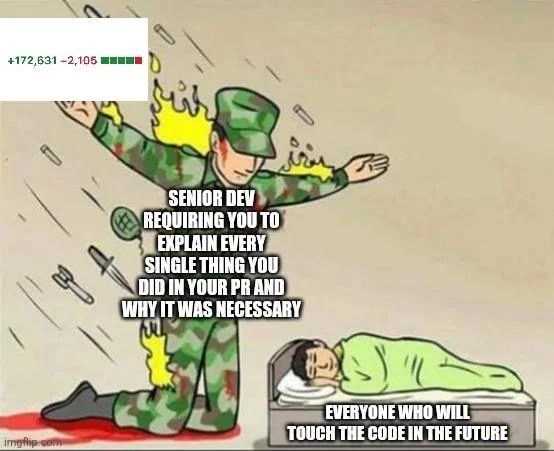
Imagine your friend has been working on a giant, secret puzzle for a long time, and only he knows all the answers. Now, suddenly, he’s moving away in a week, and he wants to teach you how to solve the whole thing before he goes. 🏃‍♂️ He’s super frantic because time is short. He covers an entire wall with all the puzzle clues, photos, and scribbled notes. He even uses red strings to connect pieces of paper, like a big web linking everything together. It looks kind of like one of those detective boards you see in mystery shows – really messy and complicated!

Your friend is pointing everywhere, talking really fast: “See, this clue leads to that one, and if you follow this red string, it connects to the picture over here! Remember the note I left in the box? That’s super important because it explains the photo on top!” He’s waving his arms wildly, trying to tell you every detail all at once. You and the others in the room are just staring, eyes wide, trying to keep up with this crazy last-minute lesson.

It’s funny in a way, because he looks a bit like a mad scientist or a conspiracy theorist with all those strings and papers – like he’s solving some huge mystery. But it’s also a little overwhelming, right? There’s no way you can absorb all that information in such a short time. You might remember some of it, but a lot will probably slip through the cracks once he’s gone.

This is exactly what the meme is showing, but in a software company. One developer (the friend) has all the secrets of how a big project works. When he’s about to leave the company, he tries to explain everything in just a few days, using a wild board of notes and connections. It’s both crazy and comical because nobody can fully understand such a rushed explanation. The feeling you get watching him panic-explain is the joke: it’s a mix of “Whoa, this is nuts!” and “Uh-oh, we’re not gonna remember any of this!” We laugh because it’s a silly, exaggerated scene of a very real scramble – a last-minute chaos that everyone hopes they won’t have to deal with, whether it’s solving a puzzle or keeping a project alive.

Level 2: Bus Factor Blues

When a developer is about to leave a company, ideally they should transfer their knowledge to others – meaning they share how the code and systems work, so the team isn’t left in the dark. This meme shows that scenario in a very exaggerated, funny way. We see a man wildly pointing at a board covered in papers and red strings connecting them. If you’ve never seen it, this image is a famous meme template (from a TV show) where someone looks like a crazy detective explaining a big conspiracy. Here, the joke is that the departing dev’s explanation seems as tangled and frantic as a conspiracy theory.

Let’s break down what’s happening and the terms involved:

  • Knowledge transfer: This is the process of handing off information from one person to others. In tech, if a key developer leaves or switches teams, they do a “knowledge transfer” session to teach colleagues about the systems or code they managed. In theory, it’s meant to prevent any single person from being the only one who knows important stuff.

  • Documentation: Documentation means all the written guides, README files, comments, or wikis that explain how a project works. Good documentation is like a map or user manual for the code. In this meme’s scenario, it’s implied the documentation is lacking or outdated (otherwise, why would the dev need to draw a crazy diagram on the wall?). The humor is that instead of calmly pointing someone to a well-written doc, the departing dev is frenetically waving at pinned papers. It highlights a common documentation woe: many projects rely too much on what’s in one person’s head.

  • Bus factor: This is a term you might hear jokingly in developer conversations. It asks, “How many people on your team could get hit by a bus before the project is in serious trouble?” 😬 It’s morbid humor, but the idea is important: if the number is 1 (often it is, meaning one person holds all the knowledge), that’s bad. You want a high bus factor (i.e., knowledge shared among many people) so the project survives if someone leaves. In our meme, the bus factor was clearly 1 – only this one dev really understood certain systems, and now that he’s leaving, everyone is panicking to learn from him. The blurry, frantic man with the tie basically represents a project with a dangerously low bus factor finally addressing the problem at the last minute.

  • Knowledge silo: This phrase means information is stuck with one person or group, and not accessible to others. Think of a silo on a farm that holds all the grain in one place – a knowledge silo holds all the know-how in one place (or person). In a healthy team, knowledge flows freely; in a siloed team, one developer might be the only one who knows how a certain system or piece of code works. In this meme, that leaving developer was a silo of knowledge. Now he’s dumping years of siloed info onto his teammates in one go. The red strings on the wall symbolize all those connections and insights that were only in his brain until now.

  • Communication: The meme is also about communication under pressure. Notice how his gesture and face look intense – he’s communicating in a rush, trying to explain everything at once. Usually, good communication at work means explaining things clearly and calmly, maybe using diagrams or documents. Here it’s happening, but the chaotic style implies it’s not exactly clear or calm! It’s like he’s saying, “Look, this part connects to that part, and if this server goes down then that service will fail – are you following?!” His colleagues (we can imagine one in the foreground) probably have bewildered expressions, trying to keep up with this torrent of information.

  • Corporate culture: In many companies, unfortunately, documenting things or training backups isn’t prioritized until it’s an emergency. Culturally, some workplaces focus on delivering features and fixes fast (the mantra of “get it done now, we’ll document later”). That “later” often never comes until someone quits or an outage happens. So it becomes part of developer culture humor to joke about “last-week knowledge transfer” crises. Everyone knows it shouldn’t happen this way, but it still does, frequently. The meme captures that irony: it’s funny because it’s poking fun at a bad habit in tech culture. The corporate humor here is a gentle roast of companies that rely on heroics and last-ditch efforts instead of proper planning.

Imagine being a new developer who just joined this team. One day you walk into a meeting and see a senior dev acting like a frantic professor, with dozens of system diagrams and sticky notes connected by red yarn. He’s essentially narrating years of project history, bizarre bug fixes, and “gotchas” in one long breath. You’d probably feel totally lost – like, do I need a detective’s notebook to understand this? That’s exactly the feeling the meme is sharing. Even if you haven’t experienced it yet, as a junior dev you might encounter something similar (hopefully less extreme!). For example, a teammate might leave and you suddenly get invited to a “knowledge transfer session” where they dump a ton of info. It can feel overwhelming, like you’re trying to learn a complex board game in five minutes.

The red strings and papers in the image are a metaphor for how everything in a codebase can be interconnected. One bug fix over here might affect a module over there. If those connections were never documented, only the person who made them knows about it. So when that person is leaving, they attempt to trace all those lines for everyone else – literally drawing a map of interdependencies. It’s both impressive and absurd, which is why we laugh. The scribbled “PEPE SILVIA” (from the TV meme) is there to emphasize the absurdity: in the show, it turned out to be a made-up thing, so it implies possibly some of the stuff might be half-remembered or near-mythical (“Pepe Silvia” could represent some arcane bug or a server name that others have never heard of).

In simpler terms, this meme is a tongue-in-cheek warning: Don’t let all the important knowledge live in one person’s head. Otherwise, when that person leaves, you’ll end up in a frantic, laugh-or-cry situation, trying to learn everything in a rush. It’s much better to share knowledge regularly (through pair programming, code reviews, writing docs, etc.) than to perform this kind of emergency handoff. But since many of us have seen or done a hurried knowledge transfer, we find the meme funny. We’re essentially nodding and saying, “Yep, I’ve either been that person or been in that room.” Documentation humor like this resonates because it’s a comic spin on a very real developer pain point.

Level 3: Conspiracy Board Crash Course

Picture this scene: a senior developer has resigned and only one frantic week remains to offload years of tribal knowledge. In the meme, he’s turned his cubicle wall into a full-blown red-yarn conspiracy diagram of the codebase, reminiscent of an FBI detective chasing an elusive suspect. This is a knowledge transfer fire drill in its rawest form. The humor (and horror) here comes from how painfully familiar this scenario is in tech: the one person who knows all the secrets is about to walk out the door, and suddenly everyone cares about documentation that never existed.

Seasoned devs recognize the bus factor alarm bell ringing. The bus factor (a darkly comic term for “how many people can be hit by a bus before a project is in jeopardy”) in this situation is exactly 1 – and that one person is gesturing wildly at a mess of papers and strings. He’s essentially a single point of failure for the team’s knowledge. The meme exaggerates it into detective-level madness: those red threads link service A’s weird bug to module B’s hidden config to a mysterious note scribbled “PEPE SILVIA” (a nod to It’s Always Sunny in Philadelphia, where the character’s wild conspiracy theory amounts to nothing real – here hinting that some of these “critical” connections might be half-imagined or absurd in hindsight). The departing dev looks unhinged, and that’s the punchline: knowledge silos can turn even the calmest engineer into a Charlie Day meme, desperately trying to explain a wildly interconnected system to wide-eyed colleagues.

Why is this so funny to experienced developers? Because it’s too real. Corporate culture often neglects proper documentation and knowledge sharing until crisis time. Deadlines trump docs; “We’ll write the wiki later” turns into never. Now that later is now, and it’s utter chaos. The departing engineer is performing an institutional memory dump, connecting the dots among systems and hacks that nobody else even knew had dots. You can almost hear him saying, “See this red line? It connects the cron job on Server42 to the hotfix we applied during the 2019 outage – you CANNOT restart that service in the wrong order or… well, just don’t, okay?!” Meanwhile, the remaining team is frantically scribbling notes, asking questions like detectives trying to solve a case in record time. It’s a scene of communication overload: part lecture, part scavenger hunt, part panic attack.

This meme nails the DeveloperCulture and CorporateHumor of such moments. It highlights the huge gap between ideal knowledge transfer and actual last-week reality. Ideally, knowledge transfer should be a calm, months-long process with documentation and shadowing. In reality, it’s often an impromptu, high-pressure crash course held over a whiteboard (or in this case, a conspiracy corkboard). It’s both funny and painful because everyone in tech either has been that desperate departing dev or the poor soul trying to learn an entire system in a week. The busFactor one scenario is a collective nightmare we laugh at to keep from crying.

Let’s compare the textbook plan vs how it actually goes down:

Best Practice (Ideal) Actual Situation (Meme)
Continuous documentation as code evolves 📝 Critical info lives only in one dev’s head 🤯
Knowledge spread across multiple team members 👥 One knowledge silo: a single expert hoarding it all 🔐
Planned handover over several weeks ✅ Frantic crash course in the final days ⌛️
Organized diagrams & written guides 📚 Chaotic red-yarn diagram on a cubicle wall 🕸️
Calm Q&A and mentorship sessions 😊 Panicked brain dump with confused nodding 😰

By now, veteran engineers are nodding (and maybe smirking) at each item on that list. The meme is hilarious because it caricatures a developer pain point we know too well: when an indispensable teammate leaves, all those postponed documentation tasks come home to roost. It’s like dumping a jigsaw puzzle on the table and then running off – leaving everyone else to piece together the picture from scattered clues. The frantic fellow in the blue shirt with his wall of strings is effectively saying, “I swear there’s an order and logic here, just let me connect everything!” But to the rest of the team, it’s confusing detective ravings.

In the end, everyone’s laughing (through clenched teeth) at this meme because it perfectly captures the absurdity of a last-week knowledge transfer. It’s a comedic reminder (and warning) about DocumentationWoes and the notorious knowledge_transfer_fire_drill: if you don’t proactively share knowledge, you might end up reenacting this conspiracy board scene for real. And trust me, nobody wants to be that guy at 3 AM, tying together years of system hacks with red string while the clock ticks down. 😅

Description

This meme uses the popular 'Pepe Silvia' or 'Charlie Day Conspiracy Board' format from the TV show 'It's Always Sunny in Philadelphia'. The image shows Charlie Kelly, looking wild-eyed and disheveled, manically gesturing at a wall covered in papers, notes, and photos all interconnected by a web of red string. The superimposed text at the top reads, 'dev who is leaving the company in a week doing knowledge transfer'. The visual chaos of the board, with graffiti like 'PEPE SILVIA', perfectly represents a complex and poorly documented system. The technical joke is that this is how it feels to receive a 'knowledge transfer' from a developer who is the sole owner of a convoluted system and is about to leave. It visualizes the frantic attempt to explain years of accumulated technical debt, undocumented dependencies, and quirky workarounds in a very short amount of time. It’s a relatable scenario for any senior engineer who has had to either give or receive a brain-dump of 'tribal knowledge' before a key team member departs
Comments

11
Anonymous ★ Top Pick And this Jenkinsfile is triggered by a webhook from a repo we no longer have access to, which then runs a script that SSHs into a box under my desk, and that's how we deploy to production. Any questions?
  1. Anonymous ★ Top Pick

    And this Jenkinsfile is triggered by a webhook from a repo we no longer have access to, which then runs a script that SSHs into a box under my desk, and that's how we deploy to production. Any questions?

  2. Anonymous

    “Here’s the documentation: follow the red string from the cron job that restarts itself every 59 minutes to dodge the memory leak, past the feature flag nobody can toggle, through the microservice that only speaks SOAP on Tuesdays - just don’t cut the yarn or prod goes down.”

  3. Anonymous

    The real conspiracy theory is believing that anyone can successfully transfer 5 years of undocumented architectural decisions, git blame context, and 'why we don't touch that service' folklore in a week of meetings that everyone will half-attend while checking Slack

  4. Anonymous

    When the only person who understands the legacy monolith's authentication flow gives their two-week notice, suddenly that 'we'll document it later' technical debt becomes a full-blown succession crisis. The red string isn't just connecting architecture diagrams - it's literally holding together the institutional knowledge that prevents the entire system from becoming an archaeological dig site for the next poor soul who inherits it

  5. Anonymous

    Compressing five years of tribal knowledge into a 90‑minute KT; the red yarn is our service mesh and the arrows mean “sometimes.”

  6. Anonymous

    Last-week KT: converting a decade of tribal entropy into a red-string diagram - cron on a pet VM triggers a bash script that flips a feature flag via a deprecated endpoint while a Jenkins job named DO_NOT_TOUCH pretends to be our orchestrator

  7. Anonymous

    Finally mapping the monolith's circular deps with yarn - because Lucidchart lied about being production-ready

  8. Deleted Account 1y

    What a wondеrful sеntiment!

  9. @Johnny_bit 1y

    What actually happens:

  10. @pixelsex 1y

    it-consult's christmas

  11. @SamsonovAnton 1y

    What should it look like: https://youtu.be/jf7sjuy6xuY?t=383

Use J and K for navigation