Cosmic Purpose Found in Vertical B2B SaaS
Why is this Career HR meme funny?
Level 1: Where’s My Adventure?
Imagine you always heard stories about people who got to go on big adventures. Your great-great-grandparents sailed across oceans to discover new lands. Maybe in the future your great-great-grandkids will zoom around the galaxy in rocket ships. Exciting, right? But then there’s you, alive right now, and the biggest “adventure” you have is sitting in an office making a software app for businesses. 😅 Instead of hunting for treasure or exploring Mars, you’re basically helping some company keep track of their sales or manage spreadsheets on a computer. It’s as if you dreamed of being an astronaut or an explorer, but ended up doing paperwork all day. That’s why it’s funny — it’s comparing a huge, awesome adventure to a super plain job and saying our timing in history kinda sucks. The joke is a little sad-funny: we missed out on the cool stuff like exploring new worlds, and we’re too early for space travel, so we’re stuck here making yet another boring business program. It’s like complaining, “Man, everyone else got to do cool things, and here I am doing something dull.” We laugh because we understand that feeling of ugh, my life is not as epic as I imagined, and putting it in such an extreme way — from exploring Earth or space all the way down to office software — is just so exaggerated that it’s hilarious.
Level 2: Niche Software for Businesses
This meme plays on the idea that every generation has its big adventures, but ours is all about tech startups. Let’s break down the jargon first. SaaS stands for Software as a Service. Instead of selling software on a disk (old-school style) or a one-time download, SaaS means you host your software on the cloud and sell subscriptions to it. Think of tools like Slack, Salesforce, or Dropbox — you log in online, use the software, and your company pays a monthly/annual fee. SaaS is basically renting software instead of owning it. It’s a huge trend because it provides steady income (recurring revenue) for companies and lets customers always use the latest version of the software without managing installs or servers themselves.
Now, B2B means Business-to-Business. A B2B company sells products or services to other businesses, not to you or me individually. For example, a company making HR management software is B2B because their customers are other companies (the ones who need HR tools). In contrast, B2C (Business-to-Consumer) sells directly to consumers — like a game app for your phone is B2C. So, B2B SaaS describes cloud software sold to businesses on a subscription basis. It’s the kind of thing many startups do: build a tool to help companies with something (like accounting, marketing, scheduling) and charge them per user or per month.
Finally, “vertical B2B SaaS” adds the word vertical. In business lingo, a “vertical” is a fancy way to say a specific industry or sector. So a vertical SaaS focuses on one niche industry’s needs. For instance, imagine a software platform just for dental clinics to manage appointments, patient records, and billing. That’s a vertical SaaS (the vertical is dental healthcare). Or say an app built only for restaurants to handle online orders and inventory — another vertical SaaS (vertical = food service). This is opposed to a horizontal SaaS which serves many industries (like an email service or a general spreadsheet tool that any company could use).
So when the meme says “build vertical B2B SaaS,” it’s painting a picture of a person working on a very niche, business-focused subscription app. That’s quite a mundane fate when compared to being an explorer of oceans or outer space! The text before it — “Born too late to explore the Earth. Born too early to explore the universe.” — refers to major eras of exploration. Exploring Earth brings to mind the historical Age of Discovery (sailing ships, new continents, scientific expeditions). Exploring the universe points to a future where maybe humans regularly travel to distant planets and galaxies. The meme jokes that we missed out on both those exciting times. And what do we get instead? The era of startups building SaaS products for every little thing. It’s a tongue-in-cheek way to say: our generation’s big adventure is just sitting at a desk writing code for yet another business app.
For context, in today’s StartupCulture, there’s a bit of a gold rush to create new SaaS products for all sorts of specialized markets. Tech entrepreneurs seek out any niche problem that businesses have and try to solve it with a cloud software tool. Got a lot of dog walkers who need scheduling help? Maybe there’s a subscription app for that. Logistics companies struggling with tracking shipments? Yep, another B2B SaaS can be made for it. This is often encouraged by venture capital investors who fund these startups, hoping one will become the next big thing (a “unicorn” company). So, industry trends have led to a proliferation of these vertical SaaS companies.
Now, if you’re a relatively new developer (or anyone early in their tech career), you might be wondering why this is funny or resonant. Imagine you got into tech dreaming of working on something exciting — maybe you love space and thought you’d work on rocket software, or you’re into environmental science and thought you’d build tech to save the planet. But instead, you find yourself working at a startup that makes, say, accounting software for car dealerships. Still important in its own way, sure, but it doesn’t exactly feel like epic work. A lot of developers go through a phase of realizing that tech jobs can sometimes be more about optimizing tedious business processes than doing something groundbreaking. The meme exaggerates this feeling in a comedic way.
Also, the phrase “stare into the void” gives a visual of someone sitting at their computer, blankly staring at the screen (the void), maybe late at night. It humorously dramatizes the idea that building yet another SaaS product can feel empty or soul-crushing, especially if you compare it to the romantic notion of being an explorer. It’s relatable because people in tech sometimes joke about burnout or feeling like their work lacks higher meaning. On platforms like Twitter (especially Tech Twitter), it’s common to see this kind of existential tech humor – where folks poke fun at the contrast between the grand potential of technology and the banal reality of what many of us end up doing (like A/B testing button colors to boost click-through rates, or writing one more CRUD app).
In summary, the meme uses tech industry lingo and generational context to set up a funny contrast. It basically says: Our ancestors had the Age of Discovery, our descendants might have the Age of Space Exploration, but here we are in the Age of Startup SaaS. For a young developer, it’s a chuckle at the idea that instead of adventure, we get another web dashboard for businesses. You’ll hear terms like “product-market fit” thrown around a lot — that’s when a startup finds a real demand for their product in a market. Here, the meme implies a bit of a “product-market fit crisis”: we’re searching for meaning while cranking out niche products that may or may not truly matter. It’s funny because it’s a bit true: not every app we build feels important in the big picture, even if it pays the bills. The humor comes from that let-down feeling presented in an exaggerated, witty way.
Level 3: The Void as a Service
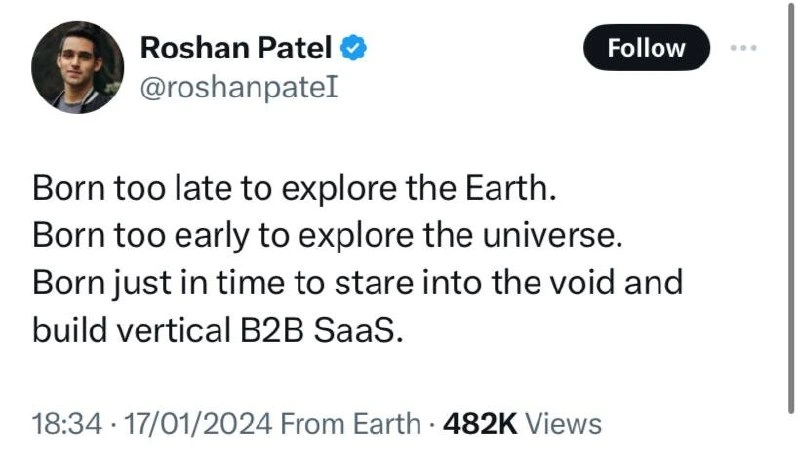
At first glance, this meme hits with savvy cynicism that only seasoned tech folks truly appreciate. It riffs on the classic internet trope: "Born too late to explore the Earth. Born too early to explore the universe." This setup evokes grand historical eras — the Age of Discovery when explorers like Magellan roamed uncharted seas, and a future age when humanity might roam the stars. Then comes the punchline: "Born just in time to stare into the void and build vertical B2B SaaS." The lofty dreams come crashing down into the ultra-nerdy, startup-era reality of our generation. For veteran developers and founders, the humor is painfully on point. We were promised jetpacks and interstellar travel; instead, we’re optimizing cloud databases for yet another niche enterprise app. Oh joy, another day at the office refactoring code for a cloud CRM while contemplating the meaning of life.
The phrase “vertical B2B SaaS” is hilariously specific and drenched in tech buzzwords. It stands for Vertical Business-to-Business Software-as-a-Service, basically describing a startup that builds subscription software targeted at a specific industry (“vertical”) and sells it to other companies (B2B, not to consumers). This is the kind of jargony term you hear in countless pitch decks on Sand Hill Road and at Y Combinator demo days. The meme’s author, presumably a tech insider on Twitter (hence the screenshot from X), intentionally chose the most unromantic collection of syllables to represent our time. In place of exploring new continents or galaxies, we’re busy spinning up yet another instance of a cloud app to manage, say, dentist office appointments or trucking logistics. The sheer banality of "build vertical B2B SaaS" contrasted with epic exploration is what makes tech veterans smirk (or maybe weep a little on the inside).
Why is this so relatable to senior engineers? Because we’ve all seen the endless parade of SaaS startups that claim to be “revolutionizing” some obscure workflow. After a few years in the industry, you can’t help but notice patterns: today’s hot startup is “Slack for Lawyers”, tomorrow’s is “AI-powered ERP for Pet Groomers”. Different verticals, same core idea. Seasoned devs have sat through those demo days where each founder excitedly pitches the new platform that is basically a slight twist on an existing solution, just niched down. After you’ve watched enough pitch decks promising to “disrupt [insert niche industry here] with subscription software”, it all blurs together. The meme lands a direct hit on that déjà vu. It’s the collective eye-roll of an industry that’s seen a thousand task-tracking apps bloom and wither.
Moreover, the line “stare into the void” adds a dark, existential humor that senior folks know all too well. It captures those late nights when you’re deploying code to production, watching a CI/CD pipeline run for the hundredth time, or combing through endless logs in a dark mode terminal — and you pause, wondering what am I doing with my life? 🤷♂️ There’s a famous saying in tech: “We wanted flying cars, instead we got 140 characters.” This meme is cut from the same cloth. We imagined changing the world in bold ways, but much of tech work feels like staring into a code editor abyss while building yet another system to send marketing emails or track KPIs. StartupCulture often glorifies “changing the world,” but let’s be real: many of us are just changing the color of a “Sign Up” button on a SaaS product that serves some corporate workflow. The void in the meme isn’t just the empty darkness of space we’re missing out on — it’s also that empty feeling when you realize your big contribution this week was fixing an off-by-one bug in a payment processing module for a product that, ultimately, is subscription software for other businesses.
This is IndustryTrends humor with a dash of existential dread. It satirizes how every venture-backed startup today chases recurring revenue in increasingly narrow domains. In the Age of Discovery, explorers had the Queen’s backing to claim gold and glory. In our age of disruption, founders have VC backing to chase valuations by SaaS-ifying everything. The meme resonates because it rings true: instead of navigating uncharted waters or mapping new stars, we hustle to achieve a high ARR (Annual Recurring Revenue) selling cloud software to, say, car wash franchises or dental clinics. The contrast is absurd and a little tragicomic. Seasoned devs laugh because they’ve felt that twinge of “Is this it? All this talent and we’re building a slightly better B2B invoicing system?” But we also laugh because, hey, those boring vertical SaaS startups can pay the bills (or make millions). It’s a living, just not the hero’s journey we imagined as kids.
Even the metadata in the tweet is a clever cherry on top. It says “From Earth” — as if mocking us with the reminder that yes, we’re squarely on this planet, not boldly going anywhere beyond. And it shows 482K views, meaning this lament resonated with nearly half a million people. That huge number of views itself underscores how many in tech feel this exact generational letdown. We collectively gazed at this tweet and nodded: Yup, trading the Age of Exploration for the Age of the SaaS Subscription. Sigh. In short, the meme’s humor comes from dramatic juxtaposition. It takes the romantic narrative of human progress and deflates it with corporate tech reality. For a CynicalVeteran developer who’s watched hype cycles come and go, it’s both hilarious and cathartic. We’re laughing at our own fate — conquering neither new worlds nor new worlds of Warcraft, but conquering… market share in a vertical software niche. Adventure has been refactored into enterprise application development, and the only new frontier is a signup form. That blend of self-deprecation and industry in-joke makes this meme hit home harder than a failed rocket launch.
Description
A screenshot of a tweet from user Roshan Patel (@roshanpateI). The tweet text reads: 'Born too late to explore the Earth. Born too early to explore the universe. Born just in time to stare into the void and build vertical B2B SaaS.' This meme humorously captures a sense of existential disillusionment prevalent in the tech industry. It plays on the popular lament of being born in the wrong era for grand adventures, but delivers a punchline that is deeply rooted in the modern software world: the seemingly mundane and hyper-specific task of creating Business-to-Business Software-as-a-Service for a niche market ('vertical'). For senior engineers, it's a witty and relatable take on trading youthful ambitions of changing the world for the reality of building enterprise software, finding a strange, resigned purpose in a very specific, unglamorous corner of the digital economy
Comments
25Comment deleted
I used to dream of architecting systems for interstellar communication, but now I'm optimizing the JWT refresh flow for a SaaS that helps regional managers of mid-sized paper companies track quarterly envelope inventory. It's the same battle against entropy, just with more TPS reports
Some ancestors mapped new continents; we map the same CRUD to Stripe, Twilio, and AWS - and call it innovation on the pitch deck
While our ancestors navigated by the stars and our descendants will navigate between them, we're here optimizing conversion funnels for dental practice management software - and somehow convincing VCs it's a $10B TAM
The modern developer's existential crisis: we missed the age of exploration, we'll miss the space age, but we're perfectly positioned for the golden era of explaining to yet another enterprise client why their 'unique' workflow actually fits into our multi-tenant architecture with just a few custom fields and a hefty implementation fee. At least the ARR is recurring
Staring into the void long enough, and it stares back with a feature request for multi-tenant isolation
Vertical B2B SaaS is where CRUD meets RBAC; the void is realizing your MVP just evolved into a configurable ERP powered by feature flags and compliance checklists
The void? That's the gap between multi-tenant ideals and that one enterprise demanding single-tenant, SAML, SOC2, and procurement's 12-week event loop
He can explore the oceans. Oceans of data with Microsoft Kusto! Comment deleted
What is a Microsoft Kusto? Sounds like Kosto which is Finnish for revenge Comment deleted
and prounounciation of that finnish word is "your coochie" in persian(with some twist) Comment deleted
and kosto means pain(psychological) in my language Comment deleted
Were you ever invaded by the Finnish? Would explain a lot 😂 Comment deleted
nope... we were invaded by the British though 🙃 Comment deleted
Crap, that's much worse ... Comment deleted
yeah... the French and the Dutch guys helped though in the end all resistances failed before the British conspiracy and backstabbing (we have an idiom that nicely describes our situation with the British... "খাল কেটে কুমির আনা"[To bring a calamity by one’s own imprudence.]) Comment deleted
I thought you were from an arab country Comment deleted
bangladesh... (don't assume someone's arab when you see arabic names :P) Comment deleted
That's Urdu, not Arabic, right? Comment deleted
nope... arabic... (مُبَشِّر) Comment deleted
Oof, yeah. I recently attended a lecture about the world's shortest (documented) war and the political circumstances around it. Different place, same assholes. Comment deleted
Reference to Jacques Cousteau Comment deleted
into your mom mf :-/ Comment deleted
Who's that?🤷♂ Comment deleted
actually, what's that B2B SaaS ? Comment deleted
Business to Business Suffering Software as a Service Comment deleted