Skip to content
DevMeme
3882 of 7435
Go's Simplicity: A Feature or a Bug?
Languages Post #4228, on Feb 19, 2022 in TG

Go's Simplicity: A Feature or a Bug?

Why is this Languages meme funny?

Level 1: Hard Mode Coolness

This meme is basically joking that someone thinks doing things the hard way is cooler than using an easy option. Imagine you have an easy way to get something done, but your friend says "Nope!" and chooses the super difficult way just to show off. For example, picture a kid who could take the comfy school bus to get to school, but instead he insists on walking a really long distance every single day because it makes him feel tough and "old-school." Most people would ride the bus (why wouldn’t you take the easy ride?), so it’s funny to see someone proudly choosing the exhausting route. In the meme, Drake is doing exactly that, but with programming: he’s rejecting the simple, modern approach and giving a thumbs-up to the ultra-challenging old-fashioned method (basically telling the computer what to do step-by-step in its own native language). It's silly in a charming way – the joke is that doing something the hard way, just to feel like a cool expert, is both absurd and kind of relatable at the same time.

Level 2: High-Level vs Low-Level

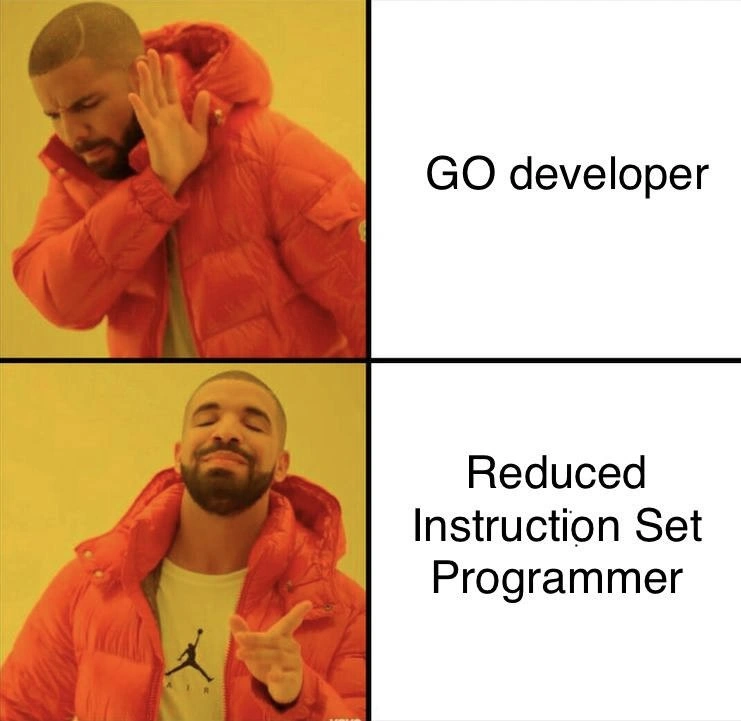
Let’s break down the joke for someone newer to programming. First, the meme template: it's the famous Drake Hotline Bling format. In the top image (Drake in the orange jacket with a hand up), he's rejecting whatever label is next to him – here it's GO developer. In the bottom image (Drake pointing approvingly), he's happy about the label Reduced Instruction Set Programmer. Memes use this format to show a preference: Drake says "no thanks" to the first thing, and "yes, that’s the good stuff" to the second thing. So, what are these two labels?

Go (often called Golang) is a programming language created by Google. A "Go developer" means someone who writes software in Go. Go is considered a high-level language, which means it takes care of a lot of the computer’s details for you. For example, Go has automatic memory management (garbage collection), so the programmer doesn’t have to manually keep track of every allocation or free up memory as you would in lower-level languages. Go code is relatively easy to read and write; you can do complex things like start a web server or handle networking with simple commands, and the language/runtime handles the gritty details behind the scenes. It's compiled (turned into machine code that the CPU can run), but as a developer you mostly think in terms of convenient abstractions, like variables, loops, and functions, not individual CPU instructions.

On the other hand, "Reduced Instruction Set Programmer" is not a real job title you see in listings – it’s a playful invention. To understand it, know that RISC stands for "Reduced Instruction Set Computer." That refers to a type of computer processor design that uses a small, optimized set of instructions. Famous RISC-type chips include ARM (which is used in most smartphones) and older ones like MIPS or SPARC. The meme replaces "Computer" with "Programmer" to imply the person is programming with that minimal instruction set. In practice, that means writing in assembly language for a RISC processor. Assembly language is as low-level as programming gets: it’s basically a human-readable form of the machine’s own instructions (almost one step above raw binary code). A low-level programmer (like an assembly coder) has to manage things like CPU registers (tiny storage slots in the CPU) and memory addresses explicitly. They write very simple operations, one by one – add this number to that, move this data from here to there – exactly what the CPU hardware will do.

So why is Drake cheering for that? It’s poking fun at the idea that programming closer to the hardware is somehow “cooler” than using a high-level language. In tech communities, this is a known humorous exaggeration: some folks pride themselves on using more primitive or difficult tools, just to show they can. It’s like someone bragging that they write their own game engine from scratch in assembly rather than using Unity or Unreal. There’s a bit of meme culture here where different programming languages get compared and fan bases rib each other (the classic language wars). One camp might say “my language gives me super speed and control,” and the other might reply “yeah, but my language gets things done with less hassle.” This Drake meme takes the extreme stance of favoring raw assembly programming over a well-regarded modern language.

To give a sense of the difference in abstraction, consider a simple task: adding two numbers and storing the result. In Go, you could do this in one line:

c := a + b  // Go code: adds a and b and stores in c

But in a RISC-style assembly, you’d have to spell it out step by step, something like:

; Assembly (pseudo-code) for c = a + b
LOAD R0, a      ; load the value of 'a' into CPU register R0
LOAD R1, b      ; load the value of 'b' into CPU register R1
ADD  R2, R0, R1 ; R2 = R0 + R1, perform the addition
STORE R2, c     ; store the result from R2 into memory location 'c'

Each instruction is very granular. High-level programming lets you simply write c = a + b and not worry about the loads and stores – the compiler figures that out. Low-level programming means you handle each of those operations yourself. It’s more work and requires knowing how the CPU operates.

Now, the phrase "Reduced Instruction Set Programmer" in the meme is jokingly suggesting that someone who writes such low-level code deserves a special, cool-sounding title. It's humor via a punny job title. The meme implies that Drake (or the type of developer he represents) finds the idea of being an assembly guru more appealing than being "just" a Go coder. This highlights the ongoing tongue-in-cheek rivalry between newer programming languages and the old-school ways. The top panel is basically saying "No thanks, I don’t want to be just a Go developer (using the easier, high-level tools)," while the bottom panel says "Yes, I’d rather be a hardcore assembly coder (doing it all the hard way)!" The joke lands because, in reality, most people would find the high-level route more practical – which makes preferring the much harder route ironically funny.

Level 3: Bare-Metal Bravado

From a seasoned developer’s perspective, this meme riffs on the classic language wars and a bit of programmer bravado. The format is the well-known Drake meme: in the first panel, Drake turns away from the label GO developer, and in the second panel he’s all smiles pointing at Reduced Instruction Set Programmer. In other words, it's portraying Drake (the stand-in for developers who fancy themselves hardcore) as rejecting the identity of a Go programmer and preferring to identify as an assembly language guru. This contrast is humorous because Go (also called Golang) is a modern high-level language known for its simplicity and strong tooling, whereas an assembly programmer is about as low-level as you can get. It's like saying, "Nah, I don't want to be just another cloud services coder, I'd rather be the bare-metal wizard twiddling CPU bits."

The meme throws a punny job title into the mix. Normally, nobody calls themselves a "Reduced Instruction Set Programmer" – that phrase is a play on RISC (Reduced Instruction Set Computer) and turns it into a self-awarded badge of honor. It's as if someone put "Assembly Language Artisan" or "Binary Whisperer" on their business card. This exaggeration lands because it hits a known trope in developer culture: the pride some engineers take in working at a lower level of abstraction than everyone else. There's a tongue-in-cheek sense of one-upmanship here. Writing in assembly is notoriously difficult and time-consuming, so claiming to do that by choice is a flex, a way to imply "I have mastered the hardest stuff."

This taps into the long-running rivalry between systems-level hackers and application-level developers. Systems programmers (the kind who might write operating systems in C or hand-tune assembly for device drivers) sometimes joke that their work is "real programming," while those using shiny high-level languages are coddled by layers of abstraction. On the flip side, high-level language developers might quip, "Have fun debugging that pointer arithmetic at 3 AM while I'll be sleeping." Here, Drake firmly takes the systems programmer’s side for comedic effect. The idea of preferring assembly over a language like Go is intentionally over-the-top. Go was actually created to make developers more productive and handle things like memory management automatically – it’s a pretty down-to-the-metal efficient language by modern standards, but it still shields you from the gnarly details of memory addresses and CPU instructions. The meme exaggerates by suggesting that someone would rather deal with those nitty-gritty details.

In real-world terms, very few jobs require you to write pure assembly all day. A "Go developer" is a common role these days (building web servers, cloud services, etc.), whereas an assembly coder is niche – think embedded systems, firmware, or specialized performance-critical code. That’s part of why the meme is funny: it flips the script. The mainstream, in-demand skill (Go programming) is depicted as uncool, and the arcane, old-school skill (assembly on a RISC machine) is portrayed as the cooler alternative. It's poking fun at a sort of hipster mentality in tech where using older or more difficult tools is seen as more authentic. Many veteran developers will recognize this vibe – perhaps they’ve known colleagues who sneer at newer languages, or they themselves remember the pride of squeezing efficiency out of an 8-bit microcontroller in assembly. The meme resonates because it captures that shared nostalgia and cheeky arrogance: real programmers use raw opcodes, and anything else is just kiddie stuff. Of course, it’s all said with a wink – an affectionate jab at our own tendency to mythologize the "good old days" of coding closer to the silicon.

Level 4: No RISC, No Reward

Beneath the punchline is a serious slice of computer architecture theory. RISC (Reduced Instruction Set Computer) refers to a design philosophy for microprocessors that emerged in the 1980s. Pioneered by computer scientists like John Hennessy and David Patterson, RISC processors use a simplified set of instructions that each execute very quickly. The idea is to have fewer complex operations built into the hardware, and instead rely on combining many simple operations. This makes the hardware implementation of the CPU simpler, allowing higher clock speeds and efficient pipelining. In contrast, CISC (Complex Instruction Set Computer) chips like the classic x86 processors have many specialized instructions (some doing quite elaborate tasks internally) – the hardware there is more complex, and each instruction can do more, but might take multiple CPU cycles or very sophisticated decoding logic to execute.

Programming in assembly language means dealing directly with these CPU instructions. On a RISC architecture, an assembly programmer explicitly orchestrates every tiny step: loading values from memory into registers, performing arithmetic or logical operations on those registers, and storing results back to memory. For example, a simple task like adding two numbers requires separate instructions to load each operand and then another to add and store the result. There are no fancy one-instruction shortcuts for high-level tasks – the reduced set means the programmer (or the compiler) spells everything out. The meme’s "Reduced Instruction Set Programmer" is someone who embraces this minimalism, writing code at the lowest level of abstraction. It's a tongue-in-cheek twist: normally RISC refers to a type of CPU, not a person’s job title. Here they’ve humorously rebranded it to imply the programmer only uses that minimal set of machine instructions as their language.

This deep-cut humor leans on the notion that working closer to the hardware is somehow more elite. In theoretical terms, there’s a certain elegance to RISC systems: they align well with formal compiler optimizations and straightforward CPU pipeline design. A RISC assembly programmer often must think about details like register allocation, instruction scheduling, and even how branch prediction or cache misses might affect their code’s performance. Writing performance-critical assembly might involve manually unrolling loops, using bitwise operations in clever ways, and counting CPU cycles – tasks that a high-level language’s compiler or runtime normally handles automatically. The meme suggests that the "Reduced Instruction Set Programmer" takes pride in doing all that by hand, reveling in an intimate understanding of the underlying mathematical and electrical realities of the machine.

There's also an implicit historical nod here. Over decades, many in computing have debated the merits of RISC vs CISC, and the pendulum has swung back and forth. Amusingly, modern CPUs have blurred this line: today’s Intel and AMD x86 chips (traditionally CISC) internally translate complex instructions into RISC-like micro-ops, while modern compilers for languages like Go or C++ are extremely adept at optimizing code so that even high-level programs run close to the speed of hand-written assembly. But none of that stops the nostalgia-tinged idealism of the hardcore low-level programmer. To them, the constraints of a reduced instruction set aren't a limitation – they're a challenge and an art form. The humor of Drake preferring the "Reduced Instruction Set Programmer" lies in dramatizing that extreme love for low-level programming, elevating a bare-metal coding style into a badge of honor.

Description

A Drake 'Hotline Bling' meme. Top panel shows Drake gesturing with disapproval at the text 'GO developer'. Bottom panel shows Drake smiling and pointing in approval at 'Reduced Instruction Set Programmer'. The humor is a sophisticated pun that plays on two levels. First, it references RISC (Reduced Instruction Set Computer) architecture. Second, it applies this concept to the Go programming language, which is famously minimalist and has a small, simple feature set compared to other modern languages. The meme affectionately teases Go developers, framing their specialization in this 'reduced instruction set' language as a point of pride, contrasting with the implied complexity of other developers. It’s a joke that resonates with senior engineers who understand language design trade-offs and the culture around Go

Comments

15
Anonymous ★ Top Pick Go developers are the ultimate RISC programmers: they have fewer instructions to work with, but they can still `go` run circles around your complex, feature-bloated CISC codebase
  1. Anonymous ★ Top Pick

    Go developers are the ultimate RISC programmers: they have fewer instructions to work with, but they can still `go` run circles around your complex, feature-bloated CISC codebase

  2. Anonymous

    Pass on goroutine whack-a-mole; give me RISC assembly - I prefer pipeline stalls that are honest about their latency

  3. Anonymous

    After 15 years of arguing about generics, Go developers finally realized they weren't writing a programming language - they were just implementing Rob Pike's personal RISC instruction set with garbage collection and goroutines

  4. Anonymous

    Fair - Go is RISC for humans: few instructions, predictable pipelines, and you hand-write the same error-handling micro-op after every load

  5. Anonymous

    When you've spent so much time optimizing at the instruction level that even the name 'Go' triggers your CISC-induced PTSD. Real programmers know that fewer instructions mean more control - unlike Go's runtime, which has more opinions than a principal engineer in an architecture review

  6. Anonymous

    Go promises minimalism; RISC enforces it - one cycle, no GC pauses

  7. Anonymous

    Go developer? Nah - Reduced Instruction Set Programmer: trim features until the cognitive pipeline runs at CPI ~1, ship one static binary, and rebrand exceptions as error returns

  8. Anonymous

    At scale, the best “Go dev” is a RISP - someone who deletes features until the SLOs pass and the build is a single static binary

  9. @RiedleroD 4y

    RISC?

  10. @RiedleroD 4y

    so… ARM or RISC-V assembly programmer

    1. @mekosko 4y

      There are more RISC archs

      1. @RiedleroD 4y

        yeah but those are the big ones

      2. @ZgGPuo8dZef58K6hxxGVj3Z2 4y

        Like CISC

  11. @saidov 4y

    LC-3 professionals check

  12. @Agent1378 4y

    CISC FTW

Use J and K for navigation