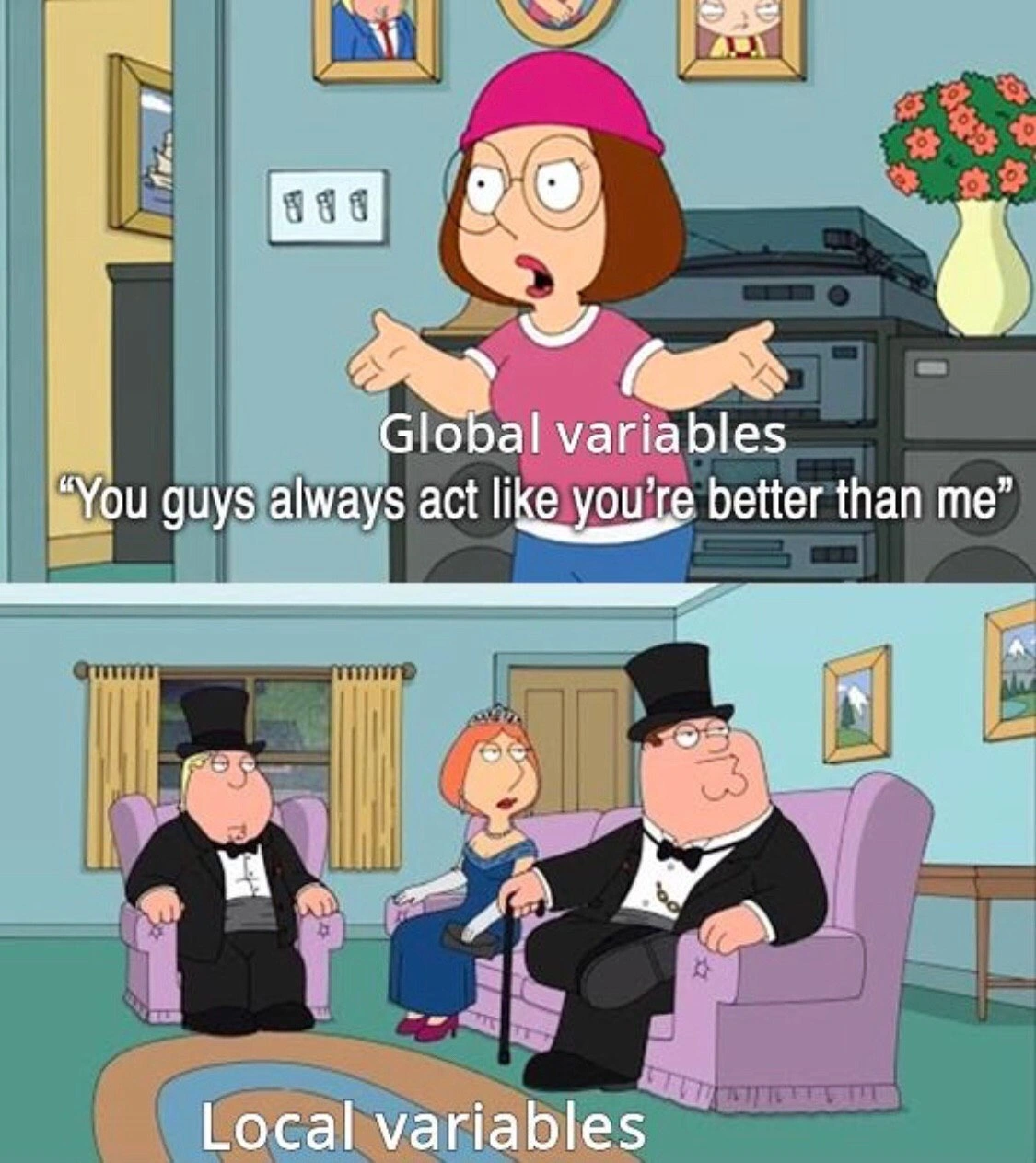
The Unquestionable Pecking Order of Variable Scopes
Why is this CodeQuality meme funny?
Level 1: The Toy Everyone Can Grab
Imagine a toy that belongs to one kid, kept safely in her own room — nobody else can lose it, break it, or repaint it. Now imagine the family toy left in the middle of the living room: anyone can grab it, anyone can break it, and when it turns up broken, everyone swears they didn't touch it. That's the joke: the fancy family in formal wear are the toys kept safely in private rooms, and poor Meg is the living-room toy that the whole household blames for every problem. Programmers laugh because they really do treat the "shared by everyone" kind of variable like the family member nobody wants to sit next to — even though, deep down, every household has one.
Level 2: Scope Is Just "Who Can See This?"
Scope is the region of a program where a variable can be seen and used. A local variable is declared inside a function and exists only while that function runs:
def calculate_total(items):
total = 0 # local: exists only inside this function
for item in items:
total += item.price
return total # after this line, 'total' is gone
A global variable is declared at the top level and is visible everywhere:
discount = 0.1 # global: any function can read or change it
def apply_discount(price):
return price * (1 - discount) # works... until someone, somewhere, changes 'discount'
The convenience is real — no passing values around — but so is the danger you'll discover in your first team project: some other function modified the global, your function misbehaves, and the failing code contains no visible mistake. That experience is exactly why code reviewers flag globals, why linters warn about them, and why the refactoring advice is almost always the same: pass data in as parameters and get it back as return values, so every dependency is visible in the function signature. Locals get the aristocrat treatment because their predictable lifetime and limited visibility make code easier to read, test, and debug — the qualities that code quality tooling and style guides are built to protect.
Level 3: Spooky Action at a Distance
The casting here is surgically accurate. Meg Griffin — the family's perpetual scapegoat — stands arms-out in exasperation as global variables, protesting:
"You guys always act like you're better than me"
while Peter, Lois, and Chris lounge below in top hats, tiara, and tuxedos as local variables, radiating inherited-wealth smugness. And the thing is: the aristocrats have earned it, mostly. A local variable's entire biography fits in one screen of code. It's born when the function is entered, it dies when the stack frame pops, and nobody outside can touch it. That's encapsulation delivering on its promise: when a local has the wrong value, the bug is in this function. Search space: fifty lines.
A global's biography, by contrast, is a sprawling true-crime documentary. Any function, any module, any thread might have written to it — which is why debugging global state is nicknamed spooky action at a distance. The value changes and the cause is nowhere near the effect. Add concurrency and it gets worse: unsynchronized mutable shared state is the raw ingredient of data races, the class of bug that reproduces only in production, only under load, only when you're on vacation. Every veteran has a story about a "temporary" global config flag that became load-bearing, got mutated from six places, and eventually required a two-week archaeology dig to remove.
But here's the layer that makes the meme honest rather than just smug: Meg has a point. The industry acts superior about globals while quietly depending on them everywhere. Singletons? Globals with a design-pattern pedigree. Environment variables, loggers, feature-flag registries, dependency-injection containers, thread-locals, the database connection pool — all global state wearing increasingly expensive top hats. The orthodoxy isn't "globals don't exist," it's "globals must be disciplined": immutable after startup, accessed through a narrow interface, never mutated casually. The Griffins sneering at Meg are, structurally, the same family. They've just laundered their scope through a constructor.
Description
A two-panel meme from the animated TV show 'Family Guy' that humorously illustrates a core programming principle. In the top panel, the character Meg Griffin, looking distressed, is labeled 'Global variables'. A caption shows her complaining, 'You guys always act like you're better than me'. The bottom panel depicts the rest of the Griffin family (Peter, Lois, and Chris) dressed in elegant formal wear, looking down with an air of superiority. This panel is labeled 'Local variables'. The meme personifies the disdain experienced software developers have for global variables, which can introduce side effects and make code difficult to debug. Local variables, with their limited scope, are considered a much cleaner and safer programming practice, hence their 'superior' depiction

Comments
8Comment deleted
Global variables are the 'works on my machine' of data structures. They're convenient until you have to explain a race condition to three different teams
Globals are basically the prod database piped into the office soda fountain - every thread gets a sip, and you’re the janitor mopping up the side effects at 3 a.m
Global variables are like that one senior engineer who's been at the company since the IPO - everyone depends on them, nobody wants to refactor around them, and they somehow know about every single state change across the entire system
Local variables get the top hats because their estate is settled the moment the stack frame pops; globals linger forever, and every thread in the house claims inheritance rights simultaneously
This meme perfectly captures the architectural snobbery we've all internalized: global variables are the Meg Griffin of programming - universally accessible yet universally scorned. Meanwhile, local variables sit in their lexically-scoped ivory towers, smugly contained within their stack frames, never causing action-at-a-distance bugs or making code reviewers question your life choices. The real irony? After 20 years, you realize that singleton patterns and dependency injection containers are just global state wearing a tuxedo
Globals are the coworker who attends every function and rewrites the agenda, turning pure functions into folklore; locals do their bit, go out of scope, and don’t invite race conditions
Globals are singletons with a terrible PR team - they turn unit tests into order-dependent integration tests and sponsor 3am Heisenbug hunts
Globals: universally accessible regret. Locals: scoped sanity that doesn't haunt your call stack