Skip to content
DevMeme
105 of 7435
When Data Corruption Becomes a Vibe
CS Fundamentals Post #135, on Feb 15, 2019 in TG

When Data Corruption Becomes a Vibe

Why is this CS Fundamentals meme funny?

Level 1: When One Tiny Thing Changes Everything

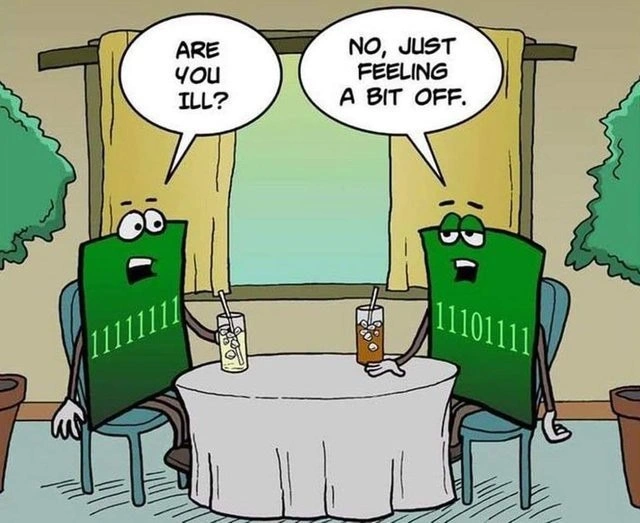
Imagine two identical twins having lunch, and one of them shows up with a single hair out of place — and when asked if they're sick, they say "no, I'm just a hair off." That's the whole joke: in a computer's world, information is written as long rows of 1s and 0s, and these two cartoon characters are wearing their numbers like name tags. One character's row is perfect; the other's has exactly one digit wrong, so when it says it's feeling "a bit off," it's being completely, mathematically literal. It's funny the way a perfect pun is funny — the everyday phrase and the technical truth click together so neatly that you groan and smile at the same time.

Level 2: Bits, Bytes, and Why One Matters

The two characters are drawn as chips (integrated circuits — picture the little black or green rectangles on any circuit board), and the numbers on their bodies are binary: the base-2 number system computers use, where every digit (called a bit) is either 1 or 0. Eight bits together make a byte, the basic unit of computer data. The healthy chip shows 11111111 — all eight bits set to 1, which equals 255. The unwell chip shows 11101111 — identical except one bit has changed from 1 to 0, making it 239.

In English, "feeling a bit off" means feeling slightly unwell. In computing, being "a bit off" means exactly one bit has the wrong value — and that's called a bit flip or single-bit error. It's a real phenomenon: electrical noise, failing hardware, or even radiation can change a stored bit. Early in your career you'll mostly encounter this concept through parity checks (a simple extra bit that detects when something flipped) and ECC memory (smarter RAM used in servers that detects and fixes these errors automatically). The first time a file's hash doesn't match for no reason you can explain, remember this cartoon — sometimes the data really did just change underneath you.

Level 3: One Flip Away From a Three-Day Debug

Every experienced engineer who laughs at this cartoon is laughing through a specific kind of trauma: the bug that wasn't in the code. The two green circuit-board characters sipping drinks display 11111111 and 11101111 — a difference of exactly one bit, position 4 — and the droopy-eyed one delivers the pun:

"NO, JUST FEELING A BIT OFF."

What lands for seniors is how invisible this failure mode is in practice. A flipped bit doesn't throw an exception. It doesn't log. It manifests as a checksum mismatch in one file out of millions, a pointer that's suddenly 16 bytes away from where it should be, a JPEG with a glitch band across the middle, or — most cruelly — a heisenbug that vanishes when you reboot. Engineers have burned days bisecting their own commits, blaming the compiler, blaming the intern, before someone runs memtest86 and discovers a bad DIMM. The industry pattern being satirized is our default assumption that hardware is axiomatically correct and all errors are our fault; humility arrives the first time the silicon itself lies to you.

There's also a deeper systemic joke here about silent data corruption. Storage and memory vendors quote bit error rates that sound astronomically small until you multiply by petabytes and years — at scale, "one in ten quadrillion" is Tuesday. This is why ZFS checksums everything, why TCP has checksums that are famously too weak for modern link speeds, and why hyperscalers have published papers about CPUs that miscompute deterministically on specific cores. The cartoon chip is the dream scenario: corruption that announces itself politely over a beverage. Reality is the chip saying "I'm fine" while quietly serving 0xEF to your database for six months.

Level 4: Hamming It Up

The reason the healthy chip can even ask "ARE YOU ILL?" is one of the most beautiful results in information theory. A single bit flipping — 11111111 becoming 11101111 — is the canonical single-bit error, and detecting it requires redundancy, because within the 8 bits themselves, 11101111 (0xEF) is a perfectly legal value. Nothing about it screams "corrupted." That's the quietly terrifying part: the sick chip only knows it's a bit off because we, the readers, can see its healthy friend across the table for comparison.

Real memory systems solve this with error-correcting codes. The classic construction, the Hamming(72,64) SECDED code used in ECC memory, stores 64 data bits with 8 check bits, positioned so that any single-bit flip produces a unique syndrome — a fingerprint identifying exactly which bit went bad. Single Error Correction, Double Error Detection: the hardware can silently flip the bit back before your program ever sees it. The math underneath is just parity over carefully chosen subsets — each check bit covers the bit positions whose index has a particular binary digit set, which is why the syndrome literally spells out the address of the flipped bit.

And bits do flip, constantly, without any software bug involved. Cosmic ray–induced soft errors — high-energy neutrons striking silicon and depositing enough charge to flip a DRAM cell — are well documented; large-scale studies of datacenter DRAM found correctable error rates orders of magnitude higher than the old "one per century" folk wisdom. This is why servers ship with ECC while consumer laptops mostly don't: the same physics applies to both, but only one market segment pays for the redundancy. The meme's premise — a byte that can self-report its own corruption — is exactly the property that non-ECC memory lacks, which is what makes the gag so wonderfully aspirational.

Description

A single-panel cartoon shows two anthropomorphic green rectangular characters, representing bytes, sitting at a table with drinks. The character on the left, which has the binary number '11111111' written on its body, looks concerned and asks in a speech bubble, 'ARE YOU ILL?'. The character on the right, which has the binary number '11101111' on its body, looks weary and replies, 'NO, JUST FEELING A BIT OFF.'. The humor is a classic computer science pun. The phrase 'a bit off' means feeling slightly unwell, but in this context, it's also a literal description of the character's state: one of its bits has been flipped from 1 to 0, making it different from its perfectly healthy companion. This resonates with developers who understand the fragility of data and how a single bit flip can lead to significant errors


Comments

8
Anonymous ★ Top Pick It's all fun and games until a cosmic ray gives your production database the same feeling, and suddenly your 'is_admin' flag is a bit off
  1. Anonymous ★ Top Pick

    It's all fun and games until a cosmic ray gives your production database the same feeling, and suddenly your 'is_admin' flag is a bit off

  2. Anonymous

    Nothing like a stray cosmic ray turning 0xFF into 0xEF and our peaceful lunch into a Sev-1 - cheers to saving $2 by skipping ECC RAM

  3. Anonymous

    When you've been debugging race conditions for so long that even your hardware starts having synchronized coffee breaks to discuss their non-deterministic states

  4. Anonymous

    Without ECC, 'feeling a bit off' is a self-diagnosis you'll never hear - the chip just confidently reports 0xEF and lets you spend three days bisecting your own code

  5. Anonymous

    This is the hardware equivalent of a soft error - when cosmic radiation flips your mood bit from 1 to 0, but you're still functional enough to meet for drinks. No ECC memory can protect you from existential bit rot, though at least it's not a hard fault requiring a full reboot. Just remember: even the most reliable systems experience occasional single-event upsets

  6. Anonymous

    From 0xFF to 0xEF - one cleared bit, the same “minor” drift that turns five-nines into nine-to-five

  7. Anonymous

    Not ill - just a single-bit flip; ECC will fix it. Wake me when it’s multi-bit and we need a postmortem

  8. Anonymous

    No ECC? That's cosmic rays flipping your bits from 111111 to 'just a bit off' in prod

Use J and K for navigation