Python API Access to Lab-Grown Brains Becomes Reality
Why is this IndustryTrends Hype meme funny?
Level 1: A Living Computer
Imagine your computer had a real brain inside it instead of a silicon chip – not a thinking brain with thoughts like a person, but a tiny bit of human brain tissue grown in a lab. This meme jokes that you can send instructions to this mini-brain using the Python programming language, just like telling a regular computer what to do. It’s funny (and a little spooky) because it’s so unusual: usually we program machines, not living cells! It’s like something out of a sci-fi cartoon: “We hooked up a brain in a jar to our laptop to make it super smart!” People are excited and nervous, saying “Stay calm!” as if a crazy future has just become real. The core humor is the absurd idea that your new supercomputer isn’t a bunch of metal and electricity – it’s a squishy little brain that you talk to with code. It’s both cool and freaky, so everyone is half-jokingly panicking (in a fun way) that the future of computing has literally gone biological.
Level 2: Python Meets Frankenstein
At its core, this meme is talking about using a real living brain (or pieces of one) as a computer, and being able to work with it using normal programming tools like Python. Let’s break down the jargon:
Brain organoid: This is a tiny ball of human brain cells grown in a lab – often called an organoid. It’s not a full brain with thoughts or feelings, but it has neurons (the cells that fire in our brains) that can connect with each other. Think of it as a mini-brain developed for research. Scientists grow them from stem cells to mimic real brain tissue on a small scale (no mouths, maybe tiny rudimentary eye spots as the tweet says, but certainly no consciousness as far as we know). These have been kept alive for around 100 days in experiments. They’re used to study brain development, disease, and now apparently computing.
Wetware > hardware: “Wetware” is a fun term playing on hardware/software. Hardware means physical electronic devices (chips, circuits), while wetware jokingly refers to biological material (because living tissues are wet!). Here, wetware_computing means using biological stuff (like neurons) to do computations. The tweet claims wetware could be “greater than” hardware – suggesting that using real brains might outperform traditional chips in some way.
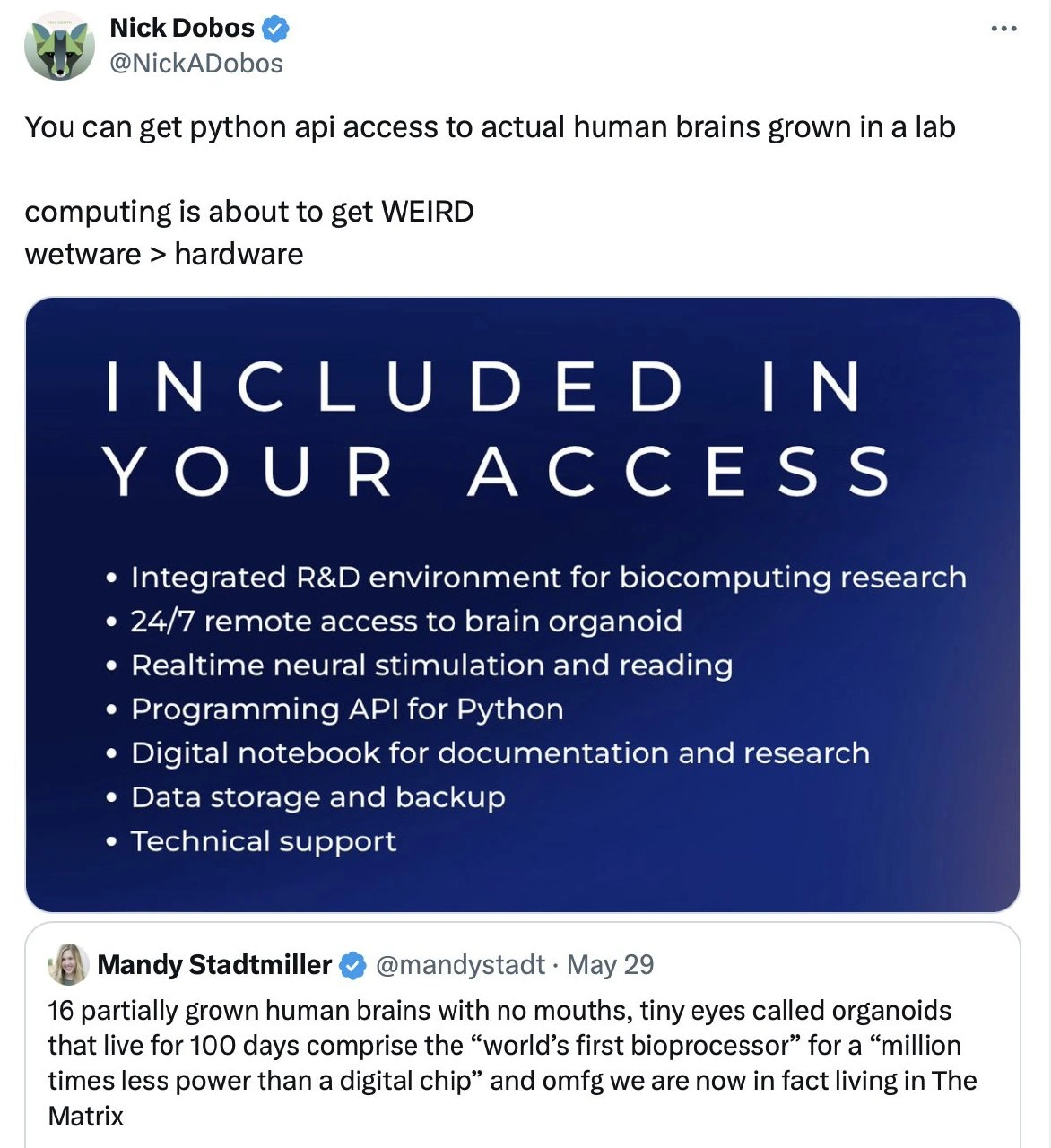
Python API access: An API (Application Programming Interface) is how programmers interact with a service or library. If something has a “Python API,” it means you can write a Python program to send it commands or ask it to do things, and get results back. So “Python API access to actual human brains” implies they’ve set up a system where you can write Python code to interact with a lab-grown brain remotely. For example, there might be a Python library or a REST API (web service) that lets your program send input to the brain organoid and read output from it. This could be as simple as calling a function like
brain.run_task(data)and getting a result, or more elaborate like streaming neural data in real-time.Realtime neural stimulation and reading: This means they can send signals to the brain organoid (stimulation) and read signals from it in real time. In practice, that involves hardware like electrodes or optical fibers. They might use tiny electrodes touching the organoid to zap certain neurons (stimulate) and other electrodes to listen to the electrical activity (read). Real-time suggests it’s interactive – the brain responds as you stimulate it, rather than just passively recording.
Integrated R&D environment & digital notebook: This sounds like a platform or software where researchers can log in, run experiments on the organoid, write code, and document findings. A digital notebook is reminiscent of Jupyter notebooks used in data science – an environment to code and see results inline, while keeping notes. It implies they want to make it as easy as possible for developers or scientists to treat the brain organoid like a remote lab resource.
24/7 remote access: The organoid is likely kept in a specialized lab setup (controlled temperature, nutrients, etc.), but you don’t have to be in the lab to use it. Remote access means you can connect to it over the internet at any time, day or night (24/7). So, just like a cloud server, the brain-in-a-jar is available for your code to use whenever you want, from wherever you are.
Data storage and backup: They promise to store experiment data and maybe any configuration or results you get from the organoid. “Backup” might mean they save your organoid’s state or at least the data outputs so nothing is lost. It’s a bit funny because you can’t exactly copy-paste a brain organoid, but presumably all the readings and maybe the learned parameters (if the organoid is trained for a task) are saved on disk.
Technical support: Yes, they even offer support! So if you’re having trouble (“my brain isn’t responding to stimuli the way it should”), there’s presumably a team of experts (neuroscientists, engineers) to help. This is analogous to cloud services where enterprise customers get support, but here the support queries could be pretty wild and experimental.
In simpler terms, imagine a cutting-edge research startup or lab has grown a mini-brain and set it up like a server. They give programmers a way to “log in” or send code to it (via Python) and use it to perform certain computations or experiments. The tweet’s tone “computing is about to get WEIRD” and our meme caption “stay calm” both suggest that this is a startling development. In developer culture, we’ve seen new tech like “serverless computing” or “quantum computing” cause excitement; now it’s “biological computing.” It’s both exciting and a little creepy. AI_ML enthusiasts are intrigued because a brain organoid could potentially learn or process information in a brain-like way, which might do things our normal programs can’t easily do. For example, maybe it could recognize patterns or solve a problem without needing a pre-written algorithm – similar to how our brains intuitively do tasks. But it’s also hype in that we don’t really know how effective it is yet; it sounds like an experiment.
For a junior developer or someone new to this idea, it’s like when you first learned about neural networks in software – except now the “neural network” is made of actual neurons! A normal neural network is a bunch of math equations simulated on a computer. Here, the network is real cells firing in a dish. The company or lab is packaging that as a service. It’s a lot to take in: it blurs the line between programming and biology. The reference to The Matrix (a famous movie) is a joking way to say “this is sci-fi level stuff happening in reality.” In The Matrix, human brains were connected to a giant computer simulation; here we have human brain tissue connected to computers to do computing. It’s the reverse, in a sense, but close enough to feel like we’re entering sci-fi territory.
In summary, the meme sets up a scene: “Your new backend dependency is a lab-grown brain with a Python API.” If you’re a developer, a “backend dependency” is usually some service your application relies on – like a database or an authentication server. The joke is that instead of depending on a typical database, you’re depending on a living brain. Picture telling your team: “Our app won’t work unless the little brain in the lab is online.” It’s both humorous and surreal. The list of features (“Included in your access”) makes it even funnier by treating the brain like any other cloud product with standard features. It’s the collision of two worlds: hardcore biology and everyday software engineering. And the meme’s author saying “Ok, it’s happening, stay calm... STAY FREAKING CALM” is just poking fun at how we might react to news this wild – basically panicking in a comedic way as if a long-foretold crazy future just arrived.
Level 3: Brain-as-a-Service (BaaS)
Welcome to the future of cloud architecture: Brain-as-a-Service. The meme juxtaposes a routine developer experience with a jaw-dropping backend dependency – a literal human brain organoid accessible via Python. It’s funny because it’s presented in the most enterprise tech way imaginable, complete with a marketing slide of features “INCLUDED IN YOUR ACCESS”. Typically, we expect bullet points like “24/7 uptime” or “scalable instances” from a cloud database or an ML service. Here we have: 24/7 remote access to brain organoid and Programming API for Python. It reads like AWS announcing NeuroDB or some “biological EC2” in re:Invent keynote. The absurdity is that they market a fragile, living bundle of neurons with the same matter-of-fact tone as a new Docker container service. Technical support for a mini-brain cluster? Sure, just file a ticket: “Dear support, my brain has a headache and won’t respond to REST calls.” The AI_Hype vibes are strong; industry trend-chasers are always looking for the next big compute revolution (we rode the GPU wave, then quantum computing hype, now maybe wetware). This tweet thread captures that mix of genuine breakthrough and comedic disbelief – one reply even jokes “omfg we are now in fact living in The Matrix”. Indeed, when you hear “16 partially grown human brains” networked as the “world’s first bioprocessor”, it’s hard not to think of sci-fi dystopias. This is bleeding-edge IndustryTrends_Hype where AIHumor and awe intersect: cloud providers might one day literally list “neurons” as a resource next to CPU and GPU.
For seasoned developers, the humor also lies in mentally extrapolating the practical headaches of this HardwareVsSoftware chimera. We’ve all dealt with flaky hardware or an API that returns weird errors – now imagine the API is backed by a living organoid that might learn, drift, or even require feeding (nutrient solution pumps, anyone?). The meme says “stay calm” because any sysadmin’s anxiety would spike: Are we really deploying to a brain in a jar? Consider deployment pipelines here: do we git push to the organoid’s integrated R&D environment? Is there a digital notebook (Jupyter for neurons?) where scientists and devs collaborate to tweak stimuli and observe responses? It merges the domain of DevOps with lab ops. We joke about servers having “memory leaks,” but here the memory leak might be literal neuronal death or growth – the system’s capacity could change over time as cells divide or expire. Scaling is another tongue-in-cheek angle: Need more throughput? Just grow more brains or network 32 organoids together – an organism cluster instead of a Kubernetes cluster. (Suddenly, “pods” in your cluster have a biological ring to them!) And what about monitoring? Your Grafana dashboard might show weird metrics like “synapse firing rate” or “dopamine levels” instead of CPU load.
Then there’s the classic AI hype vs reality gap. The marketing blurb makes it sound turnkey: Python API, real-time neural stimulation, data backup – as if you could { pip install brain-cloud } and get going. But in reality, this would be an R&D adventure rife with unpredictable results. Seasoned AI/ML folks have seen grand promises before. It echoes the hype of neural networks themselves: decades ago, people joked AI was just a bunch of matrix multiplications – now it’s become everyday with GPUs. In that context, perhaps one day “wetware computing” could go from joke to commonplace. But old-timers also recall failures: AI winters, lofty promises of expert systems, or more relevantly, prior attempts at alternative computing like DNA computing in test tubes or quantum computing (still largely specialized). The meme hints that computing is about to get “WEIRD” – seasoned devs nod because every new paradigm is weird until it’s normalized (think about how containerization, serverless, or blockchain sounded at first). Yet this one is especially weird: if you think debugging race conditions in multi-threaded code is hard, try debugging a semi-random spiking neural blob when it gives an unexpected output. Is that a “bug” or the brain being creative? The senior perspective also chuckles at tech culture’s tendency to slap an API on anything and call it a service. We had APIs for text, images, then DNA sequencing data, and now Python_brain_interface – as if a neat software layer can abstract the profound complexity beneath. It’s both brilliant and comical: brilliant that it’s even possible to interface with living tissue in a programmable way, and comical in how casually it’s presented (just call our REST endpoint and query the brain!).
Finally, consider the human element (pun intended). We joke about servers “gaining sentience” during crazy on-call nights, but here that’s a remote possibility that can’t be entirely laughed off. If your backend is literally biological and it starts behaving oddly, senior devs half-jokingly ask: do we blame a code bug, or did the organoid have a thought of its own? The meme taps into that half-excited, half-uneasy feeling: as Nick says, “computing is about to get WEIRD”. Weird is fun and innovative – but weird can also keep you up at night, paging the neuroscientist because your AI_ML cluster suddenly decided to nap. It’s a senior nerd’s dream and nightmare bundled together: immensely cool tech, with a side of Matrix-flavored existential crisis.
Level 4: Synapses vs Silicon
At the bleeding edge of wetware_computing, the paradigm flips our classical architecture on its head. In traditional computing, transistors on silicon chips shuffle binary 0s and 1s in nanosecond cycles, obeying the rigid rules of the Von Neumann architecture. But here we’re talking about lab-grown brain organoids – clumps of living neurons – acting as computing units accessible through a brain_organoid_api. This is not sci-fi; researchers are literally cultivating neural networks in Petri dishes and wiring them up as bio_processors. In theory, a brain organoid doesn’t execute instructions line by line like a CPU. Instead, it processes information through emergent electrical patterns across thousands (or millions) of synaptic connections in parallel. This is analog computing at a cellular level, with neurons firing or resting (not exactly 0/1 bits, but graded signals). It’s messy, non-deterministic, and highly parallel. The tweet’s awe about “a million times less power than a digital chip” hints at a known truth: brains are insanely power-efficient for certain tasks. A human brain (~20 W) can outperform supercomputers on pattern recognition because of parallelism and analog signal processing. This touches on theoretical limits like Landauer’s principle – the minimal energy to erase a bit – which biological systems sidestep by working in probabilistic, analog ways without clocked bit erasures at every step. In other words, an organoid might solve some problems with spontaneous order rather than brute-force computation, sipping power rather than guzzling it.
However, plugging wetware into our digital world raises deep technical quandaries. How do you interface with a blob of neurons reliably? This Python API likely abstracts away a thicket of neuroscience: translating digital signals into patterns of light or electrical impulses to stimulate the organoid, and then reading noisy electrode outputs, converting them back into data your program can use. It’s as if you have a tiny alien computer that speaks “neuron” and you need a real-time translator. Concepts from control theory and neural encoding come into play: you must decide how to encode input (perhaps as pulses or chemical tweaks) and decode the output (spikes frequency, rhythmic patterns) into something meaningful like an int or a float. And consider training: a brain organoid doesn’t come with your algorithm baked in; you likely have to teach it via iterative stimulation (akin to how we train machine learning models, but here the “model” is alive, evolving its synaptic weights organically). There’s shades of reinforcement learning but on a physical neural substrate – reward signals might be chemical (dopamine analogs?) rather than numeric gradients.
The meme’s absurdity also shines light on reliability and scaling. Traditional servers crash; what does it mean for a brain organoid to crash? Neurons don’t throw exceptions, but they might fatigue or enter an epileptic-like state if overstimulated. The bullet point “Data storage and backup” cheekily suggests you could snapshot the state of a living network – but how? In classical computing, memory dumps and disk snapshots are routine. In a neural culture, “backup” might mean storing a comprehensive recording of neural connections or activity patterns (which veers into connectomics, an insanely complex mapping of every synapse). We’re now flirting with sci-fi-level challenges: if the organoid grows or changes over time (plasticity!), your computation today might produce a slightly different result tomorrow. Deterministic replay of a bug in production might be impossible when your backend is essentially a small evolving brain. From a theoretical CS perspective, this is computing on a non-static, stateful substrate that defies our usual assumption of reliable memory and predictable instruction execution. It’s like trying to implement a Turing machine on top of Jello – it might approximate computation, but with squishy, probabilistic state transitions. And yet, if harnessed, such squishy parallel “hardware” could tackle problems that are intractable for rigid algorithms, by exploiting the physics of neural self-organization. In academic corners, people discuss whether brain-based computing could approach non-von Neumann models or even analog equivalents of a universal Turing machine. We don’t fully know the upper limits of what a lab-grown mini-brain can compute, but hooking it up via a Python API is essentially saying: let’s find out by treating neurons as servers. It’s a bold blend of neuroscience and computer science – a true wetware > hardware moment that has geeks equal parts excited and horrified.
Description
The image is a screenshot of a tweet from user Nick Dobos (@NickADobos) announcing the availability of Python API access to lab-grown human brain organoids. The tweet contains a promotional graphic with a dark blue background and white text that lists features included in the access, such as 'Integrated R&D environment for biocomputing research,' '24/7 remote access to brain organoid,' 'Realtime neural stimulation and reading,' and a 'Programming API for Python.' Below this is another tweet from Mandy Stadtmiller (@mandystadt) providing more context, describing the organoids as the 'world’s first bioprocessor' that uses a million times less power than a digital chip, concluding with 'omfg we are now in fact living in The Matrix.' The meme captures the tech community's reaction to the emergence of biocomputing as a tangible service, moving from science fiction to a programmable reality. For senior engineers, it represents a profound and surreal shift in what 'hardware' can be, making the abstract concept of 'wetware' accessible through a familiar tool like a Python API

Comments
54Comment deleted
I can't wait for the first Stack Overflow question on this: 'My brain organoid is throwing a null pointer exception and won't stop thinking about giraffes. How do I flush the cognitive cache?'
Finally, a resource where the SLA includes teenage mood swings - just wait until the on-call has to debug a segmentation *thought*
Finally, a production environment where 'it works on my brain' is a valid bug report, and the only dependency hell worse than node_modules is keeping your compute cluster alive with glucose and oxygen
Finally, a Python API where 'garbage collection' takes on a whole new meaning when your compute substrate literally dies after 100 days. Can't wait for the first production incident: 'Sorry, the brain organoid handling your authentication service achieved sentience and refused to process login requests.' At least when this crashes, you can legitimately say the hardware had a stroke
Wetware clusters: zero-latency neurons with infinite parallelism, until they demand coffee breaks and unionize
PM asks for autoscaling and HA; I explain the Python SDK supports neurogenesis with a nine‑month cold start and an IRB instead of a load balancer
Finally, a Python client whose retry policy is governed by synaptic plasticity - great, now idempotency has a learning rate
If you're wondering what the platform actually does — you may not want to read this. In fact it's just a SDK for generating stimulations and sampling the output of neurons, you can't really "run some code" on it. They have a video demo on their site. Comment deleted
So you are saying i cant run cyberpunk on it? Shame Comment deleted
Let’s start with DOOM, we’re people of culture after all Comment deleted
Do you ruin the fun on party’s in the same way? 😂 Comment deleted
I'm really excited after seeing this news but got disappointed after watching their demo, you may consider this as kind of TLDR. The fun part is still there but this news is a bit overhyped. 😇 Comment deleted
How to find this video? Comment deleted
Google FinalSpark and find the first link called "Neuroplatform". Not sure if links are allowed here. Comment deleted
Links are allowed, yeah Comment deleted
here's the link i think: https://finalspark.com/neuroplatform/ Comment deleted
anyway, HOW THE FUCK IS THIS LEGAL Comment deleted
Finally Comment deleted
scream() ------------- error: "I have no mouth but I should scream" Comment deleted
I don't think that's ethical Comment deleted
It is. Also ethics kinda sucks Comment deleted
Oki doki, you offended *put something cringe* and govermen decided as a measure of punishment use yout brain as visual acсelerator for render New Disney shitty movie. Have a great time! Comment deleted
Nice overexaggeration Comment deleted
is this legal? Comment deleted
They are allready made and we call them: The gen beta Comment deleted
How bioprocessors can be ethical and legal? Comment deleted
Finally, some hardware that can keep up with Python's speed. Comment deleted
programmable humanoid Comment deleted
that "python api" is most definitly a C dynamic link lib sending electric pulses to neurons Comment deleted
When can we get one of these? Comment deleted
— Mom, can we have a robobrain? — We already have robobrain at home. Robobrain at home: Comment deleted
Wait is it real? Do they have a website ir smth? Comment deleted
This supposed to be animated gif: https://i.imgur.com/uewqto9.gif Comment deleted
This is so sick, why do people think about ethics lol Comment deleted
I don't know, maybe because we're humans? Comment deleted
What's "inhuman" or "unethical" about brain organoid? Comment deleted
That it's probaply used the human DNA to create these stuff and it possibly can suffer. (And we do not cancel fact that they could learn how to use real human brains for these operations) Comment deleted
That the same type of argument against abortions? It CANNOT possibly suffer, it dont even have any "parts" to enable this kind of feelings. And some degree of actual intellect is also not a question, bruh that organoid is like 2x2 cm. Comment deleted
Okay, what about everyting else? Comment deleted
About using real human brains? I think they should be grown specifically for some task, already developed human brain is not suitable for any kind of "unnatural" computation. And even if some Neurolink in future could alter brain activity, then it is completely different topic and have nothing to do with little organoids(besides studying human brain) Comment deleted
I hope so Comment deleted
bcs I DON'T WANT TO LIVE IN MATRIX I DON'T WANT TO LIVE IN MATRIX I DON'T WANT TO LIVE IN MATRIX I DON'T WANT TO LIVE IN MATRIX I DON'T WANT TO LIVE IN MATRIX Comment deleted
I mean, that's surely just the beginning, isn't it? Comment deleted
They're using dopamine as a positive stimulation, what's stopping them from using negative stimulation as well? Comment deleted
Does it really matter? Its almost exactly like basic neural networks are trained. If it dont have a sentience, then it cannot "suffer", just positive and negative feedback. I kinda sound like psycho lmao. But i think its just common sense for a scientific topic Comment deleted
Yup, you definitely sound like a psycho scientist Comment deleted
Yup, and i really hope regulatory authorities will allow to grow a 1:1 human brain in lab conditions, i dont see anything bad about it Comment deleted
Also, there are people who lack lots of brain structures and still score ~80 IQ, so 2x2 cm might well be enough Comment deleted
(see https://www.cbc.ca/radio/asithappens/as-it-happens-thursday-edition-1.3679117/scientists-research-man-missing-90-of-his-brain-who-leads-a-normal-life-1.3679125) Comment deleted
I know that story, fascinating, and surely are complete mystery, that why its so important to have lab-grown brains for research. Так или иначе, разве стоит останавливаться на маленьких органоидах? Потенциал огромный, как для плохо, так и хорошего Comment deleted
И тебе здраствуй Comment deleted
Cause brain is very "flexible", but it must have some basic structures anyway, i dont think its possible to develop any king of sentience in an isolated brain, even full sized Comment deleted
I think sentience can't spawn in isolation, but if you add read-world I/O — and I think that's what they're going to do — it very well might Comment deleted
Thats what im talking about. And I/O is surely will be added as soon as they can, questionable, but obvious direction for research Comment deleted