Coding Challenge: Don't Touch Your Face
Why is this DevCommunities meme funny?
Level 1: Hand Meets Face
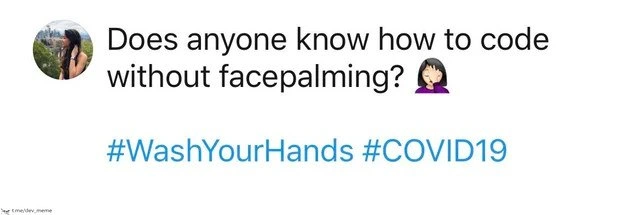
Imagine you’re trying to solve a really hard puzzle or fix your bike, and you keep making a mistake that causes everything to mess up. Eventually, you might get so frustrated that you put your hand on your face and go “ugh!” That’s a facepalm. Programmers do this all the time when writing software because coding is like solving a big puzzle with lots of pieces – it’s easy to get something wrong. This meme is saying “Does anyone know how to write code without doing that?” which is a funny way of admitting that messing up is super common when programming. The big #WashYourHands and #COVID19 words are there because when this was made, the world was dealing with the coronavirus outbreak. Back then, everyone kept reminding each other to wash their hands to stay safe. By putting those reminders on a coding joke, it’s kind of like mixing a serious world problem with a silly everyday problem. Why is that funny? It’s the surprise of seeing them together. It’s as if someone is saying, “Writing code makes me want to facepalm, and oh by the way, don’t forget to wash your hands!” It shows that even when serious things are happening, people still find time to joke about daily struggles. So, the meme feels both comforting and humorous: it’s okay to feel frustrated when doing hard things (like coding), and remember to take care of yourself (wash your hands) – a little laugh connecting both ideas.
Level 2: Code Hygiene 101
Let’s break down the meme’s ingredients in simpler terms. First, the format: it’s styled like a Twitter post. There’s a small profile photo of a woman on the left and the text looks just like a tweet. Developers often share quick quips or frustrations on Twitter, so this format immediately says “this is a casual, relatable thought from a coder.” The text reads: “Does anyone know how to code without facepalming?” and includes a woman-facepalming emoji (🤦). In developer lingo, facepalming means literally putting your hand to your face in frustration or disappointment. It’s what you do when you discover you wrote a bug that breaks everything or when you realize you spent two hours debugging a problem that turned out to be a typo. The emoji 🤦 is commonly used in chats and forums when someone admits a silly mistake or when code behaves in a ridiculous way. So, the person in the meme is essentially asking: Is it even possible to write code without constantly feeling exasperated at yourself? It’s a tongue-in-cheek question, because most programmers – whether new or experienced – have felt that exact way. Coding can be frustrating, and feeling a bit stupid from time to time is almost guaranteed.
Now, what about those big blue hashtags #WashYourHands and #COVID19? This meme was made in early 2020, right when the COVID-19 pandemic was ramping up. On social media, especially Twitter, everyone was using hashtags like #WashYourHands to spread awareness of good hygiene practices. #COVID19 was the standard tag to talk about the coronavirus outbreak. By putting those hashtags in a coding joke, the meme ties a programmer’s daily struggle to the big global issue of that time. It’s a bit absurd – washing your hands has nothing to do with writing code – and that’s exactly why it’s funny. The contrast is comical. Imagine reading a tweet from a developer friend complaining about a baffling bug, and then you see it end with “#WashYourHands #COVID19.” It would feel a bit random! The meme is highlighting that in March 2020, everything online came with a dose of pandemic awareness, even unrelated content. It was almost a trend or even a duty to tag posts with those public health reminders. So here, the developer’s cry for help (“coding without facepalming, anyone?”) is humorously mixed with pandemic-era advice, as if coding faux pas were as widespread as a virus.
Let’s connect this to debugging and troubleshooting, since those are key tags. Debugging is the process of finding and fixing errors or “bugs” in your code. A bug is just a coding mistake or an oversight that makes the software act in unintended ways (the term comes from an actual insect causing trouble in an early computer, believe it or not!). Troubleshooting is a similar idea: systematically figuring out what’s going wrong in a system. For a junior developer or someone learning to code, debugging is both an essential skill and a frequent source of head-smacking moments. For example, suppose you wrote a small program and it’s crashing. You might print out values, read an error log or a stack trace (that’s the long list of function calls you see when an error occurs) to track down the issue. When you finally find the cause, you may realize it was something straightforward like using = instead of == in a comparison, or forgetting to call a function. Cue the facepalm. It’s a mix of relief that you found the bug and a bit of embarrassment that it was something you “should have” caught. This cycle is extremely common in development. In fact, part of the Developer Experience (often abbreviated DX) is improving tools and practices so that these errors are easier to catch and maybe happen less often – essentially to minimize those facepalm moments.
The meme’s mention of washing hands can be seen as an analogy for something in coding: think of code hygiene or writing “clean code.” Just like personal hygiene is about good habits to stay healthy, code hygiene is about good practices to keep your code healthy (readable, maintainable, and less bug-prone). For instance, consistently naming your variables, commenting your code, writing tests, and not letting your functions do too much – these are all part of clean coding practices. A beginner might not know this term, but over time you learn that sloppy code tends to create more bugs (much like not washing hands can spread germs). The meme jokily implies “Maybe if I apply good hygiene (like washing hands) to coding, I won’t facepalm as much.” Of course, in reality, even very clean code can have bugs, but the idea is that being careful and methodical can reduce mistakes. Another subtle tech term here is “code smell.” In software, a “code smell” is a hint that something is off in the code (perhaps it’s overly complicated or uses a bad practice). We say it “smells” because it’s not outright broken like a bug, but might lead to bugs – something just isn’t fresh about it. It’s funny because it again relates to hygiene; if code can smell, maybe we should wash it! So a junior developer learning about these concepts might see the parallel: keeping things clean (hands or code) helps avoid trouble (illness or bugs), but it’s an ongoing effort.
Finally, consider the relatable developer humor aspect. This meme falls under CodingHumor that just about any programmer can chuckle at. Why? Because the scenario – facepalming at code – is universal. If you’ve only been coding for a few weeks, you might have already experienced the mini-panic of your code not working and the joyous despair of finding the dumb mistake behind it. If you’ve been coding for years, you have a whole collection of war stories: the time you accidentally deleted a database table in production (yikes) or the time you pushed a fix that took down the login service. These stories are often told with a smile after the fact, and usually with an accompanying 🤦 emoji or a headshake. Jokes and memes like this are a way to say “hey, we’ve all been there, it’s okay.” In March 2020, with everyone stuck at home, these online shares became even more of a bonding experience. Even the hashtag #PandemicHumor became a thing – people joking about Zoom meetings in pajamas or variable names like covidCounter. This particular meme captured that moment where serious advice (wash your hands!) intersected with the silly reality of coding errors. For a new developer, it’s a lighthearted reminder: no matter how advanced you become, you’ll still have moments where you slap your forehead and groan at your screen. And apparently, the whole world could be falling apart, and you’ll still be there asking Stack Overflow why your code is throwing null pointer exceptions – that’s the life of a coder!
Level 3: Flatten the Bug Curve
At first glance, this meme looks like a simple tweet, but it cleverly merges developer frustration with early-pandemic social media vibes. The top line asks:
Does anyone know how to code without facepalming? 🤦
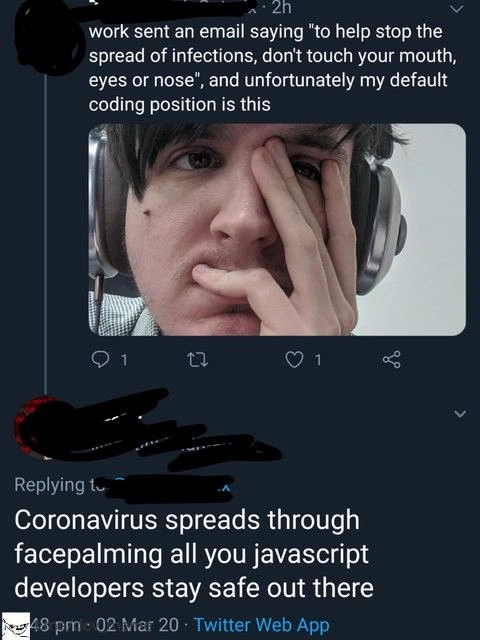
Seasoned programmers smirk at this rhetorical question because coding without facepalms is as mythical as a bug-free software release. The humor hits home by comparing the ubiquity of coding mishaps to a global outbreak. In early 2020, #WashYourHands and #COVID19 were everywhere – even tech Twitter was inundated with public health advice. By slapping those hashtags onto a coding gripe, the meme creates an absurd mashup: a daily dev struggle presented with the same urgency as a pandemic PSA. It’s poking fun at how our timelines (and minds) were constantly context-switching between debugging stack traces and doomscrolling virus news.
For senior developers, the scenario is painfully relatable. You’re refactoring some gnarly legacy code and inevitably hit a moment that makes you literally facepalm – that universal gesture of “I can’t believe I did that” or “why is this code like this?” It might be discovering an obvious off-by-one error at 2 AM or realizing you spent an hour chasing a bug caused by a missing semicolon. In a team setting, you’ve probably seen a colleague raise their hand to their face after deploying to production and immediately seeing errors flood the logs. Facepalms are practically part of the job description in software development; they’re the unspoken punctuation at the end of a debugging session. As a cynical saying goes, if you’re not facepalming at your code at least once a day, are you even coding?
Now consider the hashtags through a senior lens. Code hygiene becomes a playful parallel to personal hygiene. “Wash your hands” was about stopping the spread of a virus; in coding, good habits stop the spread of bugs. Veteran devs often preach writing clean code, adding tests, and doing code reviews – effectively sanitizing the codebase to prevent contagious problems later. The meme’s juxtaposition implies that writing code without constant errors might require the same diligence as avoiding illness. Just like you’d use sanitizer to kill germs, a savvy coder uses unit tests and linters to catch bugs early. Yet, even with the best practices, some bugs slip through – and when they do, 🤦 facepalm is the reflex. There’s a darkly funny truth here: no matter how “clean” you keep your code, it’s virtually impossible to eliminate all sources of frustration. The only code that has zero bugs is no code at all (and even that’s debatable!).
The Twitter-format styling of the meme also resonates with tech insiders. In 2020, much of the Developer Experience (DX) was shaped by remote work and online communities. Devs vented on Twitter about everything from botched releases to cabin fever. By mimicking a tweet, complete with a profile pic and viral hashtags, the meme feels like an authentic snippet from a developer’s timeline. It captures that zeitgeist where a tweet about a baffling NullPointerException might sit right above a tweet about COVID case numbers. The humor here is partly in the absurd context switch: one second you’re deep in code, the next you’re reminded to disinfect your groceries. For a senior developer, it evokes memories of trying to fix a production crash while also adjusting to a new world of hand sanitizer and Zoom meetings. The two worlds – software bugs and viral outbreaks – blur together comically. “Flatten the bug curve,” indeed: reduce those spikes of errors in your code just like flattening the COVID curve. Both tasks felt crucial and tricky at the time.
On a more reflective note, the meme underscores that developer humor often serves as a coping mechanism. It’s a way to bond over shared pain points. That knowing facepalm emoji 🤦 is basically a badge of membership in the programmer club. When a colleague shares a screenshot of an inexplicable stack trace with the caption “FML 🤦”, senior engineers instinctively empathize. We’ve all been there, maybe even introduced that very same bug ourselves in the past. This solidarity in frustration became even more important during the pandemic when everyone was isolated. Sharing a laugh (or a groan) about coding problems on Twitter was a quick morale boost. Even the Debugging/Troubleshooting process – normally dry and technical – spawned jokes like “I didn’t find a bug, the bug found me” or “99 little bugs in the code, take one down, patch it around, 127 little bugs in the code… 🤦”. In the spirit of those jokes, the meme’s author facetiously asks if anyone knows how to avoid the facepalm moments. The subtext is clear: nope, it’s universal. Even the gurus who invented the frameworks you use have slapped their foreheads over mistakes.
By anchoring the joke in the very real COVID-19 context, there’s also an element of gallows humor. 2020 was tough; injecting a bit of TechHumor into the serious flood of pandemic news helped people cope. It’s as if the meme says: “We can’t escape bugs or viruses, so here’s a laugh through the pain.” For senior devs, there’s an extra layer: we remember other crises and how tech folks responded with humor (from “It's always DNS” during outages to “Have you tried turning it off and on again?” in support calls). The #COVID19 era became another chapter in that history – where even PandemicHumor found its way into commit messages and Slack emojis. (Don’t be surprised if somewhere out there is a commit like fix: removed viral bug (washed hands 🧼).) Ultimately, this level of the joke acknowledges that writing software is inherently an error-prone, forehead-slapping endeavor even on a good day, and 2020 was definitely not full of good days. So the meme perfectly blends a RelatableDeveloperExperience (constant facepalms at code) with a slice of world history (constant hand-washing reminders) to elicit a knowing laugh from anyone who’s been in the trenches of code.
Description
This image is a screenshot of a tweet that captures a specific dilemma for developers during the early days of the COVID-19 pandemic. The tweet, from a user with a circular profile picture of a woman outdoors, asks, 'Does anyone know how to code without facepalming?'. The text is accompanied by a female facepalm emoji. Below this, in a prominent blue font, are the hashtags '#WashYourHands #COVID19'. The meme's humor comes from the direct collision of a deeply ingrained developer habit - facepalming in response to bugs, errors, or general frustration - with the urgent public health advice of the time to avoid touching one's face to prevent the spread of infection. It's a simple, relatable post that highlights how a universal coding trope gained a new layer of real-world consequence
Comments
7Comment deleted
In 2020, the most critical code review wasn't for logic errors, it was your webcam catching you touching your face after a failed build
Pro tip: treat legacy code like COVID - keep 6 feet of abstraction, sanitize every commit, and whatever you do, don’t touch your face after a git blame
The CDC recommends not touching your face, but they've clearly never tried to debug a race condition that only happens in production on Tuesdays during a full moon
The real question isn't whether you can code without facepalming - it's whether you've achieved the senior engineer milestone of facepalming *before* even reading the code, just from seeing the PR title, the Jira ticket description, or hearing 'we need to support IE11.' At 15+ YoE, the facepalm becomes preemptive: a defensive reflex honed by years of legacy codebases, production incidents at 3 AM, and stakeholders asking 'how hard could it be?' The pandemic gave us hand sanitizer; experience gives us the wisdom to know that no amount of washing will cleanse what we've seen in that 10,000-line God class
Even post-20 YoE, facepalming remains the one distributed system guarantee: eventual palm-forehead consistency
New PR policy: for every WTF/min in your diff, increase sanitizer throughput - finally, backpressure on facepalms
Want to code without facepalming? Sure - just make requirements Consistent, Available, and Partition‑tolerant. Until product beats CAP, I’ll keep washing up for the inevitable eventual facepalms