Skip to content
DevMeme
1629 of 7435
GitHub Notifications: A Rollercoaster of Emotions
Security Post #1822, on Aug 1, 2020 in TG

GitHub Notifications: A Rollercoaster of Emotions

Why is this Security meme funny?

Level 1: From Yay to Uh-Oh

Imagine you’re at school and your teacher calls out your name. You sit up excited, thinking you might get a gold star for a good job you did. But instead, the teacher says, “There’s a mistake in your work that you need to fix.” Instantly, your happy excitement turns into worry and dread.

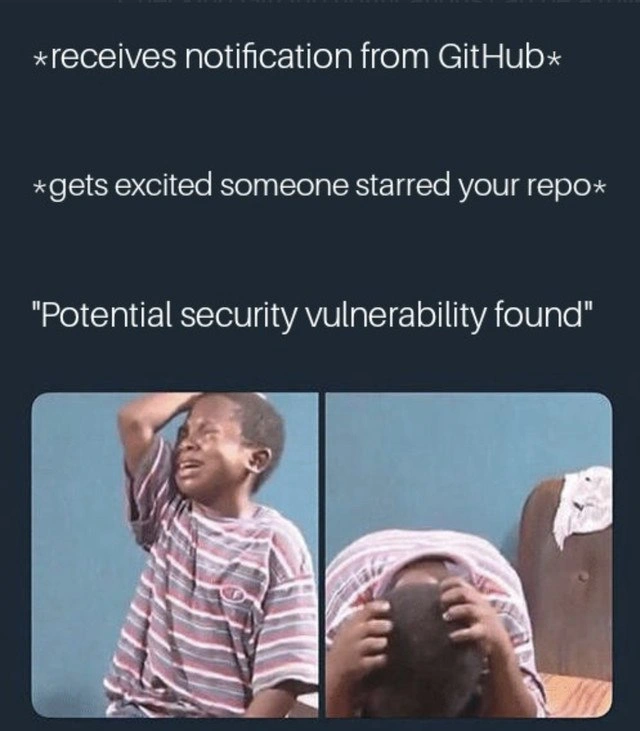
That’s exactly what happened to the programmer in this meme. They thought the notification from GitHub was like getting a gold star — a sign of praise. But actually, it was bad news about a problem in their project (something unsafe that needed fixing). So they went from feeling super happy to super upset in just a moment. The left picture shows them celebrating (that’s the “Yay, I got something good!” feeling) and the right picture shows them holding their head (that’s the “Oh no, something’s wrong!” feeling).

The meme is funny because it’s a little bit like a prank or a mix-up that we can all understand: expecting something good and then finding out it’s a problem instead. It highlights how a developer can be really excited thinking they got a nice surprise, but then feel really disappointed when it turns out to be a scary warning about their code. It's an emotional rollercoaster in a single notification!

Level 2: Star or Scare

Let’s break down what’s happening in simpler terms. GitHub is a popular website where developers store and share their code using Version Control (specifically git). It has a notification system – kind of like a social media feed – that alerts you when something important happens in your projects. For example, you might get a notification if someone "stars" your repository. A star on GitHub is basically a way for someone to bookmark or show appreciation for your project. It’s the equivalent of a “like” or a small compliment: it doesn’t change your code but it indicates that someone noticed and liked your work. Many new developers get excited to see these stars, because it feels like your project is getting some love from the community.

Now, GitHub also sends out another kind of notification: security alerts about your project’s dependencies. Dependencies are the external libraries or packages that your project uses. Think of them as building blocks or tools your code calls on to do certain things. Because we often reuse code others have written (why reinvent the wheel, right?), almost every project has some dependencies (for example, a web project might depend on frameworks like React or Rails, or libraries for tasks like image processing).

The important thing is that these dependencies can have known security vulnerabilities. A security vulnerability is a problem in the code (like a bug or flaw) that could allow hackers or malicious users to do something bad - maybe steal data or crash the system or take control in some way. When such a vulnerability is discovered in a library, it gets reported and usually fixed in a newer version. These vulnerabilities are catalogued as entries in databases (often called CVEs, which stands for Common Vulnerabilities and Exposures).

GitHub has an automated system (originally a tool called Dependabot that GitHub integrated) that keeps track of your project’s dependencies and checks if any have known vulnerabilities. If it finds one, it generates a notification or alert for you with a message like "Potential security vulnerability found". That means “Hey, one of the libraries you’re using has a known security problem in it – you should update it to a safer version.”

So in the meme, the developer sees a GitHub notification and thinks, “Oh, someone gave my project a star!” because that’s a fun, happy kind of notification. But what actually happened is that GitHub is warning them about a security issue. The text “Potential security vulnerability found” is exactly the kind of alert title you get for these dependency/security problems. Instead of good news, it’s basically saying there’s work to do: maybe you need to upgrade a library or patch something to ensure your project is secure.

The reaction images in the meme illustrate this emotional rollercoaster:

  • In the first panel, the person is smiling big and throwing up their arm in celebration. This represents the developer’s excitement at the thought of a new star on their repo.
  • In the second panel, the person is hunched over with their hands on their head, looking distressed. This represents the feeling of “Oh no…” when they realize it’s actually a security alert, meaning something could be wrong with their project’s dependencies.

For a junior developer or someone new to GitHub, this highlights a couple of important concepts:

  • Open-source maintenance isn’t just writing cool code and getting stars. It also involves keeping your project up-to-date and safe. When you share code publicly (open source), you become responsible for fixing issues in it, including updating those external libraries when vulnerabilities are found.
  • Dependency management tools (like npm for Node.js, pip for Python, etc.) often have commands to check for vulnerabilities (for instance, npm audit will list known issues in your Node.js project’s dependencies). GitHub’s notifications are a proactive way to let you know, so you don’t have to constantly run those checks yourself.
  • Security vs. features: As a developer, you may be more excited to add new features or get recognition (stars, positive feedback), but you also need to pay attention to security problems even if they’re less fun. It’s a balance between making things and making sure they’re safe to use.

In short, the meme is a funny take on learning that not all notifications are good news. It’s using a relatable scenario – expecting praise but getting a warning – to poke fun at the experience of managing a project on GitHub. If you've ever had that moment where you see a notification badge and your heart flutters, only to read it and go "uh-oh", then this meme will definitely make sense to you!

Level 3: Gold Star vs Red Alert

In this meme, a developer gets a GitHub notification and feels the rush of social validation — imagining it's a new star on their repository — only to discover it's actually GitHub’s dreaded security vulnerability alert. It's a moment of notification whiplash that many seasoned devs know too well. The humor strikes right at the heart of open-source maintenance: the tug-of-war between the ego boost of a repository star and the anxiety of a Dependabot warning.

This meme uses a classic two-panel reaction image: on the left, our developer is elated, arms raised in victory, representing that split-second of joy thinking "Yes! Someone starred my repo!". Stars on GitHub function like gold stars in grade school or likes on social media – they don’t change your code at all, but they sure feel rewarding. For open-source maintainers, each star is like a tiny badge of accomplishment, a sign that somebody appreciated their work. It's a bit of VersionControlHumor: we all crave those stars even though they’re largely symbolic.

But then comes the punchline. The right image shows the developer hunched over, head in hands, in utter despair. Why? Because the actual notification reads "Potential security vulnerability found". Instead of a pat on the back, it's a slap on the wrist. This phrase is instantly recognizable to anyone who’s managed project dependencies on GitHub in recent years. GitHub (often via Dependabot, an automated helper) scans your project’s libraries and finds a known security flaw. It’s basically telling you "Hey, one of your dependencies has a SecurityFlaw." In other words, “Drop everything and update that package, or your project (and its users) could be at risk.”

The contrast is comedic gold because it’s so relatable. Dependency management is an unglamorous part of development that often sneaks up on you. One moment you’re riding high, thinking your project is gaining traction, and the next you’re reading a GitHub security advisory about some library you included months ago. It's like expecting a celebratory high-five but getting handed a todo list. Every experienced developer has had that "not again" sigh when seeing these alerts. If you've ever maintained a project with dozens of libraries, you know that feeling when your inbox or the little GitHub bell icon lights up with what you hope is praise... but it’s actually an automated DependencyScanning alert about, say, a critical vulnerability in lodash or django or some other core piece.

Under the hood, GitHub’s security notifications are powered by a continuously updated database of known vulnerabilities (think CVE entries in the global Common Vulnerabilities and Exposures list). When you push code or when a new CVE is reported, GitHub checks if any of your pinned versions match the vulnerable ones. This is great for safety, but it means maintainers are constantly reminded that software is never truly done. There’s always one more patch to apply. The senior dev community often jokes that DependencyManagement and security upkeep are the "tax" you pay for using open-source packages. This meme captures that sentiment perfectly: the small triumph of getting a star, immediately taxed by the responsibility of fixing a security issue.

What makes this especially humorous to an experienced eye is how accurate it is. It’s common to get excited by trivial positive feedback (GitHub stars don’t actually do anything except look nice), yet get completely deflated by a major issue that actually matters. It's a reality check. The meme exudes a kind of "of course it was too good to be true" vibe. Seasoned developers have learned not to get too excited until they've read the whole notification – a kind of cautious optimism honed by years of SecurityVulnerabilities popping up at the worst times. There's even a bit of dark irony: the more popular your project becomes (more stars, more users), the more pressure you feel to quickly address these vulnerability alerts. In other words, that star you were so happy about might be exactly why you must care about the security warning (because now people rely on your code!).

In summary, the meme speaks to the duality of modern code life on GitHub: where your VersionControl platform dishes out dopamine and stress in equal measure. It’s funny because it’s true – we've all misread a notification or had that rush of excitement turned to dread in a single click. This little dark-theme post and reaction pair perfectly encapsulate that open-source maintainer mood swing: from “Yay, recognition!” to “Oh no, time to do maintenance.”

Description

A meme about the developer experience with GitHub notifications. The top half of the image contains three lines of text on a dark background. The first line reads, '*receives notification from GitHub*'. The second, '*gets excited someone starred your repo*'. The third, in quotes, reveals the disappointing reality: '"Potential security vulnerability found"'. The bottom half consists of a two-panel image of a young Black child crying in distress. In the left panel, he's crying with one hand to his forehead. In the right panel, he's bent over, clutching his head in despair. The meme humorously captures the emotional whiplash developers feel when the anticipation of positive community feedback (a starred repository) is crushed by the mundane, and often urgent, reality of a security alert, typically from an automated tool like Dependabot. For senior engineers, this is a deeply relatable moment of false hope, turning a potential ego boost into an immediate, unplanned task of auditing and updating dependencies
Comments

7
Anonymous ★ Top Pick The five stages of GitHub notifications: hope, excitement, reading, despair, and finally, `npm audit fix --force`
  1. Anonymous ★ Top Pick

    The five stages of GitHub notifications: hope, excitement, reading, despair, and finally, `npm audit fix --force`

  2. Anonymous

    GitHub’s conditioning experiment: every time the bell rings I expect a star, and Dependabot shows up with a CVSS 9.8 invoice for the transitive log4j hiding three layers under left-pad

  3. Anonymous

    The only thing more reliable than Dependabot finding a critical vulnerability in your 5-year-old lodash dependency is the fact that fixing it will break three production systems that somehow relied on that specific vulnerable behavior as a 'feature'

  4. Anonymous

    The modern open source maintainer's journey: You publish a side project hoping for stars and contributors, but instead you become a full-time security patch manager for dependencies you didn't even know you had. Bonus points when it's a vulnerability in a transitive dependency 47 layers deep that you can't actually fix without breaking half your stack - so you just acknowledge the Dependabot PR and move on with your life, knowing that CVE-2024-XXXXX with a CVSS score of 3.2 affecting an obscure edge case in a logging library is probably not your biggest threat model concern

  5. Anonymous

    GitHub stars: the universe's reminder that OSS popularity scales linearly, but transitive dependency CVEs explode exponentially

  6. Anonymous

    Every GitHub ping is either a star or a CVE - statistically, it’s a CVE buried three levels deep in a transitive dependency you never knew you shipped

  7. Anonymous

    GitHub notifications: 1% ⭐, 99% “CVE in a transitive YAML parser you’ve never touched” - and somehow that still mandates a release, a change review, and a fresh SBOM

Use J and K for navigation