A Literal Interpretation of Deep Learning
Why is this AI ML meme funny?
Level 1: Dive into Your Studies
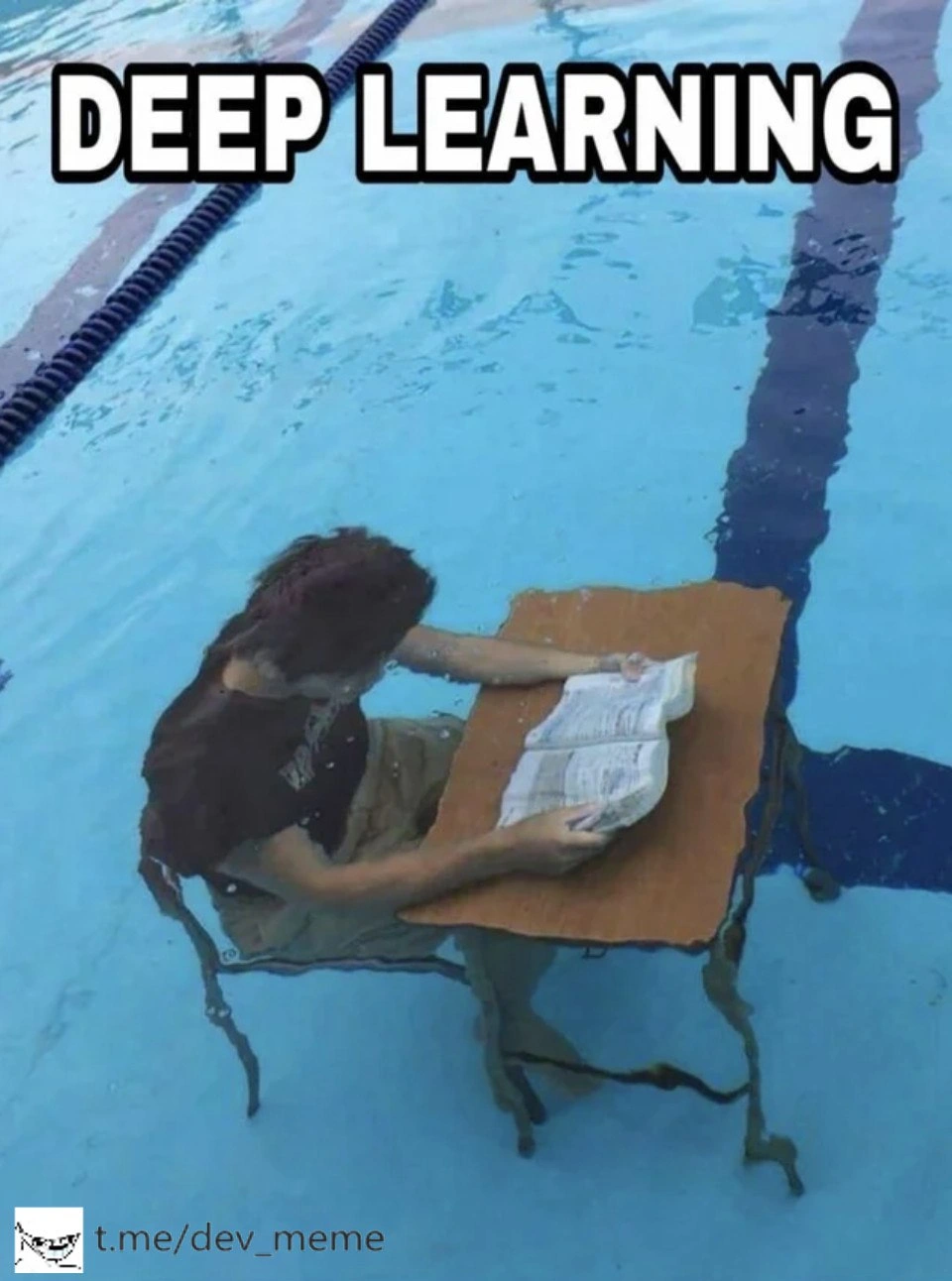
Imagine someone told you to “dive right into learning.” They meant you should start learning enthusiastically, but you took the words literally – and jumped into the deep end of a swimming pool with your school desk and book! 😄 That’s exactly the silly idea this picture shows. The big text says “DEEP LEARNING,” so a student decided, “Hmm, deep learning… I guess I should learn in deep water!” It’s funny because normally when we talk about learning something “deep,” we just mean learning something really hard or advanced, not actually going underwater. In the photo, the student is sitting under blue pool water, completely wet, trying to read a textbook. Of course, in real life you’d never study underwater – you can’t breathe down there and your poor book would get all soggy and ruined! But seeing someone do it in a joke image makes us laugh because it’s so absurd. It’s like a child misunderstanding a phrase and doing something crazy as a result. We find it funny and cute because we know the person is way overdoing it. They’re “immersing” themselves in learning to a ridiculous extreme (literally immersing, as in dunking into water). The core of the humor is a simple mix-up: the phrase “deep learning” was meant as a kind of learning in the field of AI, but the student acted out the other meaning of “deep” (deep underwater). It’s the surprise of that mix-up that makes the joke work. Even without any tech knowledge, anyone can giggle at the sight of someone studying at a desk under water – it’s a goofy, cartoonish scenario. So, basically, the meme is saying: this student took the advice to learn deeply a bit too literally and ended up all wet! It’s a playful reminder that words can have more than one meaning, and taking them the wrong way can lead to some pretty funny situations.
Level 2: Submerged in Study
The meme’s joke centers around the phrase “Deep Learning.” In the world of technology, Deep Learning is a popular term in Artificial Intelligence (AI) that refers to a kind of Machine Learning (ML) using multi-layered neural networks. In simple terms, machine learning is about teaching computers to make predictions or decisions based on data (for example, learning to recognize pictures of cats versus dogs by looking at many examples). Deep learning is a special approach where the computer model has many layers of simulated neurons stacked on top of each other (hence “deep”) to learn very complex patterns. When people say they are doing deep learning, they usually mean they are training these deep neural networks on lots of data – not that they are doing any learning at the bottom of the ocean! The word “deep” in this context describes the depth of the model’s architecture (i.e., how many layers of neurons it has). It’s a metaphor, implying a deep (thorough) understanding or a deep structure in the algorithm.
Now, the meme takes this term literally and that’s where the humor comes from. The image shows a student sitting at a little desk completely underwater in a swimming pool, reading a textbook. Above him, in big bold letters, it says “DEEP LEARNING.” At first glance, if you didn’t know the tech meaning, you might just see a goofy scene: someone studying underwater as if that’s a normal thing to do. But for those who know the term, it’s immediately clear that this is a pun — a play on words. It’s a literal_visual_pun: the meme makers heard “deep learning” and thought, “aha, what if someone learned in the deep end of a pool?” It’s funny because normally “deep” in deep learning has nothing to do with water or physical depth. The meme highlights that disconnect. Essentially, it’s showing a very literal interpretation of a phrase that, in everyday use, is figurative.
Let’s break down the scene like a junior developer encountering this joke:
- In reality, if you’re studying DeepLearning, you’ll be on a computer running code, studying math, or tuning algorithms. You do not need a diving mask or flippers. 😉 The student in the picture, however, is acting out the words “deep learning” as if someone meant “go learn in deep water.” He’s even brought a wooden desk and a book into the pool! Of course, books and water don’t mix – the pages of his textbook are soaked and illegible. That absurd detail just adds to the silliness.
- This is a form of AI humor because it relies on knowing an AI term and seeing it twisted in a funny way. It’s also developer humor because tech folks often encounter situations where terms sound like everyday words but mean something very specific in computing. Here the term happens to invite a funny mental image which they’ve made real.
- The tags like underwater_study_session and submerged_workspace describe exactly what we see: an actual study session happening underwater, a workspace (desk, chair, book) fully submerged. That’s obviously not something you see every day, and it immediately signals this is a joke scene, not a serious scenario.
For a newcomer or junior developer, let’s clarify the key concept: MachineLearning is a field where you teach machines by example rather than programming every rule. DeepLearning is a subset of that field that uses complex multi-layer networks (inspired by the brain’s neural networks) to learn really subtle or high-level patterns. It’s called “deep” because of those many layers of neurons, not because anyone goes deep underwater. The humor is that someone unfamiliar with the jargon might misinterpret it – much like if you heard the term “cloud computing” and imagined you needed to find a computer up in the clouds. (In reality, cloud computing just means using servers over the internet, nothing to do with the sky!). Similarly, learning_curve is another term we use to describe how much effort it takes to learn something new: a “steep learning curve” means it’s challenging at the start. For deep learning, many would say the learning curve feels quite steep; you need to grasp linear algebra, calculus, Python programming, and more. That overwhelming feeling is often described figuratively as “diving into” a subject or “immersing yourself” in study. This meme cheekily visualizes those phrases: the student is immersed, quite literally, in his studies under water!
In summary, the meme is a punny illustration. The top text “DEEP LEARNING” clues us into the wordplay, while the picture delivers the punchline: the student is doing a deep (water) learning session. It’s poking fun at how non-literal our tech language can be. Once you know the context, the deep_learning_wordplay is obvious and clever. We laugh because we know nobody would actually do this – it exaggerates both the difficulty of learning advanced AI (feels like you’re underwater sometimes) and the misinterpretation of the term (someone taking “deep” to mean “submerge yourself”). It’s a memorable visual metaphor for how overwhelming diving into a complex new topic can feel for a learner, all wrapped up in a goofy, literal gag. In essence: deep neural networks might fry your brain, but at least you can study them without holding your breath underwater!
Level 3: In Too Deep
Every seasoned developer or AI researcher chuckles at this meme because it captures a familiar feeling: being in over your head. The phrase “thrown in the deep end” is usually metaphorical, describing how it feels to tackle a complex task without much preparation – and learning deep learning often is a “deep end” experience! The meme takes that idea and runs (or swims) with it. Here we have a student literally sitting at a desk at the bottom of a pool. For anyone who’s slogged through dense machine learning textbooks and mind-bending research papers, the image hits home in a tongue-in-cheek way. We’ve all had moments studying AI when we felt like we were drowning in information – endless algorithms, perplexing equations, countless acronyms (CNN, RNN, GAN, LSTM, GPT… SOS!). Seeing a developer actually submerged visually represents that sensation of information overload. It’s an absurd exaggeration of the learning_curve for advanced AI, which can indeed be more of a vertical cliff than a gentle slope. Instead of a shallow introduction, many students find themselves plunged directly into deep neural networks, much like being dropped into the deep end of a pool and told to swim. The meme says, “Yup, this is what learning AI sometimes feels like” – equal parts HumorInTech and commiseration.
Tech folks also love this because it pokes fun at our field’s jargon. We constantly use metaphorical terms that sound bizarre if taken literally. We say “cloud computing” but we don’t actually put servers on fluffy clouds in the sky. We talk about “killing a process” but no actual murder occurs (thankfully!). And we throw around “deep learning” to mean multi-layer neural networks, not scuba-study sessions. Yet here, someone took the jargon at face value: Oh, deep learning? Better grab my desk and head underwater! 😂 It’s a classic case of nerdy wordplay. AIHumor often involves these inside jokes where a technical term is misunderstood on purpose. The seasoned programmer in us finds it hilarious because we’re so used to the abstract meaning that the literal image is delightfully ridiculous. It reminds us not to become too serious about our buzzwords. In a way, the meme is winking at all the hype around AI: sometimes diving into the latest DeepLearning framework (say TensorFlow or PyTorch) without enough preparation can make you feel like this kid underwater – struggling to hold your breath under a sea of new concepts.
There’s also a subtext about dedication and absurd lengths we go to master technology. Ever pull an all-nighter surrounded by documentation prints, empty coffee cups, and Stack Overflow tabs? This meme one-ups that: the student’s workspace is literally submerged. Talk about commitment! It’s as if he said, “I’ll study so hard, I don’t even need oxygen.” Seasoned devs recognize a bit of self-parody here. In the quest to become an AI expert, we’ve all had times we felt we might as well be sitting at the bottom of a pool, squinting at incomprehensible formulas. The meme exaggerates that dedication to a cartoonish extreme, and that’s why it elicits a knowing laugh. It’s developer humor 101: take a common experience (feeling underwater while learning something hard) and show it literally. The result is equal parts relatable and absurd. Experienced engineers nod and smile because they remember being that student figuratively – utterly immersed in a tough problem – and they’re grateful they didn’t actually need a wetsuit to get through it. In short, “Deep Learning” as pictured here is a perfect parody of our love for tech buzzwords and the sometimes sink-or-swim nature of mastering new skills in our field. Just be glad our real-world training doesn’t require waterproof textbooks!
Level 4: Gradient Descent into Depth
At the cutting edge of AI research, the term Deep Learning has a very specific meaning – and it’s not about diving underwater! In computer science, “deep” refers to the number of layers in a neural network. A neural network is an interconnected web of artificial “neurons” (mathematical functions) that transform input data through multiple stages. A shallow neural network might have only one hidden layer between input and output. A deep neural network, by contrast, stacks many hidden layers on top of each other – sometimes dozens or even hundreds. These layers allow the network to learn intricate, hierarchical representations of data. For example, in image recognition, early layers might detect simple edges, middle layers detect shapes, and deeper layers identify complex features like faces or objects. The deeper the network, the more abstract and high-level the learned features can become. This is why DeepLearning has powered breakthroughs in computer vision, natural language processing, and speech recognition – the depth lets the model capture remarkable complexity.
Training such a deep neural network is no trivial task. It typically involves backpropagation, an algorithm that adjusts the network’s weights by propagating errors backward from the output to each layer. During training, we use gradient descent (and its variants) to iteratively minimize a loss function – essentially, the network “learns” by gradually improving on its mistakes. However, as networks got deeper, researchers in the 1990s encountered the notorious vanishing gradient problem: the gradients (error signals) became extremely small by the time they reached the earliest layers, making it hard to update those weights. For a while, this limited neural networks to only a few layers (so “deep” learning wasn’t feasible yet). The resurgence of deep learning around 2012 was fueled by solutions to this problem – like new activation functions (ReLUs brought neurons that don’t saturate as easily), better weight initialization, layer normalization, and architectural innovations (e.g. skip connections in ResNets) that let information flow through many layers without vanishing. Combine those advances with exponentially faster hardware (GPUs and TPUs crunching massive matrix multiplications) and suddenly we could train networks 100+ layers deep. The term deep learning caught on to distinguish these multi-layered systems from older, shallower methods.
So why is this meme hilarious to an AI engineer? Because it yanks “deep learning” out of its abstract, math-heavy context and dunks it literally underwater. When we talk about a “deep” neural net, we’re counting layers in a model – not meters of water depth. But the meme imagines a scenario where a keen student, perhaps overwhelmed by the idea of mastering such complex material, decides the secret is to study at the bottom of a pool! It’s a tongue-in-cheek nod to how intense and all-absorbing learning advanced AI can feel. After all, deep learning specialists humorously say they are “drowning in data” or “immersed in research” – and here we have someone taking that immersion very seriously. In reality, mastering deep learning means grappling with linear algebra, calculus, and algorithms on dry land (often with lots of coffee, not scuba gear). The physical_depth_metaphor in this image plays on the word “deep” to juxtapose the depth of neural networks with the depth of a swimming pool. One is measured in layers, the other in feet of water – and our poor student seems to think the key to state-of-the-art AI is to bring his textbook into the deep end. It’s a classic literal_visual_pun that tickles anyone who knows how unrelated the two meanings of “deep” are. For a machine learning expert, the only “deep” thing in deep learning should be the network’s architecture – if you find yourself literally underwater while tuning hyperparameters, you’ve gone off the deep end (pun intended).
# Pseudocode: what "deep learning" actually looks like (no water required)
model = Sequential() # start a neural network model
for layer_index in range(5): # add 5 hidden layers (making it a "deep" network)
model.add(Dense(units=128, activation='relu'))
model.add(Dense(units=10, activation='softmax')) # output layer for 10 classes
# Normally, we'd now train the model with data using backpropagation:
model.compile(optimizer='adam', loss='categorical_crossentropy')
model.fit(training_data, training_labels, epochs=50)
# Each epoch, gradient descent tweaks the weights a bit.
# By the end, the network has "learned" from the data - all without anyone getting wet!
In the code above, we programmatically build a deep neural network with 5 hidden layers. Each layer (Dense(...)) adds complexity (128 neurons with ReLU activation in this case). Training it (model.fit) uses mathematical optimization – gradient descent nudges the network’s parameters a little closer to the right solution on each pass through the data. Notice there’s nothing water-related in the code – deep refers to the stack of layers. The humorous contrast is clear: actual deep learning involves code and matrices, whereas our meme’s student is literally submerged_workspace with his homework! The image screams “he’s taking deep learning to a whole new depth.” It’s a clever geeky joke: mixing a high-level computing concept with a ridiculously literal interpretation. Anyone who’s waded through neural network theory can appreciate the absurdity of thinking you need a snorkel to study MachineLearning. Ultimately, the meme gives an academic concept a goofy twist, and that incongruity is what makes it so entertaining to those in the know.
Description
A meme with a large, white, bold-font caption at the top that reads 'DEEP LEARNING'. The image below depicts a person fully submerged in the clear blue water of a swimming pool. The person is sitting at a wooden school desk and appears to be intently reading a book that is open on the desk. This is a visual pun that plays on the literal meaning of the words 'deep' and 'learning' versus its technical meaning in the field of artificial intelligence. For developers, especially those in or adjacent to the AI/ML space, the humor comes from the absurdly simple and literal visualization of a highly complex and abstract technological concept. It's a low-effort, high-impact joke that provides a moment of levity by grounding a major industry buzzword in a silly, physical reality

Comments
7Comment deleted
This is how it feels when you're 20 layers deep into a neural network and realize you forgot to normalize the input data
Architect told me the cure for vanishing gradients was more depth - now I’m three meters under and the paper still won’t reproduce
The cardboard raft is still more stable than our model's performance on production data after the training set had 90% ImageNet photos of cats
When the PM asks how deep your neural network architecture goes and you take it literally - turns out training at 10 feet underwater doesn't improve model accuracy, but it does give new meaning to 'drowning in hyperparameters' and 'backpropagation through fluid dynamics.'
Backpropagation in deep learning: swimming upstream against vanishing gradients
You can tell it’s deep learning - the gradients vanish, the labels get waterlogged, and Ops insists everything be stored as floats
OKR said “go deeper on AI,” so I set depth=128 and moved my desk to the deep end - great for vanishing gradients, catastrophic for documentation