Skip to content
DevMeme
1628 of 7435
The Ultimate Social Distancing Technique for Engineers
Compilers Post #1821, on Jul 31, 2020 in TG

The Ultimate Social Distancing Technique for Engineers

Why is this Compilers meme funny?

Level 1: How to Clear a Room

Imagine you and your friends are chatting about something fun, like a popular movie or a game, and then one friend suddenly starts talking about very complicated stuff – say they begin explaining the intricate rules of quantum physics or the detailed history of some obscure invention. What do you think happens? Everyone else might get confused or bored, and they slowly wander off to do something else. This meme is exactly about that kind of situation, but in the world of programmers. “Compilers and programming language design” are super complicated, brainy topics in computer science – kind of like rocket science for coding. Most people don’t find those fun to talk about in casual conversation. So, the joke here is that mentioning those topics is like a magic spell to make everyone disappear, just like how during COVID people would quickly step away to keep safe if someone was coughing. It’s saying: if you ever want some instant space and quiet, just start talking about really nerdy computer theories, and poof – you’ll have the whole room to yourself!

Level 2: Compilers vs. Conversation

So let’s break down the joke in simpler terms. Compilers are programs that translate code from a programming language (like C++ or Java) into another form, usually machine code that the computer can run. Programming language design is the field of deciding how a programming language works – its rules, its features, how it looks (syntax), and how it behaves (semantics). These topics are pretty specialized in computer science. A lot of developers don’t deal with them directly in their daily jobs; they might use languages, but never worry about how to create a language or build a compiler from scratch. That makes “compiler talk” kind of a niche, nerdy interest – the sort of deep-in-the-weeds technical subject that can make many eyes glaze over if they’re not equally passionate about it.

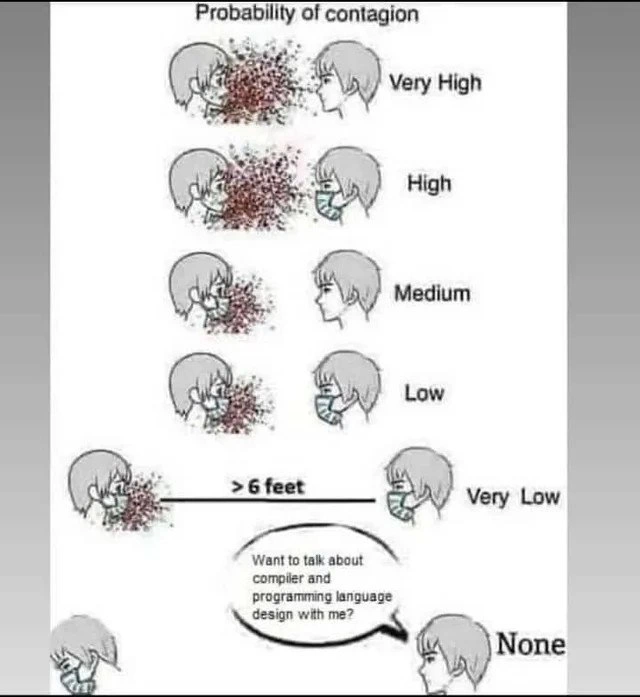
Now, the meme uses an image format that was popular during COVID-19: a safety chart about the “Probability of contagion.” In the first panels, it shows two characters facing each other. The left character is unmasked and coughing red particles (representing germs) toward the right character. In each subsequent panel, the right character adds more protection – first no mask vs. no mask (“Very High” contagion risk), then one mask, then more distance, and so on – with labels like “High,” “Medium,” “Low,” and finally “> 6 feet – Very Low.” This mirrored the public health illustrations explaining that wearing masks and keeping distance reduces the chance of spreading COVID. People in 2020 immediately recognize this format.

The meme’s twist comes in the last row. Instead of showing even more distance or protection, the left character simply says:

“Want to talk about compiler and programming language design with me?”

That’s it – just asking that question. And the right-hand character isn’t even there anymore! The label for this final scenario is “None,” implying the probability of contagion is zero because the other person has completely vanished. It humorously suggests that if you bring up programming_language_design theories or compiler internals in conversation, everyone else will socially distance themselves right out of the room. No mask needed – the topic itself is like a repellent. This is a play on the idea that such advanced or nerdy topics can be unintentionally exclusionary. It’s not that compilers aren’t important (in fact, they’re critical – every program you run has been through a compiler or interpreter), but not many people find them fun to chat about casually. Talking in depth about how a compiler optimizes code or how a type system was designed can feel as out-of-place as discussing quantum physics formulas at a dinner party.

In developer terms, this meme highlights a communication gap: one person’s tech passion can be another person’s boredom or confusion. It falls under developer humor because many coders have seen this scenario – the “too technical, didn’t ask” moment. We label it NerdHumor when the joke requires some technical knowledge (here, knowing that compilers are a complex topic). The tag LanguageComparison is also relevant: often, if you mention language design, people think you’re about to start a heavy discussion comparing programming languages (which can lead to long debates or “holy wars” that many prefer to avoid). All these cues tell a junior developer or an observer, “Hey, this meme is saying that bringing up ultra-nerdy stuff like compiler construction will effectively end your conversation, as surely as high voltage clears an area.” It’s a lighthearted warning: choose your topics wisely unless you want some alone time!

Level 3: Guaranteed Isolation

This meme is a witty snapshot of a well-known communication gap in developer culture: some topics are such powerful conversation repellents that they guarantee instant social distancing. It humorously labels compilers and programming language design as a prime example of a conversation_killer_topic. In practice, this scenario is all too familiar in the software world. Imagine a team stand-up or a casual Zoom chat among developers: one enthusiastic engineer starts gushing, “I’ve been reading about optimizing an LLVM backend and the nuances of type inference algorithms in language X…” – and suddenly you notice everyone else either goes silent, starts inching away (virtually or physically), or quickly changes the subject to the latest UI framework. The meme repurposes a COVID-19 social_distancing_meme infographic (masks, distance, and all) to visualize this effect. In the first five panels, it mimics the guidance on reducing virus spread – masks and >6 feet distance progressively lower the “probability of contagion.” This is an analogy: the “contagion” is a topic spreading in a conversation. Then comes the punchline panel: one character says, “Want to talk about compiler and programming language design with me?” and the other character disappears entirely. The risk of contagion is labeled “None.” In other words, the topic is so niche or intimidating that no one sticks around long enough to catch it. It’s a slice of DeveloperHumor and NerdHumor that rings true for many in tech — bring up something like writing a compiler, designing a new language, or the theory behind it, and you’ll achieve guaranteed isolation.

Why is this so funny (and a bit painful)? Because it satirizes a real divide in the developer community. Most developers use programming languages every day, but only a small subset deal with the compilers that implement those languages or the theory that could create new ones. Talking about CompilerDesign intricacies can make even very skilled engineers uncomfortable or bored, especially if their day-to-day work is far removed from low-level language internals. A senior developer will chuckle knowingly because they’ve either been that excited compiler nerd who cleared the room, or they’ve been on the other side feeling like the topic flew over their head. There’s an industry truth here: many programmers have traumatic memories of a tough compilers class in college or endless debates about language comparison (C++ template meta-programming vs. a Haskell typeclass, anyone?). When someone dives into such theoretical territory without warning, it’s like dropping a social repellent bomb – coworkers suddenly recall “urgent meetings” elsewhere. The meme also nods to the 2020 context: back then, everyone was acutely aware of contagion and distancing. By using the familiar format of a pandemic safety chart, it cleverly implies that talking about compilers is the conversational equivalent of bathing in hand sanitizer – absolutely no conversational “germs” will survive. In essence, the image says: if you’re tired of people crowding you (in person or in chat), just start a monologue on compilers and watch the instant social distancing take effect. It’s a playful jab at how specialized knowledge in tech can isolatingly set one apart, turning a would-be dialogue into a one-person lecture. For those of us in software, it’s a reminder of the unwritten rule that some nerd humor subjects, like hardcore language theory, are best saved for the right audience – lest you achieve total conversation lockdown.

Level 4: Context-Free Conversation

At the highest technical tier, this meme riffs on the deep theory behind programming language design and compiler construction. Mentioning these topics is like pulling out a textbook on formal grammars and type theory in a casual chat – it’s a conversation formulated in a language only a compiler could love. Under the hood, every programming language is defined by a set of formal rules (often a BNF or EBNF grammar) that specify its syntax. A compiler uses these rules to parse code, building structures like an Abstract Syntax Tree (AST) from your source. For example, a simple arithmetic grammar might look like:

<expr> ::= <expr> "+" <term> | <term>
<term> ::= <number> | <identifier>

This defines how expressions can be constructed – it’s the kind of CompilerDesign detail that would make most developers’ eyes glaze over. In language design theory, you also wade into concepts like context-free grammars (the basis for many programming languages), lexical analysis (tokenizing source code), and automata theory (think state machines that parse text). You might even bring up the lambda calculus or category theory when discussing type systems or functional language semantics. These are beautiful, abstract foundations of computing – the mathematical DNA of languages – but they’re notoriously esoteric. Outside of a niche programming_language_design community, terms like LALR parser, monomorphization, or dependent type aren’t exactly water-cooler talk. The meme exaggerates this academic aura: mentioning compilers or PL theory has a contagion rate of zero in normal social settings. It’s humor for the uber-nerds – those who know that diving into the theory of compilers can feel like stepping into an intellectual quarantine zone. Ironically, what’s intellectually contagious to a PL theorist (they nerd out excitedly over abstract semantics) is socially distancing to others. This covid_infographic_parody visually equates heavy CS theory with an instant “vaccine” against further conversation: the theories are so formally complex, they immunize everyone else from participating. The punchline builds on the idea that the mere mention of context-free grammar or compiler optimizations in a group of developers will parse the crowd into two tokens – you, and no one else. Essentially, the meme encodes a truth in geek folklore: talking about the intricacies of compilers is a surefire way to execute a socialDisconnect(); in any casual dev conversation.

Description

An infographic-style meme titled 'Probability of contagion'. It's a vertical series of six illustrations depicting two anime-style characters. The first five panels show a person coughing particles at another, with the probability of contagion decreasing based on the use of face masks and distance, rated from 'Very High' to 'Very Low'. The scenarios include no masks, one person masked, both masked, and both masked at over 6 feet apart. The final panel is the punchline: the character on the right asks the one on the left, 'Want to talk about compiler and programming language design with me?' from a safe distance. The probability of contagion in this scenario is labeled 'None'. The humor comes from the self-deprecating stereotype that deep, esoteric computer science topics like compiler design are so intensely niche and uninteresting to the average person that they act as a perfect repellent, thus being the ultimate form of social distancing. It’s a joke that resonates with senior engineers who appreciate the complexity of these topics while also recognizing their power to end a casual conversation instantly
Comments

7
Anonymous ★ Top Pick My preferred method of social distancing is bringing up my 'hot takes' on memory management in Rust. It works better than a six-foot pole
  1. Anonymous ★ Top Pick

    My preferred method of social distancing is bringing up my 'hot takes' on memory management in Rust. It works better than a six-foot pole

  2. Anonymous

    My foolproof pandemic protocol: announce you’re rewriting the company DSL compiler in continuation-passing style and need reviewers - watch the R₀ drop to zero before your mic unmutes

  3. Anonymous

    The only thing more effective at maintaining social distance than a pandemic is mentioning you're implementing a new type system with dependent types and effect handlers in your hobby language that compiles to LLVM IR

  4. Anonymous

    The chart scientifically proves what we've known all along: the most effective social distancing mechanism isn't masks or physical separation - it's mentioning you want to discuss Hindley-Milner type inference or LLVM optimization passes. Works better than any N95, and the isolation radius extends well beyond 6 feet. Bonus points if you bring up monads or effect systems - that'll clear a room faster than a production outage on Friday at 4:59 PM

  5. Anonymous

    Need guaranteed isolation? Start discussing substructural type systems and SSA form - your social graph hits strong consistency instantly

  6. Anonymous

    Language design chats: the only topic achieving perfect isolation via CAP theorem - choose consistency or availability, but never both attendees

  7. Anonymous

    Best social distancing: ask whether your new DSL should use linear types and CPS for async or an effect system - the R0 drops to Option.None

Use J and K for navigation