Skip to content
DevMeme
3385 of 7435
Bug Report: Code Quality Exceeds Industry Standards
CodeQuality Post #3718, on Sep 18, 2021 in TG

Bug Report: Code Quality Exceeds Industry Standards

Why is this CodeQuality meme funny?

Level 1: Lowering the Bar

Imagine you got an A+ on a test, and then your teacher says, “Whoa, that score is too high. Next time, please make some mistakes so your grade drops to a B, you know, to match the class average.” Sounds ridiculous, right? You’d probably laugh or be super confused – normally doing well is good, so why would anyone ask you to do worse on purpose?

That’s exactly the kind of silly scenario this meme is joking about, but in the world of coding. It’s like a friend spent hours cleaning their room until it was spotless, and their parent walks in and says, “Hmm, this is too clean. Can you mess it up a bit so it looks more like a typical teenager’s room?” 😆 The humor comes from this opposite day request. We expect people to want higher quality (better grades, cleaner rooms, better code). Being told to lower the quality is so backward that it’s funny.

In the picture (meme), a developer is essentially being told, “Your code is too good. Please make it a little worse to meet the normal standard.” The emotional core here is a mix of surprise and shared frustration – developers often try their best, and it’s comically tragic to imagine being asked to do a bad job intentionally. It’s funny because it’s absurd. It flips the normal script: instead of “please improve this,” it’s “please un-improve this.”

Anyone can laugh at the sheer nonsense of that. It highlights a feeling many of us get when our hard work isn’t appreciated: “Do you actually want me to do a crummy job?!” By turning that feeling into a literal joke, the meme makes us smile. In simple terms, it’s saying: some places are so used to average-quality work that excellent work seems out of place. That idea is exaggerated to the point of asking for worse work, which is a pretty silly request – and that silliness is why it’s funny. So even without any coding knowledge, you can appreciate the joke: it’s like being told to lower the bar when you’ve raised it, a request so goofy that you can’t help but laugh.

Level 2: When Code Is Too Good

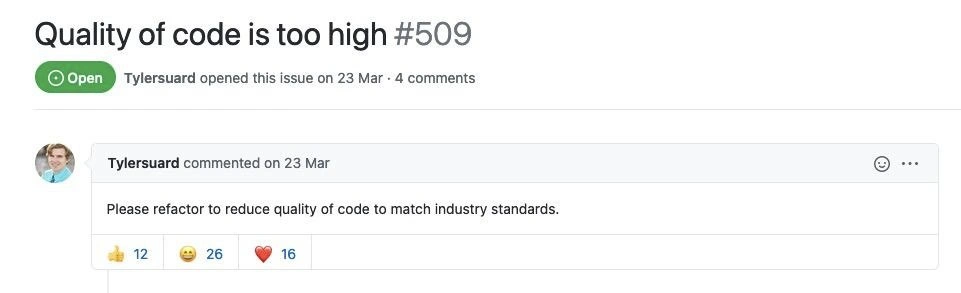
Let’s break this down for a newer developer or someone just getting into coding. The meme looks like a screenshot of a GitHub issue page. GitHub is a popular platform where developers store code and track problems or feature requests. An “issue” is basically a ticket or discussion thread about something that needs attention in the project – often a bug, an improvement suggestion, or a task. Issues usually have a title and a number (here #509) and show who opened it and when. In this screenshot, the title says “Quality of code is too high”, which immediately sounds odd. Usually you’d expect something like “Quality of code is too low” or “Code has bugs” – because those are problems. Claiming the code’s quality is “too high” is a funny, upside-down twist. It reads as if high quality is a bad thing that needs fixing. 😂

Below the title, we see a comment by the user (Tylersuard) who opened the issue. They say: “Please refactor to reduce quality of code to match industry standards.” Now, let’s clarify some terms here for those new to this:

  • Code Quality: This refers to how good the code is in terms of readability, maintainability, and correctness. High-quality code is usually easy to understand, well-organized, has fewer bugs, and follows best practices. Low-quality code might work, but it’s messy, hard to follow, and likely to break or confuse people later. Think of code quality like the craftsmanship of a product – a well-crafted chair versus one that’s rickety and full of splinters. Good code = sturdy, reliable, and pleasant to use; bad code = wobbly and full of “splinters” (bugs and confusion).
  • Refactor: To refactor code means to restructure the existing code without changing what it does (its external behavior). Developers refactor to improve code quality – for example, simplifying a complex function, renaming variables to meaningful names, or splitting one long file into multiple logical modules. The key is that after refactoring, the program’s output or functionality should remain the same, but the internals are cleaner. A classic book on this is Martin Fowler’s “Refactoring”, which is all about code transformations that make code better-organized and easier to maintain.
  • Industry Standards: In theory, this term means the common agreed-upon best practices and quality levels that professionals in the software industry strive for. For instance, using version control (like git), writing tests for your code, following style guidelines, etc., are considered industry-standard practices. However, in this joke, “industry standards” is used sarcastically. Instead of meaning “top-notch quality,” it’s implying the average real-world standard, which can actually be mediocre. In other words, what’s normal out there in many codebases isn’t always pretty. The joke suggests that really high quality code might be above what people usually see in industry, so someone is jokingly asking to lower it down to the typical level.

Now, why is this funny? Because normally if your code quality is high, that’s great – you’d be praised, not asked to change it. Here it’s the opposite: “Your code is too good, please make it worse.” 😜 It’s pure TechSatire. Developers often encounter situations where, due to time pressure or legacy habits, they can’t keep the code as clean as they want. Maybe you’ve heard of “tech debt” – that’s when you take shortcuts in code (lower quality) to meet a deadline or quick fix, and you plan to fix it later (though sometimes “later” never comes). This meme exaggerates that dynamic. It’s basically saying: We’ve gotten so used to cutting corners that high quality feels out of place!

To make this more concrete, let’s imagine what “reducing code quality” looks like in practice. Here’s a simple before-and-after example in code form:

# high_quality.py - Before "reducing quality"
def calculate_sum(numbers):
    """Return the sum of a list of numbers. If input is invalid, raise an error."""
    if not isinstance(numbers, list):
        raise TypeError("Input must be a list of numbers")
    total = 0
    for number in numbers:
        total += number  # accumulate sum
    return total

# low_quality.py - After "reducing quality"
def calcSum(nums):
    tot=0
    for x in nums: tot+=x
    return tot

In the first part (high_quality.py), we have a function calculate_sum that’s high quality:

  • It has a docstring (the triple-quoted text) explaining what the function does and how it behaves.
  • It checks the type of the input (isinstance(numbers, list)) and raises a clear error if something is wrong. That’s defensive programming to prevent misuse.
  • It uses a clear variable name total and accumulates the sum in a straightforward loop, one line at a time for clarity.
  • It’s easy to read and understand what’s happening.

In the second part (low_quality.py), we “reduced the quality”:

  • The function name calcSum and parameter nums are shorter and less descriptive (not terrible, but not as clear as before). We lost the docstring entirely – no explanation of what it expects or does.
  • We removed the type check and error handling. If you pass something that isn’t a list, this code will just blow up or behave unexpectedly. Even if nums is a list, if it contains something that isn’t a number, you’ll get a runtime error. The robust safeguard is gone.
  • We also condensed the loop into one line: for x in nums: tot+=x. Technically Python allows this, but it’s considered poor style to put loop logic on the same line – it’s harder to read, especially for beginners. There’s no comment explaining the tot+=x, and the variable name x is not descriptive.
  • Basically, the second version works for the happy-path (a list of numbers), but it’s less readable and less safe. It’s “just good enough” code.

By comparing these, you can see what we mean by higher vs. lower code quality. The first one adheres to best practices (clear naming, documentation, error checking), which every coding course or style guide encourages. The second one might be something you’d slap together quickly and not be proud of, but it runs.

Now, imagine a code reviewer or project manager looking at a codebase that is largely like the second version (minimalistic, not many checks, just does the job) and then encountering a module or function written like the first version (very thorough and clean). In a healthy environment, they’d say, “Wow, let’s make the rest of the code more like this!” But in a cynical interpretation of “industry standards”, they might instead say, “We don’t usually do all that, it’s overkill – just make it like the rest.” That’s the scenario this meme is joking about. It’s like an only-half-joking complaint that in the real world, your idealism sometimes gets squashed.

CodeReview context: In a normal code review, peer developers or leads comment on your code changes to suggest improvements. Often that includes raising code quality: e.g., “Hey, can you refactor this? It’s a bit hard to follow,” or “Add some tests/documentation to improve quality.” Receiving a comment to reduce quality is unheard of – it’s purely satirical. But it pokes fun at the kind of backward feedback you might feel you’re getting when your good practices aren’t appreciated. For instance, a junior dev might meticulously format and document their code, only for a hurried team to say, “You didn’t need to do all that.” The junior dev thinks, So... you want it worse? 😕 That’s why this resonates. It’s exaggerating a real frustration to comic extremes.

Think about CorporateCulture: Many industries have something called “industry standard practice,” and usually that’s positive – a quality bar everyone is expected to reach. But here it’s implying the industry standard is actually low. It’s a bit like saying the average passing grade is a C, so if you come in with an A+, you’re an outlier. A new developer might be surprised to learn that not all software projects are shining examples of clean architecture; plenty are held together by duct tape and last-minute fixes. When you enter a large legacy codebase, you might be shocked at how rough some code is, despite the company calling it “standard.” This meme is basically taking that shock and turning it into a joke issue: “Our project’s code quality is unexpectedly high in this spot, please uglify it for consistency.” It’s sarcasm aimed at the status quo.

Also, notice the little green label that says Open on the issue. On GitHub, that just means the issue is not closed yet (still “active”). It’s humorously implying that this “problem” (too-good code) is awaiting resolution. And the comment has reaction emojis with surprisingly high numbers. That means other GitHub users (or coworkers) reacted with a thumbs-up, a laugh, or a heart. For a single silly issue, seeing a dozen 👍 and many 😂 and ❤️ means a lot of people found it funny and agreed with the sentiment. It’s like a mini Reddit thread happening on a fake issue. That detail adds realism (as if it’s a real scenario others are chiming in on) and also shows the widespread relatability. The DeveloperHumor community often upvotes or reacts to things that “feel so true.” Here, those reactions are meta: even in the fake screenshot, it’s like the whole team is in on the joke, saying “haha, so true, we’ve seen this”.

In summary, for a junior developer: this meme is mocking the absurd idea of being asked to lower your standards. It teaches an underlying lesson about real-life coding: while we strive for high quality, the average code out there often isn’t perfect due to constraints and old habits. The humor comes from that contrast – expecting a pat on the back for good code, but getting a tongue-in-cheek request to make it worse. It’s a form of TechSatire that also lets developers vent a bit about the sometimes frustrating realities of software development. Don’t worry – in a good workplace, nobody will literally tell you to write bad code. This is more of a cathartic joke: laughing at the idea so we don’t cry about the mediocre code we sometimes have to deal with. 😀

Level 3: Deliberate Technical Debt

In a classic display of developer irony, this meme presents a GitHub issue titled “Quality of code is too high” – essentially treating excellent code as if it’s a bug to be fixed. The issue opener deadpans: “Please refactor to reduce quality of code to match industry standards.” 🤦‍♂️ This absurd request hits experienced engineers right in the feels, because it flips our expectations: normally we refactor code to improve quality, not to sabotage it. Here we have an open ticket (#509, for comedic authenticity) demanding a reverse refactor, as if high code quality is a critical problem. It’s a cheeky satire of corporate CodeReviewPainPoints and the sad reality that “industry standard” quality is often... well, not that great. The humor lands because every senior dev knows the painful truth: sometimes the real unwritten requirement is to keep code consistently mediocre so it doesn’t rock the boat.

Let’s unpack the layers. First, the phrasing itself is gold: “reduce quality of code to match industry standards.” This implies that current code quality is above average – so high that it’s making the rest of the industry look bad! It’s a sarcastic jab at CorporateCulture where doing just the bare minimum can become the norm. Seasoned engineers have witnessed this paradox: a teammate or manager might call well-written, well-tested code “over-engineered” or “too complicated for our needs.” In other words, Clean Code and best practices sometimes get weirdly discouraged under the guise of pragmatism. The meme exaggerates this to hilarious effect by framing it as an official GitHub issue. The normally serious UI (title, issue number, Open status, comments) is played totally straight, which makes the ridiculous content even funnier. It reads like some jaded tech lead’s dark joke: “Hey, could you dumb down this module? It’s making our legacy codebase look bad. Thanks.” 😈

Why would anyone ever ask to lower code quality?
As a cynical veteran might say: Welcome to the real world, kid. There are times when writing beautifully clean, well-structured code actually draws criticism. Maybe it doesn’t conform to the rest of a messy project and raises uncomfortable questions. Maybe it took a bit longer to craft, and management only cares about this week’s deadline. Or maybe maintaining ultra-high quality isn’t “the way we do things here.” This meme strikes a chord because it mocks that defeatist attitude. It’s a satirical industry_standards_critique: the so-called “standards” out there can be depressingly low, to the point where exceptional quality might be viewed as an outlier that needs correction. It’s the tall poppy syndrome of software: if one piece of code is too good, it might shame all the shabby code around it, so chop it down! 🌱✂️

Refactor usually means improving code structure without changing behavior – think simplifying logic, renaming variables for clarity, eliminating duplication, adding tests, etc. Here it’s used with cruel irony: “refactor” this code to reduce its quality. It’s like telling a chef to re-cook a gourmet meal into fast-food mush because gourmet isn’t our “standard.” For a senior dev, the joke cuts deep. We often talk about TechnicalDebt – the accumulated burden of quick-and-dirty code that will eventually need fixing. In this issue, they’re literally asking for technical debt to be added intentionally! 😅 If we were to take it at face value, how would one “reduce code quality”? Probably by introducing all the code smells and anti-patterns we normally avoid. For example:

  • Kill the tests: Delete or ignore unit tests and any form of QA. If it runs, it’s “good enough”. Who needs a safety net, right?
  • Obfuscate logic: Replace clear, modular design with a monolithic spaghetti function. Maybe throw in some deeply nested loops and a dash of global state for good measure.
  • Terrible naming: Change descriptive variable names to x, data, or temp123. Better yet, reuse the same variable for multiple purposes. Clarity is overrated!
  • Duplicate and triplicate: Copy-paste blocks of code instead of refactoring them properly. DRY (Don’t Repeat Yourself) becomes WET – “Write Everything Twice.”
  • Drop documentation: Remove comments and docs because “self-documenting code” (sarcasm) will magically explain itself. Future maintainers love deciphering mystery codebases!

In short, do everything that gives linters, code reviewers, and CodeQuality tools nightmares. 😈 These are the “industry standard” bad habits that the meme jokingly suggests we should aspire to. Realistically, no one would open a ticket explicitly asking for this (if they did, it’s time to update your résumé), but it captures the CodeReviewPainPoints many of us have felt. How many times has a developer poured their heart into cleaning up a gnarly system, only to be told by a deadline-driven manager, “This is great, but we don’t have time for perfect – just ship it.” Over time, that attitude institutionalizes mediocrity. The meme calls it out with razor wit: our code quality is too high; let’s dumb it down to the accepted norm. Ouch.

Notice those emoji reactions below the issue comment: 👍 12, 😀 26, ❤️ 16. That’s a lot of GitHub users essentially saying “Amen” and laughing along. Those are fellow devs who have likely experienced this exact irony. The 👍 and ❤️ show agreement and love for the joke, and the 😄 indicates it’s making people literally laugh. It’s a small UI detail, but it confirms this satire hit a nerve in the community. Seeing others react with “haha so true!” is a reminder that this isn’t an isolated sentiment – the struggle between ideal code quality and real-world “standards” is a common developer headache.

Lastly, consider the broader TechSatire in play. The issue format itself is a parody of how we track real problems. By labeling “too high quality” as an open bug, it humorously implies that in some dysfunctional environment, good code is treated as a defect. It’s like a mirror held up to the software industry’s bad habits, and it’s not a flattering reflection. Senior folks chuckle because they’ve been there – they’ve seen offices where CorporateCulture values quick hacks over maintainable solutions, or where industry standards are cited as an excuse to not innovate or improve. This meme compresses all that frustration into one screenshot of a fake issue. It’s funny, it’s a bit sad, and it’s highly relatable. In the end, the message is clear: sometimes our DeveloperHumor is the only way to cope with the absurdity of lowering the bar just to meet the “standard.”

Description

A screenshot of a satirical GitHub issue, perfectly capturing a cynical take on software development culture. The issue, #509, is titled 'Quality of code is too high' and is marked as 'Open'. The user 'Tylersuard' opened the issue and left a comment that reads, 'Please refactor to reduce quality of code to match industry standards.' The comment has received numerous positive reactions, including thumbs up, smiles, and hearts. The humor is deeply resonant for senior engineers who have often faced pressure to prioritize speed over quality, leading to the accumulation of technical debt. The joke implies that 'industry standard' is often synonymous with mediocre or poor code, making this a painfully relatable piece of commentary on corporate development practices
Comments

11
Anonymous ★ Top Pick Received a similar ticket once. Closed as 'Won't Fix,' explaining that the author's 10x productivity was tragically inflating the team's average code quality and setting unrealistic expectations for management
  1. Anonymous ★ Top Pick

    Received a similar ticket once. Closed as 'Won't Fix,' explaining that the author's 10x productivity was tragically inflating the team's average code quality and setting unrealistic expectations for management

  2. Anonymous

    Issue #509 translation: finance can’t depreciate craftsmanship, so we need to inject enough Singleton-God-Objects and magic strings to hit our quarterly technical-debt quota

  3. Anonymous

    After 20 years in enterprise software, I've learned that code quality is inversely proportional to the number of architects involved - this issue finally acknowledges that our pristine, well-tested codebase is making the offshore maintenance team uncomfortable and the consultants unemployed

  4. Anonymous

    Ah yes, the classic 'our code is too maintainable' problem. Every senior engineer knows that truly enterprise-grade code should require at least three archaeology expeditions, two Rosetta Stones, and a blood sacrifice to understand. This developer is clearly trying to future-proof their job security by ensuring the codebase becomes sufficiently 'industry standard' - you know, the kind where every function does seventeen things, variable names are single letters, and the only documentation is a comment from 2009 saying 'TODO: fix this later.' Bonus points if they can work in some nested ternaries and a few God objects. After all, if the code is too clean, how will we justify those 'emergency refactoring sprints' and consulting fees?

  5. Anonymous

    Enterprise compliance update: please refactor the clean code into a service-locator singleton with shared mutable state until SonarQube drops us from A to “industry standard.”

  6. Anonymous

    Enterprise gold: when pristine code gets an issue to corrode into 'maintainable' sprawl faster than a legacy monolith

  7. Anonymous

    New policy: if Sonar reports fewer than 500 code smells, refactor to reintroduce inheritance diamonds and static singletons - can’t risk exceeding the industry’s mediocrity SLO

  8. @TERASKULL 4y

    It's on the industry standard fizz buzz repo btw

  9. @deerspangle 4y

    Link for the curious: https://github.com/EnterpriseQualityCoding/FizzBuzzEnterpriseEdition/issues/509

  10. @igordata 4y

    Was already posted a few months ago

    1. @yoyatayo 3y

      I havent seen that

Use J and K for navigation