The sophisticated way to do nothing in assembly
Why is this LowLevelProgramming meme funny?
Level 1: Doing Nothing with Style
Imagine you have two people who both decide to do nothing for a moment. The first person simply sits there quietly and waits – plain and simple. The second person, however, decides to make a little show of it: they stand up and immediately sit back down in the exact same spot, accomplishing nothing different than if they’d just stayed seated. It’s a bit silly, right? They ended up in the same place doing nothing, but with extra flourish.
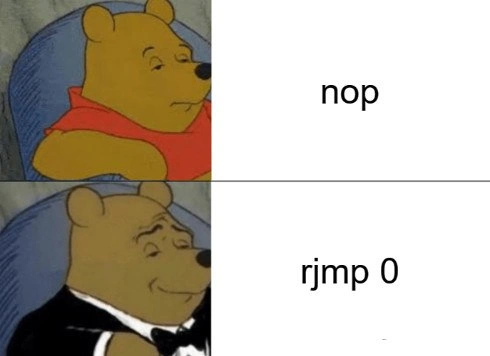
That’s exactly the joke here. The meme uses Winnie-the-Pooh to represent those two people. In the top part, Pooh is casually sitting (doing nothing). In the bottom, Pooh is in a fancy tuxedo, looking proud of himself after basically doing nothing in a fancy way. In tech terms, “nop” is the simple sitting still, and “rjmp 0” is the stand-up-and-sit-down trick. Both result in nothing changing, but one is just trying to look more impressive while not actually doing more. That contrast is why it’s funny – it’s poking fun at people (or in this case, programmers) who take something very simple and do it in an unnecessarily complicated or pretentious way, just to feel a bit superior or stylish. Even though the end result is the same (nothing happened!), the attitude makes all the difference.
Level 2: Doing Nothing, Differently
Let’s break down the joke in simpler terms. In assembly (a low-level programming language that talks almost directly to the CPU), there’s a command called nop, which stands for No Operation. Literally, when the processor sees a nop, it just wastes a tiny slice of time and moves on to the next instruction without changing anything. Think of nop as the CPU saying, “I’ll just sit here idle for one step.” Developers use nop instructions in embedded systems often to create very short delays or to align timing – since each nop might take, say, one clock cycle, a few of them in a row can pause the processor briefly.
Now, rjmp 0 is another assembly instruction. RJMP stands for Relative Jump. It tells the CPU to jump a certain number of steps (addresses) away from where it currently is. The number after it is how far to jump. So rjmp 5 would skip ahead 5 steps (or go back if the number is negative). If we put 0 as the number, rjmp 0 means “jump 0 steps away” – essentially, don’t go anywhere new. The CPU will execute the jump instruction, then end up… right at the next instruction (exactly where it would have been if it hadn’t jumped at all). In effect, rjmp 0 doesn’t change the flow of the program – it’s another way to do nothing useful! It’s like a very roundabout no-op.
Why would anyone do that? In normal situations, they wouldn’t – they’d just use nop. But this meme jokes that assembly fans (people who love low-level programming) find the rjmp 0 trick classy or fancy. It’s humorously implying that an assembly nerd might say, “Ah, yes, a plain nop works, but I prefer the refined approach of a relative jump to nowhere.” It’s akin to a tech insider joke. If you’re new to this, imagine someone learning a secret handshake versus a normal hello – functionally the hello and the secret handshake both greet someone, but the secret handshake is more elaborate just for the sake of it. That’s rjmp 0 compared to nop.
To see the difference in actual code, here’s what these instructions might look like in an assembly program (using a generic assembly syntax for an AVR microcontroller):
nop ; No Operation: do nothing and move to the next line
rjmp 0 ; Relative Jump by 0: jump to the next line (does nothing new)
; (Next instruction would execute after both of these.)
You can read the comments after each ; to understand what’s happening. Both lines above essentially have the same end result: the next instruction (whatever comes after these) will execute, with no other effect on the system state. The only difference is how we achieved that no-effect. The first one is explicitly a “do nothing” command. The second one is a “jump” command, but because we told it to jump zero steps, it ends up being a fancy way of doing nothing.
This relates to low-level programming and embedded systems because in those fields, you often care about exact CPU instructions. Assembly language is full of little mnemonic codes like these (nop, rjmp, etc.). The meme tags like AssemblyLanguage and LowLevelProgramming signal that the joke lives in that realm of nerdy detail. If you’ve written or studied any assembly (say, x86 assembly for PCs or AVR assembly for microcontrollers), you learn what a no-op is. In x86 (the language for PCs), the NOP instruction is commonly used and does the same kind of thing – it’s even used to pad timing or memory alignment. There isn’t an exact rjmp 0 in x86, but you could mimic it with a jump instruction that goes to the next byte (though that would be a weird thing to do). On an AVR microcontroller (the kind often used in Arduino projects), RJMP is a normal instruction for jumping around in the program. So an AVR assembly enthusiast would chuckle seeing rjmp 0 because they recognize it as a valid command that effectively ends up being a no-op. It’s an instruction set humor — making a joke out of the CPU’s vocabulary.
For a junior developer or someone without assembly background, the key point is: both “nop” and “rjmp 0” mean the CPU isn’t doing any new work at that moment. The meme just presents one in a normal way and the other in a “fancy” way. The Winnie-the-Pooh image helps convey that: the casual Pooh is fine with a basic no-op, and the tuxedo Pooh smugly prefers the clever workaround. It’s a playful way to highlight that in programming, especially low-level, there are often many ways to accomplish the same thing – and nerds love the more convoluted option if it makes them feel like an expert. It doesn’t mean rjmp 0 is actually better; it’s just funnier. In real code, using a jump-to-self where a no-op would do might confuse people, so it’s generally not done without reason. But as a joke, it perfectly captures that nerd humor of using an unnecessary trick just to show off knowledge.
Level 3: Jump to Self-Indulgence
This meme is a classic in Low-Level Programming humor, contrasting two ways of achieving the same do-nothing result in assembly language. In the top panel, we have the humble nop – the straightforward no-operation instruction that simply wastes one cycle. It’s presented with Pooh in his normal red shirt, looking mildly content. This represents the plain, ordinary way to insert a tiny delay or placeholder in code. Every assembly programmer knows about nop; it’s like the bread-and-butter of timing loops and instruction alignment.
In the bottom panel, Pooh has donned a tuxedo and wears a smug expression. The text says rjmp 0. This is a tongue-in-cheek way of showing an over-engineered solution to the same problem. RJMP 0 means Relative Jump by 0 bytes – in other words, jump to the next instruction (since “relative 0” doesn’t move you anywhere new). Essentially, it’s a more convoluted way to accomplish nothing, and that’s exactly why it’s funny to embedded systems geeks. It’s the fancy-pants version of a NOP. The meme is implying: “Regular devs might use a normal no-op, but an assembly language aficionado will choose an elegant self-jump.” The humor comes from that air of pretentiousness about a trivial operation. It’s poking fun at how nerds sometimes take pride in knowing alternate or archaic ways to do simple things – like a kind of inside joke among assembly developers.
Why is this nuance appreciated? Because in the world of embedded programming and assembly language, tiny differences can be a big deal (or at least a big ego boost). Perhaps an old-timer once told you, “On this specific microcontroller, we didn’t have a real NOP, so we used a jump-to-self as a workaround,” and that stuck as a bit of lore. Or maybe it’s just the delight of knowing multiple solutions where one would do – a hallmark of the “I know something you don’t” nerd humor. In real projects, you’d almost always use nop for clarity (and on modern assemblers, nop is guaranteed to exist or be emulated). But the assembly fan flex is to deliberately use rjmp 0 and call it “elegant.” It’s like a senior developer showing off an esoteric trick, eliciting knowing chuckles from peers: we all recognize that it’s completely unnecessary, yet we admire the commitment to low-level quirkiness.
This particular meme format – Winnie-the-Pooh in a tuxedo – is popular for contrasting a basic thing with a fancier equivalent. By using monospace, code-style text (“nop” and “rjmp 0”), the meme leans into Developer Humor aesthetics, as if these terms are printed straight out of an assembly listing. The top part says just nop in plain text: that’s the common, unexciting term. The bottom says rjmp 0 in the same plain font, but contextually we imagine it spoken with a smug, refined tone. It’s the Pooh Tuxedo meme’s way of saying “observe my sophisticated alternative.” Developers who have worked with assembly (especially on microcontrollers like AVR, which uses mnemonics like RJMP) will immediately get the reference and likely smirk. It’s a gentle roast of our tendency to be pedantic about micro-optimizations or stylistic preferences in low-level code.
In real-life coding scenarios, both instructions might appear in an AVR assembly program. For example, if you open an Arduino-generated assembly listing, you might see a few nop instructions used to create very short delays (like tuning precise microseconds for a signal). On the other hand, you might also find something like an rjmp to itself at the end of a program or in an error loop to keep the processor occupied (an infinite loop so the chip doesn’t wander off into invalid memory). While rjmp 0 specifically jumps to the next line (thus not infinite on its own), an rjmp to a label that points to itself is a common pattern for a stop/halt loop. The meme exaggerates this into a preference: the idea that an assembly enthusiast would even use a one-step jump as a substitute for a no-op, just because it’s a bit more clever. It’s humor born from familiarity – if you’ve ever spent time hand-tuning assembly, you’ve probably encountered folks who have strong opinions on the “right” way to do a no-op (and odd little tricks like using jumps or other innocuous instructions).
Importantly, nothing “breaks” by using rjmp 0 instead of nop in these contexts – except maybe the readability or the expectations of someone reading the code. A junior programmer might scratch their head: Why are we jumping to ourselves for no reason? Meanwhile, the senior firmware engineer grins because it’s a quirky little inside joke in the code. This meme nails that dynamic in a simple visual: AssemblyLanguage nerds turning something as mundane as doing nothing into a point of pride. It resonates in the community of low-level developers who enjoy the nerd humor of it all. After all, engineering isn’t just about efficiency – sometimes it’s about style (even if that style is objectively pointless!).
Level 4: No-Op Nobility
At the microarchitectural level, the difference between a plain nop and an “elegant” rjmp 0 highlights the subtle art of doing nothing in a CPU. A NOP (No Operation) is an official CPU instruction that literally performs no action except incrementing the program counter to the next instruction. In many architectures (including AVR microcontrollers), a nop is a single-cycle, single-word instruction with no side effects – it’s the CPU’s equivalent of a rest note in music. By contrast, RJMP (Relative Jump) with an offset of 0 is a control-flow instruction: it tells the processor to jump relative to the current address by +0, effectively landing it right back to the very next instruction. Functionally, the outcome is the same as a nop – no registers or memory are changed, and execution proceeds to whatever follows. However, under the hood the CPU treats them differently. The rjmp 0 goes through the branch execution path (complete with updating the program counter as if making a jump), whereas a nop keeps the pipeline flowing smoothly with no disruption. On a simple pipelined microcontroller, that means rjmp 0 might incur an extra cycle (or more) because the CPU’s control unit does a bit of work to “jump” even though it ends up where it started. It’s like the processor took an unnecessary detour: formally adjusting its route only to realize it’s already at the destination.
In terms of the Instruction Set Architecture (ISA), nop is often a special-case opcode dedicated to doing nothing (for AVR, the machine code for nop is often 0x0000). RJMP k is a general relative jump instruction encoded with a displacement. If we set that displacement to zero (RJMP 0), the machine code might be something like 0xC000 on AVR (where the high bits 1100 indicate a jump). This bit-pattern distinction matters to hardware: the CPU’s decode logic recognizes a NOP as a no-op micro-op, while an RJMP is decoded as a branch. There’s no branch predictor or speculative execution on a tiny microcontroller, but conceptually rjmp 0 still exercises the program counter logic. We could say nop is an idempotent operation (it leaves the machine state unchanged, acting like the identity function in the state space), and rjmp 0 is an idempotent branch (it changes the program counter to exactly what it would have been anyway). Both end up doing nothing useful, but via different internal paths.
To illustrate the nuance, consider performance and timing:
| Instruction | Type | Size (words) | Typical Cycles (AVR) | Program Counter Effect |
|---|---|---|---|---|
NOP |
No-operation | 1 word | 1 cycle | PC = PC + 1 (just move on) |
RJMP 0 |
Unconditional branch | 1 word | 2 cycles (branch) | PC = PC + 1 (jump to next) |
Even though both instructions occupy the same space in memory (one 16-bit word on AVR) and result in the PC moving to the next address, the timing differs. That extra cycle for rjmp 0 can be a feature or a bug depending on context – assembly developers might use a dummy jump if they need a slightly longer delay than a nop provides, or to align timing precisely. In a world of embedded systems where cycle-counted loops are common, such details are part of the craft. This is the kind of nuance low-level programmers savor: knowing the exact timing and side-effects of each instruction. It’s almost aristocratic in the sense that only a true assembly language connoisseur would bother with a relative jump that goes nowhere and appreciate its subtle charm. The meme’s tuxedo-clad Pooh Bear humorously personifies that “nobility” – the rjmp 0 is doing nothing, but doing it with a dignified air, triggering the CPU’s branching mechanism as if it were a grand leap, only to elegantly land exactly where it started.
Description
A classic 'Tuxedo Winnie the Pooh' meme format comparing two assembly language instructions. In the top panel, a regular, unimpressed Pooh is paired with the text 'nop'. This represents the standard, simple 'No Operation' instruction that tells a processor to do nothing for one clock cycle. In the bottom panel, a sophisticated Pooh in a tuxedo is paired with 'rjmp 0'. This represents 'Relative Jump 0', an instruction that tells the processor to jump to its own address, creating a deliberate, one-instruction infinite loop. The joke is a deep cut for low-level and embedded systems programmers, humorously framing the act of intentionally halting the CPU in an infinite loop as a more elegant and refined choice than simply skipping a single cycle

Comments
16Comment deleted
'nop' is asking the CPU to take a quick coffee break. 'rjmp 0' is telling it to stare into the abyss until the heat death of the universe, or until a watchdog timer mercifully bites
Why settle for a one-cycle nop when you can rjmp 0 and make the branch predictor, prefetch buffer, and power budget all share in the existential futility?
When you've been optimizing embedded systems for 20 years and realize your most elegant infinite loop is still just a fancy way to make the CPU do absolutely nothing while burning the exact same amount of power
Ah yes, the eternal debate: do you halt execution with elegant simplicity using NOP, or do you assert dominance by forcing the CPU into an infinite loop with RJMP 0? Real embedded engineers know that burning CPU cycles in style is far superior to merely doing nothing. Bonus points if you've actually debugged a production system where someone accidentally shipped the tuxedo version and wondered why the watchdog timer kept firing
Doing nothing is a nop; doing nothing with enterprise requirements is rjmp 0 - two cycles, survives linker relaxation, and doubles as a hot‑patch anchor when “nothing” inevitably gets a spec
Graduating from NOP to RJMP 0 is peak embedded: burn an extra cycle to make your bit‑banged bus pass timing, then call it instruction scheduling in the postmortem
NOP for honest idling; RJMP 0 for the architect's plausible deniability on that 'soft' reset
low level humor Comment deleted
Is this a mfking assembly reference? Comment deleted
This is a trap... A 0 can make you think that you're jumping to the same instruction, but if you check the docs (https://content.instructables.com/ORIG/FIH/E7GU/I301K81S/FIHE7GUI301K81S.pdf page 9, section 2.13) you can clearly see that 1 is always added to the address computation, so it jumps, indeed, to the next instruction Comment deleted
Well, if you jump to same instruction that’d be quite equal to hlt, but more like while (1) {}; So rjmp 0 is technically the same as nop - waste a cycle and move to the next instruction Comment deleted
exactly Comment deleted
That's exactly why it compared to nop in meme, but you explanation could be usefull for those who are not into the topic! Comment deleted
Lol Comment deleted
i'm too stupid for this meme😭 Comment deleted
relative jump to next inst = no operation Comment deleted