
Skip to content
DevMeme
3386 of 7435
Beyond Alpha and Beta: The Production-Ready Male
SDLC Post #3719, on Sep 18, 2021 in TG

Beyond Alpha and Beta: The Production-Ready Male

Why is this SDLC meme funny?

Level 1: No More Training Wheels

Imagine two little kids on bicycles with training wheels, each one bragging, “I’m faster!” – even though both of them are still wobbling and making mistakes as they ride. They’re like early, unfinished versions of a biker, each trying to prove something. Now picture an older kid who has already learned to ride without training wheels. He’s zooming around smoothly, no wobble at all, quietly confident because he’s mastered it. He doesn’t even bother joining the argument – he knows he can ride well, so he just enjoys the ride. In this funny meme, those two arguing kids are like the unfinished guys (alpha and beta test versions) who still have kinks to work out, and the older kid is like a finished product (fully released version) who’s got all those kinks fixed. It’s humorous because it compares people’s behavior to versions of a product: the ones fighting to be “top dog” are like toys that aren’t fully built yet, while the calm, experienced one is like a final toy that’s been fixed up perfectly. The joke is basically saying: the real winner is the one who’s all done with improvements, not the ones still clumsily trying to prove themselves.

Level 2: From Prototype to Production

Let’s break down the software terms and jokes at play. In software development, we often release programs in stages. Alpha testing is usually the first round: the software is in an alpha version (maybe v0.1-alpha), which means it’s very early and likely unstable. Think of an alpha like a rough draft of an app – it mostly runs, but there are lots of placeholders and known problems. Only the developers or a small internal team try out an alpha build because it can crash or misbehave easily. Next comes the beta version. A beta (for example v0.9-beta) is closer to finished; the core features are there, but there might still be hidden bugs (errors or flaws) that need to be found. Beta testing often involves a larger group – sometimes actual users are invited to use the software and report issues. If you’ve ever signed up to test a “beta” of a game or app, you were helping the developers find and squash bugs during this phase! Each bug found in alpha or beta gets fixed in what’s often called a patch – a small update to repair a flaw. Developers might release multiple bug-fixing patches (like v0.9.1, v0.9.2, etc.) during beta until they feel confident.

Finally, when the software is deemed ready, it is fully released as version 1.0 (or sometimes called the release candidate/GA if it’s the version just before final polish). This is the version for everyone – the production version – which ideally has all major bugs patched. Of course, even after release, developers might discover new minor bugs and release additional patches or minor version updates. But the key idea is that the journey from alpha to beta to release is a progression from buggy and incomplete to stable and reliable. This progression is a core part of release cycles and good release management: you don’t give everyone a program until it’s been battle-tested in alpha/beta and improved. It’s all about code quality improving step by step.

Now, the meme takes these software stages and makes a big joke by applying them to people. The phrase “alpha male” in everyday language refers to a dominant, leader-type guy, and “beta male” is used (often jokingly or pejoratively) for someone viewed as more submissive or secondary. But in developer language, calling something “alpha” or “beta” is not praising it – it’s practically a warning label! 😅 So here we have a blurred-out guy in the background labeled as an alpha/beta fighting for dominance (like two test builds competing). Meanwhile, the Shiba Inu (Doge) in the foreground calls himself a “fully released male with all bug patches.” He’s basically saying, “I’m the version 1.0 of a man – I’ve been through all the tests and fixes, and I’m complete.” It’s an absurdly literal twist on self-improvement: as if life is a software project where you can apply patches to fix your personality quirks (your “bugs”).

For a junior developer or someone new to these terms, it helps to see the parallel: alpha = early stage (lots of issues), beta = later stage (fewer issues, but still in testing), release = final stage (most issues resolved). A “fully released male” with “bug patches” implies this person (or dog, in the meme) has worked out his problems and is confident, whereas those “alpha” and “beta” males still have plenty of glitches to fix. This meme is developer humor because it assumes you know about software version stages. If you’ve just started coding, think of when you first wrote a program: your very first try was like an alpha – it probably had errors (NullPointerException, anyone?). After debugging, your next version was more like a beta – better, but you might still find a bug when a friend tests it. Finally, you get it to a stable state where it runs correctly for all users – that’s your 1.0 release. Now imagine calling yourself “Life 1.0” – meaning you’ve leveled up through trial and error. Doge sitting at the chessboard with that satisfied look is the visual punchline: he’s the wise application that’s passed all its unit tests, watching two early versions battle on the chessboard of life. It’s a lighthearted way to say experience and self-improvement win over raw posturing, using the language of software versioning that tech folks find relatable and funny.

Level 3: Battle of the Builds

In this meme, developer jargon is cleverly mapped onto a social scenario of rivalry. The blurred man deep in thought is labeled “alpha and beta males fighting for dominance,” while the Shiba Inu (the famous Doge meme dog) smugly proclaims “Me who is a fully released male with all the bug patches.” For seasoned developers, this immediately reads as a software inside-joke: the terms alpha, beta, and fully released refer to stages of the software release cycle. An alpha build is an extremely early version of software — often unstable, missing features, and crawling with bugs. A beta build comes next: more complete but still a work-in-progress, released to a limited audience (beta testers) to catch remaining bugs. Neither alpha nor beta versions are considered “dominant” in quality; they’re pre-release versions known for rough edges. By contrast, a fully released version (sometimes called the production or GA (General Availability) release) is the polished product that’s been through rigorous bug fixing and patching. The meme humorously casts the Doge as that battle-tested version 1.0 enjoying life while the “alpha” and “beta” humans duel like glitchy prototypes. It’s a nerdy reversal of the usual “alpha male” trope, because in software terms being an alpha is hardly something to brag about – it means you’re not finished and likely to crash!

The chessboard setting amplifies the “battle for dominance” metaphor. The two humans bent over the board resemble two competing pre-release builds trying hard to prove their worth. They’re like two early-stage apps struggling with logic bugs (maybe stuck in an infinite loop of one-upmanship). Meanwhile, Doge sits in the foreground, calm and half-smiling, much like a stable release that has passed all its tests. His expression says, “I’ve been through all the code reviews and patch releases, and I know I work as intended.” Experienced devs chuckle here because they’ve seen this pattern in projects: those frantic early versions (alpha/beta) are often riddled with issues and ego, while the mature release just quietly meets the requirements. The Doge’s confidence is the production-ready confidence of code that’s been debugged and optimized, watching the unrefined versions struggle with basic checks. It’s the software equivalent of “been there, fixed that.”

This joke hits home in the SDLC (Software Development Life Cycle) and CodeQuality categories. Every senior engineer remembers the chaotic energy of an alpha release, when features barely work and bug trackers overflow. Beta releases are better, but still saw plenty of late-night bug-fixing and “will this finally stop crashing?” moments. By the time you get to a full release, many bugs in the software have been patched (though never say all bugs — there’s always version 1.0.1 🤓). So when Doge calls himself “fully released with all the bug patches,” it’s a tongue-in-cheek way of saying he has achieved a high level of personal stability and quality. The meme merges dev lingo with the social concept of “alpha vs beta males” to poke fun at that hierarchy: in nerd terms, those self-proclaimed Alpha males are just v0.1 code with a lot of bugs, and the true champion is the one who’s reached production quality. It’s funny because it frames personal growth like a software project — the relatable dev experience of iterating through trial and error. In the chess game of life (and code), the quiet stable release can effortlessly checkmate the noisy unfinished builds.

Description

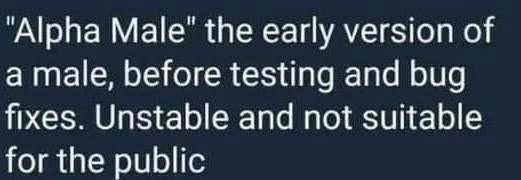
A meme featuring a Shiba Inu dog calmly playing chess against a stressed-looking young man. The scene is captioned with a clever software development analogy. The man, looking defeated with his head in his hands, is labeled 'Alpha and beta males fighting for dominance'. The serene dog, positioned in the foreground, is labeled 'Me who is a Fully released male with all the bug patches'. The humor comes from applying the software development lifecycle (SDLC) terms - alpha, beta, and a fully patched release - to the popular but often-mocked social concept of 'alpha' and 'beta' males. For experienced developers, this resonates deeply as it equates maturity and stability (a 'fully released' product) with true superiority over the buggy, unstable, and feature-incomplete 'alpha' and 'beta' versions

Comments

7
Anonymous ★ Top Pick Some guys brag about being 'alpha,' but senior devs know that's just an unstable build with memory leaks and a high chance of segfaulting during basic social interactions. I'll take the LTS version any day
  1. Anonymous ★ Top Pick

    Some guys brag about being 'alpha,' but senior devs know that's just an unstable build with memory leaks and a high chance of segfaulting during basic social interactions. I'll take the LTS version any day

  2. Anonymous

    Watching the alpha and beta builds trash-talk the chessboard while I sit here like the LTS release - feature-frozen, fully patched, and still the only version ops dares deploy on a Friday

  3. Anonymous

    The real power move is being the engineer who pushed to production on Friday afternoon, then calmly played chess all weekend while the on-call team discovered your 'fully patched' release still had a memory leak that only manifests under exactly 73% CPU load

  4. Anonymous

    The real power move is being the production release that's been battle-tested in the wild for six months - you've survived the edge cases that alpha and beta never even knew existed, your performance is optimized from real user data, and you've got monitoring dashboards proving your stability. Meanwhile, alpha and beta are still arguing about architectural decisions while you're quietly handling millions of requests with a 99.99% uptime

  5. Anonymous

    Alphas overfit to hype, betas hallucinate features - I'm the LTS release actually serving users at scale

  6. Anonymous

    Alpha vs beta is cute; real dominance is being the LTS build - 1.0.x forever, 73 hotfixes deep, backward compatible with a 2008 monolith, still hitting SLOs

  7. Anonymous

    Let the alphas and betas posture; I’m the LTS branch - ABI-stable, semver-patch only, and the pager hasn’t rung in quarters

Use J and K for navigation