Skip to content
DevMeme
4159 of 7435
Developers react to GitHub Copilot’s new $10 price tag on the IQ bell curve
AI ML Post #4541, on Jun 23, 2022 in TG

Developers react to GitHub Copilot’s new $10 price tag on the IQ bell curve

Why is this AI ML meme funny?

Level 1: Chores, Allowance, and a Helpful Robot

Imagine you and your friends have a little homework robot. During a trial period, everyone could use this robot for free and it would help with your homework or chores. Now that the trial is over, the maker of the robot says, “Okay, if you want to keep using it, it costs $10 a month.” You get three types of reactions:

  • One friend scratches his head and says, “Wait, what robot? I didn’t even know there was a homework robot!” He has no idea about it, so he isn’t upset or happy — he’s just out of the loop.

  • Another friend crosses her arms angrily and says, “That’s not fair! You can’t just build a cool homework robot and then ask us to pay money for it! Homework help should be free!” She’s basically upset that something useful now costs money. It’s like she felt entitled to use it for free and now feels it’s a rip-off to charge for it.

  • The third friend, the calm wise one, shrugs and says, “Ten dollars is actually a good deal. This robot will save me so much time, it’s worth it.” He figures that if the robot saves him many hours of doing chores or homework, paying a little bit is okay because it lets him use those saved hours to do other things he likes.

This is exactly what the meme is showing, but with programmers and an AI tool. The funny part is how different the reactions are. The first kid didn’t even know about the robot (so he doesn’t care), the second kid is super mad about the price, and the third kid is totally fine with it because he sees the benefit. It’s like when a new gadget or app comes out: one person hasn’t heard of it, another person is mad if it’s not free, and another person thinks it’s worth the money. The meme uses this situation to make us laugh, because we can see each of those kids’ attitudes in people around us. In the end, it’s showing that sometimes the smartest approach is like the third kid’s: recognizing when paying a little is okay if you get a lot in return – like buying time and convenience with that helpful robot.

Level 2: What’s Copilot?

GitHub Copilot is basically an AI pair programmer that lives in your editor. Imagine while you’re coding in VS Code (or another supported IDE), there’s an assistant that suggests the next line of code or even whole functions for you. That’s what Copilot does – it’s an advanced form of code autocomplete. Traditional autocomplete might finish a variable name or method signature. Copilot goes further: it uses a machine learning model (a big neural network trained on tons of code) to understand what you’re trying to do and offer more substantial suggestions. For example, you write a comment “// function to sort an array of numbers” and Copilot might actually generate the entire function code for you on the spot. It feels a bit like coding with a super smart sidekick who has read Stack Overflow and GitHub repos all day. This is why it’s called an AI assistant – it doesn’t replace the developer, but it helps by writing boilerplate or giving ideas for how to implement something.

Now, during its initial preview phase, Copilot was free to use. Developers could install it, try it out, and many found it exciting (sometimes even a little spooky) how well it could complete code. After the beta period, GitHub announced it would become a paid product – about $10 per month (with some exceptions, like it’s free for students and open-source maintainers). That announcement (“Copilot will no longer be free”) caught everyone’s attention. Ten dollars a month is like two fancy lattes – not huge, but also not nothing, especially for devs used to free tools. The meme shows three different reactions to this Copilot pricing news:

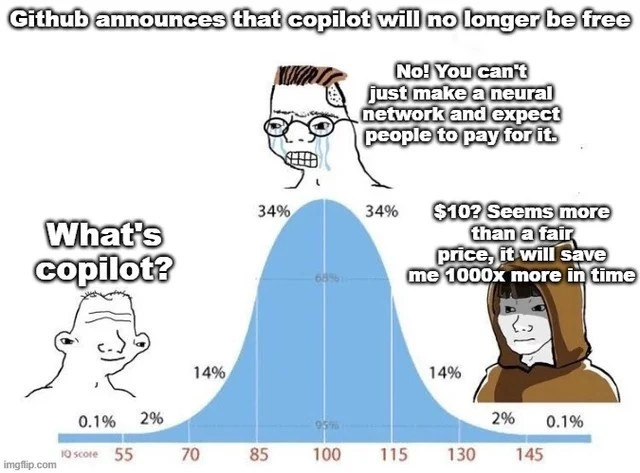
  • “What’s copilot?” – The first reaction, on the left side of the image, is a simpleton-looking character who hasn’t even heard of Copilot. This represents developers who might not be following the latest trends in AI/ML for coding. If you’re new to programming or simply not reading tech headlines, you might genuinely ask, “What is Copilot?” (perhaps thinking it’s some pilot program or a GitHub feature you missed). In context: Copilot is the thing we just described – an AI code helper. This character’s response is funny because it’s so out-of-the-loop that the whole pricing drama doesn’t matter to him; you can’t be mad about a $10 price if you don’t know what the product is! It highlights that not every developer is on the hype train for new tools. Some people are too busy debugging or just learning basics to keep up with every new AI tool announcement.

  • “No! You can’t just make a neural network and expect people to pay for it.” – The middle reaction in the meme is a frustrated, nerdy character with glasses. He clearly knows what Copilot is (he mentions the neural network, which is the technology behind it), and he’s upset. This viewpoint is basically: software tools should be either free or one-time purchases; why are you charging a subscription for this AI thing? A neural network is a type of AI model inspired by the brain, which “learns” from lots of examples. Copilot’s neural network learned from public code. So one underlying complaint here is: “You train on our open-source code and then charge us money? That’s not fair!” It’s a real sentiment some developers had – they felt like Copilot’s intelligence was built on community knowledge that was originally free. Also, many developers just aren’t used to paying monthly for developer tools. There are so many free resources (free IDEs like VS Code, free libraries, free Stack Overflow answers) that paying $10 for code suggestions might feel odd. The meme exaggerates the protest to highlight the drama: this character is practically yelling in disbelief. It’s humorous because it’s a bit entitled – as if saying, “How dare you ask us to pay for this fancy new thing!” It echoes those times in tech where a cool free beta ends and some users get very vocal about not wanting to pull out their wallet.

  • “$10? Seems more than a fair price, it will save me 1000× more in time.” – The rightmost reaction is a calm, hooded character – often depicted as the “enlightened” or wise figure in these memes. This developer knows exactly what Copilot is and has likely used it. His reaction is the opposite of the middle guy’s: total acceptance, even approval, of the price. He says $10 is “more than fair” because he believes the tool will save him a lot of time. This is a straightforward cost vs. benefit mindset. Maybe he’s thinking: “If Copilot saves me a few hours of work each month, then $10 is nothing compared to the value of those hours.” For context, in professional software development, time is money – developers often think in terms of hourly rates or the value of delivering features faster. So this character is calculating what we call return on investment (ROI): if I spend $10 and get back way more than $10 worth of work done via time saved, it’s a great deal. Saying it will save “1000× more” is hyperbole (that would mean $10 → $10,000 of value!), but he’s intentionally exaggerating to make a point: Copilot significantly speeds up his coding, so paying for it makes sense. This reaction also represents experienced developers who have seen the benefits of good tools. For instance, a senior dev might remember paying for something like a JetBrains IDE subscription or a linting tool because it made them more productive. To them, this AI assistant is just another productivity tool – one that can automate the boring parts of coding or help avoid mistakes, well worth the cost of a few bucks a month.

All together, the meme’s three panels show a miniature debate in the community: from ignorance, to resistance, to practical acceptance. It touches on AI/ML in developer experience and how it’s received. Some devs are super excited and fine with subscribing, others feel AI tools are overhyped or have principles against paying, and some are just catching up on what these tools even do. The image uses an IQ bell curve meme format – often used jokingly to compare simple vs. complex thinking. The idea (tongue-in-cheek) is that the very naive and the very wise sometimes oddly agree, while those in the middle are overthinking or misunderstanding. Here the naive guy doesn’t know about Copilot (so he’s not upset), and the wise guy isn’t upset either (because he sees the logic of paying). It makes the middle complainer look kind of silly – which is the comedic effect. Of course, in real life, whether $10 for Copilot is “worth it” can depend on personal circumstance (maybe a student can’t easily afford it, which is why GitHub made it free for students). But the humor comes from these exaggerated stereotypical responses that we’ve all seen online.

For a junior developer or someone new: Copilot might sound like sci-fi – an AI that writes code with you! This meme is showing that after the initial wonder fades, the conversation turns to practical matters like cost. Don’t be surprised if you hear debates among programmers about whether AI coding assistants are worth it. It’s just like any new tool – people will argue if it’s necessary or if it’s worth the money. In simple terms, the meme is saying: some developers don’t know about the new AI tool, some are mad they might have to pay for it, and others think it’s a good deal. And it does that with a funny chart implying that maybe the ones who think it’s a good deal are seeing something the complainers aren’t.

Level 3: The Price of Productivity

This meme hilariously captures a bell curve of developer reactions to GitHub Copilot’s pricing. When GitHub announced the end of the free beta – “Copilot will no longer be free” – it set off a spectrum of responses. On one end, you have oblivious folks (the far left cartoon asking “What’s Copilot?”) who represent developers totally out of the loop on the latest AI tools. Maybe they’ve been heads-down in legacy code or simply didn’t follow the AI hype news. Their reaction (or lack thereof) is funny because it’s so basic: they can’t be upset about a $10 price tag if they don’t even know what the product is! This character embodies blissful ignorance in the face of industry trends – every team has that one developer who’s still saying “Wait, what’s this new thing everyone's talking about?” while the rest are arguing about it.

In the middle of the curve, we see the archetype of the outraged developer (the Wojak with glasses, mid IQ range) practically yelling, “No! You can’t just make a neural network and expect people to pay for it.” This voice is Developer Twitter/Hacker News incarnate – the mix of indignation and entitlement that surfaces whenever a free beta service introduces a fee. There’s rich subtext here: this person likely enjoyed Copilot during its free preview and now feels betrayed or just sticker-shocked. It satirizes the notion that software (especially anything labeled AI/ML) should somehow be free by default, as if a neural network powered coding assistant is a basic human right for developers. The statement also hints at a common skepticism: “You just threw together a neural net with code data; why should we pay for something that was trained on our open-source contributions?” In 2022, some devs indeed grumbled that GitHub (owned by Microsoft) trained Copilot on public GitHub repos (our code!), and now planned to monetize it. That sentiment is captured in the outrage: the idea of expecting people to pay for it was offensive to those who felt the community’s code was being “resold” to them. It’s a mix of ethical pushback and classic resistance to change. Also, average developers might balk at paying for any new tool – historically, plenty of us have been conditioned by free IDEs, free plugins, and open-source everything. So the middle guy’s stance, while comically over-the-top, reflects a real developer experience (DX) gripe: “I already have Stack Overflow and free IntelliSense, why pay for this fancy autocompletion?”

Now the punchline (far right of the IQ curve) is the hooded, zen-like figure who says: “$10? Seems more than a fair price, it will save me 1000× more in time.” This represents the enlightened developer perspective. Ironically, in these IQ memes, the far left and far right often agree in some way that the middle doesn’t – here the agreement is that neither the very naive nor the truly wise are upset about the pricing. The wise guru character is comically hyper-rational: instead of rage, he’s calculating tooling_cost_vs_time_savings. This is the senior developer or pragmatic team lead who values productivity above all. They’ve likely lived through many tech hypes and know to judge a tool by one thing: does it actually save time and effort? From that vantage, $10/month is cheap. They probably recall times when a developer tool license could cost hundreds of dollars a year (think of JetBrains IDEs, or old Microsoft Visual Studio packages) – so ten bucks for an AI assistant feels like a steal. More importantly, this character implicitly understands ROI (Return on Investment). They’re essentially saying, “If Copilot saves me even a few hours of coding or avoids a bug, it pays for itself many times over.” Many experienced devs do this mental math. For example, if you earn, say, $50/hour as a developer, and Copilot saves you just 0.2 hours (12 minutes) of time in a month, that’s $10 of value right there. And if it prevents one major bug or fills in boilerplate instantly, it could save hours. So the 1000× is exaggeration for comic effect, but it drives home the point – the top-tier mindset is focusing on productivity gains and real-world outcomes, not just the sticker price. This perspective is also fueled by genuine experience: seasoned developers have seen tools come and go, and they’ve likely paid for things like cloud services or premium plugins. They know sometimes investing in a good tool (whether it’s a faster laptop, a better editor, or now an AI pair-programmer) pays dividends by making development faster or less painful.

The meme brilliantly uses the IQ bell curve format to map these attitudes to “intelligence” levels ironically. It suggests that the simplest thinker and the truly wise both don’t oppose the fee (one doesn’t know enough to care, the other knows enough to accept it), while the mid-level intelligence (or perhaps mid-experience) is the one caught up in righteous anger. It’s poking fun at that middle crowd of developers who might think they’re being logical (“why would I pay for something that was free / that I didn’t ask for?”) but are arguably missing the bigger picture of value. It’s a common dynamic in tech communities: a new IndustryTrend emerges (here, AI coding assistants), and the reactions split between dismissive ignorance, loud skepticism, and quiet pragmatism.

From an industry trends perspective, this meme also reflects the hype vs. reality cycle. Early on, AI coding tools were hyped as revolutionary (AIHype tag fits well) – during the free beta, everyone wanted to try Copilot. But as soon as the hype turned into a paid product, the tone shifted. The middle character’s protest is basically, “You hyped this as amazing, but now you want money for it? Unacceptable!” We’ve seen this story with other services too (think of developers reacting to Cloud API pricing, or a beloved free tier getting limited). The far right character cuts through the hype backlash by evaluating the tool’s actual usefulness calmly: if it’s as good as hyped, paying makes sense. If not, you simply wouldn’t subscribe. This pragmatic acceptance is often seen in senior devs who have navigated many shiny new tools. There’s also an undercurrent of humor aimed at how developers value things: it’s not uncommon to see devs who happily spend $5 on a Starbucks coffee every day complain that $10/month for a powerful coding tool is too expensive. The meme exaggerates it to IQ levels to make us laugh at ourselves – sometimes the “smarter” move (both intellectually and business-wise) is to drop the ego, drop the outrage, and just use the tool if it helps, even if it costs a little.

In essence, the meme highlights a slice of developer culture:

  • Newbie (or clueless) dev: “Copilot? 🤔 What’s that?” – not engaged in the hype at all.
  • Typical crowd (intermediate mindset): “Outrage! How dare they charge for this AI thing?” – focused on principle and cost, maybe missing nuances.
  • Wise old hacker (enlightened mindset): “If it works, $10 is nothing – I have code to ship.” – focused on results and efficiency.

It’s funny because each of us can probably recognize these personas in our teams or online discussions. And depending on the day (and our mood about new tools), we might’ve been each of these characters. The AI humor here isn’t just that AI exists, but how developers react to AI’s growing role in our craft – from ignorance to hype-driven cynicism to coolheaded pragmatism. The bell curve format delivers this contrast in one image. It’s a commentary on how we handle change: whether it’s excitement, fear of monetization, or calm calculation of value. For a seemingly small announcement about Copilot pricing, it sure managed to expose big differences in mindset – and that’s why this meme resonates and makes devs smirk: it’s painfully true and absurd at the same time.

Level 4: Transformer Economics

Under the hood, GitHub Copilot is powered by a cutting-edge transformer model (OpenAI’s Codex, a descendant of GPT-3). This is a large language model trained on mountains of public code from GitHub. With billions of parameters (think of each parameter like a tiny dial tuned during training), it can interpret your code context and predict useful completions. Running such a model isn’t trivial – it’s like having a super-smart engine revving in the cloud every time you write a line. Those predictions aren’t magically appearing in VS Code; they’re served from data centers with hefty GPUs crunching numbers. There’s real computational cost each time Copilot suggests a clever line of code. Training the model in the first place likely burned through hundreds of thousands of dollars in cloud compute, as it ingested and learned from the vast corpus of open-source code. In ML there’s a saying called the “No Free Lunch” theorem, and here it’s literally true in terms of money: you can’t get advanced AI code assistance without paying the piper somewhere down the line (be it in research investment, compute power, or a monthly fee).

From a purely technical and economic standpoint, charging a subscription fee for this service makes sense. AI code completion at Copilot’s scale is essentially AI-as-a-Service. Every time you invoke the assistant, a forward-pass through a gigantic neural network runs on expensive hardware. Unlike a simple local algorithm, a neural network of this size means ongoing costs for GitHub/Microsoft for servers and maintenance. That $10 price tag isn’t just arbitrarily slapped on – it helps cover the continuous GPU cycles and model improvement efforts. We can even frame it as an equation of value:

$$ \text{If (Time Saved per Month in hours)} \times \text{(Your hourly rate)} > $10, $$

then Copilot literally pays for itself in productivity. The hooded “high IQ” character in the meme claiming “$10 saves me 1000× more in time” is performing this mental math. A senior developer’s hour is expensive; if an AI assistant shaves off even a fraction of those hours by auto-completing boilerplate or suggesting tricky algorithmic code, the return on investment is huge. In fact, the rational far-right figure is effectively acknowledging the economies of scale behind modern AI tooling – a one-to-many model like Copilot, once developed, can serve millions of developers, but each developer’s tiny contribution ($10) collectively funds the system’s existence. In a way, it’s a distributed patronage for a massive always-learning coding brain. The neural network subscription model represents a new era: instead of purchasing software outright, developers pay for the ongoing intelligence and improvements of an AI on tap. It’s a shift aligning with cloud economics and continual AI model updates (much like how we pay for cloud IDEs or API usage). Far from being trivial, this “make a neural network and expect people to pay” approach is backed by serious math and computing – and evidently, by a portion of the developer community who understand that quality code suggestions at scale can’t be purely free. The joke here has a kernel of truth rooted in both AI/ML innovation and plain dollars-and-cents pragmatism.

Description

Meme uses the classic IQ bell-curve template: a blue normal distribution labeled “IQ score” along the x-axis with ticks 55, 70, 85, 100, 115, 130, 145 and percentage markings 0.1 %, 2 %, 14 %, 34 % mirroring each side of the mean. Three stereotypical characters are placed on the curve. Far left (low IQ zone) a simple, smiling cartoon asks in bold white text with black outline, “What’s copilot?”. Center (average IQ zone) a glasses-wearing Wojak shouts, “No! You can’t just make a neural network and expect people to pay for it.” Far right (high IQ zone) a hooded, serene figure says, “$10? Seems more than a fair price, it will save me 1000x more in time”. Across the top, a headline reads, “Github announces that copilot will no longer be free”. The joke contrasts differing developer attitudes toward paid AI code-completion: ignorance, outrage, and pragmatic ROI acceptance - highlighting AI/ML tooling economics and developer experience considerations
Comments

6
Anonymous ★ Top Pick $10 for Copilot? That’s roughly four minutes of engineer burn rate - if it prevents even one alt-tab spiral each sprint, it’s the only line item that actually amortizes itself
  1. Anonymous ★ Top Pick

    $10 for Copilot? That’s roughly four minutes of engineer burn rate - if it prevents even one alt-tab spiral each sprint, it’s the only line item that actually amortizes itself

  2. Anonymous

    The real bell curve is watching junior devs argue about $10/month for Copilot while simultaneously burning $10,000/month in AWS costs because someone forgot to tear down that test environment from Q2

  3. Anonymous

    The real insight here is that both the junior who doesn't know what Copilot is and the staff engineer who's calculated the ROI down to the keystroke will happily ignore the pricing change, while the entire middle of the distribution - who've been using it just long enough to feel dependent but not long enough to quantify the value - will spend more time debating the $10/month than they'd save in a single debugging session. It's the developer equivalent of arguing about AWS costs while running unoptimized queries that burn through more money during the meeting than the annual Copilot subscription

  4. Anonymous

    The calendar invite to debate Copilot’s $10 seat costs more than the seat; once Security and Legal join, you’ve accidentally bought the enterprise plan

  5. Anonymous

    Bell curve perfection: 68% of devs hit peak ROI at $10/month, while tails cling to SO copy-paste - Copilot's the real normalizer

  6. Anonymous

    Copilot at $10/month: the only tool where a single avoided context switch repays the license before npm install finishes

Use J and K for navigation