Skip to content
DevMeme
4158 of 7435
Internet Explorer joins the infamous 27-year ‘club’ of things gone too soon
Microsoft Post #4540, on Jun 23, 2022 in TG

Internet Explorer joins the infamous 27-year ‘club’ of things gone too soon

Why is this Microsoft meme funny?

Level 1: Goodbye, Internet Explorer

Imagine you have a very old toy that you’ve been stuck playing with because some games only work with that toy. It was super popular when it first came out, but over the years, everyone got newer, better toys. Still, you kept it on the shelf because a few games in your house only worked with that old toy, so you couldn’t throw it away. Finally, one day, the company that made the toy says, “We’re not going to make or fix this toy anymore. It’s time to say goodbye to it.” You and your friends feel kind of happy and a bit nostalgic at the same time.

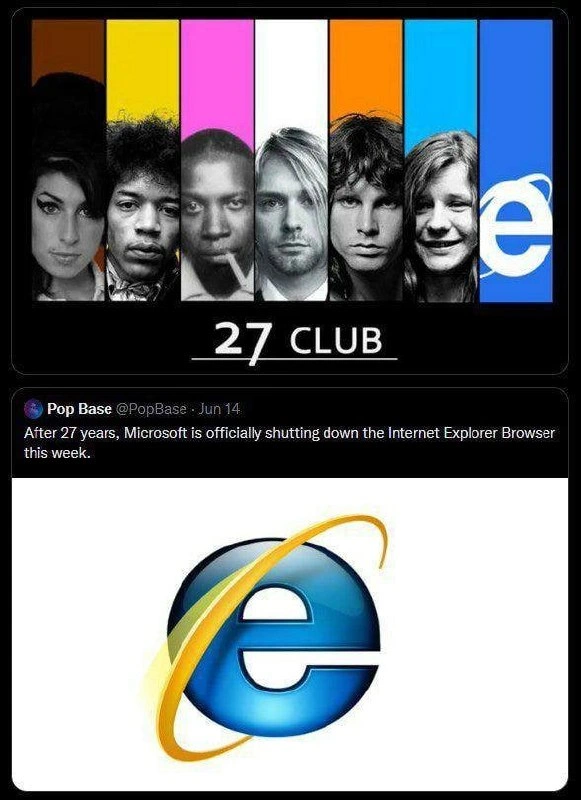
This meme is like throwing a funny farewell party for that old toy. It pretends the toy (which in real life is the Internet Explorer web browser) was like a famous rockstar. There’s a real thing called the “27 Club” where some famous musicians sadly died at age 27. The joke here is that Internet Explorer lasted 27 years and then “died,” so they put its logo next to those rockstars as if it was one of them. It’s a silly way of saying goodbye. People who make websites are joking that Internet Explorer’s end is like a big celebrity event – finally the old browser is gone! It’s funny because we don’t usually treat software like a person. By saying “Internet Explorer has joined the 27 Club,” they’re just making an exaggerated, playful comparison. The feeling in real life is mostly relief – like finally not having to use that clunky old thing – but the meme dresses it up like we’re honoring a legend. In simple terms: a really old web browser is being retired, and the internet folks are giving it a dramatic send-off with a wink and a smile.

Level 2: End-of-Life Blues

So what exactly is going on here? The meme is treating Internet Explorer like a famous person who just died young. In pop culture, the “27 Club” refers to a group of legendary musicians and artists who all died at 27 years old – think of icons like Jimi Hendrix or Kurt Cobain. It’s kind of a spooky coincidence in music history. The top panel of the meme shows six of those famous faces in bright-colored panels, and then the last panel (in cyan/blue) shows the big blue “e” logo of Internet Explorer instead of a person. Below all their pictures it says “27 CLUB.” Basically, they’re joking that Internet Explorer is the newest member of that club because it lasted 27 years before “dying.”

Now, of course, browsers aren’t people – they don’t die of natural causes. “After 27 years, Microsoft is officially shutting down Internet Explorer” means that Microsoft is ending support for it. This is sometimes called a browser_end_of_life, which is a software way of saying “we’re retiring this product, it’s done.” Internet Explorer (often shorted to IE) came out in 1995 and was once the most popular web browser. It’s a product made by Microsoft, and it was basically how a whole generation of people surfed the web, especially on Windows computers. Over time, though, other browsers like Google Chrome, Firefox, and Safari became more popular, and Internet Explorer became old and slow in comparison. Developers also got frustrated because IE didn’t follow modern web standards very well, leading to lots of errors or missing features on websites. Supporting IE became a special chore in WebDevelopment – you’d often hear devs talk about “IE support” as a headache, since they had to write extra code or fixes just to make their site work on that one browser. That’s what we mean by legacy_browser_support: keeping old software (like IE) working even when everything else has moved on.

The tweet in the bottom panel is real news from June 2022 announcing IE’s shutdown. Under the tweet, they show the Internet Explorer logo large and in full color, like a big portrait of the “fallen” browser. So the whole meme is formatted almost like a tribute or a eulogy you’d see when a celebrity passes away. It’s tongue-in-cheek because we don’t usually get all sentimental over software being discontinued – usually it’s only people or maybe beloved TV shows that get that treatment. But here, web developers are kind of jokingly celebrating this “death.” Why? Because IE’s end-of-life is actually a relief for many of them. For years, as long as IE was officially supported, companies and dev teams felt obligated to make sure websites worked on it. Now that Microsoft is shutting it down, developers can finally drop that burden. No more tweaking modern CSS to behave like it’s 2005, no more special code for IE’s quirks. It’s like an old piece of machinery that the factory can finally retire.

That said, Microsoft isn’t leaving IE users completely stranded. They’ve been pushing everyone towards the Edge browser. Edge is the newer browser from Microsoft, which has a modern engine (in fact, the newest Edge is built on Google’s Chromium engine, same as Chrome under the hood). Edge even has an “IE mode” for businesses that absolutely need to use old sites that only work in Internet Explorer. This is part of the edge_migration strategy: get people onto Edge while still giving a crutch for older LegacySystems that can’t change overnight. It’s kind of funny – even when IE is “dead,” it still haunts us a bit through Edge’s compatibility mode. But overall, the message is that Internet Explorer is done and dusted. After a 27-year run, it’s being put out to pasture, much like a very old rock star finally retiring (or, in the meme’s darker joke, like one that died at 27).

For junior devs or those new to the industry, it’s worth understanding how big a deal IE used to be. Back in the late 90s and early 2000s, IE was the browser everyone used on Windows – and Windows was everywhere. There was a period called the BrowserWars where Microsoft’s IE and Netscape were fiercely competing. Microsoft won by bundling IE free with every Windows PC, which was a controversial move (there were even antitrust lawsuits about it). IE’s dominance meant web developers often only targeted IE, using things like ActiveX (proprietary tech for interactive content) that only IE had. But as the years went on, IE got very outdated. When new browsers like Firefox and Chrome came along championing open web standards (like proper CSS and JavaScript support, faster engines, better security), IE started to look like an aging diva who refused to go on a new diet. Over time, most users switched to those newer browsers. Microsoft itself built Edge to replace IE starting in 2015. However, IE hung around in the background — many enterprise IT setups mandated using IE for old apps, and some non-technical users just kept clicking the “blue e” out of habit.

So the “club of things gone too soon” is actually a joke because many would say IE didn’t go away soon enough! It overstayed its welcome. The meme’s humor comes from mixing a MicrosoftProducts tech announcement with rock-and-roll tragedy imagery. It’s like making a nerdy inside joke: “Internet Explorer is finally dead at 27. What a legend… or at least, what a long, strange trip it’s been.” It resonates with anyone who’s had to write <!-- if IE> hacks or wonder why their site’s JavaScript was crashing only in that one old browser. This is a bit of collective high-five moment in the web community – a send-off to an infamous browser.

Level 3: Embrace, Extend, Extinguished

This meme hits senior developers right in the nostalgia and nightmares. It compares Internet Explorer’s retirement to the fabled 27 Club – the tragic group of rock legends who all died at age 27 (think Jimi Hendrix, Janis Joplin, Kurt Cobain, Amy Winehouse). By sliding IE’s iconic blue “e” logo into that lineup, the meme cheekily anoints the browser as another legend “gone too soon.” The irony is rich: for web developers, IE’s 27-year run wasn’t too soon at all – if anything, it felt like an eternity. After decades of wrestling with IE-only bugs and quirks, devs have joked for years that the old browser was an immortal zombie. Now, officially shutting it down in 2022 at age 27, Microsoft has finally “killed” the beast. The meme frames it like the dramatic death of a superstar, poking fun at how overdramatic that sounds for a piece of software.

From a TechHistory perspective, Internet Explorer truly was a superstar of its era. It launched in 1995 and rocketed to dominance during the BrowserWars of the late ’90s by boldly bundling with Windows – the classic Microsoft “embrace, extend, extinguish” strategy. IE famously beat Netscape Navigator into oblivion, capturing over 90% market share by the early 2000s. It was the browser king, the Microsoft poster child product, and an essential piece of corporate LegacySystems everywhere. But the fame got to its head: Microsoft stagnated on innovation after winning the war. Internet Explorer 6 infamously lingered for years without meaningful updates. By the mid-2000s, new rivals like Firefox and Chrome rose like edgy new bands, while IE had become the bloated aging rockstar refusing to retire. The meme’s dark humor is that IE is now treated like a legendary artist whose “career” ends at 27 – but in truth, IE stuck around far past its prime and is only now being forced off stage.

The pain and WebDevelopment trauma behind this humor are very real. “Internet Explorer support” became shorthand for endless headaches. Everyone who built websites in the 2000s or 2010s remembers scattering ugly hacks in their codebase specifically for IE. For example, developers often wrote conditional HTML like this just to target IE’s peculiar behavior:

<!--[if IE]>
  <link rel="stylesheet" href="ie-fixes.css" />
<![endif]-->

Or they used bizarre CSS tricks (* html .box { ... }) to accommodate IE’s broken box model and other deviations from web standards. Each new CSS spec or JavaScript feature came with the dread question: “But how will it break in IE?” The LegacyTech baggage was immense – even as modern browsers advanced, companies clung to old IE-specific enterprise apps that forced devs to keep supporting IE. The “27-year club” joke taps into that shared suffering. It’s the gallows humor of a generation of engineers who spent late nights making ActiveX controls work and debugging why their site was crystal clear in Chrome but a soup sandwich in IE. The meme wryly suggests InternetExplorerSupport has been an epic, tragic saga worthy of a rock documentary.

Organizationally, the fact that IE lasted 27 years is a tale of LegacySystems inertia. Many businesses built internal tools that only worked in IE (thanks to proprietary tech like ActiveX or old versions of SharePoint that required IE’s Trident rendering engine). Even as IE became obsolete and security-prone, the cost of rewriting those legacy apps was so high that IT departments just kept IE alive within their walls. Microsoft recognized this clinginess; their newer Edge browser even shipped with an “IE mode” to run those creaky old apps. In other words, IE’s ghost has been lurking in Edge, like a retired rocker occasionally guest-starring on a new artist’s track. The meme’s timing (referencing Microsoft “officially shutting down” IE) nods to the corporate decision to finally yank life support. It’s a bittersweet moment: WebDev veterans are cheering that they can drop support for IE at long last, but it’s also the end of an era – the closing act of the first Browser War champion.

In classic MicrosoftProducts fashion, Internet Explorer’s demise is also a marketing push. Microsoft has been nudging users towards Edge (now Chromium-based) for years, effectively saying “IE is dead, long live the new king!” This edge_migration has a whiff of a farewell tour: IE gets one last headline (“After 27 years, IE is shutting down this week!”) as it exits stage left, while Edge stands in the wings ready to rock modern web standards. The meme exaggerates this send-off to absurd heights by lumping IE with doomed rockstars. It’s as if the community is holding a fake candlelight vigil for a browser that most of them actually couldn’t wait to bury. That tension – between formal eulogy and good riddance – is exactly what makes the joke land. It’s a cathartic laugh. We’re closing the casket on IE’s long, troubled life, with a tongue-in-cheek tribute: “You were a legend of your time, Internet Explorer, welcome to the 27 Club (and thanks for finally freeing us from supporting you!).”

Description

Meme composed of two stacked panels. Top panel: a famous "27 CLUB" montage normally showing musicians who died at age 27; seven vertical rectangles in bright colors (yellow, magenta, white, orange, cyan, etc.) each contain a grayscale portrait, but the final cyan rectangle instead features the blue Internet Explorer “e” logo. Below the portraits, bold white text reads “27 CLUB.” Bottom panel is a tweet from Pop Base dated Jun 14 that says: “After 27 years, Microsoft is officially shutting down the Internet Explorer Browser this week.” Under the tweet is a large, full-color Internet Explorer logo. The joke reframes the browser’s retirement as a celebrity death, poking fun at legacy browser support, Microsoft’s shift to Edge, and the end-of-life pain Web-devs have endured for decades
Comments

8
Anonymous ★ Top Pick IE joining the 27 Club feels right - after two decades of conditional comments, hasLayout séances, and CFOs insisting on ActiveX, retirement might be the first truly developer-friendly feature it ever shipped
  1. Anonymous ★ Top Pick

    IE joining the 27 Club feels right - after two decades of conditional comments, hasLayout séances, and CFOs insisting on ActiveX, retirement might be the first truly developer-friendly feature it ever shipped

  2. Anonymous

    Unlike the other 27 Club members who left us too soon, Internet Explorer spent its final decade making everyone wish it would hurry up and die already

  3. Anonymous

    After 27 years of forcing web developers to write `if (navigator.userAgent.indexOf('MSIE') !== -1)` conditional hacks, maintaining separate CSS files with `<!--[if IE]>` comments, and debugging why `position: fixed` didn't work, Internet Explorer finally achieved what every senior engineer dreams of: a graceful retirement with full stakeholder buy-in. Unlike the tragic 27 Club it references, IE's demise was celebrated with champagne by frontend developers worldwide who could finally delete thousands of lines of polyfill code and stop explaining to product managers why 'it works in Chrome' isn't the same as 'it works everywhere.' The real tragedy? Some enterprise codebases still have ActiveX dependencies that will outlive us all

  4. Anonymous

    IE joins the 27 Club at 27 - meanwhile, the enterprise intranet still demands IE8 for 'full compatibility'

  5. Anonymous

    IE joined the 27 Club; our intranet promptly respawned in Edge’s IE Mode - NTLM, ActiveX, and Quirks Mode: the kind of tech debt that survives its maintainers

  6. Anonymous

    IE joining the 27 Club means we can finally delete X‑UA‑Compatible, Quirks Mode stylesheets, and that one ActiveX print control - unless finance still needs it, in which case Edge IE mode is just technical‑debt hospice

  7. @dsmagikswsa 4y

    Why this meme so late….

    1. @TERASKULL 4y

      take a wild guess

Use J and K for navigation